Showing posts with label Tourism. Show all posts

Sunday, September 15, 2019

A Fortnight in India: What I learned about Modi's India From India-Today, Economic Times and Sun T.V.

Whenever I visit any country I make it a habit to check local press and publications. I did so in India too, naturally. Just one issue of the weekly news magazine 'India Today' was sufficient to encapsulate the state of Modi's India. Thanks to my several hotel stays and the freely supplied 'Economic Times' I got a ringside view of Indian economy especially when the newly minted Nirmala Sitaraman was rolling out changes. Then a few days of watching Sun T.V. gave me the hope that one day BJP may actually romp home as a ruling party in Tamil Nadu or at least as a major ally to the ruling party. Here's what I learned.

India Today


I started reading India-Today back in the late 80s, during Rajiv Gandhi's administration, when it was a fortnightly sold at Rs 6. 'Frontline' from 'The Hindu' followed soon after. While Frontline hewed a left wing tilt India-Today tilted to the right. Prabhu Chawla and Swapan Dasgupta from India-Today are now effectively BJP's cheer leaders along with the likes of Indian Express's Tavleen Singh. Arun Shourie is disenchanted with Modi after being a member of the Vajpayee cabinet. All these journalists were united in their disdain and hatred of the Congress regimes. To be fair Rajiv and Congress did do their share to alienate the press. Aroon Purie, editor of India-Today, was a Doon school classmate of Rajiv. With this backdrop the issue dated August 12th 2019 with a cover story "Unsold" about the economic crises affecting the auto-sector was interesting to me for not just the cover story but several other articles and I think the stories offer a snapshot of Modi's India. I'll provide excerpts from key articles. All excerpts are within quotes and anything without a quote is my opinion or information or paraphrasing.


Mutilating Right to Information Act


"India's Right to Information Act, recognized the world over as one of the most robust sunshine laws, has been mutilated". RTI, as the act is popularly known, was passed by Manmohan Singh's government in 2005, following several anti-corruption protest movements led by Anna Hazare that whipped up the middle class mostly. Those protests were key in promoting the idea that the Singh administration was mired in corruption. Yet, it was Singh who created this law that is now undone by the seemingly cleaner administration of Narendra Modi.

India-Today's article summed up not just the dangers of mutilating the act but more importantly how the government used its brute majority. "In the Lok Sabha, the NDA simply used its brute majority to ride roughshod over the objections raised by opposition benches. But in the Rajya Sabha, even though 15 political parties reportedly signed a motion to have the bill referred to a select committee, many backtracked on their demand during voting, fueling apprehensions about the pressure that was exerted by the ruling dispensation".

Drawing a distinction between Donald Trump and Narendra Modi the British weekly The Economist said that unlike Trump who wishes he can use the tax agencies to stifle opposition Modi actually can accomplish it. That is the pressure that India-Today is alluding to.

The Immigration Bogey


Modi and Amit Shah, like Trump, find it useful to stoke the problem of illegal immigration. The US, unlike India, at least, has a problem of real proportions. "Shah's threat", a story in the issue outlines, "to extend the National Register of Citizens from North Eastern states to the rest of the country doesn't square with the census data, which finds immigration rates to be below 0.5 percent in the majority of districts. Besides, many of these immigrants are of Indian origin who have returned from US, UK, Canada, Australia and the Gulf. The census figures belie the government's concern about illegal immigrants, even accounting for the under-reporting of 'illegals'.

Yatras and their costs


The hundreds of crores once spent by Indian government to subsidize the Haj pilgrimage was an irritant for the BJP foot soldier notwithstanding the fact that that subsidy was more to keep the state airline, the only approved carrier, afloat. That subsidy is now gone and there were no riots when it was withdrawn.

Nearly 301,000 pilgrims undertook the Amaranth eater this year costing the "J&K administration Rs 495.2 crores ($72 million)" and a deployment of "40,000 security personnel".


Aaya-Ram & Gaya-Ram


Party hopping politician Gaya Lal was pejoratively referred as "Aaya Ram, Gaya Ram". During the 2019 parliamentary elections Modi openly spoke of opposition party big-wigs waiting to cross over to BJP. While party hopping is not new to India that a PM would stoop to openly declare it at a rally was a new low even by the standards of Indian politics.

The title and subtitle of a story says it all. "A bitter aftertaste: After a spate of inductions of TMC leaders with a dubious past, the BJP is forced to rethink".

"Death of the Opposition"

A letter to the Vice President Venkiah Naidu, also the chairman of Rajya Sabha, signed by 17 opposition statement makes a startling factual accusation that is scary for anyone interested in the health of democracy and democratic norms. "The letter says 60 percent of the bills in the 14th Lok Sabha were referred to parliamentary committees. In the next one, 71 percent of the bills went to such committees. But in the 16th Lok Sabha, when Narendra Modi-led government came to power first, the figure dropped drastically to 26 percent. Now, in the first session of the 17th Lok Sabha, 14 bills have been passed, but not a single one was sent to a house committee". The article blames the opposition party leadership for foisting family candidates to leadership. These leaders, unlike those who stood up to Indira Gandhi, rarely carry a political weight and are not up to the task.

The Auto-Sector Slowdown


Aroon Purie's editorial warned on the issue's first page, "Our government cannot afford to let this sector slide, with the prospect of massive layoffs, adding to the ranks of the unemployed. This has implications that go far beyond economics, it may even lead to social unrest".

India's auto-sector, valued at Rs 8.3 lakh crores, employs, directly or indirectly, 32 million people. "Ram Venkatramani, president of Automotive Component Manufacturers Association (ACMA), said that if improvements do not materialize, around 1 million jobs could be lost - 20 per cent of the total employment in that sector". "Overall sales" of vehicles has "fallen by almost 8 per cent". "The growth rates for both private and commercial vehicle sales are in the red".

Rahul Bajaj, chairman of Bjaj Auto, was blunt, "there is no demand and no private investment - so where will growth come from? It doesn't fall from the heavens". This kind of blunt language is startling in the Modi era especially when it comes from a leader of a much respected Indian brand.

"Demonetisation", V.G. Ramakrishnan, "managing director of of Avanteum advisors" said, "left a mark on the psyche of consumers". A key factor behind the slowdown is that the Indian consumer is putting off purchase of even fast-moving consumable goods (FMCG), a key indicator of slowing down of purchasing power. Liquidity crises and lack of good credit reporting are affecting loans. Added to all that is the whimsical attitude in rolling out regulations. The Bharat Stage VI (BS-VI) regulations, new axle load norms, governmental push for increased use of electric vehicles have all contributed in pushing to the auto-sector to despair. Venkatramani told India-Today, "Changes are welcome, but what put us in a tizzy is the speed at which regulations are changing. It becomes difficult to predict when to invest and in what technology".


All the above paint a grim picture and raise a sharp question of an administration that it's supporters assiduously promote as the most business friendly government. For all the mocking of Nehruvian era of socialism Modi's finance minister is turning to that lethal arsenal of any government facing an economic crises, increasing government spending to boost consumer spending. The prohibition of government departments from purchasing new cars has been lifted and it appears that the government is all set to become the biggest consumer of the auto-sector. This is textbook socialism.

The Economic Times


Issues dated 20th August and 31st August of The Economic Times provided interesting perspectives. The front page on 20th August carried a warning from R.C. Bhargava that without government incentives the auto-sector may continue to suffer. Curiously the title used an American word, Motown, to denote India's auto sector.

In a similar vein another sector cried out for government help. "India's software export industry may lose out on its competitive edge due to falling incentives and rising tax rates, industry executives said and have asked the government to extend the policy benefits under the Special Economic Zones (SEZ) beyond April 2020; reduce corporate taxes for large companies and review the buyback tax introduced in the budget".


Continuing the trend of petitioning the government for relief from regulation or seeking help the nascent peer-to-peer lending firms have asked the government to relax the lender limit of Rs 10 lakh and allowing High Net Worth Individuals (HNI) to use the platforms.

Nishanth Vasudevan, head of Motilal Oswald Financial Services, had more warnings in an interview. The foreign investors, Vasudevan said, "feels letdown by the way they're treated" compared to China. Asked about current slowdown he said, "the correction which you're seeing is the actual decline in consumer spending". "Google search for a lot of durables is down by 15-20%". He also added that this is driven more by sentiment and that businesses may not be doing too bad and the expected tax receipts data would provide clarity. He did concede that the economy was growing only at 5.8%.

The editorial column calling for concerted policy action and urgent reforms blamed structural woes like subsidies. "India's share of global exports", the editorial said, "is just 1.7%". Essentially on the map of world trade India is less than a blip. Forget about being super power India is not even a power to reckon with at the global trade map.

On August 30th with executive fiat the finance minister announced the merger of "Ten PSBs into Four" (per The Economic Times headline on 31st). In one fell swoop India created four really mega banks. This runs completely counter to the US wariness of big banks and the desire in US policy making circles to breaking up big banks. US banking regulations, called Dodd-Frank regulations, promulgated after the financial crises of 2008 that almost destroyed the world's greatest economy agonizes in great detail about how to methodically unwind a too-big-to-fail financial institution. Indian journalism often leaves much to be desired and is more often just clerical writing and on this epochal event the reportage was pathetic.

The finance minister claimed that the criteria for the pairings of specific banks was driven by "tech-integration" capabilities rather than "geographical capability". Such rationale is unheard of and really no tech study was proffered. "Managing directors of these banks were informed of the merger decision earlier in the day by the the department of financial services even though discussions had been going on for some time". The reportage did not say at what organization levels discussions were held and what "going on for some time" meant. The managing directors presiding over hundreds of crores of depositor cash were informed like they were peons.

The editorial page of ET cheered the move saying it is in line with making India a $5 Trillion economy but cautioned on the lack of "supportive regulation". With the US crises serving as a caution a responsible newspaper, let alone one focused on economics, should have screamed first about the lack of regulation prior to such a move and scream about possible financial crises that could cripple the Indian economy. Note, India's economy if it faces a US style crises lacks many of the abilities that were at the disposal of US economy. Till date the government has shown absolutely no inclination to create a Dodd-Frank equivalent.

The issue dated August 31st announced the bank mergers on front page and along side carried dismal statistics on the economy with an equally prominent headline as the one for the merger news, "Meter Down: At 5%, Economic Growth at 6 yr Low in June Qtr. The editorial summary is grim: Manufacturing, around 16% of India's economy, collapsed totally: from growing more than 12% in Q1 of last year, to stalling at 0.6% now", "car sales have crashed to 20-year lows","Household consumption has also fallen","Mining, metals, minerals and so on are in a downward spiral", "Capacity utilization of companies below 80%". The editorial said that the only silver lining, if one looked for it, is that the "government is clearly not trying to hide the bad economic news". If that's the silver lining only god can save Indian economy.

State of Education


A recent ranking of universities worldwide showed that not one of India's coveted institutions have cracked the ranking above 300. Forget about cracking the top 10 or 50 or 100. A.M. Nik, chairman of Larsen and Toubro and head of National Skills Development Corporation in an interview with ET sounded beyond pessimistic.

Asked about Normal Sitaraman's call to foreign students to study in India Naik was dismissive saying, "problem is everybody is going out of the country and nobody is coming in. India has a few good educational institutions but they require a very high cut off which a lot of people can't get. We don't have good teachers and the education system itself has been watered down in line with the no-fail policy". "Finding the right teaching talent is the biggest problem. We need institutions to train teachers".

While Naik laments the very absence of good teaching the government thinks, per an article in ET on 20th August about the LEAP program, that lack of leadership skills amongst event good academicians is hurting India from making it big on global rankings. "Over the last 5 years 11 of the 40 central universities have seen inquiries, show cause notices and even sackings of vice-chancellors". Let that sink in for a moment. Nearly one-fourth of central universities are run by no good vice chancellors.


LEAP (Leadership for Academicians Program) started in 2018 with 269 has managed to identify 46 high-scorers, whatever that means, for leadership role. Again, think on that for a moment. In a country of a billion people a leadership program has found 46 'high-scorers'. Only god can save Indian education.

Institutional Corruption, Religious India and a Titular Prime Minister


When former finance minister P. Chidambaram was arrested BJP supporters openly celebrated it as engineered by Amit Shah, the home minister. This was supposed to be tit for tat for Amit Shah being arrested and exiled from his home state when Chidambaram was home minister. In Indian politics, the rule of law be damned, what is important is that your side gets tit-for-tat. On August 20th ET reported that two top ranking officials in National Investigating Agency were under investigation for blackmailing a business man in return for not falsely including his name in a terror-finance related case. The use of central agencies, particularly tax related and intelligence agencies, as puppets to settle political scores is now openly cheered by partisan supporters.

Nilanjan Mukhopadhyay in an oped in ET dated 31st August wrote, "if not in word, then in sprit, what is being increasingly endorsed is the notion that if democracy is a collateral damage while strengthening the nation, so be it".

What is emboldening Modi? How did he muster this majority? Why is secularism almost dead in India today? Why is the notion of keeping religion private would never have a chance in India? Was secularism, as defined by modern liberalism, ever a reality in India? To find those answers let us turn briefly to statistics of India's tourism.

For all the wonderful heritage stretching back into more than a millennia and the country being populated by places of history and natural beauty India's place in world tourism, like it's place on world trade, is pathetic. While France and Spain lead the US with 89 and 83 million tourist visitors compared to 80 million for US when it comes to dollar value the US earns $214 billion compared to $67 million and $74 million respectively for France and Spain. India gets 17 million tourists and earns $29 million. B.K. Goswami, former Director General of tourism for Government of India, in a letter to ET points out that 90% of Indian tourism is domestic tourism and of that 80% is related to pilgrim tourism.


Indians are religious to an extent that is not seen in the Western world and they flaunt it. Nothing intrinsically wrong with that but that is a key factor in the rise of Narendra Modi. Turn on Tamil Nadu's cable TV channels, even the one run by the state's principal political party that pays lip service to secularism and atheism, one is drowned in religious propaganda. All channels run some form astrology related programs in the morning. The obnoxious serials freely load the stories with religious, mostly Hindu, themes or references. Thanks to Sun T.V. and the religious programs it is running it is possible that the BJP might actually become a significant player in the state or even possibly a ruling party in its own right.

Now, many may laugh at the prospect of BJP becoming a major party in Tamil Nadu but my tour made me think that. As I said in my last blog I'll turn, in my next and last blog on the tour, to the religious fervor that is gripping the state and the reasons, in my opinion, as to why Narendra Modi, despite such dismal economy, romped home with a brute majority in the parliamentary elections.

One thing is clear though, if anyone suggests even remotely that they support Modi only for economic governance or mostly for that reason and if they are still sticking with that reason they owe an answer to those who think it is hogwash.

Monday, September 9, 2019

A Fortnight in India: Lots of History, Architecture, Artless Cities and Reading Habits of Indians

After nearly ten years I visited India, again, as tourist last month. When I last visited India, for touring, in 2010 Manmohan was into his second term. Though I had made several visits in 2014-15 they were for medical emergencies and involved no touring. Narendra Modi had just then wrested power after a decade long reign by Manmohan Singh. Modi has recently won a massive victory that all but decimated the entire opposition and is set to rule for the next 5 years. What did I see?

Landing in a New India


V.S. Naipaul's trilogy on India started with "An area of darkness", a book that still riles up Indians and continued, slightly mellowed but equally offending to many Indians in "A Wounded civilization" and finally concluded in the now dated but thematically relevant, "India: A million mutinies now". Naipaul, wrote 'A wounded civilization' as India's democracy was under assault by Indira's Emergency. He lamented, "nothing beyond food - and survival - had as yet become an object of ambition". Nearly a half century later India has come a long way from that. The country now can feed itself, says no to foreign aid, even offered a billion dollar finance to Russia, looks to conquer the space, careers for graduates now have multiplied from the binary choice of Doctor or Engineer and the economy can no longer be jeered at as 'Hindu rate of growth'. That is the India of 2019 I stepped into.

Compared to the days when visa application involved a distasteful visit to Indian consulate now I opted for electronic visa that worked like a charm. The application and approval were pretty simple and at immigration check it was a breeze. I feared, this being my first time with e-visa, some serious trouble but there was none.

My travel this time to Jaipur and Bengaluru was made possible by the availability of flight connections. Air travel has been truly democratized in India. Gone are the days when air travel was meant for the high and mighty. The budget airline Indigo really serves well with good connections and good service. For all my bookings I had used the 'Fast Forward' service that promised delivery of checked baggage to be prioritized over others and it was delivered as promised. In 2010 traveling by train was a nightmare due to the stench and cockroaches that ran around. In 2019 I was spared that. Mostly youngsters, girls and boys alike, were the ones doing all jobs. It was heartening to see young girls go around with great confidence as air hostesses and other roles at all hours of the day. However, India's airports, especially the Chennai airports, are completely inadequate to accommodate the fast expanding clientele. Even the business class lounges were ho-hum in Chennai.

Road travel is certainly better than what was possible 20 years ago. There are more highways, by Indian standards, but literally no hygienic rest areas for travelers to use on long trips. On the Jaipur-Agra highway cows literally travel like they own the roads and they're aplenty. My driver, a proud Hindu, said it was because now many are afraid to sell cows for meat they simply let loose cows they cannot afford to continue keeping. The road signs in and around Jaipur in Hindi were just transliteration of English words like 'Lane' etc. In Tamil Nadu English words are more often translated.

The hospitality at the hotels I stayed (a Taj, a Marriott and a Hilton) was beyond exemplary. At these luxury hotels the staff go above and beyond to make the visitor comfortable. Whether it is the chauffeurs or even the ill informed guides I've absolutely no complaint about anyone on a personal level. They were all polite to a fault and many where very aware of online reviews and handed cards requesting good reviews. I did oblige and they richly deserved it. The hotel amenities and buffet choices can make any western tourist feel completely at home. I splurged on Rajasthani and Indian delicacies. I did not come to Jaipur to eat croissants and bagels.

Jaipur and Belur-Halebid

The Amer fort near Jaipur was fabulous. The elaborate courtyards, the exquisite Sheesh Mahal studded with mirrors, the baths and toilets, the harems and their secret passageways transport the visitor to a different era.


The sprawling temples in Thanjavur, Belur and Halebid were breathtaking. Though I've been to the Big Temple in Thanjavur a hundred times the recent study of the Chola empire made me the see the temple anew. Now the fort like structure of the temple became readily apparent and I remembered historians drawing attention to the fact that temples were not just temples but literally fortresses.

The City Palace in Jaipur, constructed by Maharaja Sawai Man Singh II in 18th century, is kind of typical with large courtyards and mirrors as stucco in halls elaborately designed.  Two large silver urns, the largest of it's kind in the world, are exhibited in this palace. Those urns, with water from Ganges, were taken by Maharaja Sawai Macho Singh II when he went to attend Edward VII's coronation in 1901, so he could use it daily during his stay abroad. I was reminded of how Gandhi was mocked for taking two goats with him to London when he went for the Round Table Conference because he'd only drink goat's milk.

Silver Urn used to transport water from Ganges
Whenever I travel to a place I try to visit any book store that I come across to find books of local interest. I was immensely happy to grab a copy of a book on Jaipur by legendary historian Jadunath Sarkar. The preface suggested that Jadunath, who wrote the book at the behest of the Rajput royal household, was open to downplaying the collaboration of the Rajput royals with the Mughal regimes of yore. The preface added that such sensitivities are now muted and the book now published is the definitive edition. It is disheartening to see a historian of Sarkar's caliber willing to mute pages of history and it raises, yet again, the question of how much of Indian history has been truthfully told.

As we crossed a posh locality of Jaipur I was informed that that's where the Chief Minister, his cabinet and top state officials have their bungalows. I was suddenly reminded of my own town Thanjavur where likewise the city judge, top police official, public works department official and collector have their bungalows on a prominent highway. Likewise in Chennai. Then it dawned on me that in India feudalism is still alive unlike the US where state officials, except perhaps the Governor, and township officials and elected representatives live amongst their neighbors.

From the hard rock temple of Thanjavur to the soft rock temples of Belur the architecture varies reflecting the era and the material. The Belur temple has intricate architecture made possible by that soft rock. The temples were spell binding if one paused and wondered how such vast acreage was planned out and built. At Belur the sculptures that line up the gopurams are often repeated with little or no variation. If one saw Belur one can skip Halebid or vice-versa. Sure, it's easy to visit both but there's quite some overlap in the architecture.

Vishnu as Half-Lion Half-Man tearing into the bowels. A sculpture at Belur.

Taj and Fatehpur Sikri


The grandiosity of Taj needs no commentary. My guide, completely ignorant of the history of painting etc, pointed with wonder how the Koran inscriptions that run along the doorway of towering structure appears to be of same width throughout but are not. He did not know that the Mughals introduced the idea of 'perspective' in drawing to India. Anyone who has seen Michelangelo's David might wonder why his hands are disproportionate. The statute was to have been installed atop a church and Michelangelo, the genius that he was, was compensating for the viewer's 'perspective' from tens of feet away and below the statue but the statue was instead kept at ground level.

The city of Stratford-upon-Avon depends on the busloads of tourists who come to visit Shakespeare's home and it is a picture perfect town to visit and relax. On the contrary visiting the Taj has to be done business like. The approach and vicinity are an insult to the monument. No wonder Naipaul thought that the Taj is a misfit in India and it appears as only a monument to a wife who bore 14 children. He felt that transported slab by slab to a US state it might have better meaning. I completely forgot having read that passage and honest to god those are my exact sentiments and I was stunned to read that passage tonight.

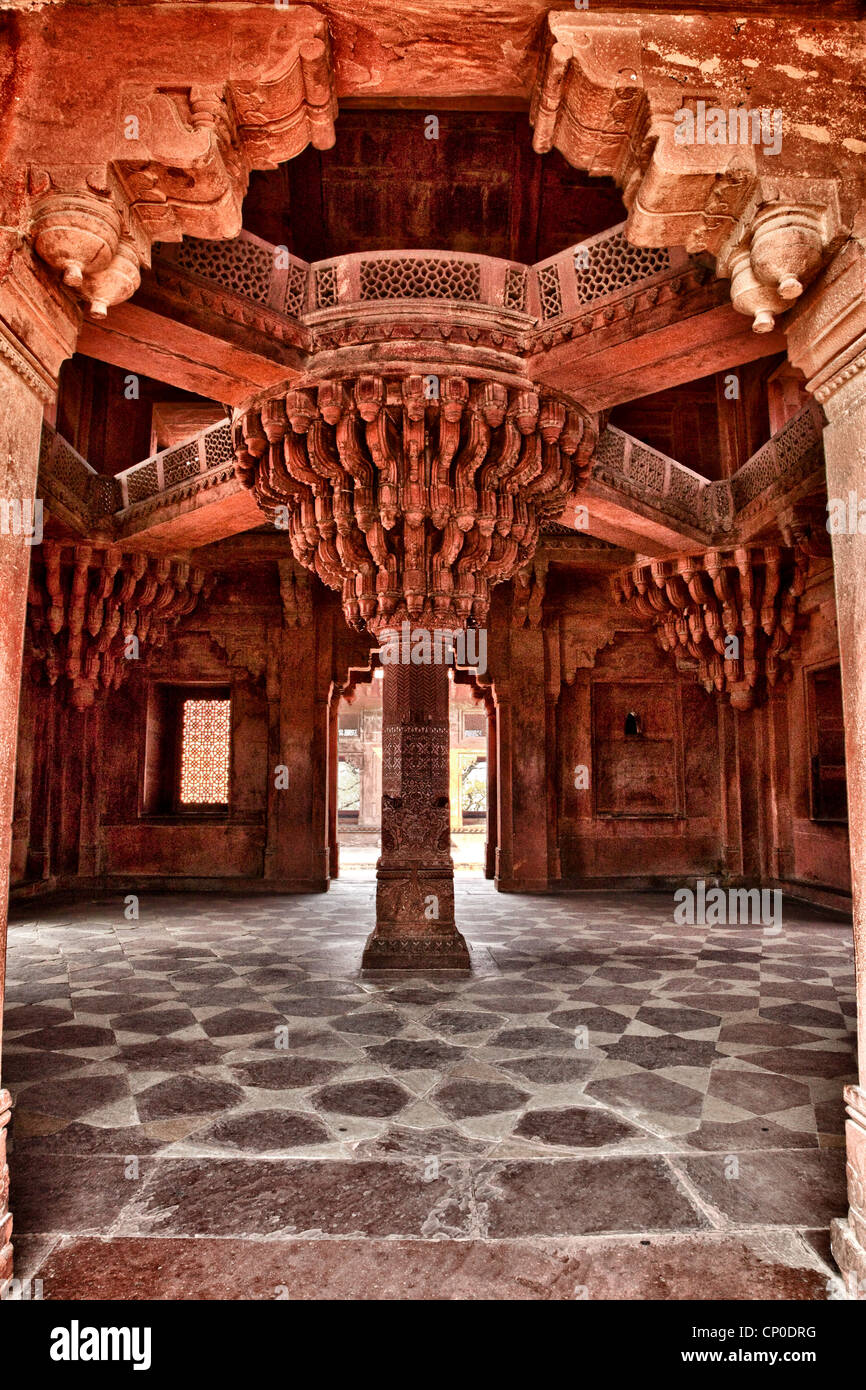
Akbar's city, Fatehpur Sikri, reflected his catholicism in the building where he held audience. A central pillar fuses Hindu, Christian and Buddhist styles in that hall. Akbar's Hindu wife had her own lavish palace complete with place for worship and even separate kitchen. The man was a complete gentleman. I did wonder, seeing that pillar, if Hindu kings have accommodated other faiths in their palaces? I don't know.


Ziegenbalg, Evangelism and Keezhavenmani


Tamil Nadu was a major port of entry for Christian evangelism in India. Bartholomaus Ziegenbalg, a German missionary, landed in Tranquebar (known in Tamil as 'Tharangambadi') as part of a Danish mission on 9th July 1706. Tranquebar was given as a territory to Danes vide a treaty between Tanjore Nayak prince and the Danish delegation on 19th November 1620. The treaty stipulated, amongst other things, that the Danes are free to practice their religion and they'd not be discriminated. It is here that protestant evangelism began in India. An interesting episode, per an exhibit at the Danish fort, was the massacre of Danes by an army sent by the 'Nabob of Tanjore' in June 1756 due to what appeared to be a misunderstanding that the Danes had broken the treaty. Another exhibit spoke of how the right-hand caste people objected to left-hand caste people using a palanquin. Also Brahmins organized a strike and then a revolt when an oil presser of lower caste used a parasol and wore slippers. The first converts were 5 natives in 1707.

A key contribution of Ziegenbalg was the importation of printing press and translating to Tamil the Bible. The Ziegenbalg museum honestly stated that the aim was religious conversion for the printing press and translation. However they incorrectly claim that this was the first printing press in India. Note, even today most Hindu scriptures are only in Sanskrit and if at all translated it is in English by a Westerner. Despite nearly 300 years of active evangelism and proselytization the state of Tamil Nadu and the surrounding areas remain Hindu majority and the town is ringed by venerable temples. That tells us something about the paranoia concerning religious conversions is just that, paranoia.

Bible Translated and Printed in 1713.
I also visited Keezhavenmani, a sleepy village near Thanjavur. It was the site of a horrific massacre of 44 Dalits on December 25th 1968 when women and children taking refuge at a hut were burned alive. A dilapidated memorial stands there. A man claiming to be the younger brother of the owner of that hut, called 'Ramiah's hut', showed me around and shared a few words. I'll return to this topic in the last part of my series on the travel when I discuss caste and religion.

Artless Cities and Intellectual Vacuity


Whether it is Sheesh Mahal in Amer fort or Fatehpur Sikri's palaces or the temples the artistic heritage is breathtaking and a depressing reminder of the current artlessness of the cities. One has to wonder how did such a civilization decay and become so artless? The cities are completely bereft of aesthetics. Whether one travels in the countryside of England, even a not so affluent quarter, or the many quaint downtowns of US or the many cities of Europe there's a sense of beauty and aesthetics whereas Jaipur, Chennai and Bengaluru are an assault on the senses with not just the ubiquitous squalor but how neighborhoods lack any character. There's no sense of a neighborhood. You've money you build to suit your whims. The colors are jarring. Chennai roads are literally overrun with chrome plated railings and road signs. It's an eyesore. Metal just criss-crosses the city like gashes on a body.

V.S. Naipaul had similarly wondered why a civilization with a tradition of art in contemporary times created buildings and monuments that were artless. He reasoned, "The British pillaged the country thoroughly; during their rule manufactures and crafts declined", "a biscuit factory is a poor exchange for gold embroidery. The country has been pillaged before. But the continuity had been maintained. With the British, continuity was broken. And perhaps the British are responsible for this Indian artistic failure". We should remember that Naipaul was a doubly the subject of a British colony, India and Trinidad. He further added, "It was a clash between positive principle and a negative; and nothing more negative can be imagined that the conjunction in 18th century of static Islam and a decadent Hinduism. In any clash between post-Renaissance Europe and India, India was bound to lose" ('An Area of Darkness' by Naipaul)

Sheesh Mahal - Amer Fort
In 2010 traveling on Trichy-Madurai highway I was appalled by how many vehicles travel on the wrong side with impunity and how blessed we were not to have been in a fatal accident. In 2019 even small towns in Tamil Nadu, like Thanjavur, and cities like Bengaluru and Chennai literally had walls as median dividers, in let alone highways, in local roads too. It was such a revolting sight to see brick walls erected as dividers. When the dividers were small enough to prevent vehicles cattle and people behaving like cattle would happily cross over and these higher walls became necessary to avoid that.

A decade who while visiting Madurai Meenakshi temple and Nayakkar Mahal I felt that the Hindu Religious and Charitable Endowments organization (HR &CE) and the Archeology Survey of India that maintain those respective places insult and deface history. I felt the same at Parthasarathy temple at Triplicane in Chennai this time. Indians often lament about treasures of India being smuggled to Western countries but I wonder if, the illegality notwithstanding, it is better than letting the treasures rot in India. Western museums showcase Indian art with respect and regard that Indians have never showed to their own treasures. Note, this is not to argue in support of nefarious illegal acts but to drive home a point.

The HR&CE department has practically created an office inside a smaller temple in the Big Temple premises and walled off a section with the divider rudely cutting into a pillar adorned with a sculpture. It's almost as if it is the mistake that the temple, built a 100 years ago (this part was recent addition) did not anticipate this need. See picture below.


Here's what I wrote, ten years ago:
I think back with lots of pain about the immense pleasure I got out of visiting historical landmarks in the west. When Indians react with smugness looking at 'stolen' treasures in British museums I say "at least the treasures are where they are respected".
My sentiments remain the same a decade later.

Two years ago I visited Italy and the many beautiful cathedrals of Christendom. In almost every church we could get finely produced brochures, for a price, that detail the history of the church and the biblical myths associated with a place. Whether it is Amer Fort in Jaipur or Taj Mahal or Fatehpur Sikri or Parthasarathy temple such brochures were completely absent. At Jantar-Mantar, an 18th century observatory, there's literally a crying need for better information about the instruments. At Taj Mahal the ASI had a depot that was dilapidated, dusty and a sleeping attendant with shoddily produced brochures of, not Taj, but Fatehpur Sikri.

The guides were mostly just hawkers who know where to get your tickets, the way inside and out. Beyond that they should be awarded a legal punishment for the butchering of history. At Amer fort the guide pointed to the toilets, with drainage system, and beamed that no one else in the world had something akin to it. I did not have the heart to tell him that probably the Roman baths that predated Amer fort had something similar. I've been to Bath, England too. At Halebid, Karnataka the guide bragged, pointing to a sculpture, that it was a binocular and it shows we invented binoculars before Galileo. Pointing to a sculpture of a warrior raining arrows he helpfully explained that it was the precursor of scud missiles. And when my lady friend stepped away he pointed to an erotic sculpture and whispered, conspiratorially in my ears, "you can take photographs". I did not.

"Together with the triviality of Indian thought on most subjects", wrote Naipaul in 'India: A Wounded Civilization", "the intellectual deficiencies of the archaic civilization finally revealed during this Emergency". Nowhere is this evident even today than in the book stores of a city like Bengaluru. Chennai is even worse when it comes to book stores.

Aside from visiting Belur-Halebid in Karnataka I spent a morning at one of the well known bookstores of Bengaluru, Gangaram Book Store and few others in Church Street. An elderly store assistant was thrilled to help me. He literally embarrassed me by running around and hauling books for me based on my preferences. I told him to stop but he persisted saying, "it's rare to see anyone ask for the books you did". As a fellow bibliophile he was just plainly excited. I had decided not to buy books that I'd get in US or through Amazon in general. I wanted local publications on local topics.

While I came across some gems like M.C. Chagla's autobiography, a book on India's churches etc the majority of the books were by hobbyists and not by academicians. Rajmohan Gandhi is now considered a historian and that's the high bar the rest are really scary. A starry eyed biographer of Sardar Patel had a chapter titled, "Lenin and Bardoli". I duly kept the book back in the shelf. Religion sells, by the bushels. Savarkar has become the subject of two recent biography. I bought one by Vikram Sampath and in 20 pages he has managed to make me puke with thinly veiled caste pride and hollow high praises. And that's a Penguin publication. Sigh. Sardar Patel clearly has become a good selling subject. India's academicians rarely publish for the common reader and maybe, given their quality, it is a blessing. The number of books on international topics are slim picking and its a usual reflection of the insular intellectual taste of Indians.

A visit to a book fair in Thanjavur was a windfall for me for all the books I bought from Kalachuvadu (Footprint) and few other publishers. However I am sure the publishers themselves had no windfall as most stalls were visited by window shoppers. High School children from pricey private schools came by the bus loads and most shopped for coloring text books or books less than Rs 15-20. Of course, no book was available at that price. Cinema tickets don't sell at that price level. Being a publisher in India is a Karmic punishment perhaps.

Whether it was at Bharati's memorials at Triplicane and Pondicherry or at Kalakshetra one is pained that Bharathi and Rukmini Devi Arundale still lack good definitive and academic biographies. Bharathi signified the birth of modern Tamil verse and prose and Rukmini Devi midwifed a classical art. Yet, we only know stories about both of them.

While India proved Naipaul wrong on the lack of ambition it, sadly, continues to vindicate his chiding of the intellectual backwardness of the country in 1976. "India's intellectual second-rateness, which is generally taken for granted but maybe the most startling and depressing fact about the world's second most populous country".

That intellectual second-rateness and the current political state of India are intricately braided with great consequence for the world at large and for India. That takes me to the question of how did Narendra Modi win such a thumping victory? As is my habit I indulged a bit in local news magazines and newspapers. Just one issue of India-Today, a news magazine published since the 1970s, with a cover story on the fiscal woes of the automobile sector provided enough material on the state of India today. About that, in the next blog.


Thursday, January 3, 2013

Salzburg: Mozart And 'The Sound of Music'

Happy New Year. I want to start off this new year with a pleasant blog about my travel to Salzburg the city of Mozart and 'The sound of music'.

Salzburg is an hour and half by train from Munich. I arrived on a pleasant Thursday morning. A tourist information center is situated within the train station. The center sells tickets for a hop-on, hop-off tour and a day trip ticket that can be used on any tram or bus in Salzburg. The day trip ticket is just 4.5 Euro.

My first stop was at Mozart house. The house was completely destroyed in the allied bombing raids during World War II. What stands today is reconstructed. In a city where Mozart died a pauper and was buried in an unmarked grave today he is celebrated in every nook and corner and his name is used to make money. In the fictional biopic the character of Mozart would protest to the emperor "I am a vulgar man your majesty but I assure you my music is not". In this museum a vivid documentation shows how vulgar Mozart can get. Mozart sent his father detailed instructions for a picture to practice shooting. The instructions and the picture are plain vulgar to recount here. I appreciate the honesty of the museum curator in show casing that too.

Musing on Mozart's prodigy Indian philosopher Radhakrishnan theorized that Mozart's genius could be the result of accumulated genius over many births. Far from it Mozart's genius was the result of very handwork as Malcolm Gladwell highlights in 'Outliers'. Mozart's father Leopold was an accomplished musician and even published well received books on music. Books arranged like pyramids were 'supposedly' read by the Mozart family. Curious items like a Abbot's diary entry about Leopold's death, portrait of Anna Maria Mozart in 'India ink', Mozart's employment contract data 17th Jan 1779 with 450 florins as salary (approx 10,350 Euro today) are all on display.

The display I liked most was Mozart's score sheet for 'Fantasy and Sonata in C minor K475 and 457'. Mozart, myth says, composed music in its entirety in his head before writing down. Not really. Mozart's use of different layout for manuscripts and how the he wrote the 1st and 3rd movements before writing the 2nd are curiosities that shed light on his style. During his Viennese years Mozart used paper imported from Italy for writing his music because it had space for improvisation.

The day I went to Salzburg was 'All Souls Day' and practically everything in the city was shutdown including other museums. So off I went on a tour of mountains of Wolfgang See along with a family from erstwhile East Germany. The tour guide was very knowledgeable about History, US politics (including Obama's pathetic performance in his first debate) and music. The guide introduced me to a music played on an instrument called 'Zither'. I showed the East German family photos I had taken at the Stasi museum. They laughed and confirmed that those were indeed horrifying days. For those looking to a holiday resort spot in Salzburg I'd recommend the 'White Horse Inn' which has a pool that opens to a lake.

Captivated by what I saw in Salzburg I went the next day too. Since I had a Eurail pass I could go any number of times to any place within Germany and Austria for 5 days. Unfortunately I went to Salzburg on Nov 2nd and Nov 3rd. All tour packages stop on Oct 31st. I just visited Salzburg museum and Salzburg cathedral. The Salzburg museum was fabulous as always with intricate arrangement of lighting to accentuate exhibits. German and Austrian museums impressed me a lot.

I've never seen a city that markets filming locations of a movie filmed there as much as Salzburg does for 'Sound of Music'. There are 3 hour tours that would take you to every spot from many famous scenes in the movie. I only walked by the river where Maria and kids run singing 'Do Re Mi'. In a memorable scene Baron Von Trapp would pull down a Nazi flag and tear it. Austria wanted to object to that scene and have it removed since they felt that it showed Austria as Nazified. The director and producers just said either the scene stays or they would show actual newsreels showing Nazi Swastika flags around Salzburg. The Austrian Anschluss, unification of Austria with Germany, was a very peaceful and enthusiastic event. Hitler paraded around Austria like a hero.

Theodore Herzl, father of Zionism, studied in Austria but left Salzburg because he could not practice law owing to him being a Jew. Austria had a deeper anti-semitism than even Germany. Simon Wiesenthal, holocaust survivor who gained reputation as Nazi hunter stayed back in Austria even after the war rather than emigrate to Israel. When Wiesenthal's wife went to a school to admit their kids the official deadpanned "I thought all of you jews were killed off". It is in this city that famous music conductor Herbert Von Karajan also lived.

Food and clothes in Europe are always classier than I'd found in USA. Salzburg was no exception. Thanks to my day trip ticket I could take a tram to an outlet mall at the outskirts of the city and saunter around for some shopping.

Other possible day trip from Salzburg is a trip to 'Wolf's Lair' where Hitler stayed and worked. 'Wolf's Lair' is where an assassination attempt on Hitler was plotted and executed. Hitler survived that attack. I could not make that trip as it stopped after Oct 31st.

Very interesting town to visit. Very urbane and charming.

Wednesday, December 5, 2012

Berlin and Nuremberg: Museums For A Ghostly Past

I've written the past few tourism blogs in a thematic manner overlooking the chronology of when I visited those places. Also I've not delved into the anecdotes of what I 'experienced' as a traveler in those cities about food, commute, people etc. I'll get to the tourist aspect in the coming days.

Subsequent post-war generations of Germany have confronted their parents with the question of "how did Nazism happen", "how did we allow holocaust to happen" etc. Ever since the unification Germany and Germans have taken it upon themselves to answer all that forthrightly. This is also possible only after the unification for several reasons. The historical sites in Berlin are now accessible giving an authenticity that was not possible earlier for a museum constructed anywhere. For instance the museum 'Topography of Terror' which details the repressive Gestapo regime during the Nazi era stands in Berlin in the same spot where Gestapo headquarters used to be. The Berlin Wall used to pass right next to it hence after the fall of the wall it is now possible for the museum to exist. Another reason is now Germany tries to view the Soviet repression and Nazi era in a connected manner of how they mutilated the soul of Germany.

Several erstwhile Nazi places that are now museums in Germany are often referred to as 'Documentation Center'. The 'Topography of Terror Museum'  constructs in artistic and painfully detailed manner the emergence of a repressive thuggish state apparatus. Running along the remnants of Berlin Wall is a series of very nice display of glass panels that are hung from steel frames detailing in chronological manner aspects of the rise of Nazism (check the picture at the right of this page http://www.topographie.de/en/exhibitions/berlin-1933-1945/#c1068). Every Siemens factory that utilized slave labor is mapped out. An artistic display tells us by using pull-outs on a calendar how holidays were declared based on Nazi festivals. Unflinching accounting of how many Nazis managed into slip into civilian life and even become judges in West Berlin is recounted in full. USSR wanted to embarrass West Germany and released a list of judges who were known to have been Nazis. While some of who lost property under Nazis some like condom manufacturer Julius Fromm, a Jew, were branded as 'Jewish proprietor of the capitalist kind' and refused restitution. Nazism which gifted the word 'Goebbelsian propaganda' was all about propaganda. A poster depicting a muscular healthy man carrying on his shoulders 'hereditary sick people' informed school students of the 'cost' of such an effort.

The inside of the museum is breathtaking. The colors are not too bright in the room, the expansive hallwith chronologically arranged labrynthine looking hanging displays with surrounding glass walls conveys a surreal feeling of openness in discussing a shameful chapter of German history (see the pics in the link http://www.topographie.de/en/exhibitions/topography-of-terror/#c1069 ).

Himmler talking of extermination, interrogation records of Jews stamped with 'J', transport lists, pictures of Jews having their beards snipped by smiling Nazis, details of camps and so much more is laid out for anyone wishing to study and learn. I'd say come to this museum not just to learn of Nazism or of how Jews were persecuted. Come to this museum to learn how hatred manifests human soul. Come here to learn what a set of human beings man did to their fellow human beings. Victims and perpetrators may change but the theme is sickeningly continuous. 

The holocaust museum in Berlin is situated, intentionally, I was told, right next to the notorious Fuhrer bunker were Hitler committed suicide. This museum is uniquely constructed with large cement blocks with grid like cobbled stone pathway that rises and falls in an undulating manner. The museum architecture evokes a sombre dark mood albeit not too depressing. The use of steel and glass is deftly combined to give a sense of openness and grimness. A room details stories of families, again with very well researched documents to trace the families path through holocaust. The room itself is imposing with mammoth cement blocks hanging from the roof inlaid with backlit glass panels of photos and documents.

The Fuhrer bunker was razed to the ground and filled up with mud by invading Red army in order to prevent any future 'shrine'. Today the place is a car park. This bunker was identified only recently. Sadly I saw some hooligan had scribbled 'holocaust ist luge' in a cycle stand nearby (and hence opposite to the holocaust museum). I jotted it down and used google to translate, it read 'holocaust is a lie'.

Nuremberg is an hour away from Munich by train. This city was the cradle of Nazism. There are no good English speaking hop on hop off tours. I just went to the 'documentation center' which is next to the large grounds where Nazi rallies took place. The taxi driver who dropped me said "look at that steel arrow like structure piercing the colosseum style building. This colosseum was left unfinished by the Nazis and the arrow like structure is there to signify an arrow into the heart of Nazism". Here we learn how Nazis used mega rallies as a method to project power and popularity. A room had displays of front pages from world newspapers that spoke of the rise of Hitler. It is sad to note how much the world knew and indeed feared Nazism and yet allowed it all to happen until an unspeakable price in human lives was paid to undo it. 

Nuremberg is not just any city. It was the center of German culture. It is here that Nazism took its shape and it is from the notorious Nuremberg rallies, so often pictured in Hollywood movies of that era, that Hitler mesmerized a nation and plunged it into untold misery. I could not visit the famous Albrecht Durer home. 

Coming a full circle Nazism faced the long arm of justice in Nuremberg. It was in Nuremberg the famous trials that convicted and executed many top Nazis took places. Those trials form the basis of today's war crimes trials. Ironically USSR which killed thousand of Polish officers in Katyn sat as part of the judges. During the trials none of the Nazis could even say a word of the conduct of Red Army which could easily be accused of war crimes that are only less severe in relation to what the Nazis did. Red army plundered and raped German villages. Allies punished Germany by obliterating most of the nation in punitive bombing raids. Dresden was flattened. The British who had their boot on India's throat and the French who plundered North Africa too were the judges.


Thursday, November 29, 2012

Berlin: City Of Museums

A German colleague once told me that I'd need ten days to tour Berlin's museum. He was right. The country which had the birth of printing press, the Reformation movement, cradle of Western Classical music, more Nobel laureates than US and UK combined until 1931, country of Goethe, Schilling and Nietzsche, Nazism, Communism, Holocaust has museums for all and it would very well take ten days to satiate a curious mind.

On the day I arrived in Berlin I trekked to Checkpoint Charlie which was 15 minute walk from the Marriott I stayed in. Only when I stood there in a street could I envisage what a brutal gash through a city the Berlin Wall was. Imagine any city you grew up in and then imagine a wall bisecting it abruptly in the middle. A private museum displays all artifacts from that era including a sub-compact car in which a fully grown adult would stuff himself/herself in the trunk to escape from East Berlin. Before I went to Berlin I browsed through Tina Rosenberg's , Pulitzer and National Book Award winner, 'Haunted Lands'. Rosenberg details the devastation of Eastern Europe by USSR. She details how unified Germany is now prosecuting erstwhile soldiers of East Germany who would shoot at fleeing East Berliners.

The Berlin Wall museum details how Peter Fechter was shot on 17th Aug 1962 by East Berlin soldiers when Fechter attempted a futile escape. The US soldiers on West Berlin stood helpless and watched Fechter bleed to death. The soldiers who shot Fechter were prosecuted in the 90's. Note that it is a contentious prosecution because the soldiers did what was legal in that country at that time.

That architecture plays an integral role to a building and particularly to a museum as thematic as Jewish museum was evident when I went to the Daniel Libeskind designed Jewish Museum in Berlin. Given the shadow of a grotesque tragedy it is natural that the architect tries to evoke a poignant gloom but balance is maintained such that the tragic sense is not overwhelming making the visitor run out in despair. The museum has geometrical alleys and narrow rectangular slices for windows with a cement pathway all intended to evoke a concentration camp feeling. A holocaust tower which has large iron doors and absolute darkness transports the visitor to a grim era.

The genius of Jewish Museum's curator is in ensuring that the museum is not only a tribute to an unspeakable tragedy but in also ensuring that a visitor gets an idea that Jews in Germany lived a culturally rich life contributing to the rich tapestry of the country. That the German Jewish community was an intellectually vibrant community and every inch German citizens is clearly brought out by unique exhibits like the glass mannequins that represent German Jews who fought on behalf of Germany in World War I.

The museum traces artfully the history of persecution of Jews in the centuries before holocaust across Christian Europe. 'Salomon bar Simson', a narrative Hebrew history, recounts the persecution of jews in Germany during the first Crusade 1096 AD. Details of how jews were stereotyped and prohibited from various professions are vivid to learn how hatred seeps into minds. Many Jews would change their last names such as 'Cohn' to 'Coen' to escape persecution. Amongst the many geniuses celebrated was Karl Marx too. Marx was of jewish lineage but his father had converted to Christianity. Marx himself wrote very harshly of Jews that he was accused of anti-semitism.

The most interestingly curious display was a collection of 'detective reports'. A prospective groom was investigated in detail by a detective from the bride's side. The notes include whether the groom had a good job, his salary and even about his mother. This museum is a must visit for any one desirous of learning Jewish cultural contribution to Germany and the world in general.

The DDR museum showcases life in East German days. Every house needed to maintain a 'house book' to record guests staying over 3 days. In libraries supposedly subversive works would be kept separately and labeled 'Poison of thought'. One needed a 'poison pass' to read any of those books. School children practiced throwing grenades and girls had to undergo 'Lehre' or compulsory apprenticeship. Oh by the way East Germans hated abortion more than today's GOP in USA, there was only one 'no' vote against a March 1972 law regulating abortion. Communist economy fixed a professional Engineer's salary at 1470 Marks (1988) and a Bricklayer's salary at 1370 Marks (1988). A chemist earned 1300DM whereas a mineworker earned 1444DM (1988).

The German history museum is breathtaking in scope and could very well take one full day by itself. Indians always haughtily talk of what they 'taught' the world. One exhibit in this museum spoke of what Germans 'learned' from technologically advanced Orient. The city of Augsburg in 1526 regulated aid for poor ensuring they are not dependent on charity by the church. Interesting exhibits on Luther and Reformation impress the vast scope of how the world was changed. Modern day unions have their roots in professional guilds that were established centuries ago for the same purposes. The guilds regulated who practiced a profession in order to stifle competition. Workers guilds practiced pretty much what todays trade unions do.

One very little known museum is the 'Medical History Museum' named after the father of Pathology 'Rudolph Virchow'. This museum has very little exhibits that have an English note. Students of medicine can benefit from a visit. Here too the German's unflinchingly face up to the the dark chapter of medical experimentation in the Nazi era. Twisted beliefs in Darwinism and eugenics led doctors to kill disabled and the mentally challenged in addition to evil experiments on children in Auschwitz and elsewhere.

I'll cover Hitler's last bunker, Holocaust museum and Topography of terror in my next post for the sake of readability.

Tuesday, November 20, 2012

Leipzig: Music, Repression and Rebellion

I'd like to take a detour from the grim topic of holocaust to an interesting visit that could be called a quintessential German city that reflected Germany's genius and its travails under Stalin's jackboot. Leipzig is little over an hour away from Berlin by train. This city is where Bach, Wagner and Mendelssohn lived and worked. Goethe studied in Leipzig. Leibniz discovered calculus there. It is in Leipzig that the Stasi, the East German Secret Police, unleashed a regime of terror leaving behind 180,000 kilometers of documents. The grass roots movement that finally brought down the Berlin Wall came to a boil in Leipzig.

The recurrent theme of Germany seems to document and face up to its past ghosts whether they be of its own creation like Nazism or imposed from without like Communism. Though Berlin has a STASI museum too it is the Leipzig museum that's more famous.

If we think Orwell predicted the repressive nature of communism we are wrong. Orwell did not even scratch the surface. Here is East Germany the state controlled every aspect of a citizen's life. A spouse or boyfriend could very well be an informer. Children were encouraged to tell on their parents. Here in this museum one comes face to face with an array of exhibits that were the tools of Big Brother. Most exhibits do not have English descriptions but the handheld audio guide comes handy.

The movie 'Lives of others' depicts the STASI vividly. A STASI interrogator would describe the art of interrogation. The suspect is made to sit on a chair upon an yellow cloth and questioned for hours together. After completion of questioning the yellow cloth, suffused with the suspect's body odor, would be sealed in a glass container and indexed clearly. When a subversive pamphlet turns up a police dog sniffs that paper. Depending on where the paper was apprehended bottles of yellow cloth collected from suspects in that area would be given to the dog to sniff and match a cloth. Here at the museum I saw such original glass containers with yellow cloth. At the GDR Museum in Berlin I saw notebooks that East German households had to maintain to register guests staying for more than 3 days.

The taping system was pretty extensive and thousands of phones were bugged. The tapes, the transcription system, vaults for safekeeping of tapes were all on display. The Stasi had elaborate equipment for breaking into houses that included counterfeit machines to duplicate eye, bugs, portable copiers to copy incriminating documents, polaroid cameras. As the movie 'Lives of others' depicts how mail was opened and read the steaming equipment used to steam and open envelopes was show cased here. Just 2 weeks before the fall of the Berlin Wall a Stasi official wrote on Oct 31st 1989 to monitor a suspect.

After nearly 2 hours of a depressing peek into the nature of communism I then headed for Johann Sebastian Bach's museum next to St.Thomas church (Thomas Kirche).

Bach symbolizes the Baroque era of western classical music. He lived in Leipzig between 1723-50 where he taught at the Thomasschule, St.Thomas church. The museum is a gem for music lovers. The visitor starts of by getting acquainted with the Bach family tree of musicians stretching back into the 16th century. Music is played softly over the display and as each piece plays the respective composer on the genealogy tree is highlighted. Another room has a map on the floor with markings of what Bach composed in each location. Stunning. A virtual orchestra helps us understand orchestration in Bach's period. An instruction manual for the boys in the dorm tells them not to urinate from windows. At a suitably lit room original scoring sheets by Bach are displayed. Bach was contracted to compose for weekly church services. No church in history ever had in its employ such a prolific composer whose music spoke across ages. What is a Bach museum without a piano? We see how Bach enjoyed learning and playing different instruments. The cafe adjacent to the museum served delicious thin pancake layered with warm crisp thinly sliced apples dusted with nice sweet sugar.

From Bach's home I headed towards Mendelssohn's home. Mendelssohn's 'wedding march' is the most played bridal march. A map tells us of Mendelssohn's travels hither and thither in Germany and even to Edinburgh. In an earlier blog I had wondered about the impact of traveling wide and imbibing wider learning on Bach's music compared to the provincial life led by Thyagaraja, the patron saint of carnatic music.

Architecture is a key aspect of museums in Germany. The museum for East German life is dark and evokes the repressive nature of that era. Unfortunately not a single exhibit had English descriptions.

Recently Wall Street Journal had an article that said the fall of Berlin Wall could possibly be due to a miscommunication amongst the police and rulers. Many who are unfamiliar with the communist history think that some strange catalytic event crystallized in the fall of the evil empire. No. Not at all. Come to Leipzig to understand how a people's movement brought a regime to its fall.

Leipzig city of Bach, Wagner and Goethe was enslaved for four decades. I wondered how could a people with such intellectual history be enslaved. How long could any machinery, even the one as brutally repressive as the communist machinery was, hold down a people? In US we often read about Reagan and Pope John Paul II combined forces to combat the Red terror. In Leipzig I learned of how the church played a central role in anti-communist protests.

St.Nikolai church in Leipzig was the womb of many protests including the string of protests starting in the fall of 1989. Tens of thousands milled around the church and challenged the might of the Soviet empire.

Just before I decided to head to the train station for return I figured out that mathematician Liebniz is honored with a statue at the University of Leipzig. Leibniz invented Calculus but was cheated from being recognized by Isaac Newton. Newton also had invented the calculus but as head of Royal Society Newton indulged in pettiness to rob Leibniz of due credit. Today historians recognize both as having independently inventing calculus and changing how we live for centuries to come. 

Thursday, July 1, 2010

India: Criticisms and Solutions

A management cliche is "be part of a solution". It does not help telling a manager what the problem is alone, give a suggested solution alongside. A few well intentioned readers have indeed asked me that regarding my blogs on India. There is another Indian phrase that I mulled in that context. "Constructive criticism". We are often told criticism should be constructive. There is no such thing, its either fair or unfair period. V.S. Naipaul wrote 3 books on India, very searing commentaries that left Indians fuming. Not one page of what he wrote had "Indians can rectify this way or India can try that". It is service enough to show what is failing. The biggest tragedy in India is much of its failures are WILLFUL and CONSCIOUS inflictions. Does not a government servant know that asking for bribes is wrong? Does not a PhD professor know  that bribing a minister for Vice-Chancellorship is wrong? Does not a VC know that telling a CM that his crappy writing is Nobel worthy is sheer sycophancy? Does not a doctor know its wrong to get a cut from a laboratory? Does not a motor cyclist know that he should stop on red signal? Does not a contractor know its wrong to use incorrectly mixed cement? Does not Manmohan Singh know that spending Rs10,000 crores for games is sheer villainy in a country where millions live on less than a dollar a day? Does not MuKa know what a waste his conference? Does not every NRI who emigrated know that so much is wrong with their beloved motherland which is why despite its 'charms' they emigrated so eagerly begging the gods for a US visa (then a green card, then citizenship)?

Then there are certain ills that are the concretely institutionalized. Inability to sue a patently corrupt CM, inability to criticize judges irrespective of how corrupt they are, a system that constantly reminds the ordinary poor citizen that his rulers are a 'privileged' class apart. Ministers can, by law, allot gas stations, get seats in schools, get seats in trains and much more. The Indian state, with assent of courts, can suspend Habeas Corpus, the cornerstone of modern civil law. The Indian state has promulgated the most draconian laws of detention that make Rowlatt act look like child's play (and the US patriot act like a Utopian dream). An Indian Supreme Court judge writes that "Intellectual Property rights" are alien to Indian culture of dispensing knowledge freely (that web page was copyrighted though). Private property is held at the will and pleasure of a state that can snatch it at will (Kerala seized a private Golf course so that not only the rich can play in it, the Supreme court assented).

I can say only one parting suggestion. Indians think that the problems in India are very unique to India and are without precedence. I've almost every problem in USA that in some way can suggest solutions to India. Indians first have to accept that they need to learn and look around.

Many of my blogs, with all humility, do contain very valid insightful observations but I've very little hope of anything being corrected. The comparisons that I incessantly draw upon are themselves prescriptions.
I can go on and on. Will India become Africa? Certainly not. India is not Congo. Will India come close to being a developed country? Certainly not. India is not mature. Will that happen in some distant future, well as Alexander Pope says "hope springs eternal in the human breast". After all in an evolutionary time scale if monkeys can become man why not???

Monday, June 28, 2010

India: Toll Road Exemptions and Allure of Power

Why does the average Indian love to see leaders abuse power? Abuse of power is a virtue in power drunk India. In fact if an MLA or a SP's car stops for traffic he/she is seen as "effete". This is not only true of semi-literate Indians. Supposedly well educated Indians in USA swear by "Kalaignar" or "Naidu" or "Modi" etc irrespective of their blatant abuses of power. What is worse these NRI's would abhor many such abuses by politicians in their adopted land.

When travelling from Trichy to Madurai on a nicely laid toll road I was surprised to see a huge board listing people who are exempted from paying tolls. The list included President, Prime minister, chief justice, CM etc. Think for a moment, the poor farmer taking his goods from Trichy to Madurai has to pay Rs 50 but the chief Justice need not. In USA probably only the President zips past a toll road, if he ever travels by one, that too only for security reasons. Our NJ governor pays tolls. Can we imagine Jaya or MK paying tolls even when not exempted by law????

Throughout the Indian citizen's life he/she is constantly reminded that the elected representatives are not 'representatives' but 'rulers'. If the common man accepts a bribe he can be investigated but to investigate a CM you need governor's approval. God help you if they both are of same party. Constitutionally and otherwise the Indian citizen is constantly reminded that the "ruling class" , politicians and bureaucrats, is entitled to different set of rules.

America's founding fathers were adamant in treating the would-be elected rulers on par with citizenry in fact the elected representatives are, by custom, held to a higher standard. The average American expects his governor or President to be judged by a higher bar than he applies to himself. The average Indian does the exact opposite. A politicians peccadilloes would disgust an American, for an Indian it is "macho". Bill Clinton paid a very heavy price for his Lewinsky fiasco.

Indians hate abuse of power only when it is not by their beloved leader. For a Dalit Mayawati's abuse of power is just "giving back to the upper caste". Jaya, Indira, Mayawati and Mamata proved that women are equally capable of being unscrupulous, corrupt, mean and venal like any man.

An American understands that a senator being frisked at the airport is no big deal. For an Indian its sacrilege that his matinee idol was questioned (not harassed as its done by Indian officials). Barack Obama and Bill Clinton would pay up from their pocket when they buy a burger or a book. A famous incident was when Bill Clinton was told by a bookshop assistant that Clinton's credit card had expired and Clinton borrowed money to buy the books. How many Indian politicians would buy a book about a country they are about to visit let alone pay for it?

The Tamil conference is the most shameful exhibit of the craven nature of Tamils. This is the state that supposedly was recast in the crucible of "self respect movement". No aspect of a Tamilian's life is devoid of sycophancy. Long back I was watching Tom Hanks receive a "lifetime achievement". Many of his co-stars who spoke poked fun at him and Tom was grinning from ear to ear. American politicians rub shoulders with the citizenry as equals. One of the signal moments after 9/11 was when Bush took the bull horn from a fire fighter and spoke to the world with his hand resting on the fire fighter's shoulder. The fire fighters standing next to the US President stood relaxed, deferential yes but not a bit obsequious. If it had been anybody but the President even that bit of deference would not have been there.

I was traveling by car in a very crowded street. Vehicles could barely move. Horns blared. Suddenly a jeep pulled along side us and the driver, apparently a policeman driving his superior, glared at our driver. He felt his authority was undermined by having had to yield to a citizen's car.

What is tragic is all this show of "power" is enshrined constitutionally and "THEREFORE" otherwise too. Paula Jones was a non-descript woman who sued a US president and caused his downfall. The US President is often rhetorically referred to as 'most powerful man on earth'. I'd say the MLA in any Indian assembly has more power than any US President. Of course that depends on how "power" is defined.

Saturday, June 26, 2010

India: A litany of excuses

We took the Guruvayoor express to Chennai from Trichy. We had booked a/c sleepers. When we stepped into the a/c coach a distinctive stench hit our noses making Hydrogen-sulphide (chemistry textbooks call H2S as rotten egg smell) look like perfume in comparison. Near the toilet a chart duly noted thatPest Control Department last checked for pests on some date. Right next to it a passenger, presumably Indian, wrotetoo many cockroaches. If Indians can feeltoo many cockroaches it REALLY has to be many. I was not disappointed. One look at where they stash the blankets and pillows made me puke. Only when I reflected I realized that I had paid only Rs 318 for the journey. Rs 318 for a 250+ KM train journey, in a/csleeper with blankets provided. That is $7.5 approx. Even by Indian standards that price is ridiculously low. In a country where one liter of petrol is Rs50+ and an auto ride from Adyar to Egmore is Rs100+ this is dirt cheap and so no wonder it was dirty. Its impossible for Railways to maintain the coaches let alone modernize. When Indians work themselves upto a lather because Lalooturned around a loss making Railways not many pause to think what they got. When year after year fares aremaintained and in a/c is made more affordable nobody pauses to think. Yes the fares aremaintained but the coaches are not.

During a couple of drives from Adyar to elsewhere Rowena saw Marina beach and wanted to visit it. I also wanted to take her to Marina just to see the colorful life on a beach. We often go to beaches in New Jersey but no beach in USA would have vendors selling stuff right on the beach its only done away from the beach area, no flying kites, no horse rides etc. Marina is colorful that way. Despite our tight schedule we made time for a beach visit on Friday evening around 7 PM. Contrary to my fears parking was easy. The beach road with its expanse, the sodium vapor lights in the median divider, the statues is quite a sight to behold on a nice evening when the weather is balmy. 

We spotted a horse ride and Rowena got on the horse with immense joy. I brought out my canon SLR to snap pictures. After seeing me take pictures the horse ride guy (jockey ???) told us “Sir  you have to pay me Rs 20 for each snap you take”. Of course we did not pay and we put him in place. What amazed me was how fast the guy cooked up a scheme to get money beyond what was his due. I’ve taken horse carriage rides in NYC, Amsterdam and elsewhere. Nowhere did anybody come up with such an excuse to extort money. In Amsterdam I paid 25 euro for a 30 min ride, our driver was a woman who did not utter a word as I snapped away to glory. I had a similar experience in 1999 when as a newlywed I stepped out in Egmore with three large suitcases. The porter demanded Rs 400 to take the suitcases a few feet to the taxi stand. I asked him why. The reply was simple “sir you are going to America”. How did he know. “who else carries these types of suitcases”. Just because I was going to America he felt “entitled” to get more than his due. The taxiwallah demanded Rs1000 to go from Egmore to Purasawalkam (an auto would charge Rs 30 those days for that trip). Again the reason was “you are going to America”.

That people feel “ENTITLED” to your money just because you earn more, considerably more, is a malaise that can be traced to the roots of our cinema culture where the hero is always “robbing the rich to pay the poor”. In a country like India where, until recent times, the rich were mostly landed gentry, zamindars, it’s not easy to comprehend or pay regard to the fact that people could get rich by hard work, honest work and be honest tax payers. “Poverty” is another excuse that I am tired of hearing. The woman in Amsterdam who drove us was not rich, she knew we were tourists, yet she did not feel ‘entitled’ to our money. A cabbie in NYC is not rich and getting a taxi license in NYC is so expensive (and corrupt too) but he does not feel entitled to my money beyond the meter. 

The favorite excuse of Indians ispopulation.we are a large country, population is a problem. Until recent times population was only aproblem but Indias demography is fast turning into amixed blessing. India reaps by the tons the benefits of its rich demography, an eager and mostly young workforce by the millions is a boon that is transforming the country. In many other spheres the population is a challenge and in certain spheres it is a malaise. BUT Indians use it as a blanket excuse for all and sundry. Coming out of Meenambakkam I thought about the population question. If I told any Indian about the deplorable state of the airport I’d get a shrugpopulation. Little do we realize  that Newark Airport or JFK or Brussels, uncluttered car park, the clean exit ramps I was back to civilization.
 
Population has got nothing to do with many ills that plague India. What haspopulation orpoverty got to do with a guy urinating near a 400 year old Mahal right under thedo not urinate here sign? First of all why would there be a need for such a sign. Has anybody ever seen ado not urinate here sign in any other part of the world. What makes it ok for literate teenagers to scribble on the walls of a protected monument, again, right next to ado not scribble on the walls?

I went to a bookshop in the new mall “Chennai City Center”. This was a branch of the biggest bookstore in Chennai. The store had a cramped design and in places books were just piled on the floor. The shelves were crammed with titles. The Tamil DVD’s were in flimsy sleeves and stacked like they are done in Burma Bazaar, no sequencing  either. Most of the books were by western authors and local editions of foreign publications. Indian publishing industry is still in its infancy and is mostly just a “printing press”. Though India does have some reputable publishing houses like Penguin, Oxford University Press etc nothing to match the prestige of a Simon and Schuster or Harper Collins etc.  

Buying books is still a luxury in India. Any good book easily crosses Rs 500. For a salaried lecturer in Trichy its a princely sum.  Take Trichy for example. In US it would be typically called a "University Town" to emphasize the preponderance of premium educational institutions. But there is not a SINGLE book store that is good, let alone public libraries. Yes REC has a good library but I can bet the engineering student there does not have access to the latest NY Times bestseller on a number of topics. But then the student first should want to read those, he/she is stifled by a curriculum that thinks a tech student should only learn circuits and bridges. For the common Tamilian reading habit is what he/she most  grazes in the morning and some pot boilers.

Indians repeat ad nauseum about how the British left the country in a hurry and in a mess. As much as that is true little do we pause to think how "BLESSED" India was at its moment of birth. Indians did not have to 'invent' constitution writing like US, the country was linked from end to end physically, very importantly it was linked end-to-end administratively. India had the unique of strength of a wonderful administrative cadre schooled in the best institutions, India's leaders-to-be were also schooled in the best institutions.Above all the emotional unity, not withstanding the communal carnage in the border states, was amazing given India's historical fragmentation. Yet, Indians have unexceptionally squandered each and every advantage and what is worse turned every blessing into a curse.

I am often told, why keep complaining, can you say something as a curative suggestion. I shall address that in my next blog.