A popular retort, of those who place themselves in opposition to the religious fundamentalism of Hindutva, is to cite select passages of Guru Golwalkar’s book ‘We or our nationhood defined’ and accuse the Guru of being an admirer of Hitler and Nazism. Accusing the Sangh Parivar of cosiness with the most repugnant ideologies of twentieth century, Nazism and Fascism, often ends up in fruitless shouting matches with shrill voices where one accuses and the other rejects. What are the facts?
Every nation, young and old, often asks of itself ‘who are we’ or variations of that. Harvard scholar Samuel Huntington wrote his highly polemical “Who are We? The challenges to America’s national identity” in 2004 and worried if the “key elements” of American Culture - “English language; Christianity; religious commitment; English concepts of rule of law, the responsibility of rulers, and the rights of individuals; and dissenting Protestant values of individualism, the work ethic”- were being threatened by the influx of “new wave of mmigrants from Latin America and Asia”.
Lest one attach the label of a demagogue Huntington draws a careful distinction that is, in effect, academic hairsplitting, with the caution, “let me make clear, an argument for the important of Anglo-Protestant culture, not for the important of Anglo-Protestant people”. He asserts that he wrote the book as “a patriot and a scholar”. As a patriot he’s worried about “unity and strength” of his country. As a scholar he finds the “historical evolution of American identity” a fit topic to discuss. He confessed that the “motives of patriotism and scholarship may conflict” and that his “selection and presentation of that evidence may well be influenced” by his patriotic desires.
Republican party ideologue Pat Buchanan, unlike Huntington, has no academic shackles to even pretend what worries him and what his remedies are. “Suicide of a Superpower: Will America survive to 2025” was Buchanan’s gloomy book published as recently as 2011. The chapters are helpfully titled, “The passing of a super power”,”The death of Christian America”,”The crisis of catholicism”, “The end of White America”.
In one of my earlier blogs I, too, have argued for immigrants to assimilate themselves into the American culture. The culture I had in mind is not what Huntington had in mind and certainly not the kind Buchanan had. Culture is never static and what Huntington characterizes with a very broad brush of Protestantism is the product of English, Germanic and Irish, amongst others. Each of them were distinct flavors and none accepted the other. Free speech, an open and accepting society, a society where minority rights are protected and in fact the culture that I enjoy and wish the immigrants learned to be a part of are exactly the kind that Buchanan hates, example, diversity.
Irrespective of their ideological background every Indian leader of note, Gandhi, Nehru, Ambedkar, Golwalkar liberally fashioned their ideas of how to unify India based on the ideas of nationalism that sweeping across the Western world. Broadly, cultural and linguistic unity were to be the bedrock of a unified India and India, precisely on those counts, posed a conundrum. No nation in the 21st century, let alone in the middle of the 20th century, offered a template for nationalism for India.
While Gandhi and Nehru were mindful of the fact that India, due to its large number of minorities, is unique and called for unique solutions Ambedkar and, specifically, Golwalkar proposed homogenization, unmindful of the cost. Broadly speaking though Golwalkar, actually, was closer to Gandhi and Vivekananda than to Adolf Hitler.
The language and sentiments are stunningly Gandhian. “Truth has drawn me into the field of politics. Those who say religion has nothing to do with politics do not know what religion is”, said Gandhi. The important distinction is, to Gandhi religion was search for truth but to Golwalkar it was Hindu theology. Even with that distinction Golwalkar’s views were not too far apart with not just Gandhi but even with that of Martin Luther King Jr. Suffusing politics with religion Gandhi often irritated Jinnah and made Nehru, a secular agnostic, uncomfortable. Golwalkar’s ‘Bunch of thoughts’ shows a positive disposition towards both Nehru and Gandhi.
Writing on why Western nations marched towards secularism Golwalkar is pretty unerring, “for the general, Race it was considered profitable to assume a more tolerant attitude towards the various sects and religious persuasions, and leave the individual to choose whichever he liked, provided only, he did not, in following his beliefs, becomes a nuisance to his neighbors. To ban religion altogether from all public and political life is but one step forward and a natural one”.
Anyone who has followed the debates concerning the place of religion in public spheres in today’s America will realize that Golwalkar’s only mistake was in assuming that the journey was unidirectional and would not slide back and forth. That said, Golwalkar’s desire of intertwining religion and politics hews closer to Gandhi and William Buckley and MLK Jr. William F. Buckley Jr, author of ‘God and man at Yale’, would’ve loved Golwalkar.
Buckley while graciously allowing that he did not want his alma mater, Yale university, to “treat her students as potential candidates for divinity school”, he asked pointedly “we can, without going that far, raise the question whether Yale fortifies or shatters the average student’s respect for Christianity”. One could hear a Hindtutva supporter cluck his tongue thinking of Indian academia similarly.
On Communism and Russia Golwalkar in unsparing prose nails it:
During the Great War Stalin forsook Communist orthodoxy against Nationalism and eagerly stoked a muscular Russian nationalism to rouse the masses against the invaders in a moment of existential threat. Golwalkar wrote “we rest satisfied with pointing out that Russia has its country, race, its materialistic godless religion, with its resultant culture and its language and stands out before the world a Nation in its complete Nationhood, shorn of its borrowed feathers of Internationalism.” Churchill would’ve agreed.
Arguing that secularism should mean equal treatment of all with no quarter for any preferential treatment to anyone Golwalkar wrote:
Samuel Huntington was indignant that Civil Rights leaders who demanded a Civil Rights Act to enshrine equality then turned around and used the very act to demand preferential quotas. Even black economist and intellectual Thomas Sowell has made the same argument. While Golwalkar presaged Huntington’s indignation both suffer from the same blindness that ‘equal opportunity’ and ‘positive discrimination’ are not antithetical and opposing goals and communities that had long suffered discrimination needed a helping hand before being able to compete on equal footing. However, the idea here is to only point out that an impartial reader can find many mainstream ideas in Golwalkar’s writings that have nothing to do with Nazism or Fascism.
Golwalkar was a patriot and a nationalist in the Bismarckian mould and could brook nothing that sowed the seeds of dissension and encouraged separatism. Though he always refers to Sanskrit as language of Gods he chides those who ridicule languages spoken by other Hindus in other parts of India. “In fact all our languages whether Tamil or Bengali, Marathi or Punjabi are our national languages. All these languages and dialects are like so many flowers shedding the same rich fragrance of our national culture”. He did think, though, that all languages were inspired by the “queen of languages, the language of gods-Sanskrit”. Golwalkar’s attitude to language is very close to the official position of Congress which was promoting the use of ‘Hindustani’, a hybrid of Hindi and Urdu, as a unifying language while local languages like Tamil are used locally.
Ambedkar and Gandhi are not too far apart from Golwalkar on the issue of conversions. Ambedkar in a stinging observation said “what the consequences of conversion will be to the country as a whole is worth bearing in mind. Conversion to Islam or Christianity will denationalize the Depressed classes…if they embrace Sikhism they will not only not harm destiny of the country but they will help the destiny of the country. They will not be denationalized…Thus it is in the interest of the country that the Depressed Classes, of they are to change their faith, should go over to Sikhism”. True to his word when he did convert himself and legions of followers Ambedkar, much to the delight of generations of Hindutva followers, chose Buddhism over Christianity or Islam.
Here’s Golwalkar:
Gandhi conceded the good work of Christian missionaries but asked, quite fairly it must be said, “even such noble service loses nobility when conversion is the motive behind it. That service is noblest which is rendered for its own sake”. Ambedkar retorted that Gandhi wanted to get services from Christian missionaries without giving anything in return. Golwalkar in one of his writings indignantly cites a Christian missionary in North East as saying that all charity work is with a motivation to convert and increase the number of Christians in India. While the charge and anger is not without merit the controversies surrounding conversions are more complicated.
THAT was not Golwalkar but Lala Lajpat Rai in a letter to firebrand revolutionary C.R. Das
THE poet referred was not Golwalkar but Rabindranath Tagore.
The quotes are from Ambedkar’s ‘Thoughts on Pakistan’ in a section titled “Can Hindus count on Muslims to show national rather than religious loyalty?”
“What is that 'common emotion', that common basis on which all can come together?” asks Golwalkar. Arguing that a Hindu’s view of Hindu-Muslim unity is ‘hallucination’ Ambedkar writes, “Are there any common historical antecedents which the Hindus and Muslims can be said to share together as matters of pride or as matters of sorrow? That is the crux of the question. That is the question which the Hindus must answer, if they wish to maintain that Hindus and Musalmans together form a nation. So far as this aspect of their relationship is concerned, they have been just two armed battalions warring against each other. There was no common cycle of participation for a common achievement. Their past is a past of mutual destruction—a past of mutual animosities, both in the political as well as in the religious fields.”
The author of an article cherrypicked a quote by Golwalkar to show that he supported casteism. Golwalkar had refuted the accusation that Hinduism, weakened by caste divisions, had fallen prey to Muslim invaders, by citing the fact that caste ridden states, unlike those where casteism was muted, had actually withstood the onslaught of Buddhism. The cherrypicking author stopped there and charged Golwalkar with prescribing a caste oriented system. Golwalkar was merely refuting the accusation with a factual basis and he proceeded further to say in an extended quote that is largely true and agreeable:
Of course Golwalkar was not being magnanimous out of a milk of kindness. Ambedkar dissembles this desire for unity amongst Hindus and points to the real cause. The purpose of this blog today is not to rebut Golwalkar but to show how close to the mainstream he was. A rebuttal will follow soon.
The most controversial and most cited quote of Golwalkar is the one passage concerning “Germany”.
Golwalkar proceeded to add,
Elst is an apologist for Golwalkar seeking to minimize the awareness of Golwalkar of the nature of the Nazi regime and his attitudes towards the minorities.
Golwalkar had only one focus, the formation of a nation that is homogenized in thought and soul and in that pursuit he lauded Nazi Germany and Zionism, equally, with no sense of irony. In the same “We or our nationhood defined” Golwalkar wrote of Zionism, “The Jews had maintained their race, religion, culture and language; and all they wanted was their natural territory to complete their Nationality. The reconstruction of the Hebrew Nation on Palestine is just an affirmation of the fact that Country, Race, Religion, Culture and Language must exist unequivocally together to form the Nation idea.”
Savarkar, too, while pointing out that Jews and Germans could not live together supported Zionism. Writing as early as 1923 Savarkar said “if the Zionists’ dreams were realised, if Palestine became a Jewish State, it would gladden us almost as much as our Jewish friends”. Koenraad Elst helpfully notes that Hindutva should draw inspiration from Zionism.
Like many other positions of Hindutva this love for Zionism and Israel had nothing to do with rejoicing at Jews getting a homeland but a sheer joy at ideological vindication in the nation of Israel. That Israel was established amidst Islamic opposition was further cause for cheer. Even with all that the love for Israel is fraught with contradictions that I’ll outline subsequently.
It was B.S. Moonje who met Mussolini the fascist dictator and his admiration for both Mussolini and fascism is often used as a stick to beat him and Hindutva. A notorious quote by Moonje is the most cited to argue his adulation of Mussolini and fascism.
“Nothing better could have been conceived for the military organisation of Italy...The idea of fascism vividly brings out the conception of unity amongst people...India and par- ticularly Hindu India need some such institution for the military regeneration of the Hindus: so that the artificial distinction so much emphasised by the British of martial and non-martial classes amongst the Hindus may disappear. Our institution of Rashtriya Swayamsewak Sangh of Nagpur under Dr Hedgewar is of this kind, though quite independently conceived.”
Sure, Moonje admired Mussolini and fascism as is evident from the quote but the motivation is driven by less nefarious factors than is often recognized. The British Raj classified some sects of Hindus as “martial classes” and provided them better opportunities to serve in the army whereas all others were deemed unsuitable, hereditarily, to belong to the ‘martial classes’. Moonje’s desire of militarization is to obliterate this artificial division and rejuvenate a warrior attitude to overthrow the colonial yoke. Until Gandhi came such attitudes were common and despite Gandhi there was always a streak of violent revolution in India. Again, let us remember the example of much lionized Subhash Bose who colluded with Germany and Japan, two of the most repugnant regimes at that time, in an attempt to liberate India by war.
The admiration of fascism as being an ideology that welded a nation together and forged unity appealed to Moonje. This too was not out of the ordinary and is less a ringing endorsement of everything that the word Fascism as defined by Mussolini meant.
There is little proof of Golwalkar cheering Nazism or Hitler. While one may call Golwalkar’s ideas as being akin to Nazism it is completely untrue and unfair to Golwalkar to say that he was inspired by Nazism or framed his ideas inspired by Hitler. He merely uses the German example to buttress his ideas concerning majority and minority in a nation. Those views were largely in vogue across Europe at that time as ‘nationalism’. However, ascendant notions of ‘liberalism’ was, in some countries, tempering the zealotry of ‘nationalism’. Tagore clashed with Gandhi precisely on that count.
Golwalkar and the Hindutva ideas were suffused with contradictions and can easily be rebutted. I’ve in this blog only tried to show that Golwalkar was not out of the mainstream in many aspects. We’ve to contextualize his views, repugnant or not, with the turbulent times when notions of diversity and secularism were quaint or non-existent. I remain a staunch opponent of Hindtuva and I’ll rebut most of these ideas in a soon to follow blog.The Sangh Parivar has recently started to distance itself from Golwalkar’s ‘We or our nationhood’ by arguing that it is the product of a young mind, he was 32 years old at that time, and that his later writings show nuance and maturity. Is it true? Await the next blog for rebuttals and more.
‘Who are we?’
Lest one attach the label of a demagogue Huntington draws a careful distinction that is, in effect, academic hairsplitting, with the caution, “let me make clear, an argument for the important of Anglo-Protestant culture, not for the important of Anglo-Protestant people”. He asserts that he wrote the book as “a patriot and a scholar”. As a patriot he’s worried about “unity and strength” of his country. As a scholar he finds the “historical evolution of American identity” a fit topic to discuss. He confessed that the “motives of patriotism and scholarship may conflict” and that his “selection and presentation of that evidence may well be influenced” by his patriotic desires.
Republican party ideologue Pat Buchanan, unlike Huntington, has no academic shackles to even pretend what worries him and what his remedies are. “Suicide of a Superpower: Will America survive to 2025” was Buchanan’s gloomy book published as recently as 2011. The chapters are helpfully titled, “The passing of a super power”,”The death of Christian America”,”The crisis of catholicism”, “The end of White America”.
In one of my earlier blogs I, too, have argued for immigrants to assimilate themselves into the American culture. The culture I had in mind is not what Huntington had in mind and certainly not the kind Buchanan had. Culture is never static and what Huntington characterizes with a very broad brush of Protestantism is the product of English, Germanic and Irish, amongst others. Each of them were distinct flavors and none accepted the other. Free speech, an open and accepting society, a society where minority rights are protected and in fact the culture that I enjoy and wish the immigrants learned to be a part of are exactly the kind that Buchanan hates, example, diversity.
Irrespective of their ideological background every Indian leader of note, Gandhi, Nehru, Ambedkar, Golwalkar liberally fashioned their ideas of how to unify India based on the ideas of nationalism that sweeping across the Western world. Broadly, cultural and linguistic unity were to be the bedrock of a unified India and India, precisely on those counts, posed a conundrum. No nation in the 21st century, let alone in the middle of the 20th century, offered a template for nationalism for India.
While Gandhi and Nehru were mindful of the fact that India, due to its large number of minorities, is unique and called for unique solutions Ambedkar and, specifically, Golwalkar proposed homogenization, unmindful of the cost. Broadly speaking though Golwalkar, actually, was closer to Gandhi and Vivekananda than to Adolf Hitler.
Golwalkar and the mainstream:
Golwalkar writes about religion:
“Religion, in its essence is that which by regulating society- in all its functions, makes room for all individual idiosyncrasies, and provides suitable ways and means for all sorts of mental frames to adopt, and evolve, and which at the same time raises the whole society as such, from the material, through the moral to the spiritual plane” and adds “Such Religion—and nothing else deserves that name—cannot be ignored in individual or public life. It must have a place in proportion to its vast importance in politics as well.”
The language and sentiments are stunningly Gandhian. “Truth has drawn me into the field of politics. Those who say religion has nothing to do with politics do not know what religion is”, said Gandhi. The important distinction is, to Gandhi religion was search for truth but to Golwalkar it was Hindu theology. Even with that distinction Golwalkar’s views were not too far apart with not just Gandhi but even with that of Martin Luther King Jr. Suffusing politics with religion Gandhi often irritated Jinnah and made Nehru, a secular agnostic, uncomfortable. Golwalkar’s ‘Bunch of thoughts’ shows a positive disposition towards both Nehru and Gandhi.
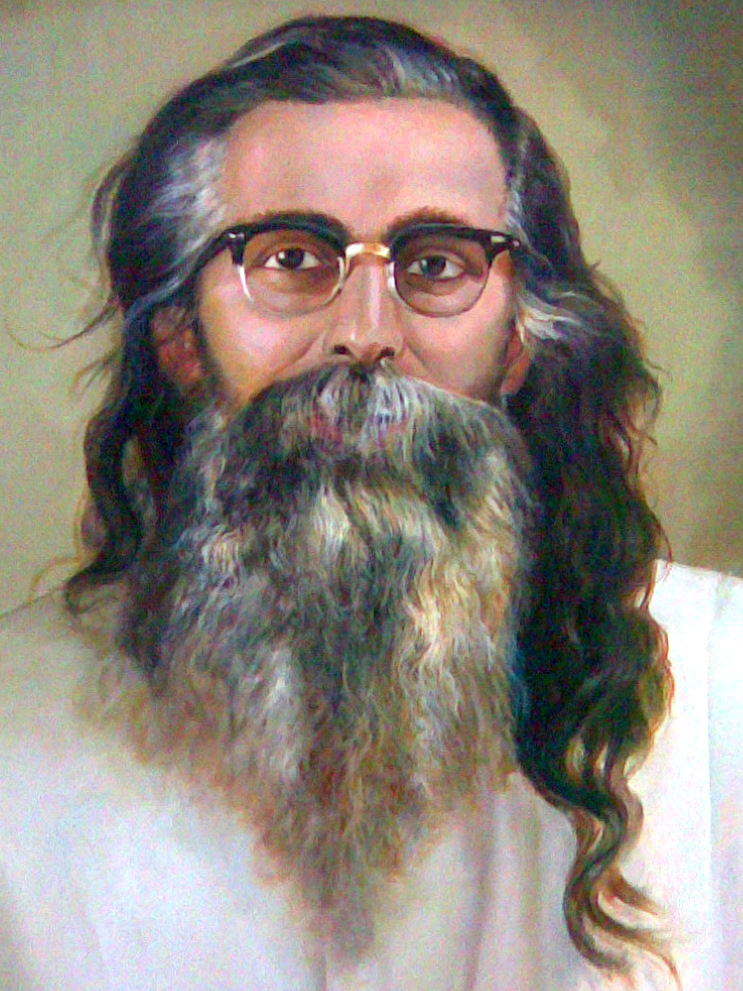 |
| Guru Golwalkar (Image Courtesy Image003.jpg) |
Writing on why Western nations marched towards secularism Golwalkar is pretty unerring, “for the general, Race it was considered profitable to assume a more tolerant attitude towards the various sects and religious persuasions, and leave the individual to choose whichever he liked, provided only, he did not, in following his beliefs, becomes a nuisance to his neighbors. To ban religion altogether from all public and political life is but one step forward and a natural one”.
Anyone who has followed the debates concerning the place of religion in public spheres in today’s America will realize that Golwalkar’s only mistake was in assuming that the journey was unidirectional and would not slide back and forth. That said, Golwalkar’s desire of intertwining religion and politics hews closer to Gandhi and William Buckley and MLK Jr. William F. Buckley Jr, author of ‘God and man at Yale’, would’ve loved Golwalkar.
Buckley while graciously allowing that he did not want his alma mater, Yale university, to “treat her students as potential candidates for divinity school”, he asked pointedly “we can, without going that far, raise the question whether Yale fortifies or shatters the average student’s respect for Christianity”. One could hear a Hindtutva supporter cluck his tongue thinking of Indian academia similarly.
On Communism and Russia Golwalkar in unsparing prose nails it:
“To most, religion means a set of opinions to be dogmatically followed, for the good of the individual and of the society and for the attainment of God. Here we have a religion which does not believe in God. It is a Godless religion but a religion none the less. For the Russians, their prophet is Karl Marx and his opinions are their Testament.”
During the Great War Stalin forsook Communist orthodoxy against Nationalism and eagerly stoked a muscular Russian nationalism to rouse the masses against the invaders in a moment of existential threat. Golwalkar wrote “we rest satisfied with pointing out that Russia has its country, race, its materialistic godless religion, with its resultant culture and its language and stands out before the world a Nation in its complete Nationhood, shorn of its borrowed feathers of Internationalism.” Churchill would’ve agreed.
Arguing that secularism should mean equal treatment of all with no quarter for any preferential treatment to anyone Golwalkar wrote:
“In secular life all citizens are equal; this principle should be strictly adhered to. We must cry a complete halt to forming groups based on caste, creed, etc., and demanding exclusive rights and privileges in services, financial aids, admission in educational institutions and all such other fields. To talk and think in terms of "minorities" and "communities" should be totally put an end to”.
Samuel Huntington was indignant that Civil Rights leaders who demanded a Civil Rights Act to enshrine equality then turned around and used the very act to demand preferential quotas. Even black economist and intellectual Thomas Sowell has made the same argument. While Golwalkar presaged Huntington’s indignation both suffer from the same blindness that ‘equal opportunity’ and ‘positive discrimination’ are not antithetical and opposing goals and communities that had long suffered discrimination needed a helping hand before being able to compete on equal footing. However, the idea here is to only point out that an impartial reader can find many mainstream ideas in Golwalkar’s writings that have nothing to do with Nazism or Fascism.
Golwalkar was a patriot and a nationalist in the Bismarckian mould and could brook nothing that sowed the seeds of dissension and encouraged separatism. Though he always refers to Sanskrit as language of Gods he chides those who ridicule languages spoken by other Hindus in other parts of India. “In fact all our languages whether Tamil or Bengali, Marathi or Punjabi are our national languages. All these languages and dialects are like so many flowers shedding the same rich fragrance of our national culture”. He did think, though, that all languages were inspired by the “queen of languages, the language of gods-Sanskrit”. Golwalkar’s attitude to language is very close to the official position of Congress which was promoting the use of ‘Hindustani’, a hybrid of Hindi and Urdu, as a unifying language while local languages like Tamil are used locally.
Ambedkar and Gandhi are not too far apart from Golwalkar on the issue of conversions. Ambedkar in a stinging observation said “what the consequences of conversion will be to the country as a whole is worth bearing in mind. Conversion to Islam or Christianity will denationalize the Depressed classes…if they embrace Sikhism they will not only not harm destiny of the country but they will help the destiny of the country. They will not be denationalized…Thus it is in the interest of the country that the Depressed Classes, of they are to change their faith, should go over to Sikhism”. True to his word when he did convert himself and legions of followers Ambedkar, much to the delight of generations of Hindutva followers, chose Buddhism over Christianity or Islam.
Here’s Golwalkar:
“Conversion of Hindus into other religions is nothing but making them succumb to divided loyalty in place of having undivided and absolute loyalty to the nation. It is dangerous to the security of the nation and the country. It is therefore necessary to put a stop to it. Conversion of an individual does not take place after a serious and comparative study of philosophies by him. It is by exploitation of poverty, illiteracy and ignorance, offering of inducements and by deceptive tactics that people are converted. There is no question of a true change of heart involved in this. It is but right that this unjust activity is prohibited. It is a duty we have to discharge towards protecting our brethren in ignorance and poverty.”
Gandhi conceded the good work of Christian missionaries but asked, quite fairly it must be said, “even such noble service loses nobility when conversion is the motive behind it. That service is noblest which is rendered for its own sake”. Ambedkar retorted that Gandhi wanted to get services from Christian missionaries without giving anything in return. Golwalkar in one of his writings indignantly cites a Christian missionary in North East as saying that all charity work is with a motivation to convert and increase the number of Christians in India. While the charge and anger is not without merit the controversies surrounding conversions are more complicated.
Question of nationalism:
“There is one point more which has been troubling me very much of late and one which I want you to think carefully and that is the question of Hindu-Mohamedan unity. I have devoted most of my time during the last six months to the study of Muslim history and Muslim Law and I am inclined to think, it is neither possible nor practicable. Assuming and admitting the sincerity of the Mohamedan leaders in the Non-cooperation movement, I think their religion provides an effective bar to anything of the kind.”
THAT was not Golwalkar but Lala Lajpat Rai in a letter to firebrand revolutionary C.R. Das
“Another very important factor which, according to the poet, was making it almost impossible for the Hindu-Mohamedan unity to become an accomplished fact was that the Mohamedans could not confine their patriotism to any one country. . . .The poet said that he had very frankly asked many Mohamedans whether, in the event of any Mohamedan power invading India, they would stand side by side with their Hindu neighbours to defend their common land. He could not be satisfied with the reply he got from them”
THE poet referred was not Golwalkar but Rabindranath Tagore.
The quotes are from Ambedkar’s ‘Thoughts on Pakistan’ in a section titled “Can Hindus count on Muslims to show national rather than religious loyalty?”
“What is that 'common emotion', that common basis on which all can come together?” asks Golwalkar. Arguing that a Hindu’s view of Hindu-Muslim unity is ‘hallucination’ Ambedkar writes, “Are there any common historical antecedents which the Hindus and Muslims can be said to share together as matters of pride or as matters of sorrow? That is the crux of the question. That is the question which the Hindus must answer, if they wish to maintain that Hindus and Musalmans together form a nation. So far as this aspect of their relationship is concerned, they have been just two armed battalions warring against each other. There was no common cycle of participation for a common achievement. Their past is a past of mutual destruction—a past of mutual animosities, both in the political as well as in the religious fields.”
Golwalkar and Caste:
“Today, of course, the caste system has degenerated beyond all recognition. Added to the perversity aggravated over the centuries, a new factor has been introduced into our body- politic which has further intensified the rigidity and perversity of castes by those very persons who are most vociferous in their denunciation of the system. During elections, their consideration for selection of candidates as also their appeal to the voters is mainly 'caste'. At the root of the rising tempo of caste hatred and rivalry lies this appeal to gross selfishness and love of power in the name of caste. Even the state machinery is being prostituted for further widening these dissensions. Separatist consciousness breeding jealousy and conflict is being fostered in sections of our people by naming them Harijans, Scheduled Castes, Scheduled Tribes and so on and by parading the gift of special concessions to them in a bid to make them all their slaves with the lure of money.”
Of course Golwalkar was not being magnanimous out of a milk of kindness. Ambedkar dissembles this desire for unity amongst Hindus and points to the real cause. The purpose of this blog today is not to rebut Golwalkar but to show how close to the mainstream he was. A rebuttal will follow soon.
Golwalkar and the Nazi Regime:
“The other Nation most in the eye of the world today is Germany. This Nation affords a very striking example. Modern Germany strove, and has to a great extent achieved what she strove for, to once again bring under one sway the whole of the territory, hereditarily Possessed by the Germans but which, as a result of political disputes, had been portioned off as different countries under different states. Austria for example, was merely a province, on par with Prussia, Bavaria and other principalities, which made the Germanic Empire. Logically Austria should not be an independant kingdom, but be one with the rest of Germany.”Koenraad Elst, a Hindutva ideologue, in a column that largely whitewashes Golwalkar’s demagoguery points out, quite correctly, that Golwalkar only talks of the nation of ‘Germany’ and not of Nazism or Hitler. Elst is indeed correct in saying that Adolf Hitler was admired by many Indians when Golwalkar wrote that passage. Let us not forget that Subhash Bose actually allied with Germany and shook hands with Hitler.
Golwalkar proceeded to add,
“Germany shocked the world by her purging the country of the Semitic Races—the Jews. Race pride at its highest has been manifested here. Germany has also shown how well-nigh impossible it is for Races and cultures, having differences going to the root, to be assimilated into one united whole, a good lesson for us in Hindusthan to learn and profit by.”The passage is being wildly misinterpreted to suggest that he was prescribing a Nazi like racial purge. He was, merely using an extreme example to point out the incompatibility of two diverse “races”, like Tagore and Ambedkar, to cohabit in comity. Golwalkar’s use of the word ‘race’ is another hot topic but suffice it to say he was using it to denote two culturally different groups.
Elst is an apologist for Golwalkar seeking to minimize the awareness of Golwalkar of the nature of the Nazi regime and his attitudes towards the minorities.
Golwalkar and Israel:
Savarkar, too, while pointing out that Jews and Germans could not live together supported Zionism. Writing as early as 1923 Savarkar said “if the Zionists’ dreams were realised, if Palestine became a Jewish State, it would gladden us almost as much as our Jewish friends”. Koenraad Elst helpfully notes that Hindutva should draw inspiration from Zionism.
Like many other positions of Hindutva this love for Zionism and Israel had nothing to do with rejoicing at Jews getting a homeland but a sheer joy at ideological vindication in the nation of Israel. That Israel was established amidst Islamic opposition was further cause for cheer. Even with all that the love for Israel is fraught with contradictions that I’ll outline subsequently.
Moonje and Mussolini:
“Nothing better could have been conceived for the military organisation of Italy...The idea of fascism vividly brings out the conception of unity amongst people...India and par- ticularly Hindu India need some such institution for the military regeneration of the Hindus: so that the artificial distinction so much emphasised by the British of martial and non-martial classes amongst the Hindus may disappear. Our institution of Rashtriya Swayamsewak Sangh of Nagpur under Dr Hedgewar is of this kind, though quite independently conceived.”
Sure, Moonje admired Mussolini and fascism as is evident from the quote but the motivation is driven by less nefarious factors than is often recognized. The British Raj classified some sects of Hindus as “martial classes” and provided them better opportunities to serve in the army whereas all others were deemed unsuitable, hereditarily, to belong to the ‘martial classes’. Moonje’s desire of militarization is to obliterate this artificial division and rejuvenate a warrior attitude to overthrow the colonial yoke. Until Gandhi came such attitudes were common and despite Gandhi there was always a streak of violent revolution in India. Again, let us remember the example of much lionized Subhash Bose who colluded with Germany and Japan, two of the most repugnant regimes at that time, in an attempt to liberate India by war.
The admiration of fascism as being an ideology that welded a nation together and forged unity appealed to Moonje. This too was not out of the ordinary and is less a ringing endorsement of everything that the word Fascism as defined by Mussolini meant.
Conclusion:
Golwalkar and the Hindutva ideas were suffused with contradictions and can easily be rebutted. I’ve in this blog only tried to show that Golwalkar was not out of the mainstream in many aspects. We’ve to contextualize his views, repugnant or not, with the turbulent times when notions of diversity and secularism were quaint or non-existent. I remain a staunch opponent of Hindtuva and I’ll rebut most of these ideas in a soon to follow blog.The Sangh Parivar has recently started to distance itself from Golwalkar’s ‘We or our nationhood’ by arguing that it is the product of a young mind, he was 32 years old at that time, and that his later writings show nuance and maturity. Is it true? Await the next blog for rebuttals and more.


