The Guinness record for the largest funeral belongs to Tamil Nadu's C.N. Annathurai. An estimated 15 million, according to Guinness, attended the funeral. Annathurai died barely two years after a historic upset election that saw the first non-Congress government come to power in Tamil Nadu. A state enthralled by his charismatic persona thronged by the thousands to mourn him. Amongst the many, many eulogies and obituaries one eulogy stood out. Addressing a 'gathering' of mourners at a function held to commemorate the departed leader Jeyakanthan, then a fire brand writer and staunch opponent of everything Annathurai espoused, breathed fire and brimstone ripping into the legacy of a man just dead and mourned by thousands. In a culture where anything critical about a dead person, especially public person, is frowned upon what Jeyakanthan did remains unparalleled for intellectual integrity and sheer courage to speak truth, at least the truth as he saw it. The speech itself is shining prose of how a person sets the stage for what he knows will shock the decency of many.
Jeyakanthan differentiates the 'gathering' in front of him from the 'mob' that milled at Annathurai's funeral procession. Then he explains the necessity to speak truths given that the person who died was not a private person but a public person who had left his imprint on a people's mind. Bristling at the moniker of 'learned person' applied to Annathurai by his fawning admirers Jeyakanthan said "only a fool would call him learned and only a greater fool would call him 'greatly learned'". In 2014 it is difficult to imagine the gumption it took a man to say that on a stage in 1969. Yet, the same Jeyakanthan had a different scale when it was his beloved Communist leader Jeeva. In his memoirs he records how he felt hearing that Jeeva passed away. "Some other day I shall think of his faults and shortcomings today I am only reminded of his raucous laughter typical of a Nagercoil native".
Indians do not just subscribe to 'speak nothing but good of the departed' ('de mortuis nil nisi bonum') but extend it to beatification of the dead for having simply died. When yesteryear Tamil playback singing legend T.M. Sounderarajan died many bemoaned 'the passing away of music'. It had been many decades since T.M.S, as he was popularly called, sang in movies after a much younger S.P.B overtook him and enchanted Tamil movie goers for decades until, in due course, other singers overtook SPB. Lost in the din of commemorating TMS was any criticism of how he sang or the person he was. The vexing question is "cannot criticism await another day?"
Oscar winning screen writer Aaron Sorkin in his eulogy for fellow awardee Seymour Hoffman bluntly noted that Hoffman "did not die of an overdose of heroin- he died from heroin". The recent tragic suicide of much loved actor Robin Williams brought out a whole discussion of depression as a clinical subject. Criticism is a very negative sounding word I should replace it with better sounding 'wholesome appreciation' when used in the context of obituaries.
Tamil writer Jeyamohan had reviewed T.J.S. George's biography of M.S. Subbulakshmi drawing attention to the fact that MS was born to a woman who was 'betrothed to the Gods' (a custom that reeked of prostitution in not too ancient Tamil Nadu Hindu temples), fell in love with a fellow singer and actor and later became a mistress to a married man. Jeyamohan received more than his usual share of brickbats for stating facts. MS's eventful life intertwined with the caste and gender politics of her profession, the era she lived in and the orthodox Brahminism that she wrapped herself with, if she had lived a counterpart life in America, an American newspaper would have celebrated as an "American story of success" but in India all that was muted and meant to be hushed into perpetual silence with the admonition "is all that relevant? We need not know any of that. We only need to celebrate her music and her achievements".
What meaning does 'celebrate achievements' have if we ignore a person's life story? The personal trials and tribulations accentuate, not diminish, one's achievements. Not knowing about Beethoven's deafness or Mozart's poverty or the indigent circumstances of Bharathi or the homosexuality of Da Vinci or the ambiguous sexuality of Walt Whitman or that Andrea Bocelli is congenitally blind will detract how we appreciate their works. Gandhi's Brahmacharya experiments are an essential part of his story as is Nehru's many loves. A senior writer justified the grotesque experiments of Gandhi as those belonging to a 'man of his times'. Bunkum. Another writer justified it as being in the tradition of India's spiritual heritage. More bunkum. Only when we face it for what it was, a man's obsession with curbing a natural impulse, would we see more of its ramifications in his other acts.
The Economist magazine notes in its obituary for Yehudi Menuhin that Tony Palmer, who made a film biography of Menuhin, was an admirer of Menuhin's recording of a concerto by Elgar because "the 16 year old could get inside that troubled music simply because his own suffering had been immense". Einstein, as was his wont, heard a performance of Menuhin and remarked "now I know there is a God in heaven". If Bohr had been near him he'd have repeated the old admonition of not to bring God into everything.Alas, Srinivas is ill-served by the absence of a Tony Palmer and an obituary like that of The Economist's.
Is an obituary the place to talk of a person's warts? Yes. And, yes. Emphatically, yes. For a public person, especially political and religious leaders, the myth making starts at death. Lenin, Gandhi, Annathurai and even Pope John Paul II went through such a myth making. In the case of Lenin and Annthurai it was done by their putative successors for political reasons. Such myth making is less for artists and creators.
Mandolin Srinivas burst into the music scene, that too into the staid and famously fossilized Carnatic music establishment, as a prodigy wielding a western instrument that was little known to many. Srinivas, tragically, passed away at a young age of 45 last week. Obituaries and eulogies have been pouring in ever since.
Most obituaries recited, in wikipedia fashion, his early rise to stardom as prodigy (many obituaries had the phrase 'child prodigy'. 'Prodigy' is a word used to denote precocious achievement by a child. It is seldom applied to grown men and hence saying 'child prodigy' is an inelegant use of the word prodigy), a list of awards he won and select quotes from music fraternity, duly expressing shock at his sudden death. A few obituaries noted towards the end that he had gone through a tortuous divorce proceeding wherein his wife had dragged him all the way to the Supreme Court. Granting divorce to Srinivas the court noted he was treated 'cruelly' by his wife for having dragged the case, but the court nevertheless granted custody of his son to his wife. The man, who became a star as a toddler and lived unto 45, sadly, remains unknown beneath the superficial details.
Partly we have to blame the eastern habit of reticence. Wordsworth's sister made meticulous notes of how and when Wordsworth wrote his poems whereas Tamils, as I often say, know next to nothing of Bharathi's moods when he wrote his poems. The one Indian who stands as a glorious exception is Jawaharlal Nehru but then in reality he remained a westerner. Indians also lack a sense of history. This could be due to Indian intellectual heritage.
Many of my friends, some namesake and some really friends, were angry with me for suggesting that Indians don't know how to write obituaries.
Of all the obituaries published when Khushwant Singh died the best was by New York Times which sketched out his varied life and his many contributions much better than any Indian newspaper had done. I had then lamented in Facebook that a Tamil writer and another blogger had presented Khushwant Singh as nothing more than a lecherous dirty Sardar.
Explaining why genius happens is the most elusive and frustrating exercise in writing about a person like Ramanujan or Mandolin Srinivas. Many including singer T.M. Krishna referred to Srinivas's prodigy as 'god's gift'. A typically Indian attitude that assigns providence as cause for anything that cannot be satisfactorily explained and for making it sound better even when explanations exist for an outlier phenomenon like Srinivas. Krishna and other Facebook posters are in good company with Sarvepalli Radhakrishnan who wrote that the genius of Mozart can only be explained as accumulated intelligence over several births.
Yehudi Menuhin played at Carnegie Hall when he was 11. Menuhin then had a stellar career as violinist, conductor, author and TV presenter of a documentary on music. New York Times obituary of Menuhin is a pleasure to read and gives a glimpse of the man who lived life at many levels. The obituary mentions how a biographer traced some of Menuhin's problems as 'psychological' effect of growing under over protective parents, 'particularly his mother'. Criticisms of Menuhin's technique, his politics, how his politics affected his art are all unflinchingly presented as part of a tapestry of a varied life. The obituary, written in 1999, in an age when Wikipedia did not exist, gives a flavor of the man beyond just the headlines and convenient cliches. Oh and one more thing, no mention of his talent being God's gift.
My objection to the cliche 'God's gift' is not out of any atheistic impulse. Far from it I feel it detracts what the artist achieved with conscious effort. Mozart, as Malcolm Gladwell point out in his book 'Outlier', spent hundreds of hours practicing. To write Figaro Mozart insisted on having Beaumarchais as the librettist. Beethoven was well tutored by Haydn and he read widely like a scholar. Srinivas, had his father as guru. In all probability Srinivas's father was not unlike Mozart's much criticized father.
A much circulated eulogy on Facebook said that Srinivas, the evening that he performed what the poster best remembers, was a conduit for a mystical force that used the artist to express itself as a raga. Nothing could be a greater insult to an artist. The Facebook poster is in good company with Jeyamohan who often says that he rarely knows what he writes and that when all is completely typed out the material appears anew to him as much as it does to the reader. Understanding and explaining the process of creativity is not the preserve of even the creator. Years of learning and practice go into what a creator or an audience thinks of as serendipitous apogee of creation. Again, no western reviewer would call a Menuhin performance or a Lang Lang performance as 'serendipitous'. As Kipling ably put it, 'the west is west and the east is east, never the twain shall meet'.
T.M. Krishna, thinking that he was paying the highest encomium, wrote in his eulogy "more than the wonder boy Shrinivas, it is the seeker of music who emerged that we are indebted to. Seeker, not of the intellectual kind, but one who wanted his instrument to say all that needed to be said. He sought Carnatic form and sound, all non-literal ideas that can only be sensed".
That insult, by T.M.Krishna, ensured that I could not read his eulogy beyond that sentence. If creativity is accidental and unintellectual where is the credit for a genius like Srinivas? In fact why give Srinivas any credit at all? As an Ayn Rand reader I cannot help puke that an artistic high point and creative process is 'unintellectual'. As Ayn Rand would argue the instrument, a contraption of metal, has no mind of its own to express anything save what the artist chooses, by a volitional act governed by the mind. The word 'instrument' means it has no free will. A mandolin in my hands will produce only noise. 'Non-literal ideas that can only be sensed'. What does that mean? The word 'idea' means a mental construct and senses are but channels to the mind which then performs the necessary act of interpreting the sensory input. Sentences like that are conjured to give a sheen of mysticism but in reality are not only non-sensical but patently idiotic. To be fair to Krishna, his oped was the only one that probably even briefly spoke of some valid criticism about Srinivas's techniques.
My objections to such obituaries and eulogies is seen as caviling. I only feel that a life like that of Srinivas's deserves better than such mediocre as tributes.
Srinivas's death due to a failed liver transplant became a much talked about controversy. Many, including me, surmised it must have been due to alcoholism, a much prevalent and dreadful habit amongst his fellow musicians. Several obituaries later made it a point to include that Srinivas's did not have any unhealthy habit. One obituary alluded to Srinivas being saddened by the demise of Sai Baba in 2011. His long drawn out divorce proceeding concluded in 2012.
A friend and another person took great exception to my Facebook post that alluded, with a caveat that it was based on hearsay, to alcoholism. First, Srinivas is a public person and a tragic sudden death is inevitable to raise questions. That is, to be blunt, the price of fame. Almost to a person many conceded that they too thought so. We should also note that the current objections also, equally, rest on hearsay. Unlike US post-mortem reports, of deaths of public persona, as in the case of Michael Jackson or Seymour Hoffman or Robin Williams, are not made public. Many would ask indignantly "Why is that required? Who cares?" As I said before a life should be celebrated warts and all, not selectively. Seymour Hoffman's death brought attention to heroin overdose as cause of death and has been a factor in now police being required to carry anti-dotes. Robin Williams's death due to depression re-ignited a national discussion on depression. One Tamil doctor now, in a puzzling recommendation, wants all to include an MRI for liver as part of annual checkup to detect liver infections that Srinivas supposedly ignored until his fatal end.
I wonder how many obituaries of violin virtuoso Kunnakudi Vaithyanathan mentioned his obnoxious habit of performing while inebriated? Ray Charles's drug addiction, Johnny Cash's alcoholism, James Brown's tumultuous personal life are all relevant in understanding complex lives.
One should not, however, make the mistake of assuming that Indians turn a blind eye to failures and cherish only memories of a person that are edifying. Rumors concerning sex lives are constant grist for rumor mills. While biographies, especially of political leaders, tend to glide over peccadilloes of the netas the rumors continue to live. When M.J. Akbar wrote of Nehru's peccadilloes with Edwina and Padmaja Naidu in his biography the salacious portions were duly excerpted as published as samples in magazines. A malicious rumor till this day about Nehru is that he died of syphilis. Annathurai, asked about his dalliance with an actress, famously said 'neither is she a chaste woman and nor am I a saint who renounced all'. It is a remark that lives in the grape vine but winked upon in biographies.
Deferring to a tradition of praising the departed, that too one who had been a prodigy, many eulogies lamented an irreparable loss. While Srinivas earned his place as a virtuoso and for making mandolin accepted as a mainstream instrument in Carnatic performance I don't think a proper appreciation of his place has taken place. Mandolin still remains an instrument of the minority and it will forever be associated as a novelty brought about by Srinivas. Thanks to having lived in the modern age of recording Srinivas's recordings may still be ought by aficionados but what is his place beyond that in a field crowded by titans who, blessed by longevity, probably have had a chance to make really lasting history. On that score posterity will be truth teller.
The arguments that went back and forth on what an obituary should be, the place and time for a wholesome view of a person etc have left me feeling, once more, how removed I've become, by choice, from my native land. I've no regrets on that score. For the record, I do wish that Srinivas had lived longer, at least for the sake of his legions of admirers.
References:
1. NYT's obituary for Yehudi Menuhin http://www.nytimes.com/1999/03/13/arts/sir-yehudi-menuhin-violinist-conductor-and-supporter-of-charities-is-dead-at-82.html?src=pm&pagewanted=1
2. NYT's obituary for Leonard Bernstein http://www.nytimes.com/learning/general/onthisday/bday/0825.html
3. NYT's obituary for James Brown http://www.nytimes.com/2006/12/25/arts/music/25cnd-brown.html?pagewanted=all&_r=0
4. Economist magazine's obituary for Yehudi Menuhin http://www.economist.com/node/320022
5. C.N. Annathurai funeral record http://en.wikipedia.org/wiki/List_of_funerals#cite_note-14
6. Jeyakanthan's speech at a function to commemorate Annathurai http://idlyvadai.blogspot.com/2009/09/blog-post_2410.html
7. The Hindu obituary for Srinivas http://www.thehindu.com/news/national/mandolin-shrinivas-the-child-prodigy-is-no-more/article6426324.ece
8. Hindustan Times obituary http://www.hindustantimes.com/lifestyle/art/celebrated-mandolin-exponent-u-srinivas-passes-away/article1-1265899.aspx
9. T.M. Krishna's eulogy http://indianexpress.com/article/india/india-others/the-musician-who-never-spoke-but-we-all-listened-to/
10. Mandolin Srinivas http://en.wikipedia.org/wiki/U._Srinivas
Jeyakanthan differentiates the 'gathering' in front of him from the 'mob' that milled at Annathurai's funeral procession. Then he explains the necessity to speak truths given that the person who died was not a private person but a public person who had left his imprint on a people's mind. Bristling at the moniker of 'learned person' applied to Annathurai by his fawning admirers Jeyakanthan said "only a fool would call him learned and only a greater fool would call him 'greatly learned'". In 2014 it is difficult to imagine the gumption it took a man to say that on a stage in 1969. Yet, the same Jeyakanthan had a different scale when it was his beloved Communist leader Jeeva. In his memoirs he records how he felt hearing that Jeeva passed away. "Some other day I shall think of his faults and shortcomings today I am only reminded of his raucous laughter typical of a Nagercoil native".
Indians do not just subscribe to 'speak nothing but good of the departed' ('de mortuis nil nisi bonum') but extend it to beatification of the dead for having simply died. When yesteryear Tamil playback singing legend T.M. Sounderarajan died many bemoaned 'the passing away of music'. It had been many decades since T.M.S, as he was popularly called, sang in movies after a much younger S.P.B overtook him and enchanted Tamil movie goers for decades until, in due course, other singers overtook SPB. Lost in the din of commemorating TMS was any criticism of how he sang or the person he was. The vexing question is "cannot criticism await another day?"
Oscar winning screen writer Aaron Sorkin in his eulogy for fellow awardee Seymour Hoffman bluntly noted that Hoffman "did not die of an overdose of heroin- he died from heroin". The recent tragic suicide of much loved actor Robin Williams brought out a whole discussion of depression as a clinical subject. Criticism is a very negative sounding word I should replace it with better sounding 'wholesome appreciation' when used in the context of obituaries.
Tamil writer Jeyamohan had reviewed T.J.S. George's biography of M.S. Subbulakshmi drawing attention to the fact that MS was born to a woman who was 'betrothed to the Gods' (a custom that reeked of prostitution in not too ancient Tamil Nadu Hindu temples), fell in love with a fellow singer and actor and later became a mistress to a married man. Jeyamohan received more than his usual share of brickbats for stating facts. MS's eventful life intertwined with the caste and gender politics of her profession, the era she lived in and the orthodox Brahminism that she wrapped herself with, if she had lived a counterpart life in America, an American newspaper would have celebrated as an "American story of success" but in India all that was muted and meant to be hushed into perpetual silence with the admonition "is all that relevant? We need not know any of that. We only need to celebrate her music and her achievements".
What meaning does 'celebrate achievements' have if we ignore a person's life story? The personal trials and tribulations accentuate, not diminish, one's achievements. Not knowing about Beethoven's deafness or Mozart's poverty or the indigent circumstances of Bharathi or the homosexuality of Da Vinci or the ambiguous sexuality of Walt Whitman or that Andrea Bocelli is congenitally blind will detract how we appreciate their works. Gandhi's Brahmacharya experiments are an essential part of his story as is Nehru's many loves. A senior writer justified the grotesque experiments of Gandhi as those belonging to a 'man of his times'. Bunkum. Another writer justified it as being in the tradition of India's spiritual heritage. More bunkum. Only when we face it for what it was, a man's obsession with curbing a natural impulse, would we see more of its ramifications in his other acts.
The Economist magazine notes in its obituary for Yehudi Menuhin that Tony Palmer, who made a film biography of Menuhin, was an admirer of Menuhin's recording of a concerto by Elgar because "the 16 year old could get inside that troubled music simply because his own suffering had been immense". Einstein, as was his wont, heard a performance of Menuhin and remarked "now I know there is a God in heaven". If Bohr had been near him he'd have repeated the old admonition of not to bring God into everything.Alas, Srinivas is ill-served by the absence of a Tony Palmer and an obituary like that of The Economist's.
Is an obituary the place to talk of a person's warts? Yes. And, yes. Emphatically, yes. For a public person, especially political and religious leaders, the myth making starts at death. Lenin, Gandhi, Annathurai and even Pope John Paul II went through such a myth making. In the case of Lenin and Annthurai it was done by their putative successors for political reasons. Such myth making is less for artists and creators.
Mandolin Srinivas burst into the music scene, that too into the staid and famously fossilized Carnatic music establishment, as a prodigy wielding a western instrument that was little known to many. Srinivas, tragically, passed away at a young age of 45 last week. Obituaries and eulogies have been pouring in ever since.
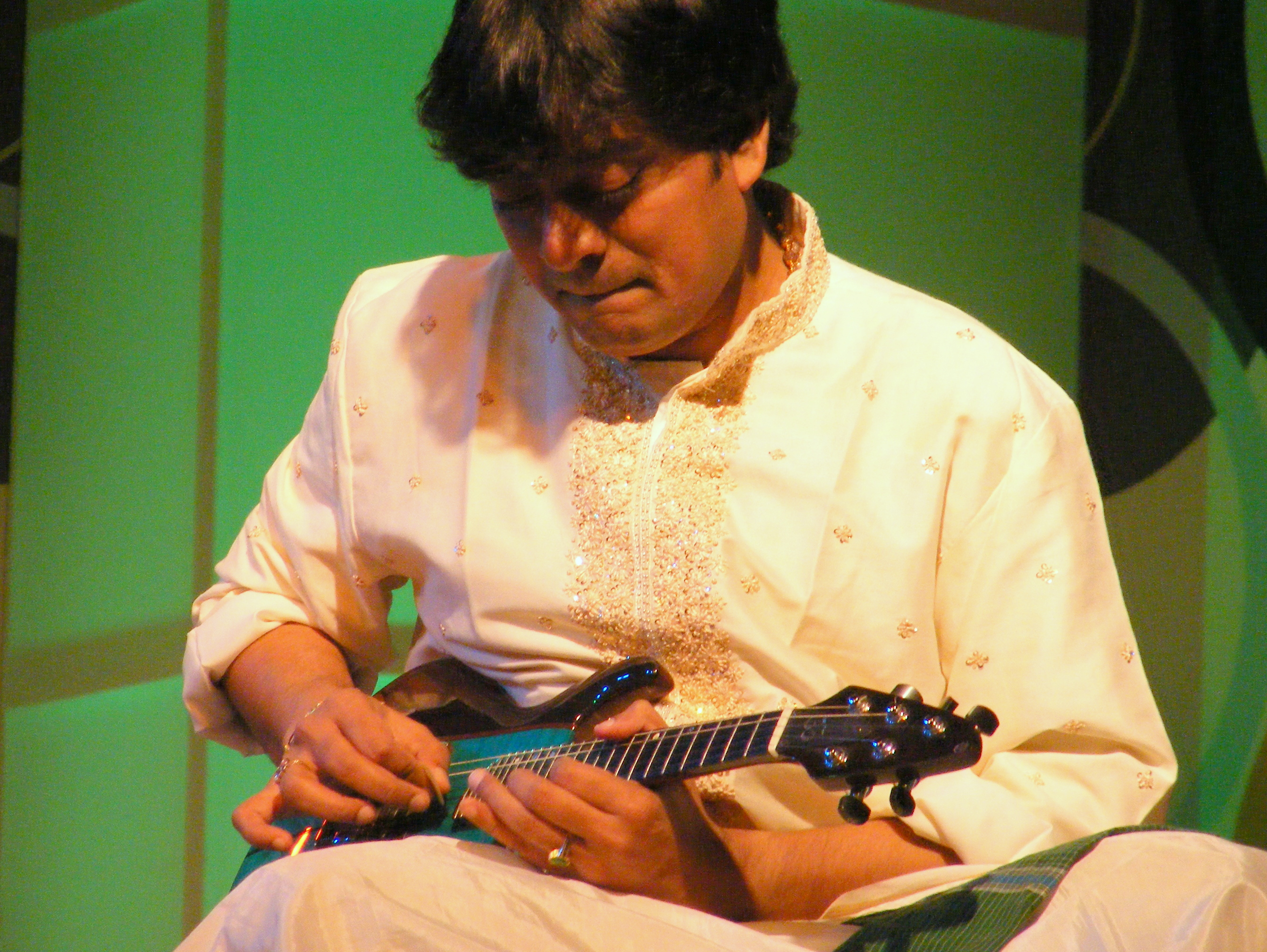 |
| Mandolin Srinivas - Courtesy Wikipedia |
Partly we have to blame the eastern habit of reticence. Wordsworth's sister made meticulous notes of how and when Wordsworth wrote his poems whereas Tamils, as I often say, know next to nothing of Bharathi's moods when he wrote his poems. The one Indian who stands as a glorious exception is Jawaharlal Nehru but then in reality he remained a westerner. Indians also lack a sense of history. This could be due to Indian intellectual heritage.
Many of my friends, some namesake and some really friends, were angry with me for suggesting that Indians don't know how to write obituaries.
Of all the obituaries published when Khushwant Singh died the best was by New York Times which sketched out his varied life and his many contributions much better than any Indian newspaper had done. I had then lamented in Facebook that a Tamil writer and another blogger had presented Khushwant Singh as nothing more than a lecherous dirty Sardar.
Explaining why genius happens is the most elusive and frustrating exercise in writing about a person like Ramanujan or Mandolin Srinivas. Many including singer T.M. Krishna referred to Srinivas's prodigy as 'god's gift'. A typically Indian attitude that assigns providence as cause for anything that cannot be satisfactorily explained and for making it sound better even when explanations exist for an outlier phenomenon like Srinivas. Krishna and other Facebook posters are in good company with Sarvepalli Radhakrishnan who wrote that the genius of Mozart can only be explained as accumulated intelligence over several births.
Yehudi Menuhin played at Carnegie Hall when he was 11. Menuhin then had a stellar career as violinist, conductor, author and TV presenter of a documentary on music. New York Times obituary of Menuhin is a pleasure to read and gives a glimpse of the man who lived life at many levels. The obituary mentions how a biographer traced some of Menuhin's problems as 'psychological' effect of growing under over protective parents, 'particularly his mother'. Criticisms of Menuhin's technique, his politics, how his politics affected his art are all unflinchingly presented as part of a tapestry of a varied life. The obituary, written in 1999, in an age when Wikipedia did not exist, gives a flavor of the man beyond just the headlines and convenient cliches. Oh and one more thing, no mention of his talent being God's gift.
My objection to the cliche 'God's gift' is not out of any atheistic impulse. Far from it I feel it detracts what the artist achieved with conscious effort. Mozart, as Malcolm Gladwell point out in his book 'Outlier', spent hundreds of hours practicing. To write Figaro Mozart insisted on having Beaumarchais as the librettist. Beethoven was well tutored by Haydn and he read widely like a scholar. Srinivas, had his father as guru. In all probability Srinivas's father was not unlike Mozart's much criticized father.
A much circulated eulogy on Facebook said that Srinivas, the evening that he performed what the poster best remembers, was a conduit for a mystical force that used the artist to express itself as a raga. Nothing could be a greater insult to an artist. The Facebook poster is in good company with Jeyamohan who often says that he rarely knows what he writes and that when all is completely typed out the material appears anew to him as much as it does to the reader. Understanding and explaining the process of creativity is not the preserve of even the creator. Years of learning and practice go into what a creator or an audience thinks of as serendipitous apogee of creation. Again, no western reviewer would call a Menuhin performance or a Lang Lang performance as 'serendipitous'. As Kipling ably put it, 'the west is west and the east is east, never the twain shall meet'.
T.M. Krishna, thinking that he was paying the highest encomium, wrote in his eulogy "more than the wonder boy Shrinivas, it is the seeker of music who emerged that we are indebted to. Seeker, not of the intellectual kind, but one who wanted his instrument to say all that needed to be said. He sought Carnatic form and sound, all non-literal ideas that can only be sensed".
That insult, by T.M.Krishna, ensured that I could not read his eulogy beyond that sentence. If creativity is accidental and unintellectual where is the credit for a genius like Srinivas? In fact why give Srinivas any credit at all? As an Ayn Rand reader I cannot help puke that an artistic high point and creative process is 'unintellectual'. As Ayn Rand would argue the instrument, a contraption of metal, has no mind of its own to express anything save what the artist chooses, by a volitional act governed by the mind. The word 'instrument' means it has no free will. A mandolin in my hands will produce only noise. 'Non-literal ideas that can only be sensed'. What does that mean? The word 'idea' means a mental construct and senses are but channels to the mind which then performs the necessary act of interpreting the sensory input. Sentences like that are conjured to give a sheen of mysticism but in reality are not only non-sensical but patently idiotic. To be fair to Krishna, his oped was the only one that probably even briefly spoke of some valid criticism about Srinivas's techniques.
My objections to such obituaries and eulogies is seen as caviling. I only feel that a life like that of Srinivas's deserves better than such mediocre as tributes.
Srinivas's death due to a failed liver transplant became a much talked about controversy. Many, including me, surmised it must have been due to alcoholism, a much prevalent and dreadful habit amongst his fellow musicians. Several obituaries later made it a point to include that Srinivas's did not have any unhealthy habit. One obituary alluded to Srinivas being saddened by the demise of Sai Baba in 2011. His long drawn out divorce proceeding concluded in 2012.
A friend and another person took great exception to my Facebook post that alluded, with a caveat that it was based on hearsay, to alcoholism. First, Srinivas is a public person and a tragic sudden death is inevitable to raise questions. That is, to be blunt, the price of fame. Almost to a person many conceded that they too thought so. We should also note that the current objections also, equally, rest on hearsay. Unlike US post-mortem reports, of deaths of public persona, as in the case of Michael Jackson or Seymour Hoffman or Robin Williams, are not made public. Many would ask indignantly "Why is that required? Who cares?" As I said before a life should be celebrated warts and all, not selectively. Seymour Hoffman's death brought attention to heroin overdose as cause of death and has been a factor in now police being required to carry anti-dotes. Robin Williams's death due to depression re-ignited a national discussion on depression. One Tamil doctor now, in a puzzling recommendation, wants all to include an MRI for liver as part of annual checkup to detect liver infections that Srinivas supposedly ignored until his fatal end.
I wonder how many obituaries of violin virtuoso Kunnakudi Vaithyanathan mentioned his obnoxious habit of performing while inebriated? Ray Charles's drug addiction, Johnny Cash's alcoholism, James Brown's tumultuous personal life are all relevant in understanding complex lives.
One should not, however, make the mistake of assuming that Indians turn a blind eye to failures and cherish only memories of a person that are edifying. Rumors concerning sex lives are constant grist for rumor mills. While biographies, especially of political leaders, tend to glide over peccadilloes of the netas the rumors continue to live. When M.J. Akbar wrote of Nehru's peccadilloes with Edwina and Padmaja Naidu in his biography the salacious portions were duly excerpted as published as samples in magazines. A malicious rumor till this day about Nehru is that he died of syphilis. Annathurai, asked about his dalliance with an actress, famously said 'neither is she a chaste woman and nor am I a saint who renounced all'. It is a remark that lives in the grape vine but winked upon in biographies.
Deferring to a tradition of praising the departed, that too one who had been a prodigy, many eulogies lamented an irreparable loss. While Srinivas earned his place as a virtuoso and for making mandolin accepted as a mainstream instrument in Carnatic performance I don't think a proper appreciation of his place has taken place. Mandolin still remains an instrument of the minority and it will forever be associated as a novelty brought about by Srinivas. Thanks to having lived in the modern age of recording Srinivas's recordings may still be ought by aficionados but what is his place beyond that in a field crowded by titans who, blessed by longevity, probably have had a chance to make really lasting history. On that score posterity will be truth teller.
The arguments that went back and forth on what an obituary should be, the place and time for a wholesome view of a person etc have left me feeling, once more, how removed I've become, by choice, from my native land. I've no regrets on that score. For the record, I do wish that Srinivas had lived longer, at least for the sake of his legions of admirers.
References:
1. NYT's obituary for Yehudi Menuhin http://www.nytimes.com/1999/03/13/arts/sir-yehudi-menuhin-violinist-conductor-and-supporter-of-charities-is-dead-at-82.html?src=pm&pagewanted=1
2. NYT's obituary for Leonard Bernstein http://www.nytimes.com/learning/general/onthisday/bday/0825.html
3. NYT's obituary for James Brown http://www.nytimes.com/2006/12/25/arts/music/25cnd-brown.html?pagewanted=all&_r=0
4. Economist magazine's obituary for Yehudi Menuhin http://www.economist.com/node/320022
5. C.N. Annathurai funeral record http://en.wikipedia.org/wiki/List_of_funerals#cite_note-14
6. Jeyakanthan's speech at a function to commemorate Annathurai http://idlyvadai.blogspot.com/2009/09/blog-post_2410.html
7. The Hindu obituary for Srinivas http://www.thehindu.com/news/national/mandolin-shrinivas-the-child-prodigy-is-no-more/article6426324.ece
8. Hindustan Times obituary http://www.hindustantimes.com/lifestyle/art/celebrated-mandolin-exponent-u-srinivas-passes-away/article1-1265899.aspx
9. T.M. Krishna's eulogy http://indianexpress.com/article/india/india-others/the-musician-who-never-spoke-but-we-all-listened-to/
10. Mandolin Srinivas http://en.wikipedia.org/wiki/U._Srinivas


