Showing posts with label Narendra Modi. Show all posts

Monday, June 26, 2023

Obama Schools India on Democracy and is, Sadly, Vindicated

Former US President Barack Obama in an interview said, in brief comment as reply to a question about India and the visiting PM Narendra Modi, that the country needs to protect all its citizens including minorities else the country will get pulled apart. This honest simple truth telling has irked the legions of foot soldiers of Modi who brook absolutely no unflattering comment from within India or from abroad. A senior member of Modi’s cabinet chose to join issue with the President but sadly the President, barely few days after his comment, stands vindicated. 


In 1927 Katherine Mayo published ‘Mother India’, a book that eviscerated India shining a spotlight on the plight of women, children and untouchables (as they were then called). The book arrived as India was locked in a struggle against a colonial regime for freedom and invited blistering attack from none other than Gandhi himself. Gandhi called the book “a drain inspector’s report”. Lala Lajpat Rai who had lived in US for 10 years then published, with a note of apology, a book that, in turn, eviscerated US for its racial inequities. He did atone for that book with another that was quite warm about USA. Notably he titled the book as “The United States of America: A Hindu’s Impression”. He chose to identify himself as Hindu and not Indian. While nationalists hauled Katherine Mayo over the coals firebrand leader of Dalits from Chennai, M.C. Rajah, celebrated the book for highlighting the plight of his fellow men that caste Hindus, who dominated the nationalist struggle, sought to deny or whitewash. Note, it wasn’t until 1933, after the Poona Pact, would Gandhi turn his immense charisma towards ameliorating the plight of the Depressed Classes.   


Post-Independence India got no reprieve from the likes of Naipaul and Gunter Grass in the early decades of freedom as the country was picking itself up from colonial rule and bootstrapping itself to progress.  Naipaul's first two books on India, "An Area of Darkness" (1964) followed by "A Wounded Civilization" (1977), advertised his disappointment with India and with what he considered symptomatic ills that go beyond the then present day poverty and squalor. Indians were infuriated then. The books are certainly outdated and India may very well say Naipaul was shown to be wrong but the books do contain nuggets that still ring true. Naipaul recounts how the country was more eager to celebrate Hargovind Khorana for his Nobel Prize than for understanding him. I saw a repeat of that with Venky Ramakrishna. Gunter Grass notoriously asked why should India bother with literature while there is depressing poverty in Calcutta streets. Naipaul's last book on India, "India: A Million Mutinies now" (1990) was relatively tame. In an ironical twist Naipaul's criticism of the Middle East is now eagerly lapped up by the Parivar brigade. 


While Katherine Mayo was lambasted for not showing sympathetic understanding to a country under a colonial yoke and Naipaul was hated for being excessively harsh on his ancestral land that was picking itself up from the ruins Obama's criticism comes at a very different juncture in India's trajectory. Today, India is the 3rd largest economy, a country that has opened doors to all multinational companies, a burgeoning upwardly mobile middle class, a country where billionaires are no longer unicorns, cars are no longer only the preserve of the rich and air travel is as common as a train ride and much more. With all that one would expect the country to be mature in its response to a former president but that did not happen. In today's India criticism of the country is seen as criticism of the infallible and indomitable leader and any criticism of the leader is ipso facto a criticism of the country, nay, even worse, the Sanatana Dharma that stretches across millennia. 


Barack Obama did not say anything that he did not say in 2014, as chief guest to India's Republic Day Parade. Speaking at Siri Fort Obama said the following and I am quoting in extenso:


We are strongest when we see the inherent dignity in every human being.  Look at our countries -- the incredible diversity even here in this hall.  India is defined by countless languages and dialects, and every color and caste and creed, gender and orientations.  And likewise, in America, we’re black and white, and Latino and Asian, and Indian-American, and Native American.  Your constitution begins with the pledge to uphold “the dignity of the individual.”  And our Declaration of Independence proclaims that “all men are created equal.”
 
"In both our countries, generations have worked to live up to these ideals.  When he came to India, Martin Luther King, Jr. was introduced to some schoolchildren as a “fellow untouchable.”  My grandfather was a cook for the British army in Kenya.  The distant branches of Michelle’s family tree include both slaves and slave owners.  When we were born, people who looked like us still couldn’t vote in some parts of the country.  Even as America has blessed us with extraordinary opportunities, there were moments in my life where I’ve been treated differently because of the color of my skin."
 
"Many countries, including the United States, grapple with questions of identity and inequality, and how we treat each other, people who are different than us, how we deal with diversity of beliefs and of faiths.  Right now, in crowded neighborhoods not far from here, a man is driving an auto-rickshaw, or washing somebody else’s clothes, or doing the hard work no one else will do.  And a woman is cleaning somebody else’s house.  And a young man is on a bicycle delivering lunch. A little girl is hauling a heavy bucket of water.  And I believe their dreams, their hopes, are just as important, just as beautiful, just as worthy as ours.  And so even as we live in a world of terrible inequality, we’re also proud to live in countries where even the grandson of a cook can become President, or even a Dalit can help write a constitution, and even a tea seller can become Prime Minister.  (Applause.)" 

"In our lives, Michelle and I have been strengthened by our Christian faith.  But there have been times where my faith has been questioned -- by people who don’t know me -- or they’ve said that I adhere to a different religion, as if that were somehow a bad thing.  Around the world, we’ve seen intolerance and violence and terror perpetrated by those who profess to be standing up for their faith, but, in fact, are betraying it.  No society is immune from the darkest impulses of man.  And too often religion has been used to tap into those darker impulses as opposed to the light of God.  Three years ago in our state of Wisconsin, back in the United States, a man went to a Sikh temple and, in a terrible act of violence, killed six innocent people -- Americans and Indians.  And in that moment of shared grief, our two countries reaffirmed a basic truth, as we must again today -- that every person has the right to practice their faith how they choose, or to practice no faith at all, and to do so free of persecution and fear and discrimination.  (Applause.) 
"And it’s when all Indians, whatever your faith, go to the movies and applaud actors like Shah Rukh Khan.  And when you celebrate athletes like Milkha Singh or Mary Kom.  And every Indian can take pride in the courage of a humanitarian who liberates boys and girls from forced labor and exploitation -- who is here today -- Kailash Satyarthi.  (Applause.)  Our most recent winner of the Nobel Prize for Peace.  (Applause.)"
 
"So that's what unifies us:  Do we act with compassion and empathy.  Are we measured by our efforts -- by what Dr. King called “the content of our character” rather than the color of our skin or the manner in which we worship our God.  In both our countries, in India and in America, our diversity is our strength.  And we have to guard against any efforts to divide ourselves along sectarian lines or any other lines.  And if we do that well, if America shows itself as an example of its diversity and yet the capacity to live together and work together in common effort, in common purpose; if India, as massive as it is, with so much diversity, so many differences is able to continually affirm its democracy, that is an example for every other country on Earth.  That's what makes us world leaders -- not just the size of our economy or the number of weapons we have, but our ability to show the way in how we work together, and how much respect we show each other."  


Before I turn to Nirmala Sitharaman's half baked repartee I'll draw attention to the salient parts of Obama's remarks. Here's a then sitting American president in a foreign country freely talking about the racial inequalities and prejudices back home and citing personal experiences. The usual Fox News crowd might have been irked but there was no brouhaha about this rare breach in traditional etiquette because America had become more comfortable talking about its ills and its unique president who tended to get professorial. It is not like Obama was lecturing 'down' to India, he was talking 'to' India. A Nehru or a Rajiv Gandhi might've understood him better.


Nirmala Sitharaman thought she was delivering a zinger by saying that Obama who as president went to war with Muslim countries. America did not go to war with Iraq or any Middle Eastern country 'because' it is an Islamic country. Let us remember that days after 9/11 at the National Cathedral a Muslim cleric, at the invitation of the then US President George W. Bush, offered prayers. Bush went to great lengths to disavow any notion of Islamophobia. On 9/18, a week after 9/11, Bush visited a Mosque to expressly declare his resolution against hate crimes. His attorney general pursued and punished perpetrators of hate crimes. One can be against the Iraq war but one cannot attribute Islamophobia as the motivator. 


Ms Sitharaman is equally unaware of Barack Obama's famous speech at Cairo University in June 2009, at the very start of his presidency. Here too, the world saw an American president, being self critical, of course within the parameters of what was politically possible. A few quotes:


"Violent extremists have exploited these tensions in a small but potent minority of Muslims.  The attacks of September 11, 2001 and the continued efforts of these extremists to engage in violence against civilians has led some in my country to view Islam as inevitably hostile not only to America and Western countries, but also to human rights.  All this has bred more fear and more mistrust. 
So long as our relationship is defined by our differences, we will empower those who sow hatred rather than peace, those who promote conflict rather than the cooperation that can help all of our people achieve justice and prosperity.  And this cycle of suspicion and discord must end. 
I've come here to Cairo to seek a new beginning between the United States and Muslims around the world, one based on mutual interest and mutual respect, and one based upon the truth that America and Islam are not exclusive and need not be in competition.  Instead, they overlap, and share common principles -- principles of justice and progress; tolerance and the dignity of all human beings. 
I do so recognizing that change cannot happen overnight.  I know there's been a lot of publicity about this speech, but no single speech can eradicate years of mistrust, nor can I answer in the time that I have this afternoon all the complex questions that brought us to this point.  But I am convinced that in order to move forward, we must say openly to each other the things we hold in our hearts and that too often are said only behind closed doors"


Mr Modi's party is notorious for intentionally excluding Muslim candidates in order to consolidate the Hindu vote. Whether it is the parliament or a state legislature wherever BJP gains political ascendancy Muslim representation has taken a deep knock. Over the last 10 years new words entered the political discourse in both US and India, in USA the words "Black Lives Matter" came into being and in India the words "cow lynching" came into being. That difference speaks volumes.


America is a country that sits at the global crossroads with an immense power that it has wielded to do good and harm, too. Obama himself won the presidency scolding the country for going into Iraq. Critique American foreign policy all you want until hell freezes over. Be my guest. Maybe I'll even help with details. That said America has more often been India's friend. It is sheer stupidity to claim that only today India commands respect on the global stage. Anyone who suggests that is ignorant of history. Jawaharlal Nehru's visits to US were huge successes and the man was feted in cities, universities and press clubs across US. Indira Gandhi and Rajiv Gandhi too had their successes. America's relationship with India had its fair share of dips too.


Even as Ms Sitharaman was trying to one up Obama a tragedy unfolded in an Indian town. In Nasik a Muslim was killed on suspicions of having beef and now 11 are arrested. This 'cow lynching' only vindicates what Obama said. Take the recent horrific train tragedy that claimed the lives of hundreds of Indians, of all religions and castes; barely within hours of the tragedy social media was agog with rumors that a mosque was nearby, the mosque turned out to be an ISKCON temple. This kind of hatred is not normal and Obama did not even go that far he merely offered a simple truth.


Tamil publisher Badri Seshadri, echoing the sentiments of fellow Hindutvaites, suggested that going forward American presidents visiting India should be quizzed on school shootings and racial inequalities. I've ZERO issues with that. Who knows maybe it'd indeed stir the American public to promulgate better gun control and we'd be better off for that. Joe Biden has acknowledged systemic racism even in his inaugural speech. The words "systemic racism" are now no longer radioactive, at least to the sensible and morally minded citizens. Curiously Badri Seshadri, who spent several years as student in US but never bothered understanding anything about the country, added "foisting cases on Trump" to his list of supposedly embarrassing topics that an American president ought to be quizzed. Actually in that same interview Obama was asked just about that. To Badri and others I'll say please go see what Trump's own former attorney general and Vice President said of his conduct. America's justice system is not a kangaroo court. 


Barack Obama schooled India on the responsibilities of a democracy and sadly he stands vindicated. 


 References:


1. Obama Speech at Siri Fort transcript  https://obamawhitehouse.archives.gov/the-press-office/2015/01/27/remarks-president-obama-address-people-india

2. Obama Speech at Cairo, transcript https://obamawhitehouse.archives.gov/the-press-office/remarks-president-cairo-university-6-04-09

3. Bush visits Mosque https://www.washingtonpost.com/archive/politics/2001/09/18/bush-visits-mosque-to-forestall-hate-crimes/d6c41c9c-9e89-4008-b7f9-292e352bc7c7/#

4. India Today Tweet by Rajdeep Sardesai https://twitter.com/IndiaToday/status/1673352565730459649?s=20

5. Badri Seshadri tweet (and my reply) https://twitter.com/arvindkannaiyan/status/1673306422237442049?s=20

6. Obama interview by Christiane Amanpour https://www.cnn.com/2023/06/23/politics/obama-amanpour-what-matters/index.html


Sunday, September 15, 2019

A Fortnight in India: What I learned about Modi's India From India-Today, Economic Times and Sun T.V.

Whenever I visit any country I make it a habit to check local press and publications. I did so in India too, naturally. Just one issue of the weekly news magazine 'India Today' was sufficient to encapsulate the state of Modi's India. Thanks to my several hotel stays and the freely supplied 'Economic Times' I got a ringside view of Indian economy especially when the newly minted Nirmala Sitaraman was rolling out changes. Then a few days of watching Sun T.V. gave me the hope that one day BJP may actually romp home as a ruling party in Tamil Nadu or at least as a major ally to the ruling party. Here's what I learned.

India Today


I started reading India-Today back in the late 80s, during Rajiv Gandhi's administration, when it was a fortnightly sold at Rs 6. 'Frontline' from 'The Hindu' followed soon after. While Frontline hewed a left wing tilt India-Today tilted to the right. Prabhu Chawla and Swapan Dasgupta from India-Today are now effectively BJP's cheer leaders along with the likes of Indian Express's Tavleen Singh. Arun Shourie is disenchanted with Modi after being a member of the Vajpayee cabinet. All these journalists were united in their disdain and hatred of the Congress regimes. To be fair Rajiv and Congress did do their share to alienate the press. Aroon Purie, editor of India-Today, was a Doon school classmate of Rajiv. With this backdrop the issue dated August 12th 2019 with a cover story "Unsold" about the economic crises affecting the auto-sector was interesting to me for not just the cover story but several other articles and I think the stories offer a snapshot of Modi's India. I'll provide excerpts from key articles. All excerpts are within quotes and anything without a quote is my opinion or information or paraphrasing.


Mutilating Right to Information Act


"India's Right to Information Act, recognized the world over as one of the most robust sunshine laws, has been mutilated". RTI, as the act is popularly known, was passed by Manmohan Singh's government in 2005, following several anti-corruption protest movements led by Anna Hazare that whipped up the middle class mostly. Those protests were key in promoting the idea that the Singh administration was mired in corruption. Yet, it was Singh who created this law that is now undone by the seemingly cleaner administration of Narendra Modi.

India-Today's article summed up not just the dangers of mutilating the act but more importantly how the government used its brute majority. "In the Lok Sabha, the NDA simply used its brute majority to ride roughshod over the objections raised by opposition benches. But in the Rajya Sabha, even though 15 political parties reportedly signed a motion to have the bill referred to a select committee, many backtracked on their demand during voting, fueling apprehensions about the pressure that was exerted by the ruling dispensation".

Drawing a distinction between Donald Trump and Narendra Modi the British weekly The Economist said that unlike Trump who wishes he can use the tax agencies to stifle opposition Modi actually can accomplish it. That is the pressure that India-Today is alluding to.

The Immigration Bogey


Modi and Amit Shah, like Trump, find it useful to stoke the problem of illegal immigration. The US, unlike India, at least, has a problem of real proportions. "Shah's threat", a story in the issue outlines, "to extend the National Register of Citizens from North Eastern states to the rest of the country doesn't square with the census data, which finds immigration rates to be below 0.5 percent in the majority of districts. Besides, many of these immigrants are of Indian origin who have returned from US, UK, Canada, Australia and the Gulf. The census figures belie the government's concern about illegal immigrants, even accounting for the under-reporting of 'illegals'.

Yatras and their costs


The hundreds of crores once spent by Indian government to subsidize the Haj pilgrimage was an irritant for the BJP foot soldier notwithstanding the fact that that subsidy was more to keep the state airline, the only approved carrier, afloat. That subsidy is now gone and there were no riots when it was withdrawn.

Nearly 301,000 pilgrims undertook the Amaranth eater this year costing the "J&K administration Rs 495.2 crores ($72 million)" and a deployment of "40,000 security personnel".


Aaya-Ram & Gaya-Ram


Party hopping politician Gaya Lal was pejoratively referred as "Aaya Ram, Gaya Ram". During the 2019 parliamentary elections Modi openly spoke of opposition party big-wigs waiting to cross over to BJP. While party hopping is not new to India that a PM would stoop to openly declare it at a rally was a new low even by the standards of Indian politics.

The title and subtitle of a story says it all. "A bitter aftertaste: After a spate of inductions of TMC leaders with a dubious past, the BJP is forced to rethink".

"Death of the Opposition"

A letter to the Vice President Venkiah Naidu, also the chairman of Rajya Sabha, signed by 17 opposition statement makes a startling factual accusation that is scary for anyone interested in the health of democracy and democratic norms. "The letter says 60 percent of the bills in the 14th Lok Sabha were referred to parliamentary committees. In the next one, 71 percent of the bills went to such committees. But in the 16th Lok Sabha, when Narendra Modi-led government came to power first, the figure dropped drastically to 26 percent. Now, in the first session of the 17th Lok Sabha, 14 bills have been passed, but not a single one was sent to a house committee". The article blames the opposition party leadership for foisting family candidates to leadership. These leaders, unlike those who stood up to Indira Gandhi, rarely carry a political weight and are not up to the task.

The Auto-Sector Slowdown


Aroon Purie's editorial warned on the issue's first page, "Our government cannot afford to let this sector slide, with the prospect of massive layoffs, adding to the ranks of the unemployed. This has implications that go far beyond economics, it may even lead to social unrest".

India's auto-sector, valued at Rs 8.3 lakh crores, employs, directly or indirectly, 32 million people. "Ram Venkatramani, president of Automotive Component Manufacturers Association (ACMA), said that if improvements do not materialize, around 1 million jobs could be lost - 20 per cent of the total employment in that sector". "Overall sales" of vehicles has "fallen by almost 8 per cent". "The growth rates for both private and commercial vehicle sales are in the red".

Rahul Bajaj, chairman of Bjaj Auto, was blunt, "there is no demand and no private investment - so where will growth come from? It doesn't fall from the heavens". This kind of blunt language is startling in the Modi era especially when it comes from a leader of a much respected Indian brand.

"Demonetisation", V.G. Ramakrishnan, "managing director of of Avanteum advisors" said, "left a mark on the psyche of consumers". A key factor behind the slowdown is that the Indian consumer is putting off purchase of even fast-moving consumable goods (FMCG), a key indicator of slowing down of purchasing power. Liquidity crises and lack of good credit reporting are affecting loans. Added to all that is the whimsical attitude in rolling out regulations. The Bharat Stage VI (BS-VI) regulations, new axle load norms, governmental push for increased use of electric vehicles have all contributed in pushing to the auto-sector to despair. Venkatramani told India-Today, "Changes are welcome, but what put us in a tizzy is the speed at which regulations are changing. It becomes difficult to predict when to invest and in what technology".


All the above paint a grim picture and raise a sharp question of an administration that it's supporters assiduously promote as the most business friendly government. For all the mocking of Nehruvian era of socialism Modi's finance minister is turning to that lethal arsenal of any government facing an economic crises, increasing government spending to boost consumer spending. The prohibition of government departments from purchasing new cars has been lifted and it appears that the government is all set to become the biggest consumer of the auto-sector. This is textbook socialism.

The Economic Times


Issues dated 20th August and 31st August of The Economic Times provided interesting perspectives. The front page on 20th August carried a warning from R.C. Bhargava that without government incentives the auto-sector may continue to suffer. Curiously the title used an American word, Motown, to denote India's auto sector.

In a similar vein another sector cried out for government help. "India's software export industry may lose out on its competitive edge due to falling incentives and rising tax rates, industry executives said and have asked the government to extend the policy benefits under the Special Economic Zones (SEZ) beyond April 2020; reduce corporate taxes for large companies and review the buyback tax introduced in the budget".


Continuing the trend of petitioning the government for relief from regulation or seeking help the nascent peer-to-peer lending firms have asked the government to relax the lender limit of Rs 10 lakh and allowing High Net Worth Individuals (HNI) to use the platforms.

Nishanth Vasudevan, head of Motilal Oswald Financial Services, had more warnings in an interview. The foreign investors, Vasudevan said, "feels letdown by the way they're treated" compared to China. Asked about current slowdown he said, "the correction which you're seeing is the actual decline in consumer spending". "Google search for a lot of durables is down by 15-20%". He also added that this is driven more by sentiment and that businesses may not be doing too bad and the expected tax receipts data would provide clarity. He did concede that the economy was growing only at 5.8%.

The editorial column calling for concerted policy action and urgent reforms blamed structural woes like subsidies. "India's share of global exports", the editorial said, "is just 1.7%". Essentially on the map of world trade India is less than a blip. Forget about being super power India is not even a power to reckon with at the global trade map.

On August 30th with executive fiat the finance minister announced the merger of "Ten PSBs into Four" (per The Economic Times headline on 31st). In one fell swoop India created four really mega banks. This runs completely counter to the US wariness of big banks and the desire in US policy making circles to breaking up big banks. US banking regulations, called Dodd-Frank regulations, promulgated after the financial crises of 2008 that almost destroyed the world's greatest economy agonizes in great detail about how to methodically unwind a too-big-to-fail financial institution. Indian journalism often leaves much to be desired and is more often just clerical writing and on this epochal event the reportage was pathetic.

The finance minister claimed that the criteria for the pairings of specific banks was driven by "tech-integration" capabilities rather than "geographical capability". Such rationale is unheard of and really no tech study was proffered. "Managing directors of these banks were informed of the merger decision earlier in the day by the the department of financial services even though discussions had been going on for some time". The reportage did not say at what organization levels discussions were held and what "going on for some time" meant. The managing directors presiding over hundreds of crores of depositor cash were informed like they were peons.

The editorial page of ET cheered the move saying it is in line with making India a $5 Trillion economy but cautioned on the lack of "supportive regulation". With the US crises serving as a caution a responsible newspaper, let alone one focused on economics, should have screamed first about the lack of regulation prior to such a move and scream about possible financial crises that could cripple the Indian economy. Note, India's economy if it faces a US style crises lacks many of the abilities that were at the disposal of US economy. Till date the government has shown absolutely no inclination to create a Dodd-Frank equivalent.

The issue dated August 31st announced the bank mergers on front page and along side carried dismal statistics on the economy with an equally prominent headline as the one for the merger news, "Meter Down: At 5%, Economic Growth at 6 yr Low in June Qtr. The editorial summary is grim: Manufacturing, around 16% of India's economy, collapsed totally: from growing more than 12% in Q1 of last year, to stalling at 0.6% now", "car sales have crashed to 20-year lows","Household consumption has also fallen","Mining, metals, minerals and so on are in a downward spiral", "Capacity utilization of companies below 80%". The editorial said that the only silver lining, if one looked for it, is that the "government is clearly not trying to hide the bad economic news". If that's the silver lining only god can save Indian economy.

State of Education


A recent ranking of universities worldwide showed that not one of India's coveted institutions have cracked the ranking above 300. Forget about cracking the top 10 or 50 or 100. A.M. Nik, chairman of Larsen and Toubro and head of National Skills Development Corporation in an interview with ET sounded beyond pessimistic.

Asked about Normal Sitaraman's call to foreign students to study in India Naik was dismissive saying, "problem is everybody is going out of the country and nobody is coming in. India has a few good educational institutions but they require a very high cut off which a lot of people can't get. We don't have good teachers and the education system itself has been watered down in line with the no-fail policy". "Finding the right teaching talent is the biggest problem. We need institutions to train teachers".

While Naik laments the very absence of good teaching the government thinks, per an article in ET on 20th August about the LEAP program, that lack of leadership skills amongst event good academicians is hurting India from making it big on global rankings. "Over the last 5 years 11 of the 40 central universities have seen inquiries, show cause notices and even sackings of vice-chancellors". Let that sink in for a moment. Nearly one-fourth of central universities are run by no good vice chancellors.


LEAP (Leadership for Academicians Program) started in 2018 with 269 has managed to identify 46 high-scorers, whatever that means, for leadership role. Again, think on that for a moment. In a country of a billion people a leadership program has found 46 'high-scorers'. Only god can save Indian education.

Institutional Corruption, Religious India and a Titular Prime Minister


When former finance minister P. Chidambaram was arrested BJP supporters openly celebrated it as engineered by Amit Shah, the home minister. This was supposed to be tit for tat for Amit Shah being arrested and exiled from his home state when Chidambaram was home minister. In Indian politics, the rule of law be damned, what is important is that your side gets tit-for-tat. On August 20th ET reported that two top ranking officials in National Investigating Agency were under investigation for blackmailing a business man in return for not falsely including his name in a terror-finance related case. The use of central agencies, particularly tax related and intelligence agencies, as puppets to settle political scores is now openly cheered by partisan supporters.

Nilanjan Mukhopadhyay in an oped in ET dated 31st August wrote, "if not in word, then in sprit, what is being increasingly endorsed is the notion that if democracy is a collateral damage while strengthening the nation, so be it".

What is emboldening Modi? How did he muster this majority? Why is secularism almost dead in India today? Why is the notion of keeping religion private would never have a chance in India? Was secularism, as defined by modern liberalism, ever a reality in India? To find those answers let us turn briefly to statistics of India's tourism.

For all the wonderful heritage stretching back into more than a millennia and the country being populated by places of history and natural beauty India's place in world tourism, like it's place on world trade, is pathetic. While France and Spain lead the US with 89 and 83 million tourist visitors compared to 80 million for US when it comes to dollar value the US earns $214 billion compared to $67 million and $74 million respectively for France and Spain. India gets 17 million tourists and earns $29 million. B.K. Goswami, former Director General of tourism for Government of India, in a letter to ET points out that 90% of Indian tourism is domestic tourism and of that 80% is related to pilgrim tourism.


Indians are religious to an extent that is not seen in the Western world and they flaunt it. Nothing intrinsically wrong with that but that is a key factor in the rise of Narendra Modi. Turn on Tamil Nadu's cable TV channels, even the one run by the state's principal political party that pays lip service to secularism and atheism, one is drowned in religious propaganda. All channels run some form astrology related programs in the morning. The obnoxious serials freely load the stories with religious, mostly Hindu, themes or references. Thanks to Sun T.V. and the religious programs it is running it is possible that the BJP might actually become a significant player in the state or even possibly a ruling party in its own right.

Now, many may laugh at the prospect of BJP becoming a major party in Tamil Nadu but my tour made me think that. As I said in my last blog I'll turn, in my next and last blog on the tour, to the religious fervor that is gripping the state and the reasons, in my opinion, as to why Narendra Modi, despite such dismal economy, romped home with a brute majority in the parliamentary elections.

One thing is clear though, if anyone suggests even remotely that they support Modi only for economic governance or mostly for that reason and if they are still sticking with that reason they owe an answer to those who think it is hogwash.

Monday, April 15, 2019

India's Election: Selling BJP as Panacea and Parallel Universes

"This is the most important election of our lifetimes" is a constant refrain for any election and it has become laughable cliche except, sometimes, it is indeed true. Democracy is not a destination but a continuous journey and elections have consequences. India is certainly facing one of its most consequential elections in recent memory. Democracies are feeling the heat of populism and liberalism is in retreat. A crude form of tribalism is undermining notions of multiculturalism and majority communities are leading the charge fueled by a mythic notion of victimhood. The parallels, between the Trump phenomenon and an election in which Narendra Modi is the central figure, are troubling.


Modi's supporters and detractors, like that of Trump's, occupy parallel universes. Modi's supporters talk of free market, national pride, dispensing with the idea of secularism as useless hypocrisy, minority communities converting India to Islam or Christianity and fusing the Indian multitude into one single whole. Modi's detractors question what is being sold as economic growth, the muscular religious fundamentalism is frightening them, that men can be lynched on the basis of suspicions of selling beef shakes their belief in the society around them and they believe Modi is as corrupt as anyone. I, of course, belong in the latter camp.

Despite the antics of Trump and Modi facts do matter. Truth is neither relative not subjective. Here's why I consider the camps to be parallel universe. Monica Halan, writing for Livemint, says that the Congress party scheme of basic income will be a non-starter because India is "now not a predominantly poor country, but one with about 20% poor people. The rest of the 80% are left wondering what's in it for them".

One can scour the internet to find arguments about the poverty estimates of India and one could, as it happens, choose articles that confirm one's own view points. Economist Surjit Bhalla estimates that new economic data being compiled, published once in 5 years, will peg India's poverty at one third of its population. Ballah's estimation points to a downward trend that includes the growth that kicked in during the previous regime.  Even if we stick with Halan's estimate that 20% is 20% of more than a billion. Estimates say that "nearly 40% of India's children under 5 are short for their age". Between those two data points is a crucial human element that Halan nonchalantly glosses over. What is worse she says 80% of the remaining India would want to know who's paying for the 'dole'. Guess what, of the 80% a meager "0.23% pay 77% of India's taxes". "Only 81,344 individuals declared a gross total incomes of more than Rs 1 crore". India is a nation of tax cheats and for this class to smugly talk about the poor and undernourished is easy because this class lives in a parallel universe.
 g_110859_tax_280x210.jpg


(Image source Forbes article. See Reference)

Halan's oped was titled, "Leaving 'maai-baap' behind, this is an India rising elections". The oped opened with an anecdote about an individual who was stopped by a traffic cop and who, instead of paying a bribe, insisted on getting a reciept for the fine due and if the cop refused that he'd email the Prime Minister's Office. The cop, Halan says, meekly fell in line and this, to the columnist, is evidence of a new India. Yes, it is a new India in her parallel universe.

In another universe a Washington Post article, amongst several others, spoke of how WhatsApp rumors fueled lynch mobs that killed individuals suspected of kidnapping children or robbing patients of body parts. "Cow Vigilante Violence" and "WhatsApp Lynchings" are wikipedia pages now. What sort of India does Ms Halan live in and what sort of India do readers who love her article live in?

Gurcharan Das, former CEO of P&G and then author of some books, recently published an article in 'Foreign Affairs', titled, "The Modi Mirage". Calling himself a liberal he speaks of an agonized choice in 2014 when he chose to support Modi risking India's "precious commitment to secularism and pluralism for the sake of prosperity, jobs, and fighting corruption". Now, if Das was truly a liberal he'd have no agony in making the choice and the choice would be that forsaking secularism for a few points of GDP is not worthwhile. These are liberals on a fair weather day.

Das excoriates Modi, on botching the implementation of GST, centralizing authority like he operated as Chief minister forgetting that he's Prime Minister, on being a 'pragmatic modernizer' and not a 'liberal reformer' and on causing a liquidity crunch through demonetization and affecting the lives of millions.

So why is Das disillusioned now? When he made the agonized choice Das depended on "India's democratic institutions" that he says are "strong enough" to prevail over Modi's "sectarian and authoritarian" style. Now suddenly Das is waking up to the fact that India's institutions, led by the IAS cadre, is not as strong.

Americans too made the same mistake in electing Donald Trump. While American institutions are certainly far stronger than Indian institutions Americans are realizing that the President does have lot of power and that unlike his predecessors Trump will not shy from tearing away gentlemanly behavior that restrained them from acting willy nilly. That's why Trump has a public feud with the Federal Reserve chairman and has the chutzpah to pardon potential witnesses against him in an inquiry.  People in high offices can test the limits of institutions. If we choose a candidate thinking institutions will retrain him or her then we are fools. Anyone requiring such restraints are unqualified to hold office in the first place.

Das adds, "some of the most robust government institutions have weakened: official data on jobs, for example, can no longer be trusted". If this is state of one of the key measurements of a large economy and if this is the comment by a former supporter can Modi's supporters have any legitimate argument to ask for his re-election? In a rational universe they'd not have any argument.

In the universe of Modi's supporters this administration has brought down or eliminated corruption, at least at high levels. Yet, only yesterday leading French newspaper Le Monde reports that France waived 143 Million Euro tax for Anil Ambani, who's company got the Rafale deal. If we make the argument that Modi is not personally corrupt then so was Manmohan Singh, for 10 years. BJP has the highest number of MPs with criminal cases and highest number of MPs with cases for crimes against women. How can this party not be corrupt? In a parallel universe it may be so.

The Attorney General, K.K. Venugopal, informed India's Supreme Court that the Indian voter has no need to know about the source of funding for parties. The Modi led government is liberalizing rules to raise money from sources, including foreign sources. Every party played along and the bill passed the Lok Sabha without a debate. This would've caused a furor in any civilized democracy. The BJP is India's richest party today. Yet, we are told this is a government where corruption trends downward.

BJP richest political party with Rs 10.03 billion income in FY17: ADR


(Source https://www.business-standard.com/article/politics/bjp-richest-political-party-with-rs-10-03-billion-income-in-fy17-adr-118041001008_1.html )

If all the above are not reasons enough to boot Modi's government out Das, who expected the leopard to change its spots, bemoans that "India's prized social cohesion is under threat, and religious minorities feel insecure". That should qualify as a gross understatement.

Here's a cartoon that is doing the rounds on Hindtutva Facebook pages.


Modi certainly did not invent casteism or Islamophobia or hatred of Christians or other minorities. But what Modi certainly made it acceptable is the mainstreaming of such filth. People who share this do so publicly and even those who disagree with this filth feel its perfectly ok to be friends, whatever that may mean in the Facebook world, with such bigots. Dishing out unprintable names about castes and members of various communities used to be done in closed circles and now it is mainstream. This is why Modi gets the level of support that Vajpayee never got. Vajpayee, for all his bigotry, had his limits whereas Modi has none.

Modi's election campaigns have degenerated into open religion baiting and dispensed with dog whistles. Rahul Gandhi contesting from Wayanad, a constituency where the three religions and tribals form good proportion, becomes a reason to castigate him as contesting from a Muslim constituency. Wayanad is NOT a Muslim constituency. Rumors were first circulated that Pakistan flags accompanied Rahul Gandhi's visit. They were the flags of Muslim League, an alliance partner of Congress. Then another rumor started that Muslim League supporters were told not to wave their party flag for being mistaken for Pakistan flag. That was debunked too with visual evidence.

While minorities are hunted and lynched in one universe in another universe stories abound about conversions for money. India, a popular meme joked, has been under Islamic rule for 500+ years and under Christian rule for 300 years and yet has remained Hindu by a vast majority and therefore what's the big deal now? Nope there's no big deal now except that Modi has happened. Not all the money of Vatican or Middle East can fund converting India to Christianity or Islam. Yesterday BJP's chief in the state of Kerala has said that one has to only remove the dress of a man to know if he's a Muslim.

Much of what we see is really not new. Social media brings these to us faster and with visceral immediacy. Social media is also becoming a threat to Indian democracy (and yes I'll be sharing this blog on Facebook). India, analyst Tarun Pathak told Wall Street Journal, "is now the world's cheapest country to spread fake news". Another analyst estimates that "some 13.7 billion WhatsApp messages are sent every day in India". All parties indulge in this but BJP probably is the leader. Their echo chambers ricochet with not just fake news but hate speech. Not all universes are alike.

Modi's supporters spend their waking moments jeering at Rahul Gandhi as 'Pappu' and forwarding memes about Rahul's intelligence or lack thereof. In another universe Modi made a fool of himself, on recorded video, trying to spell the word 'Strength' and explaining the mathematical formula (a+b)2.

Which universe will triumph when the votes are counted?

Only W.B. Yeats can do justice to the moment.

Turning and turning in the widening gyre   
The falcon cannot hear the falconer;
Things fall apart; the centre cannot hold;
Mere anarchy is loosed upon the world,
The blood-dimmed tide is loosed, and everywhere   
The ceremony of innocence is drowned;
The best lack all conviction, while the worst   
Are full of passionate intensity.


References:

1. https://www.livemint.com/elections/opinion/opinion-leaving-maai-baap-behind-this-is-an-india-rising-elections/amp-1554900859061.html
2. http://www.forbesindia.com/article/india-rich-list-2018/indias-tryst-with-taxes/51833/1
3. Modi Mirage https://www.foreignaffairs.com/articles/india/2019-04-11/modi-mirage
4. https://www.cnn.com/2018/07/16/asia/india-whatsapp-lynching-intl/index.html 
5. https://www.washingtonpost.com/world/asia_pacific/as-mob-lynchings-fueled-by-whatsapp-sweep-india-authorities-struggle-to-combat-fake-news/2018/07/02/683a1578-7bba-11e8-ac4e-421ef7165923_story.html?utm_term=.a0e3878fa6ad
6. https://www.wsj.com/articles/fake-news-is-rampant-on-whatsapp-as-indian-elections-loom-11554055428
7. https://www.thenewsminute.com/article/voters-don-t-have-right-know-source-political-party-funds-ag-venugopal-sc-99867
8. https://www.indiatoday.in/crime/story/bjp-has-highest-number-of-mps-and-mlas-with-cases-of-crimes-against-women-says-study-1215840-2018-04-19
9. https://www.thehindu.com/news/national/lok-sabha-passes-bill-to-exempt-political-parties-from-scrutiny-on-foreign-funds-without-debate/article23285764.ece
10. https://www.washingtonpost.com/news/worldviews/wp/2018/07/10/india-is-no-longer-home-to-the-largest-number-of-poor-people-in-the-world-nigeria-is/?utm_term=.ce61edc8498e
11. https://indianexpress.com/article/opinion/columns/india-is-middle-income-now-raise-the-poverty-line-5239269/
12. https://en.wikipedia.org/wiki/Cow_vigilante_violence_in_India_since_2014


Wednesday, November 30, 2016

S. Gurumurthy On Demonetization at SASTRA: Polemics, Politics and Nonsense

I'm an alumnus of what is now known as SASTRA, a fact that both alumnus and alma mater may wish to forget. I'm often asked, by my fellow alumni, who'd rather remain unidentified in this blog, as to why I'm harsh about SASTRA in my Facebook posts and today I'll give my answer. SASTRA invited erstwhile chartered accountant and now newly christened, by SASTRA, 'Distinguished Research Professor in Legal Anthropology, S. Gurumurthy to deliver a lecture on the burning topic of the day, the demonetization drive launched by Narendra Modi. The lecture brought to the fore my visceral distaste of everything SASTRA has become.

SASTRA is now a Hindutva stronghold and is firmly in the camp of Narendra Modi. Dr S. Vaidhya Subramanian, in his opening remarks, made his admiration for the scheme quite explicit but the lecturer of the evening after dishing out dollops of polemics in the name of economic analyses made some stunning admissions that ran counter to what Dr. Vaidhya Subramanian had said.


The 'Distinguished Research Professor' and the keynote speaker said that the demonetization scheme will cause a contraction to the economy and that those who planned this are well aware of this consequence. The possibility of a contraction is now a widely conceded point. However, Gurumurthy, as he would do throughout the lecture, is playing loose with facts here and that is a major issue in a lecture given by one who carries a title like he does and that too within the aegis of an academic institution in what is supposed to be like an academic lecture. There is no inkling so far from the government, officially or otherwise, that possible economic contraction is factored into their decision making. If it was factored there is no estimation what would be the severity and within what limits that contraction would be deemed tolerable or expected. Essentially, Gurumurthy is just making up facts here and that is an insult to the audience and the academic institution that he now represents.

Two-thirds of the Rs 1000 denomination notes and one-third of the Rs 500 denomination notes do not return to the banking system but sloshes around, probably as black money, said Gurumurthy. A questioner asked then "why introduce a higher denomination of Rs 2000? Would that not increase the hoarding?" Gurumurthy nonchalantly said that the government could not print enough Rs 500 or Rs 1000 and hence the higher denomination and added, rather stunningly, 'this is an interim measure'. The audience clapped without realizing that what Gurumurthy said had no factual basis and the government has not said any such thing. Moreover while Modi is pleading the people to bear pain for 50 days Mr Gurumurthy happily says that this currency crunch will continue for 3-4 months. Modi supporters now need to run for cover.

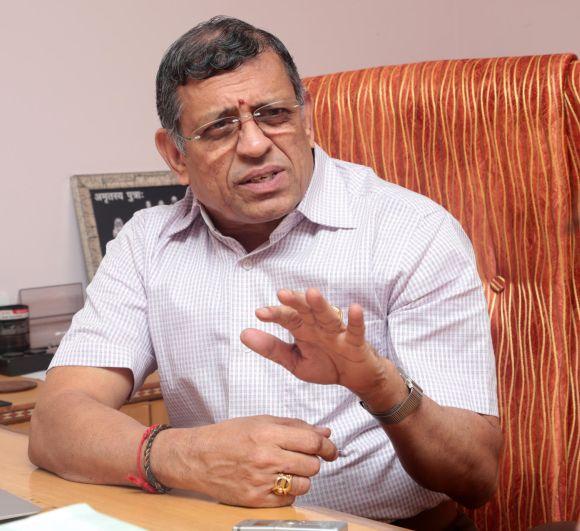
S.Gurumurthy -- Image Courtesy Rediff (20gurumurthy1.jpg)
Gurumurthy also asserts that one of the key motivations for Modi to carry out this step is to stem the trend of jobless growth and stimulate job growth. That might be news to Modi himself. Gurumurthy does make valid points, about that shortly, on how the Manmohan Singh period, 2004-2014, was fueled by influx of dollar and how that excess liquidity sloshed in the monetary system. Modi's stated reason was curbing the menace of fake currency and black money. Gurumurthy is cooly attributing motives that were not spelled out by Modi and is still only a theoretical possibility. Modi's economy is plagued by jobless growth and that is, no doubt, causing political concern. The roots of that problem will not be adequately addressed by this demonetization.

Gurumurthy cites an 'Economic Times' report that said thanks to the demonetization move life in the the 'fake currency capital of India, Malda in West Bengal, has come to a grinding halt. He snidely hints that this is a Muslim problem. A June 8th report in Indian express cites a now widely referred study which says that nearly 250 out of a million currency notes are fake and that this is largely done through ISI. Of the fake currencies recovered Delhi and Uttar Pradesh account for nearly 43%. Interestingly while the government blames Pakistan's ISI for the problem they signed an MoU with Bangladesh to stem the flow from the Indo-Bangladesh border. Between these two articles the scenario is patchy and information is sparse but our Distinguished Researcher needs only convenient pegs to hang his narrative. Also, fake currency constitutes only Rs 70 crore annually. The big problem is pathetic infrastructure to detect and seize the currency. So while the demonetization program would render the estimated Rs 400 crores, total in the financial system, possibly useless there is no hope that the cycle will be stopped forever. The nation is being subject to torment for a problem that is inadequately addressed by this gargantuan step.

Refuting allegations that construction industry has ground to a halt Gurumurthy quoted a friend of his, this how researchers in Indian universities like SASTRA collect data, to say that it is high value builders who are dependent on buyers flush with black money that are hit hard. He then conceded that this too is a temporary phase for maybe the next 3-4 years. Black money and corruption, the root cause, will remain India's Sisyphean problem.

Choking off terrorism financing and the supposed reduction of stone throwing against Indian army soldiers in Kashmir is all attributed to this scheme. Gurumurthy explains how terrorists, with meager funding, could wreck havoc on a large economic scale as was done during the Mumbai attacks. But, by his own logic then the terrorists need only small funding and having no need for large funding this demonetization will, if at all, only put a dampener for a very short while. The horrific 9/11 attacks, also a very low cost operation, cost the US economy hundreds of millions of dollars, possibly billions. Demonetization is the most ineffective tool to fight terrorism. Kashmir's problem is a long festering one and runs way too deep to receive a body blow from this step. This is laughable premise and one that only a chartered accountant turned researcher can offer.

The reasonably good part of the lecture was when Gurumurthy talked about how Manmohan Singh sought to manage the humongous inflow of dollar by making low-interest imports possible and which in turn strained domestic manufacturing. Gurumurthy is also correct in labeling the dollar influx as 'hot money'. From 2004-2014 dollar and FDI inflow was on a scorching pace as the global market was hunting for higher returns in emerging markets as the US market teeter from 9/11 and dot-com bust first and then in 2008 the debilitating near fatal financial crises. Also, in that period US based offshoring soared exponentially bringing FDI with it.

While Gurumurthy was on solid ground talking about the problems created by excess liquidity he then took a leap into name dropping Thomas Piketty and tied "Piketty Bubble', a term referring mostly to wealth inequality driven by Capital, to "asset price inflation". Also, Piketty's own conclusions are now being increasingly questioned. A notable paper by an MIT grad exposed some flaws in Piketty's approach to curbing wealth inequality. The paper also showed some problems with current approaches to curbing excess liquidity by crimping growth. This is exactly where a true academic rather than a lumpen polemicist would have shone through with illuminating arguments. Alas, this is SASTRA and he's Gurumurthy and we cannot expect anything better.

The partisan polemicist in Gurumurthy came to the fore when he very tenuously tried to connect the dots between how Manmohan Singh's government managed excess liquidity and the black money crisis that Modi is purportedly addressing with this demonetization process. Note that according to a white paper authored by Pranab Mukherjee, now President, in 2012, cash component of black money accounts for only 3.7-7.4%. 93% of black money is not held as cash. The FDI inflow (3.6 billion dollar in 2004 reached a peak of 43.4 Billion dollar in 2008 and then tapered to 27.4 Billion dollar in 2010 and touching 44 billion in 2014) and dollar inflow, the prime drivers of excess liquidity, could not seep entirely into the financial system as black money. The connecting dots that Gurumurthy claims he researched, remember 'distinguished', were not published in any peer reviewed journal. That somebody could claim what can be charitably called 'back of the envelop calculations' as research and get applauded in an academic forum speaks volumes about the standards of Indian Universities. Interestingly, when Gurumurthy said that Manmohan's management of the economy was "monumental mismanagement" the audience enthusiastically clapped. One wonders why would an audience clap when a 10 year government led by an economist was labeled a 'monumental mismanagement". But this is a crowd that came to SASTRA to hear Gurumurthy speak, their political allegiance is no mystery.

For someone billed as researcher Gurumurthy is heavily dependent of anecdotes and even tweets that he had noticed as sources of data. So why does SASTRA patronize such a mediocre guy? Gurumurthy's politics of militant Hindutva completely dovetails with the current philosophical bent of SASTRA. What can one expect from a University that conducts a technology conference centered on Mahabharata and publishes a blog by a computer science student claiming that In-vitro-fertilization technique was well known in the mythical era.

Seeking to buttress his theory that India has ways to cope with draconian surprises like the demonetization scheme Gurumurthy again anecdotally claimed that vegetable vendors in popular bazaars operate on 'relationship' basis and are adapting to this temporary inconvenience by forgoing immediate payment. Then he proceeded to contrast this with 'contract' based western model and said "if Walmart had entered India this would not be possible". I'd love to know from this researcher of legal anthropology if Reliance Fresh, a mega grocery chain run by the Ambanis, friends of Modi, would sell vegetables to the common man on 'relationship basis?

I'm sick to my stomach of these upper middle class Marie Antoinettes patronizingly recalling how the maids and other laborers they use refuse payment or accept payment at a later date in the national interest. National interest, my foot. I cannot think of doctors or medicine shops or diagnostic clinics or marriage halls ready to accept payment at a later date. If these Antoinette's don't have cash how do they expect the maid who cleans their kitchens to have cash and these maids would not have plastic cards to buy at Reliance Fresh. I'm being told "oh there's paytm", "there's ATM". Banks are struggling to dole cash that the government says should be available to customers. This is reality. Gurumurthy speaks of an auto-rickshaw guy who refuses Rs 50 in payment. I wonder how the auto-wallah found money to pay for gas. In a nation where corruption has eaten into the body politic like cancer am I to believe that its citizenry suddenly found their soul and moral uprightness the moment Modi the messiah waved a wand? Bollocks. Bull Crap.

This Twitter Exchange Went Viral and Captures My Sentiments Exactly.
When Gurumurthy, who once extolled about the virtues of Varnashrama Dharma in SASTRA, praises 'relationship' based economy I shudder. It is not without reason that Kancha Iliah, Dalit activist, supported the move to allow Walmart into retail sector in India. Retail sector in India, like everything else, is caste ridden. A 'contract based' free market dependent Walmart will be a boon to Dalits. But that might irk Gurumurthy, a Brahmin. Also, let's not forget that Gurumurthy was once the flag bearer of an organization called 'Swadeshi Jagran Manch' which harped on self-reliance. Ironically Modi, his supporters believe, is a free marketer open to inviting foreign capital. Modi has assiduously courted foreign investments in his frequent foreign jaunts.

In typical uppity manner Gurumurthy that he often talks to his "security fellow because he's from a village". Would Gurumurthy refer to anyone on the stage or in the audience as 'fellow'? And is someone coming from a village a lab rat that his royal highness distinguished researcher seeks to study like they are guinea pigs?

Gurumurthy fulminates that the RBI sets monetary policy and is "arrogant" and does not kow-tow to the government. He wonders if in the world any where else such an institution exists. The guy SASTRA identifies as 'eminent columnist' (is that a degree now?) has not probably heard of America's Federal Reserve and its autonomy.

Only a partisan political hack like Gurumurthy will compare Raghuram Rajan to Gandhi and say that Rajan, unlike Gandhi who was instructed by Gokhale to learn India by touring, did not understand India because he was an American academic. Rajan did not come to India to start a political revolution or to find a bride for himself. Rajan, a legendary academician who crossed swords with the even more legendary Alan Greenspan, came to run the RBI because of his experience at IMF and for his knowledge of capital markets. But then this is SASTRA and he's Gurumurthy.

Dr S.Vaidhya Subramanian deserves special mention. I had to cringe when the Dean of planning refers to a memento as "momentous momentum". The opening remarks are a showcase in mediocrity and illustrates what ails Indian academia. Unfortunately for me my father did not own an university else I too might have a Ph.D and carry a title exceeding my abilities. Trying to rise up to the occasion the heir apparent plumbed the depths of ridiculousness. He said the scheme had elements of geography, since people asked "what about Modi's promise of bringing money from Switzerland and other tax havens abroad"; elements of physics, since "there were equal and opposite reactions to the scheme"; elements of chemistry, since relationship "between god and devotee changed, employer-employee relationship changed". I wish Dr. Vaidhya Subramanian the very best and my sincere prayers that one day he may indeed grow up to the title he carries today.

One Mr Mahalingam was called upon to present some remarks and moderate the question answer session that was to follow Gurumurthy's lecture. Alas, Mr. Mahalingam had no such thing to do. If moderating a question answer session is taken as reading written questions then yes he did moderate. He probably went home wondering what was he invited for.

Finally Gurumurthy. SASTRA has conferred an ill defined but very high sounding honorific title, "Distinguished Researcher in Legal Anthropology". First of all Gurumurthy is none of that. He's not at all a researcher much less a distinguished one and even less in something as esoteric as legal anthropology. By the way he's neither a researcher in law or, for that matter, anthropology let alone 'legal anthropology'.

What a waste.

References:

http://scroll.in/article/822390/only-16-of-every-250-fake-notes-were-detected-in-india-in-2015-16

http://indianexpress.com/article/explained/on-paper-1-in-4000-are-fake-notes-on-indias-huge-currency-problem-2840193/

http://economictimes.indiatimes.com/news/politics-and-nation/life-has-come-to-standstill-in-indias-counterfeit-capital/articleshow/55406694.cms

http://www.firstpost.com/politics/note-ban-how-narendra-modi-changed-narrative-from-black-money-to-cashless-economy-3127628.html

http://www.livemint.com/Politics/F3oWtSiG34RCv1BagTg87J/What-PM-Narendra-Modi-has-said-on-demonetisation-so-far.html

World Bank Data for FDI inflow http://data.worldbank.org/indicator/BX.KLT.DINV.CD.WD?end=2015&locations=IN&start=1998&view=chart

Piketty Bubble http://marginalrevolution.com/marginalrevolution/2014/05/the-piketty-bubble.html

The disconnect between jobs and growth http://www.livemint.com/Money/1UZDnb9QcCz5s5dKnJ8maO/The-growing-disconnect-between-economic-growth-and-jobs.html

"Where are the jobs" -- India Today article- http://indiatoday.intoday.in/story/employment-scenario-job-crunch-jobless-growth-economy/1/647573.html

MIT student challenges Piketty http://fortune.com/2015/04/06/inequality-piketty/