“Power”, Winston Churchill said on the eve of India’s Independence, “has to gone to men of straw”. Military historian Srinath Raghavan’s “War and Peace in Modern India” demolishes Churchill’s arrogant remark and shows in great detail how the British had left behind a gigantic mess. D.F. Karaka famously called Nehru a “lotus eater from Kashmir”. Raghavan’s book fleshes out a layered narrative of who Nehru was and what were his motivations as he shepherded a nascent country.
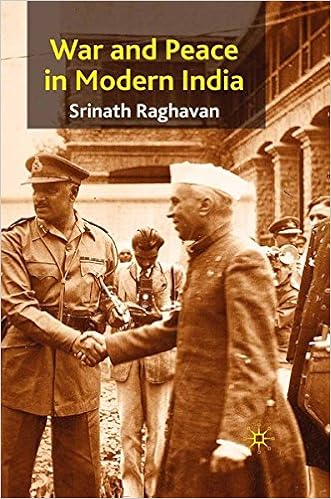
In a brief chapter Raghavan touches upon Nehru’s intellectual influences and philosophy regarding power. To many Indians the common caricature of Nehru is one who was beholden to Marx and Stalin when he is not subservient to Western philosophy and yet, nothing is further from the truth than that caricature. Nehru was an avid student of history and a keen intellectual who sought out a wide spectrum of ideas.
Nehru's Ideological Development
Raghavan fixes Nehru’s philosophy of power in the “liberal realism” camp. Drawing on lessons from Marx on concepts of power Nehru was influenced by American philosopher Reinhold Niebuhr who chided those who failed to grasp the “power of self interest and collective egoism in all inter-group relations”. Nehru had a “tendency to avoid plunging headlong into a situation or succumbing to the emotions”. The partition left a deep scar on Nehru’s psyche and Sunil Khilnani suggests that “It showed him the destructive potentialities of politics, and therefore the need to use power with great circumspection”.
That leadership is not a science but an art was not lost on Nehru who told General Montgomery that “a leader cannot act to a degree beyond what the people will take; he must, of course have courage, but if the people will not follow his decisions, he will inevitably fail. He must therefore be a persuader”. Nehru knew the vital importance of public opinion. During his visits to England he met with British military historian and theoretician Liddel Hart. Nehru quoted Liddel Hart in his ‘Discovery of India’ to underscore that a statesman, unlike a prophet, is limited by what the public will support and “striking a balance” is essential.
Historian Stanley Wolpert called the manner in which the British left India a “shameful flight”. The door for chaos of biblical proportions was left open when the British decided to leave India and letting every princely state, of which there were hundreds, make their choice to either align with India or Pakistan or remain independent. The Balkanization of India was avoided by the herculean efforts of Nehru, Patel and V.P. Menon amongst many others. Raghavan’s book is a succinct narrative of the key conflicts and how the unification called for a collective genius in solving intractable labyrinthine problems that almost fragmented India at its very birth.
Sardar Patel is lionized in India as India’s Bismarck but it is Nehru who looms like a colossus in Raghavan’s telling.
Both India and Pakistan understood that Kashmir was the real prize and all else were battlefields for testing tactics and tolerance limits. Junagadh and Hyderabad were the initial flashpoints that the two nations faced off in a battle of nerves.
Junagadh
Junagadh was a largely Hindu state ruled by a Muslim ruler and had no contiguous boundary with Pakistan. Yet, the Nawab signed an instrument of accession to Pakistan. Mangrol a vassal state of Junagadh argued that in the event of the British leaving and Jungadh acceding to Pakistan their own client status to Junagadh becomes defunct and they’re free to accede to India. Kathiawar threatened likewise. While Bengal and Punjab were exploding in communal strife Junagadh’s accession, Kathiawar and Mangrol warned India, would inflame communal tensions in the coastal state and elsewhere.
India embargoed supplies to Junagadh barring essentials following a policy of “encirclement”. Managing these crises called on for diplomatic skills that easily rank alongside the finest shown by any country in world history in similar situations is made evident by Raghavan in explaining how India’s press communique in the wake of Junagadh’s accession to Pakistan addressed multiple audiences with pertinent messages for each: ”to clarify India’s interest to Pakistan and Jungadh but also reassure them that force would not be used if they agreed to a referendum; to assure domestic constituencies that the government was seized of the problem; to demonstrate resolve to the states, especially Hyderabad; and to convince the international community of India’s peaceful intentions”.
As if what the Nawab did was not enough to complicate things the army chiefs, who were still British and though they headed two different armies were still tied into common ‘single service list, complicated it further by underscoring that they cannot partake in a war between India and Pakistan. Another complicated legacy due to the partition and the ‘shameful flight’.
While Junagadh teetered on the precipice Pakistan invaded Kashmir on 22nd October 1947 by sending in 5000 tribesmen supported by their army. Indian army entered Junagdh in the first week of November and in a very swift operation annexed the state. Nevertheless India honored its undertaking of conducting a plebiscite. In the plebiscite conducted in February 1948 95% of Junagadh voted to remain with India.
 |
| Srinath Raghavan |
The Junagadh crises “prefigured Nehru’s approach that laid emphasis on controlling the situation to preclude escalation, on employing military to demonstrate resolve whilst exploring diplomatic options to avoid war”.
Hyderabad
The Hyderabad crises closely followed the Jungadh crises and was important on a grander scale. The princely states tried to make hay by playing off India and Pakistan against each other while nurturing ambitions of their own and in the process throwing to the wind the needs of the people and the Nizam was a prime example of this.
Indian public opinion clamored for action against Hyderabad. Nehru, in a letter to premiers, counseled restraint because the army was already stretched thin in Kashmir and in riot torn areas. Nehru was keeping an open channel of communication that was honest with leaders across the country. This will be a recurrent character of Nehru all through his tenure. Addressing a public meeting in Vishakhpatnam Nehru leveled with his audience, the citizens, that India was strong enough to deal with Hyderabad and the inflammatory rhetoric by the Razvi of Ittehad was noted but not worth getting hysterical over and he counseled restraint from adopting methods that’d pay off in the short run but come “at a big cost we would rather not pay”.
India and Hyderabad engaged in a battle of nerves. India blockaded Hyderabad and Hyderabad banned Indian currency. Into this heated atmosphere “Razvi threw a molotov cocktail” by calling on Muslims of India to be “fifth columnists in any showdown”.
Nehru was adept in using a carrot and stick approach as he “sought to yoke military measures with diplomatic moves towards a settlement”. This too is a recurrent character of Nehru and one that is barely recognized. He takes care not to contribute to escalation by mindless militarism. He’s extremely cautious in judging how military deployments would appear to the opponent. He’s also eager to de-escalate when meaningful overtures are made. Above all he constantly worries about the religious fault line that is ever combustible. That India should not become a Hindu Pakistan nags him constantly.
As the menace of the Razakar’s reached a feverish pitch and having gotten assurances from other premiers that communal riots would not break out in other provinces Nehru moved forward with a military solution and in a swift operation Hyderabad was annexed to India.
While many today recall the murderous exploits of Razakars and curse Nehru for not having acted sooner and saved the lives of many Hindus a topic that is rarely mentioned is how Muslims were butchered in retaliation by Hindu mobs after the liberation. Raghavan harshly chides that the aftermaths showed that “if anything secularism in India had failed a critical test”. “The possibility of reprisals against Muslims was neither envisioned nor provided for”. Patel and V.P. Menon were almost callously indifferent to the reprisals. Local reports reached Nehru and he instituted an inquiry. Patel actively dissented. The Sunderlal report said around “27,000-40,000’ Muslims were killed.
Bengal
Meanwhile Bengal was not idle. The brewing conflagration in West Bengal brought to the fore many other forces that were operating like eddies in the two countries. East Pakistan Hindus were being killed in a genocidal spree and the refugees streaming into West Bengal carried with them gory tales, true and exaggerated. Inflamed Bengali Hindus carried out reprisal attacks on Muslims and now Muslim refugees streamed into East Pakistan carrying their tales. The vernacular presses in both countries inflamed local passions by carrying opinion polls calling for military invasions by their countries. Nehru faced great opposition within Congress itself in support of an invasion or a population exchange. Liaquat Ali Khan on the other hand could not afford to be seen as bringing order to East Pakistan based on exhortations from India because that’d show him and West Pakistan as kow-towing to Delhi and he could ill afford that.
Nehru was neither a peacenik nor a war monger but a hard-nosed realist. Brushing off suggestions to invade East Pakistan Nehru underscored that millions of Hindus would be “bottled up in a hostile area”. War, Nehru correctly reasoned, would not be localized but become an all out war against Pakistan in multiple fronts and the costs would seriously jeopardize India’s much needed development plans. A half century later the current disparity between the living conditions of Indians and Pakistanis has vindicated Nehru.
Kashmir
Nothing has bedeviled the legacy of Nehru as war time leader as his choices on Kashmir and China did. In very packed and brief chapters Raghavan corrects the record on Nehru and offers some much needed context for the choices made by Nehru.
Raghavan, based on his reading of the materials, insists that the Raja of Kashmir signed the instrument of accession on 26th October and not 27th October as India claimed. Nehru, while adhering to the principle of plebiscite was categorically clear in his mind that a plebiscite could be carried out in Kashmir only when “complete law and order have been established”. Jinnah was lukewarm to the idea of plebiscite when he thought the aggression, with the tribal invaders as front, was going in his favor.
Patel and Baldev Singh wanted aerial bombardment to establish “cordon sanitaire ten miles deep”. Nehru disagreed and wanted to focus the bombardment more narrowly on specific military targets which the military agreed with. On the other hand when the military wanted to evacuate from Poonch Nehru stood firm because that would signal weakness to Pakistan at a crucial juncture. While curbing military enthusiasm of his colleagues Nehru was also mindful of when to insist that the military has to deliver key objectives that would serve diplomatic initiatives.
The internationalization of Kashmir thanks to Nehru’s decision to approach the UN has come in for very sharp criticism. Raghavan addresses this very briefly. The internationalization of Kashmir was anyway bound to happen and the world powers, via UN, were already “seized of the the dispute”. Nehru did little more than preempt Pakistan in approaching UN. Also, Nehru thought that India had an unassailable case to defend in the world body and he placed faith, unlike Patel, that the UN would see Pakistan as an aggressor.
It should be remembered here that Nehru was an institution builder. It is not for nothing Nehru is referred to as the architect of modern India. Just as JFK insisted on the Organization of America supporting a Cuban embargo unanimously, Nehru, as was his nature, felt the moral advantage in approaching a world body in good faith would in the long run pay different dividends. Nehru approaching the UN should’ve been presented in deeper context with what JFK or even George H.W. Bush did during crises. That the UN failed in its moral obligation should not be made Nehru’s fault.
Patel and Nehru reluctantly were even amenable to partition Kashmir. Nehru told Liaquat that Pakistan either accept UN recommendations completely or agree to a partition plan. At this juncture for all practical purposes the idea of a plebiscite was “ruled out”. The talks failed and the countries slouched towards a truce.
China
The war with China and the factors leading up to it remain a hot button issue in evaluating Nehru as a leader. Raghavan’s quotes about China’s behavior by Indian officials and leaders a half century ago make for eery reading in 2016 as China indulges in saber rattling in South China seas.
Nehru wrote in a letter to the Chief Ministers wrote, “The Chinese have always, in their past history, had the notion that any territory which they once occupied in the past necessarily belonged to them subsequently”. V.P. Menon accused the Chinese of practicing “irredentism” irrespective whether it was the Kuomintang or the Communists at the helm.
If one had to pick a criticism of the book it is that it could benefit with some more material that explains the choices even more contextually. Example, the messy global geo-political tangle in the China war is too compressed and insufficiently impresses upon the reader how difficult an act Nehru pulled off in that. Bruce Reidel’s stilted account in “JFK’s forgotten war” provides such a detail (Reviewed by me here). That said, Srinath Raghavan’s book is a much needed welcome addition to the study of Nehruvian era.
The border issue with China was one more messy legacy dating back to the Raj. The Sino-Indian boundary comprised of three segments with varying levels of uncertainty: The Western sector, which included Ladakh and Aksai Chin was thought as very ill defined and India conceded that the Chinese probably had a solid claim here; the Middle sector bordering UP, this was the least controversial; the Eastern sector, which included what was then called ‘North East Frontier Agency’ (NEFA) and now as Arunachal Pradesh was bound by the McMohan line, India strongly felt that the McMohan line was inviolable.
The peoples of NEFA, Nehru thought, required a ‘hearts and mind approach’ to assimilate them into the broader fabric of India and make them less susceptible to temptations from China based on ethnicity or ideology. While the fortification of NEFA’s binding with India proceeded apace Nehru yielded to K.M. Panikkar’s idea of not raking up the border issue with China explicitly. Many hold Nehru as having passed on a golden opportunity to open up the issue and drive home India’s concerns when China was preoccupied with the Korean war. However, Raghavan contextualizes that the thrust of Panikkar’s advice was premised on the idea that India while not raising the issue openly should use the period lull to fortify itself. Meanwhile the infrastructure programs in NEFA were being stalled.
The ‘Panchsheel’ pact signed on 29th April 1954 recognized China’s claim on Tibet and proceeded to create a framework of cooperation with India. This agreement is often uncharitably characterized as evidence of Nehru’s naivety due to the lofty idealism that suffused the language. On the contrary, Raghavan says, Nehru was not in the least bit naive and privately expressed that nations operate more out of distrust and emphasized the need to strengthen India’s position.
The Chinese showed a duplicity that was breathtaking. They gave explicit signals that they were good with the McMohan line. When Nehru confronted Zhou Enlai about Chinese maps showing Indian territory as belonging to China Zhou dismissed them as “old maps”. An irritated Nehru asked him “supposing we publish a map showing Tibet as part of India, how would China feel about it?”
Neville Maxwell’s book “India’s China War” has become an almost canonical work on the subject. Maxwell sowed the idea that on the border issue Nehru was belligerent and adopted a hawkish unilateral stance based on his reading of a partial memo that he had access to. In an important paragraph Raghavan provides a wider context and disproves that notion.
An idea of bartering Ladakh for acceptance by China of the McMohan line was stoutly opposed by Indian public opinion. Nehru confided “if I give them that I shall no longer be Prime Minister of India- I will not do it”. Nevertheless the barter solution was rejected by China.
The military leadership meanwhile changed hands to Indians and British officers had left. Indian officers, it should be noted, had very little battle command experience. The Thimayya resignation episode had little to do with Krishna Menon’s penchant for promoting sycophants and Thimayya’s own opinion about the limited ability of Indian army to confront the Chinese continued to shape the army’s strategies. Civilian leadership was presented with military options that did not include any strategy for a long term conflict and avoiding such a conflict, the army assumed, was the duty of civilian leadership. “The chiefs evidently sought to wage the kind of war with which they were most comfortable”.
The much criticized ‘forward policy’, a strategy of ‘zig zagging’ outposts across the border to prevent the Chinese from claiming ‘presence’ along an area, was the result of mutually reinforcing opinions between the Intelligence Bureau, the military and civilian leadership. IB assured Nehru that China would not brook the outposts as incursions. As a military historian Raghavan faults the decision to ask IB to evaluate intelligence provided the department itself. “IB was asked to gather intelligence and generate assessments”.
Raghavan disputes the charge that India did not sufficiently procure weapons. The decrease in defense expenditure was marginal, the army leadership was even confident that the “Chinese will not attack” and there was a serious budgetary constraint due to the then prevailing “grave balance of payments situation”.
Raghavan also faults Nehru’s evaluation that there’d be an irreconcilable Sino-Soviet split leading to an inhibition of China’s desire to attack India. Moreover, Nehru, Raghavan charges, underestimated ideological camaraderie between China and Russia and thought nationalist impulses would be a greater driving force. Khrushchev was very sympathetic to India and Nehru until, in Raghavan’s opinion, ideological unity with China mattered more.
I disagree with this characterization. William Taubman’s “Krushchev:The man and his era” describes vividly the mercurial and stormy relationship between Krushschev and Mao in the backdrop of competition for leadership of the Communist world. Krushchev, in typical fashion, hurled insults and invective at Mao. Any world leader observing this, as Nehru did, would reach the same conclusions. Let’s not forget that China and Russia were totalitarian states where leaders sent signals through subterfuge and something as innocuous as the receiving line for a leader arriving at Moscow airport was a sign of who is in favor with the politburo. The U2 spy plane crash in 1960 over Soviet territory, collapse of US-Sino talks at Paris, failure of Vienna summit, later Sino-Soviet split that hastened Krushschev’s ouster should all be put in perspective. There appears to be more realpolitik than ideological camaraderie.
War, when it came, was unmitigated disaster for India and for Nehru personally. China’s betrayal, as Nehru saw it, literally broke him physically. John Galbraith wrote to Kennedy that Nehru was a tired leader and even enclosed a photo of Nehru looking demoralized (‘The international ambitions of Mao and Nehru: National Efficacy Beliefs and the making of foreign policy’ by Andrew Bingham Kennedy)
Conclusion and Criticism
Raghavan, in conclusion, levels two chief criticisms of Nehru.
First, While commending that Nehru was “correct in his initial calculation of the interests of all parties”, “he failed to keep up with the evolving situation”. This, I feel, is a criticism that does not bear justification given the details that Raghavan himself provides. In a rapidly changing tableau, Nehru, within the context of the times and the constraints within which he had to function, was nimble enough either in escalating or in de-escalating. Most importantly we should note that this was a man who was not only prosecuting war like Churchill but, like FDR or Truman or even, perhaps Stalin, was also building up a nation and more to the point unlike any of them Nehru was building a nation from almost scratch. To say that the immediate post-war world was complex is a complete understatement. Seen in that perspective Nehru shows uncommon perspicacity and clairvoyance. This is not an apology by a Nehru admirer but a realistic estimation of a man against the times in which he lived.
Second, Raghavan cites the “absence of a functional and effective mechanism to collate and analyze the available intelligence contributed in no small measure to this (the referred above) failure”. Andrew Bingham Kennedy cites defense analyst K.Subrahmanyam and says “the Indian government had no strategic planning process that could have anticipated a range of possible Chinese actions and prepared appropriate responses”
While criticisms like those are valid and accurate a little bit more context would help especially when one evaluates the nature of leadership. India was a nascent country birthed in the cauldron of civil war conditions and depressing poverty thanks to three centuries of rapacious colonialism that bled the country. Despite fine institutions like Council of Foreign Relations and Brookings Institutions that incubated excellent intellects that served the US government FDR was no more clairvoyant towards the Japanese than Nehru was towards the Chinese without such institutional support. It was Nehru who seeing the lack of an institution, as always, established the Indian Foreign Service. That was the pathetic state of institutions in India.
Those criticisms aside, Raghavan pays fulsome tribute to the leadership of Nehru. “The most important and relevant aspect of Nehru’s strategic approach is his grasp of the nature and the limits of power”. “Nehru’s brand of liberal realism also sensitized him to the fact that moral and political legitimacy was as important as economic and military resources”. “Nehru displayed a willingness to communicate with adversaries and search for acceptable compromises”.
A historian should not become an advocate for his subject hence Raghavan stops with evaluating Nehru without measuring him up against other leaders of the era and their successes and defeats as leaders during wars. Churchill had his Gallipoli, FDR had not only Pearl Harbor but a nation whose military might was completely depleted thanks to decades of liberal policies, Stalin went into a stupor as Hitler’s panzers hurtled towards Moscow, Golda Meir almost lost Israel in the Yom Kippur war and one could go on.
Nehru’s penchant for moral upper hand and his evaluation of the strategic importance of doing the right thing should be seen alongside JFK’s handling of Cuban missile crises and George H.W. Bush prosecuting the Iraq War.
The conflicts and the role of public opinion in driving the choices that the leaders made is an important perspective. Throughout history more than we realize public opinion, especially in democracies, has either promoted isolationism or adventurism. While Nehru was less propelled by opinion and proved more adept in shaping opinion Liaquat Ali Khan was more a prisoner of seething rage amongst his citizens.
When Indians speak of the unification of India it is Patel who is often spoken glowingly of and little is spoken of people like V.P. Menon. Menon, rose from very humble station to playing a pivotal role in forging the destiny of India. India was gifted to have such bureaucrats.
If one had to pick a criticism of the book it is that it could benefit with some more material that explains the choices even more contextually. Example, the messy global geo-political tangle in the China war is too compressed and insufficiently impresses upon the reader how difficult an act Nehru pulled off in that. Bruce Reidel’s stilted account in “JFK’s forgotten war” provides such a detail. That said, Srinath Raghavan’s book is a much needed welcome addition to the study of Nehruvian era.


