Monday, April 18, 2016

Defeating Donald Trump is a Moral imperative.

"His imagination should not be married to power". With words of rare eloquence and passion Mitt Romney summed up why Donald Trump's candidacy threatens the bedrock of American democracy. Defeating Trump is not a political choice but a moral imperative and here's why.

Every election year we hear that this is the most important election of our lifetime but 2016 election is, without a doubt, the election of our lifetimes. Donald Trump and Bernie Sanders are riding a wave of discontentment fueled by voters anger against the so-called 'establishment' and 'status-quo'. Trump and Sanders are easily interchangeable but for the mendacity and racism that undergirds Trump's candidacy. Sanders and Trump's positions on trade and foreign policy, two of America's most important pillars, are absolutely alike. They both have stoked a resentment towards establishment candidates and the parties themselves that seek to be standard bearers of. Both have literally hijacked the parties they seek to represent. Yet, it is Trump who literally threatens the heart and soul of America and therefore defeating him is a moral choice.

"He tells it like it is" say his supporters. Nothing is further from truth. Trump says what voters want to hear and without filters. Trump has made a virtue of being politically incorrect and his voters swoon with admiration that he's tearing up the playbook. When he was booed at a debate Trump sneered, with contempt dancing on his lips, "all lobbyists and supporters of Jeb". He was right. Tickets for being in debate audiences were often sold to lobbyists, campaigns and volunteers. What no candidate would've had the chutzpah to state bluntly Trump gladly stated and dismissed unfavorable audience reaction. Like many things with Trump he is correct once and wrong many times over. His 'tell it like it is' was less about stating inconvenient truths and more about flinging offensive accusations, blatant racism and sexism.


Trump launched his candidacy by informing America that Mexicans are rapists and vowed that he'd deport millions of illegal immigrants. In a country where the politically correct term for an illegal immigrant is 'undocumented immigrant' Trump's offensive became refreshing candor. While it is liberalism run amuck to object calling an illegal immigrant by the word "illegal" it is beyond indecency to call a people as 'rapists'. It is naked bigotry and accepting it because he serves it alongside with a dish of boldness is exactly the stupidity that'll unmake a great country. What is worse Trump cites the controversial programs of the Eisenhower era to support the feasibility of deporting millions. That program was unmitigated humanitarian disaster and America, at large, will simply not tolerate it today. China has a wall that was built to fend of invaders and therefore building a wall will be panacea to America's immigration mess says Trump and, to the lusty cheer of his supporters, he adds that he'll make "Mexico to pay for the wall". Pressed on how he'd make Mexico pay for it Trump cites the trade deficits with Mexico as a leverage. Damn the consequences of a trade war.

Both Sanders and Trump rail against trade agreements like NAFTA as having robbed America's jobs. Trump in addition rants that American negotiators, unlike him, the author of 'The art of the deal', were weak and every other country practically took advantage of US. When I watched a documentary of Reagan negotiating with Gorbachev at Reykjavik I wondered if Obama, famously aloof, would ever do such a thing. The trans-pacific-pact is a grand achievement that serves important economic and strategic goals of US. Trump said that China, which is not a part of the deal, had the better part of the deal. Why bother with knowing the details when empty sloganeering with dollops of outrage is all the electorate needs?

Why should America , asked Trump, defend South Korea and Japan while their cars, not American cars, take the lion's share of American car buying. Both Sanders and Trump conveniently forget that Japanese cars, more expensive than American cars, are the choice of American consumers who benefit from better quality vehicles being available. A little realized fact is that Hondas and Nissans are now mostly made in America. And, they are sold in America by the same rights that GM enjoys in selling in China and India.

Trump shocked foreign policy orthodoxy when he suggested that South Korea and Japan acquire nuclear weapons of their own. A nuclear arms race in South Asia is the last thing the world needs. After apoplectic reactions ricocheted across the world Trump gave an incoherent back track.

Sanders and Trump rail against NATO, the most successful military alliance in human history. Yes, it has been a long standing complaint that Europe takes a free ride on American military expenditure but no one in their sane mind has suggested, precisely when Russia and China are threatening global peace, torpedoing the grand military alliance.

Building a wall, tearing up NAFTA, withdrawing from NATO would all be acceptable nonsense and even an artless blunt way of speaking about issues in an attention grabbing way. All of that while enough to disqualify him for the Presidency what make him dangerous is his non-policy related vitriol. Policy related insanity can be stopped by Congress and other institutions but the democratic institutions of any country, including a 200 year old republic, are no match to racist rhetoric.

ISIS is beheading hostages so it is OK to waterboard them or kill their families said Trump. When CIA chief said that his organization will not follow any illegal order even if it is the commander-in-chief issuing them Trump blustered that as President he has the right to issue any order. I was reminded of Richard Nixon's "when the President does it, it is not illegal".

I was watching Oliver Stone's largely fictional 'Nixon' and it dawned on me that Donald Trump is more dangerous than Richard Nixon.

A sickening refrain I hear from his supporters is that he'll be more presidential once he gets the nomination or the presidency. We're told by his admirers that all this vulgarity and pugnacity is for show and that unbeknownst to us there is a gentleman to boot within Trump's persona that is waiting to taking front seat once he sits at the Oval office. This is absolute cockamamie bullshit and Nixon was proof of it.

Richard Nixon believed and practiced slash and burn politics. Nixon, the president, it turned out, was no different from Nixon the candidate. Speaking of his democratic opponent, a lady, Nixon said "she's pink down to her underwear". In office Nixon referred to Indira Gandhi, a leader he loathed, will even worse epithets. Trump wants to make it easy to sue for libel and give the First Amendment a knock. Richard Nixon's henchmen cast the press as enemies and went at the press with gusto. Race baiting was par for the course for Richard Nixon and Trump follows suit. In office Nixon was no different.

During the heated presidential race of 2008 rumors flew about Sarah Palin's youngest child and about the pregnancy of her teenage daughter. Obama unequivocally said "family is off limits". When a supporter spoke of Obama as a Muslim McCain objected and said "No" to the supporter. Campaigns have played nasty about families but never before has it been done directly by the candidate himself. In fact candidates go to great lengths to distance themselves from the troops who malign opponents, just to appear presidential. Hypocritical as it may seem we little realize that the sense of shame that makes candidates behave so is the last remaining defense against a president become the attack dog himself.

When a Super PAC released half-naked photos of Trump's wife Trump, after threatening to 'spill the beans' on Ted Cruz's wife, retaliated by sending tweet of an unflattering photo of Ted Cruz's wife alongside a stunning photo of his wife. All lines of decency has been breached by Trump. To add to it all, he, without any evidence, accused the Ted Cruz campaign of having coordinated with the Super PAC, a federal crime, to release those photos of his wife from a photoshoot she did in her days as a model. Accusing an opponent of federal crime and then disgracing his wife for her looks shows that Trump, in pursuit of the office, will not only slash burn but practically adopt a Hannibal like scorched earth policy.

Let us assume for a moment that Trump indeed becomes presidential after getting the nomination should we then forget and forgive these transgressions. Absolutely no. If we did that we'd have only condoned the attitude of unleashing a spectrum of despicable behaviors in the pursuit of office. A victory does not and never should it validate abandoning principles in it's pursuit. Never in human history has anyone achieved victory dishonorably only to behave honorably in office. Dishonorable candidates have been worse in office. Richard Nixon is a stark reminder of that.

Both Sanders and Trump are proving to be sore losers when it comes to how they talk of possibly losing the nomination thanks to the labyrinthine rules of the primary processes in each party. While the primary processes of each party can do with some reforms it is churlish when candidates complain of the process when they lose. Sanders's supporters, equally mercenary like and very willfully blind to logic like Trump voters, threaten revolting against the nominee if it's not their candidate. A key difference is that Trump, unlike Sanders, is openly threatening violence at the convention. Whatever the merits in Trump's complaints be, threatening violence unless he gets his way is a dangerous attitude that even Nixon did not show.

The 1960 election was a nail biting close one and charges of voter fraud against JFK, especially in Chicago, flew thick and fast and yet, even Richard Nixon, shied away from contesting the election. While Al Gore tried every constitutional method to change the verdict in Florida there came a point where even he yielded in the larger interest of the nation. To both Nixon and Gore the country was above party and the presidency was above satisfying personal ambition. Don't expect such grace from Trump. He'd rather leave the country dismembered than subjugate his volcanic ego. This is not portrayal of strong leadership but dangerously naked megalomania.

Politicians have always had contentious and even confrontational relationships with journalists and media houses. During a campaign stop in 2000 Bush was overheard on an open microphone, which he did not know was open, referring to New York Times journalist Adam Clymer unflatteringly and Dick Cheney agreeing. What they'd say behind closed doors Trump will do on twitter for all world to see. Trump's conduct of hurling abuses at Fox News anchor Megyn Kelly has been the most interesting sub-plot of this election. From accusing that her tough questioning of him during a debate was because she was menstruating ('she has blood coming out of her wherever')to ranting that he's overrated he has made it a personal crusade between himself and her. Again, that Bush would be careful to say something in what he thought was a private moment and not in public is not hypocrisy or being weak. Spouting off whatever crosses one's mind in a moment is not how ordinary citizens conduct themselves in their daily lives with their spouses, colleagues and kids, let alone presidents or candidates running for the highest office of the land. Now, think about whether Richard Nixon said anything close to Trump's tweets about Washington Post or Bob Woodward and Carl Bernstein.

Who was the last American presidential candidate who talked on a debate stage about the size of his hands and that of his genitals? Who was the last candidate who relished giving his opponents offensive nicknames? Lying Ted. Low energy Jeb. Short Marco. Crooked Hillary. Would we condone our kids behaving like that? Why should we accept from a presidential candidate what we would not accept from our kids? We teach our kids that being a bully is not being strong. How do we accept schoolyard taunts from a candidate? Today it is his political opponents and tomorrow it very well could be Angela Merkel or David Cameron. Presidents and Prime Ministers speak colorfully of their counterparts in private meetings but when such comments are leaked a full blown damage control will be unleashed. Again, and again, by obliterating what people do in private and in full public glare and by promoting it as 'telling it like it is' we are promoting a bully.

The Trump rhetoric is seeping into the public conscience and already reports are coming out that school kids are adopting his rhetoric. In Wisconsin, a Fox news report says, at a high school girls soccer match "a group of students yelled 'Donald Trump' and 'Build the wall' at rival Latino players". The report says that similar incidents occurred in high school basketball games in Indiana and Iowa. The report adds that an analysis by Southern Poverty Law Center, an organization that tracks racial incidents, showed that 'of 5000 comments from teacher across the country' a staggering '1000 of them mentioned Trump as a factor in spreading racial and religious tension'.

Trump nonchalantly cites FDR's internment of Japanese-Americans in the aftermath of Pearl Harbor as precedence for treating Muslim-Americans differently. Are Americans concerned about terrorists using refugees as cover to infiltrate? Of course, yes. But to pander to fear and to fuel it by proposing an embargo on Muslims is sheer bigotry. In a moment of sweet irony now even democrats, including Obama, are citing how George Bush conducted himself very carefully after 9/11 and went to great lengths to show that America is not at war with Islam. Muslims serve in US military and CIA and Muslim neighborhoods in US have cooperated with FBI is combating terror.

I recently visited Pearl Harbor in Hawaii and saw a moving exhibit about letters that Japanese-American fathers wrote to their sons who joined the all-Nisei 100th infantry battalion. A father wrote, "do your best for your country (America). Die if you must. Live, if you can, but whatever you do, do not bring haji (shame) to the family. Your country, the honor of your family comes first". Let us remember that the most famous and longest running incidents of espionage in FBI and CIA were carried out by white Americans.

Mitt Romney was hounded all through 2008 for being the CEO of Bain Capital, a private equity firm that specialized in Leveraged Buy Outs. He was pilloried endlessly for the layoffs at firms that Bain took over. Romney always nervously explained how he created jobs 'net-net'. Private equity firms are literally the last resort of failing firms and therefore in the inevitable restructuring that follows. Watching a passionate and eloquent  Romney making the case for why Trump should not be elected many muttered "we'd not be here if only he had shown such passion and eloquence in getting himself elected". Where Romney was shy to explain the virtues of private equity Trump supplied bombast and bravado when asked to explain the bankruptcies of his firms. Trump thumped his chest and said that as businessman he was smart to use the available legal options for shutting down non-profitable businesses. The audience cheered as he added that having used the loopholes he's knowledgeable to fix American economy. Oy vey, why not elect Bernie Madoff and the long list of corporate crooks? America, with good reason does not 'elect' CEOs and with even better reasons does not 'select' CEOs to be Presidents.

Romney himself unwittingly provides the best evidence of the dangers of accommodating a little evil in the hope that it is just objectionable and nothing serious. Trump endorsed Romney in 2012 for the presidency. At that time Trump was notorious for what is called 'birther' nonsense, questioning that Obama was not qualified to be president because he was not, contrary to all evidence, a natural born US citizen. When such basic indecency is tolerated as a passing fad we should not be surprised when it mutates into something monstrous as mendacity without limits. Trump hit back at Romney saying that if he had asked Romney to "drop down" on his knees for that endorsement in 2012 Romney would've gladly done so.

The United States Holocaust Memorial quote's a text from Pastor Martin Neimoller to illustrate the dangers of accommodating evil because it is directed at somebody else.

"First they came for the Socialists, and I did not speak out-
Because I was not a socialist.
Then they came for the Trade Unionists, and I did not speak out-
Because I was not a Trade Unionist.
Then they came for the Jews, and I did not speak out-
Because I was not a Jew.
Then they came for me-and there was no one left to speak for me"

If Romney had repudiated Trump when he was insulting the President of the United States as unqualified he could've occupied an unsullied moral pedestal from which if he had issued his condemnations they would've had a unrivaled moral strength.

I vividly remember how Lal Krishna Advani stoked the fires of religious separatism in pursuit of political office. In office as Deputy Prime Minister Advani's conduct was irreproachable but the Frankenstein's monster he had unleashed continues reverberate and create tremors in the Indian polity. Nixon created the EPA, the darling of today's leftists; wanted to implement universal healthcare, an obsession for Sanders today; created history by opening relationships with China and yet he's rated as the worst president in US history for the many wrongs he inflicted on humanity and democracy and all his wrongs stemmed from Nixon's own twisted megalomania married to power. America and the world can ill afford another Richard Nixon.

Donald Trump may become the nominee of the Republican Party or even, god forbid, the President but he'd have done so without my vote. I owe this to my conscience and to my daughter.

Monday, April 11, 2016

H is for Hawk:Falconry as Therapy for Grief

"We sat in chairs that Dad should be sitting in, drank from cups he had drunk from, and when I saw his careful handwriting on a note pinned by the back door it got too much". Having lost a much loved father Helen Macdonald learns that "Absences. Losses. Things that were there are no longer. And you realize, too, that you have to grow around and between gaps". Grow, she does, 'between the gaps' by turning to falconry.

Macdonald decides to raise a falcon and not just any falcon but a goshawk, a breed known for its ferocity and find meaning after the death of her father leaves a painful vacuum. Published to great acclaim 'H is for Hawk' is a lyrical tale told with beauty that braids falconry, grief and biography of falconer and author T.H. White.


When I read Paul Kalanithi's masterful "When breathe becomes air" all I could think of was my dad who passed away recently. As I wrote in my book review he would've enjoyed that book at many levels. A song, a book, a thought here, a beach there, a piece of music, a phrase all can conjure up memories of my dad. Even my politics is guided by the values we shared. MacDonald makes a profound observation when she states that the "archeology of grief is not ordered. It is more like earth under a spade, turning up things you had forgotten. Surprising things come to light: not simply memories, but states of mind, emotions, older ways of seeing the world".

Writing dismissively of how people often mistake a sparrowhawk for a goshawk MacDonald describes a goshawk, "In real life goshawks resemble sparrowhawks the way leopards resemble housecats. Bigger, yes. But bulkier, bloodier, deadlier, scarier and much, much harder to see. Birds of the deep woodlands, not gardens, they're the birdwatchers' dark grail". It is such a bird that MacDonald decides would be therapy to her grief stricken soul.

As an 8 year old Macdonald had read T.H. White's 'The goshawk' and felt "this was a book about falconry by a man who seemed to know nothing about it". A falconer's journal had summed  up the book as "The Goshawk will be a well-written catalogue of most things one should not do". Now, an adult falconer, MacDonald turns to White's book to re-read. The book then flits back and forth between Macdonald's domestication of the goshawk, White's compelling life history and falconry itself. Punctuating this layered storytelling are memories of Macdonald's father. The chapter titled "Holding Tight" narrates how making jesses, harnesses for the falcon, reminds the author of how she's holding tight to her father's memory.


T.H. White, his biographer wrote, was a sado-masochist and Macdonald writes "White always took great pains to be gentle precisely because he wanted to be cruel". White, a homosexual, and author of books on the Arthur legend retreated from society to raise a goshawk. He penned a memoir that was discovered by chance and published in 1951.

Manning a goshawk was to White a "metaphysical battle" akin to tales like "Old man and the sea" and "Moby Dick". White's retreat to the countryside was motivated by another vital factor than just his conflict with human society. Being a gay man in then England was, as Alan Turing would learn, a death sentence. Macdonald trenchantly observes that "the countryside wasn't just something that was safe to love: it was love that was safe to write about". "Many classic books about animals", MacDonald realizes, "were by gay writers who wrote of their relationships with animals in lieu of human loves of which they could not speak".

In class obsessed England White realizes that improper usage of falconry vocabulary will make him an outcaste. Macdonald who reads the old classics of falconry realizes that unconsciously she was "soaking up the assumptions of an imperial elite".

Macdonald, alternates between seeing herself as the hawk and realizing that she and the hawk will never be the same. At one moment she feels "the hawk was everything I wanted to be: solitary, self possessed, free from grief, and numb to the hurts of life". But then she realizes that "the world she lives is not" hers because the "hawk can see colors" that she could not, "right into the ultraviolet spectrum".

Falcons have always suffused the imagery of war and Macdonald, in one chapter, weaves memories of her father growing up during the war, airmen who flew allied aircraft during the war amidst great danger and White's politics. "One in four did not complete their tour of duty", she wrote of the airmen, "The sky was not a place of safety, no matter how commanding their view. What happened to them was terrible. What they did was terrible beyond imagining. No war can ever be just air".

Birds have inspired both Keats and Shelley. Macdonald quotes Keats when she feels she has become one with the hawk:"you are exercising what the poet Keats called your chameleon like quality, the ability to tolerate a loss of self, and a loss of rationality by trusting the capacity to recreate oneself in another character or another environment". Now read Shelley's 'Ode to a skylark'. The lines will radiate and be transformative.

"Higher still and higher
From the earth thou springest,
Like a cloud of fire;
The blue deep thou wingest,
And singing still dost soar, and soaring ever singest."

                                (Watch this video to see a goshawk fly in slow motion - BBC)


The idea of Keats's 'chameleon like quality' reaches new heights in the observations of anthropologist Rane Willersley about the Yukaghir community that Macdonald quotes. The Yukaghir community, Macdonald quotes Willersley, think that "humans and animals can turn into each other by temporarily taking on one another's bodies".

Writing about animals gives scope for colorful vocabulary. People in groups are crowds, gatherings or mobs but for animals a group of lions is a herd, a group of hyenas is a pack, a group of pheasants is a city. Helen Macdonald, a lprofessor of history and philosophy, serves up iridescent passages where profound observations come clothed in fine prose and in places sparkling prose brings vividly to the reader's mind a picture.

Comparing the relative advantages of a hare, running on the ground, from its aerial predator, the goshawk, Macdonald writes "The hare has purchase: its claws and furry pads dig into leaves and mud, and it uses the ground to propel itself against. But the hawk moves in air alone. It is like watching one element against another. One world versus another, like a gannet diving into the sea for fish".

"Have you ever watched a deer walking out from cover? They step, stop, and stay, motionless, nose to the air, looking and smelling. A nervous twitch might run down their flanks. And then, reassured that all is safe, they ankle their way out of the brush to graze". Any sensitive reader can imagine vividly a deer that apprehensively steps out and "ankles out of a brush". Calling shreds of a chicken that the hawk eagerly tears and swallows Macdonald coins a fine phrase, "disarticulated pieces of chicken'.

The finest prose is when Macdonald describes how a male, called a tiercel, and female hawk flirtatiously fly.

"They were loving the space between each other, and carving it into all sorts of beautiful concentric chords and distances. A couple of flaps, and the male, the tiercel, would be above the female, and then he'd drift north of her, and then slip down, fast, like a knife cut, a smooth calligraphic scrawl underneath her, and she'd dip a wing, and they soar up again". Read Shelley again.

Describing a world spinning out of control W.B. Yeats wrote "the falcon does not listen to the falconer". Reading 'H is for Hawk' taught me why Yeats chose the falcon and falconry as symbols of a world order being disturbed. "Civilizations rise and fall but hawks stay the same".

"H is for Hawk" was awarded the Samuel Johnson prize and made it to the top 10 books to be read in New York Times's list of books in 2015 and one of the best books of the year by The Economist. All richly deserved accolades.

The book is a very rewarding read. That said, I felt the book could've benefited more with better articulation of why Macdonald feels so deeply attached to her father. The snatches of memory that she interweaves into the narration give glimpses into her father's nature but not too much about how her father affected her. Maybe the lightness of detail is intentional so the private remains sacred and private. The eponymously titled chapters frames each chapter into a readymade expectation for the reader thus robbing of subtleties and kind of provides the reader with an instant gratification when passages that reiterate the chapter title occurs and that detracts some artistic merit.

Sunday, March 20, 2016

JFK, Nehru, Tibet, CIA and the Sino-Indian War

On 20th October 1962 war broke out between India and China along the border with Tibet. The war was disastrous to India and a crushing personal failure for Jawaharlal Nehru. The Kashmir tangle and the Sino-Indian war remain the most hotly debated topics of Nehru's regime. The popular Indian narrative is that China invaded India and routed an army that was ill equipped for a war and suffered from effete political leadership that was at best naive about Chinese intentions and at worst plainly incompetent. There is, however, much more to that story. Bruce Reidel's book "JFK's forgotten crisis: Tibet, the CIA and the Sino-Indian War" weaves a narrative of a conflict that drew into it the US, USSR, China and Pakistan.


The Sino-Indian war illustrates how nations unwittingly march towards war and how in geo-politics where nations operate out of perceived self interest and in that pursuit allies become enemies, enemies become bed-fellows. A little known fact in India about the war is how the US, with Pakistan, practically fomented the war.

Mao Tse Tung established the People's Republic of China in 1949 and within a year launched two wars, that too almost simultaneously. On October 7th 1950 Mao annexed Tibet and in November 1950 China entered the Korean war on the side of North Korea.

Nehru protested the use of force by China but conceded that China had a claim on Tibet. Miffed by China's incursion into Korea US wanted to internationalize the Tibet issue in the UN. Seidel writes, "Nehru worked quietly both to calm his agitated domestic constituency and to keep the Tibet issue out of the UN". India and Nehru played a larger role in the Korean conflict.

India was one of the few non-communist countries to recognize Mao's China, PRC and send an ambassador. K.M. Panikkar, India's ambassador to China, had good relations with Zhou en Lai. On October 2nd 1950 Zhou summoned Panikkar and informed him of China's intention to invade Korea. The pompous and megalomanic American warlord Douglas MacArthur, who was promising America that the US army will be back home by Christmas, was not only refusing to believe that China would invade the US forces via Yalu he also throttled the flow of intelligence reports to Truman. India promptly relayed Zhou's intention but was brushed aside by self styled wise heads in Washington.

India played an "important role in arranging the cease-fire between the PRC and UN and helped with the repatriation of captured prisoners to each side". A delicate issue arose when many North Korean POWs preferred to stay back in South Korea and India "supervised a careful process that ensured they were able to defect, but without too much humiliation for the communist regimes".

Dwight Eisenhower rode the Korean war issue to emerging victorious in the presidential election and took office in 1953. Ike's administration came to be dominated by two brothers, John Foster Dulles as Secretary of State and Allen Dulles as Director of CIA. The Dulles brothers unleashed a set of policy prescriptions, blessed by Ike, whereby regime changes and military alliances became the order of the day. Pakistan's Ayub Khan eagerly signed onto not one but two military alliances with US, CENTO and SEATO driven by his obsession over Kashmir and a paranoia about India. India, led by Nehru, was steadfast in not being drawn into the Cold War and focusing on domestic development.

Allen Dulles created the U2 spy plane program that flew over USSR in spy missions and over Tibet too. The spy planes took off from Pakistan's Peshawar base. Added to this was the CIAs active incitement of insurgency in Tibet, also with Pakistan's cooperation. In all of this Nehru ensured India was embroiled in any way. Nehru visited US in 1956 and was hosted by Ike at Gettysburg where they discussed for hours. Though key areas of disagreements remained they developed a mutual respect. Ike reciprocated with a trip to Asia that included India.

Amidst all of this Nehru signed a treaty with China in 1954, called the Panch-Sheel (5 principles). Though Nehru gave it the sentimental flavor of HIndi-Chini bhai-bhai the agreement was grounded in pragmatism and the lopsided military superiority of China was a critical factor. The Dalai Lama sought refuge in India in 1959. The capture of a U2 pilot, Francis Gary Powers, in 1961 by USSR plunged US-Soviet relationship to it's lowest. Further flights over USSR were stopped by US but flights over Tibet continued.

Ike departed office gifting incoming president JFK a world steeped in chaos. JFK's first year in office was rocked by the disastrous Bay of pigs invasion of Cuba. JFK retained Allen Dulles at the CIA. At a meeting held on Fenruary 14th 1961 JFK approved support for continued stoking of insurgency in Tibet. Now declassified CIA files show that by 1961 CIA had escalated the insurgency in tibet with more air drops, more arms and ammunition, use of larger C-130 planes instead of C-118 planes for air drops. Seidel says JFK persisted with this despite the objection of his ambassador to India, John Kenneth Galbraith. "Galbraith thought the whole Tibet covert operation was too dangerous, recklessly provoking the Chinese".

Unhappy over Kennedy becoming friendly with India Ayub Khan rescinded permission for US access to air bases in East Pakistan but retaining access to those in West Pakistan. International diplomacy is an art in skulduggery.

Nehru visited US in 1961 and met with JFK. The visit was unmitigated disaster. The aging Indian leader and the charismatic young president did not get along. By all accounts Nehru was frosty, except when chatting with Jacqueline.

1961 was a watershed year that paved the year for the calamitous events next year. The Bay of Pigs invasion fiasco convinced Kruschev that he needed to supply Cuba with nuclear missiles. In India, alarmed by China constructing a road in Aksai Chin area, Nehru, in a meeting held on November 2nd 1961, initiated what came to be called 'Forward policy'. In 1959 China had proposed that India cede Aksai Chin in return for them agreeing to honor the McMohan line in the west. Nehru had rejected that.

The 'Forward Policy' was completely ill thought out. Indian intelligence bureau and CIA which were monitoring the Communist Party of India intercepted communications from China that had propaganda material meant to bolster China's case when war came.

Events moved on many fronts across the globe now. USSR had signed a treaty with India on August 17 1962 which included sale of MIGs. Alarmed Pakistan moved towards China. Pakistan had it's own border problem with Afghanistan for which Afghanistan turned to USSR for help. Pakistan was not backed up by US contrary to expectation. When the UN voted on allowing China to become part of UN for the first time Pakistan voted 'yes'.

In line with 'Forward Policy' Indian army started fortifying positions across the border especially near Aksai Chin. China responded in kind but with overwhelming numbers. On October 16th 1962 the Cuban missile crisis hurtled the world towards World War III and On October 20th China invaded Indian army positions. Thus the world was teetering on global conflict.After initial assault China withdrew giving a pause to the operations. With the nation in turmoil and facing political compulsions Nehru pressed on with ill-fated assault where the Indian army was outnumbered and outmatched in arms. By November 17th China appeared ready to overrun North East frontier and even Bengal. Nehru sought urgent help from Kennedy and practically asked US to join India in the war. Having made it's point China abruptly stopped the war on November 20th. Galbraith recorded that "peace came in the night like a thief". China withdrew to "positions 20 KMs behind the Line of Actual Control which existed between India and China on November 7 1959". The humiliation of Nehru and India was complete. Nehru never recovered from the disaster politically.

Seeking to buttress his ceasefire war Mao released a statement signed "editorial department" in the newspaper Renmin Ribao titled "More on Nehru's philosophy in the light of the Sino-Indian boundary question" on October 27th 1962. I happened to get a book released by Chinese government in US during the war with detailed maps, Zhou en Lai's letter, notes from their ministries and the above referred editorial. This rare book illustrates the propaganda effort by China. In the editorial Chinese government interestingly cited portions of Nehru's 'Discovery of India' and 'Autobiography' and other quotes to show that Nehru's position on the borders mirrored the colonial position and that his mind worked within colonial paradigms. The editorial cast aspersions on the nature of the Congress led freedom struggle and the nature of socialism in Nehru's economic policies.

A complete re-alignment of alliances happened between US, India and USSR, likewise the alliances between Pakistan, US, China also changed. JFK continued to move closer to India and military alliances were signed in addition to financial aid. USSR provided far more generous aid to India  giving, as US ambassador Chester Bowles summed up, "all that India asked for and more". Indian army became more reliant on USSR.

The death of JFK and Nehru soon after the 1962 war saw leadership changes that had great implications for Indo-US relationship. LBJ was distracted by the war in Vietnam and lacked JFK's appreciation of India. Nixon was even worse and he openly favored Pakistan. Nixon's historic opening up of relations with China recast US-India relations. China insisted on admission to UN with Nixon, its long sought holy grail, and as evidence of being a responsible global player cited it's restraint in the war with India in 1962. US, Pakistan and China now formed a triad with India left with no option but to gravitate towards USSR.

Reidel's book is patently mediocre and fails in its central mission in proving any central role for JFK in the Sino-Indian war. Reidel praises JFK for rejecting the advice of 'experts' during the Cuban crisis and in the very next page nonchalantly mentions that JFK would've done well to heed to the advice of Galbraith in stopping the covert operations in Tibet. India practically bore the brunt of US-Pak adventurism in Tibet because China suspected that India had some inkling of the covert efforts.

The book is billed as important because draws upon 'declassified CIA documents'. The new material cited is pretty much damp squib and contains no new earthshaking revelation. Those were just memos commissioned by JFK to understand the political climate of China and India.

The connection between US moving its fleet and China stopping the war abruptly on Nov 20th is very tenuous at best. From all available evidence it appears China only intended to teach India a lesson. Also, Mao wanted to send a message to USSR and US that China has to be given it's due place and it is not a vassal state of USSR.

Reidel is starry eyed about Kennedy when he suggests that Jacqueline Kennedy's visit to India healed the rift between US and India post the annexation of Goa by Nehru. This is silly. Reidel happily cites the collective chortling in US about Nehru's supposed hypocrisy when he annexed Goa. Little does he realize or contextualize Nehru's decision was rooted in pragmatism and that it came after implacable intransigence by Portugal. It was grating to read Reidel refer to Jacquiline Kennedy as JBK just to make it rhyming with JFK. Jackie was never referred as such and after all she died as Jackie Onassis.

Rider's knowledge of Nehru and India is pathetic. Referring to Nehru he writes, "he had been jailed for 13 years in British prisons...he had led the Quit India movement during World War II, seeking to sabotage the British war effort and colonial government, which ultimately helped to bring independence for his country". Nehru spent 9 years in jail, not 13. Nehru did not lead Quit India movement and what is even more egregious it was not an attempt to 'sabotage' the British war effort. Absolutely careless writing. He also says that Nehru took part in the non-aligned meeting in Cairo in October 1964. Nehru died on May 27th 1964.

Nehru famously had many amorous affairs and all of them were anything but a secret. But, Nehru was no skirt chaser. Reidel implies that Nehru was skirt chaser when he writes that during JFK's visit to India along with his 'attractive' sister Pat Nehru got bored talking with JFK and was more interested in talking to Pat. A similar canard is perpetuated about Nehru being more interested in talking to Jackie during his visit to US in 1961. This factoid comes from Stanley Wolpert's biography of Nehru. I referred the book only to find that Wolpert in turn had relied on hearsay from an Indian, possibly someone with an axe to grind. Reidel calls Wolpert a 'pre-eminent' biographer of Nehru. That's facetious.

Writing about how Allen Dulles played a role in the famous and aborted assassination attempt to kill Hitler Reidel says that the episode was "immmortalized" in the movie 'Valkyrie'. Since when was a B grade Hollywood movie considered immortal and one that was panned by critics. This is sloppy writing.

The book is readable only because it serves as a good summary of three other better books, one by Neville Maxwell, second by J.P. Dalvi and third by John Kenneth Knaus. The bibliography wrongly lists Ramachandra Guha as Ramachandra Gupta.

This book as with Neville Maxwell's suffers from a serious lacuna due to Chinese sources still being completely inaccessible. Though Indian government commissioned Henderson-Brooks report remains classified there is much information from Indian and American sources but next to nothing from China.

Nehru's policy of non-alignment served India well in those treacherous years and if anything India was an unwitting victim, as I said above, of US-Pakistan led adventurism in Tibet. The insistence by Nehru that Mao's China be included in UN is often portrayed in current India as a sign of naive idealism. On the contrary it was an important concession that China hankered after and finally got from US.

Nehru, in the opinion of legions of detractors, is pilloried for being supposedly a dove and insufficiently hawkish unlike Patel. An honest appreciation of Nehru's conduct towards threats from within and without show that he would easily be a hawk. The annexations of Junagadh and Goa, the repression of Communists, the arrest of Sheikh Abdullah, the Forward Policy all portray a more hawkish leader than is commonly realized. At the same time his non-alignment was not naive and nor was it cynical isolationism but it was pragmatic choice not to be sucked into a maddening swirl of competitive militarism. 

Monday, March 14, 2016

Smriti Irani Vs Sugata Bose: Bombast Triumphs and Truth is Casualty

How did a mediocre institute like Jawaharlal Nehru University and a pedestrian student leader like Kanhaiya Kumar become the symbol of dissent and gain worldwide fame? Both JNU and Kumar owe Narendra Modi and his college dropout turned tinsel town talent turned education minister Smriti Irani a big thanks.

On a good day neither JNU nor Kanhaiya Kumar will earn my love or respect. Kumar is a product of a Marxist cesspool that is JNU. Institutions where Marxism rules the roost intolerance is a virtue and intellectualism is defined as parroting Marxist nonsense, condemning US imperialism will earn additional brownie points and clothing the rhetoric in a blather of social justice with Ambedkar's name thrown in will earn a halo. Thanks to Irani and Modi today I've the unpalatable task of defending JNU and Kumar.

Smriti Irani - Courtesy 'The Wire"
Of the many things that my father taught me one was to avoid and distrust bombast in speeches. Having weaned himself away from the Dravidian political leadership that peddled bombastic nonsense in sham rhetoric he taught me to identify when speeches are empty. That is why I remain completely inoculated to the supposed rhetorical talents of Barack Obama. Smriti Irani's fiery performance in the parliament is better than anything Obama could've managed and ranks along side the histrionics of Sivaji Ganesan.The only difference is that while Ganesan was the mouth piece of dialogue writer Karunanidhi Irani wrote her own verses.

Irani's shrewish speech has now been touted by the crazed worshippers of fanatic Hindutva as 'fitting reply' to those they tar as anti-nationals. The speech was certainly entertaining to watch and Irani rolled on like a juggernaut pulverizing a feeble opposition that was no match for her lung power or theatrics. Waving sheaf after sheaf of papers Irani seemingly pummeled the hapless opposition into submission with unrelenting verbal assault. Time and again the minister reminded all that she was asking in an 'august' body. She probably had learned the word a day earlier and had a childish enthusiasm to use it as often as she could without understanding what it meant. The parliament is an august body not because it is an ornate edifice or because it has the largest gathering of the high and mighty but it is august because it is the custodian of a nation's soul, the parliament is where the nation's poorest have sent their elected representative to forge a destiny. Yet, it is in that august body the minister delivered a blistering speech that had everything but truth. Smriti Irani has besmirched the highest legislative body of the world's largest democracy and for that she should be ashamed.

It takes a diabolical chutzpah to equate a letter by Hanumantha Rao, that sought the minister's attention to the plight of Dalit students, to another letter seeking the minister to intervene against students. Context and truth were inconvenient roadblocks that the battering ram of rhetoric trammeled into dust. The minister, a woman, sought to portray herself in maternal symbolism by referring to Rohit Vemula as 'child' and proceed to assert in the 'august' body a grotesque lie, that the 'child' could've possibly been saved if only urgent medical attention had been provided. This turned out to be a blatant falsehood as it is now proven that Rohit Vemula was found hanging and dead. The minister railed against those who used the death for political scores but it is the minister who has shamed herself and an august body by her falsehoods.

The minister made a virtue out of forwarding letters her ministry receives. Is Irani a minister or a post master general? A responsible minister is not expected to just 'forward' letters but action on them intelligently. She knows fully well what the implied meaning is to a university Vice-Chancellor when he/she receives a letter forwarded by the HRD ministry. This makes the moral equivalence game of equating a letter conveying concern with a letter calling for expulsion of a select group of students as base, repugnant and shameful.

The Irani juggernaut rolled with complete reckless disregard for facts. The minister summoned outrage to express how authorities not appointed by this government had conducted investigations and called for action in the universities of Hyderabad and JNU. Both cases had more to it than just that.

Smug with the arrogance of a prosecutor having nailed the defense Irani proceeded to make a larger case and picked on the celebration of Mahishasura in a festival organized in the premises of JNU. With prosecutorial glee alloyed with a manufactured outrage for her religious sensibilities the minister railed that the truant students had insulted in derogatory manner a beloved goddess of Hindus, the majority of India. An MP from her own ruling party, Udit Raj, had taken part in the 'Mahishasura Martyrdom Day' event. The Durga legend is a colorful mythology in the Hindu canon and Hinduism is not averse or new to re-telling of myths or re-interpretation of myths. The Hindutva brigade often makes inflated claims about the catholicism and tolerance of Hinduism for the many groups that jostle within that umbrella with their own gods and myths.

Fancying herself as the demon slaying Durga Irani then pivoted to the favorite bug bear of the Hindutva Khaki crowd, the textbooks that, in her opinion, helped create such counter currents which have, again, in her opinion, an offensive strain. What Irani referred to as a textbook material on Shivaji was in fact a teacher's manual and that too long since withdrawn. The Maratha warrior Shivaji, like Durga, is being held hostage by the Hindutva crowd and any nuance, let alone plain facts, of his era that is inconvenient to their own chauvinistic narration are silenced.

If her speech was a litany of falsehoods delivered in high decibel with theatrical gesticulations her failure, to address the grotesque incident of assault of Kanhaiya Kumar within court premises by lawyers , was not even mentioned. and that's the real shame. What kind of a nation allows an accused to be beaten black and blue inside the court premises and the thugs who beat him brag openly on TV of what they had done? This is the kind of nation that the minister and a mob, calling themselves the majority, expect Kanhaiya Kumar to be proud of and sing its praises. What kind of a government doctors videos and whips up a jingoistic frenzy?

The events surrounding the contentious charges of sedition are very murky. The students, including Kumar, are charged with inciting and participating seditious slogans in the university. India, the Hindutva crowd never tires of pointing out, is a country with an ancient history, a glorious one at that. Post independence India has seen many separatist movements across the length and breadth of the country and I come from Tamil Nadu where such a political strain was vibrant for nearly two decades since 1947. India has overcome many of those because of public apathy towards such claims or in equally many cases with the iron hand of the state. The rag tag rabble rousers of JNU lack the ideology or cause and most importantly the will and means to action on any of their supposed anti-national impulses. What should have either been laughed off as hot blooded adolescent activism or at best met with counter propaganda has morphed into lionizing an effete crowd by slapping the charge of sedition on hapless students. It is an insult to the draconian provision of sedition charges to apply it to these students, intellectually incapable of articulating any serious sedition or attracting mass support.

While India is a country with a history stretching back into several millennia India the nation-state is a very young one and is practically, in the perspective of historical timeline, in it's infancy and is still learning the alphabets of modern political ideas of nationhood, secular state and liberal democracy.

The objections to Kanhaiya's alleged conduct ranged from the ludicrous to the mildly absurd. The most ludicrous one was the outrage that JNU students, subsidized by the Indian tax payer, are anti-national. By that yard stick it is the IIT students who are the worst turn coats and that goes for many an Indian thumping his chest in pro-Indian fervor sitting in Silicon Valley. Opposing the government of the day is clumsily equated with opposing the nation. Opposing the state is not the same as opposing the nation. More harm has been done by holding aloft the slogan "my country, right or wrong".

In the 1960s Tamil Nadu colleges saw a rash of anti-national and even seditious protests clamoring for Dravidanadu. Today many of those who cried hoarse in those rallies are busy communicating with their children in Western countries and worrying about rain water clogging the streets of Chennai and other places. The JNU protests and Kumar were unnecessarily lionized and given publicity. The inept and effete state has given oxygen to an asinine group of adolescents.

An interesting question that popped up in several commentaries, especially by the motley jingoistic crowd, was "would this be allowed in American universities?". Some even cited the police firing that happened at Kent state on May 4th 1970 that killed 4 students and implied that no such thing happened at JNU.

The Kent state firings happened during the dark Nixonian era when the country was plunged into literally civil unrest over the Vietnam war and universities across US were battlegrounds at the forefront of the anti-war movement. Even a president as sinister and unsympathetic as Nixon was forced to form a commission. The commission, the president appointed commission, called the firings unjustified. A memorial at the site today commemorates the lives lost on that shameful day. Can JNU erect a memorial to commemorate the shameful state tyranny on hapless and mindless students guilty of nothing other than empty sloganeering? America certainly makes mistakes but the difference between America and India is that America learns from it's mistakes whereas India has an inflexible intrinsic hatred towards learning anything.

Pulitzer Prize winning photograph of Kent State Shootings. Courtesy Wikipedia
Today if any student were to cry anti-American slogans at the top pf his/her lungs inside a university campus the First Amendment will certainly protect the student. Forget students making such noises there have been professors who happily dish out anti-Semitism in the name of supporting Palestine and others who openly accuse that US deserved 9/11. Prof. Ward Churchill said those who died in the WTC attacks were not victims but 'little Eichmanns'. Noam Chomsky, from his perch at MIT, writes screed after screed scolding US imperialism. A stunning majority of US university professors voted against then sitting President Bush in the election of 2004.

A more recent example shows how even a professor cannot intimidate a student reporter. During the recent rash of protests by african-American students across university campuses when a student attempted to film a protest at the University of Missouri a faculty member threatened him and told him to leave. The student reporter calmly said "this is a public place and I've rights". The professor then called for 'some muscle' to have him removed and the video of that exchange went viral and resulted in the professor getting fired.

Aravindan Neelakandan, a known rabid Hindutva hate-monger, cited the suspension of Habeas Corpus by Lincoln during the civil war and suggested that the Indian government may have to do the same. First, Habeas Corpus is the corner stone of modern jurisprudence and a cherished right that established that not even the monarch (later the state) has the power to imprison a citizen without trial and this writ exists as a check against that whereby a court of law can compel the state to produce the arrested person in the court just to prove that the person had not been harmed. The sinister advice that Neelakandan is suggesting is to suspend this sacred right and the only outcome of such a suspension would be a police state where dissent is not just stifled but terminated.

Curiously Neelakandan is citing the American example and that too the hallowed name of Lincoln. Neelakandan's guile would make a viper look tame. The layered meanings are that even in the so called land of the free and that too by none other than the guy revered as the Great Emancipator this right was suspended and therefore its ok for a mere mortal like Modi to do so in India. It is not without reason Neelakandan conveniently forgot that Indira Gandhi had suspended Habeas Corpus during Emergency and unlike Lincoln's example this applied to all citizens and terror regime was unleashed that resulted, at least, in one famous death, a student in Kerala who was tortured and killed in police custody.

P. Rajan - Student Killed in Police Custody in Kerala during Emergency. Courtesy Wikipedia
America learned from it's mistake and successive attempts to suspend Habeas Corpus were either extremely restricted or plainly unsuccessful after courts overturned them. India learned nothing from it's dalliance with totalitarianism. The much hated MISA was replaced successively by TADA and then POTA each more draconian than the predecessor.

The only silver lining to the shameful performance of Smriti Irani was the prebuttal by Sugata Bose. Bose gave a passionate speech calling for tolerance. Unlike Irani Bose was not all bluster but just erudite and passionate. My only criticism of Bose's speech is that it was too much Bengal centric, he could've picked a few eclectic choices from across India to buttress his call for diversity and tolerance.

It was interesting to see an intellectual dichotomy on social media with one group, in large numbers, thumping their chests and sharing Smriti Irani's bombast while another group, in much smaller numbers, sharing Bose's speech and beseeching attention to sanity. It almost appeared that the crowd was more in favor of Barabbas while a prophet of peace is ignored.

The High Court judgment that released Kanhaiya Kumar on bail is a head scratcher. The judge reminded Kumar that India's army guarantees the freedoms of it's citizens. Yes, there are thousands of soldiers who are defending India from external enemies but they do so only to protect the rights of citizens and the rights include criticizing the country, it's army, the judiciary and most certainly the government. The rights, as Thomas Jefferson sagely said, were 'inalienable rights endowed by their creator' not from courts or mortals. The Declaration, called America's most sacred scripture, then rolls on in staccato verse laying out the vision of a people who dared to declare themselves free of foreign yoke, "that to secure these rights, governments are instituted by men, deriving their just powers from the consent of the governed, That whenever any form of government becomes destructive of these ends, it is the right of the people to alter it or abolish it". Rarely in human history has man's mind spoken more pregnant words and set the destiny of a nation for ages to come.

Another sick viral video is of a Indian army general weeping that the nation he defended is turning anti-national. Indians, by and large, admire and whole heartedly support the Indian army for it's sacrifices but how many Indians know about atrocities committed by the Indian army in the North East Frontier States, that too with impunity because they are shielded from prosecution? That too, is the face of the Indian army and speaking about it is not anti-national.

PS: Much of this blog was already completed when allegations came out that Kanhaiya Kumar had been charged with improper behavior towards a girl. Apparently, he was found urinating on the campus by a girl and he behave 'improperly'. The JNU administration fined him Rs 3000 and warned that future acts would invite more stringent actions. This is nonsense. Laws against sexual harassment are very lenient in India. Charges should have been filed against Kumar, not let off with a paltry fine and a warning.

I also condemn a newspaper headline referring to Smriti Irani as 'aunty-national'. Irani is certainly a disgrace to the office she occupies and is unworthy of being listed along side Abul Kalam Azad but ridiculing a minister in sexist terms is gutter we should keep away from.


References:

Note: Contrary to my habit I'll NOT give the youtube URL to Smriti Irani's shameless speech. Readers can easily google it. I don't want to give any more advertisement to that dishonest drivel.

1. Full text of Smriti Irani's speech http://indiatoday.intoday.in/story/here-is-the-full-text-of-smriti-iranis-lok-sabha-speech-on-rohith-vemula-and-jnu-row/1/604620.html

2. Factual errors in Smriti Irani's speech http://indiatoday.intoday.in/story/smriti-irani-factual-error-rohith-vemula-loksabha-speech/1/605323.html

3. Fact check on Irani's speech http://www.abplive.in/india-news/a-fact-check-on-what-smriti-irani-said-in-parliament-295872

4. On the Mahishasura legend http://thewire.in/2016/02/27/mahishasura-and-the-minister-22866/

5. Kent State Firings https://en.wikipedia.org/wiki/Kent_State_shootings

6. Habeas Corpus use in United States https://en.wikipedia.org/wiki/Habeas_corpus_in_the_United_States

7. Rajan murder case (during Emergency) https://en.wikipedia.org/wiki/Rajan_case

8. Sugata Bose's speech


Sunday, February 28, 2016

Bernie Sanders is Bad for Indian-Americans and America

The 2016 US presidential election could easily be called the 'rage election'. Both parties are witnessing full blown revolts by their respective voter bases and voters are literally hoisting certifiably lunatic candidates and showering electoral success on them. Electorates of the past have gone to the polls and vented their ire against status quo but the candidates they chose to be the vessels of their hopes were candidates of hope like Reagan or Clinton or Obama but this election cycle see the voters running behind a socialist peddling hare brained schemes that promise utopia and a hate mongering billionaire clown.

The danger that Donald Trump poses is apparent and needs no sophistication to unravel but the danger posed by Bernie Sanders, self styled 'Democratic Socialist, is more subtle but no less poisonous because it comes wrapped in good intentions and therefore very attractive to the gullible. Policy makers sympathetic to Democrats have come out openly and issued a signed statement debunking Sanders's proposals as fantasies that if enacted would wreck the American economy. Sanders's socialism has found wide acceptance within the Democratic party which is intellectually predisposed to such an ideology. Indian-Americans are mostly democrats and have surprisingly become supporters of Sanders overlooking Hillary Clinton. How did an ethnic group that ran away from a socialist country become cheerleaders for a socialist? Why does an ethnic group that has enjoyed the fruits of capitalism become supporters of socialism? How did an immigrant group end up supporting a anti-immigration advocate?

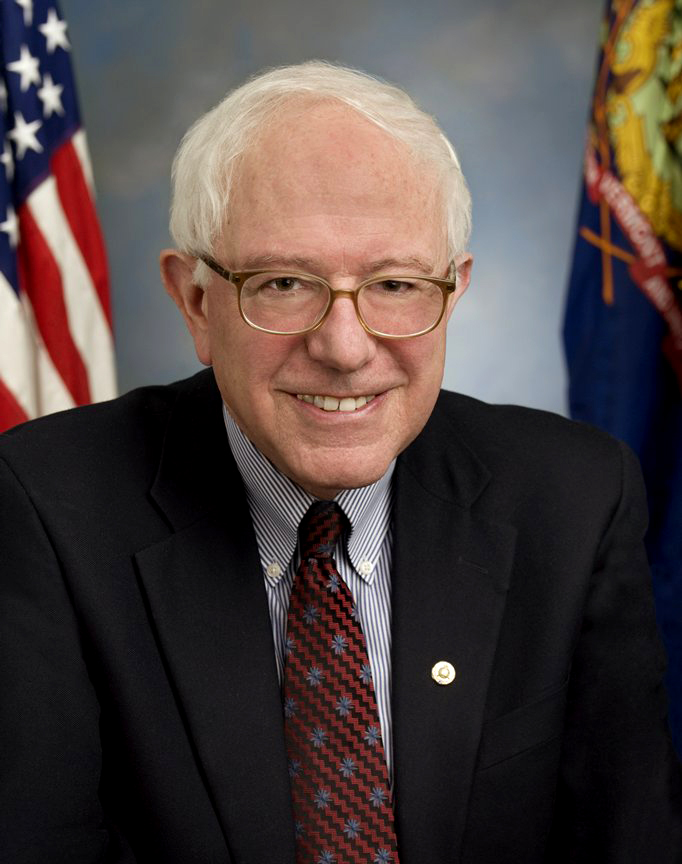
Bernie Sanders (Image courtesy Wikipedia)
The most attractive proposal of Sanders that has literally caught fire is his 'medicare-for-all'. Sanders's proposal is to institute a single payer system akin to what countries like UK, Canada and other European countries have. The woes of America's healthcare system are well known. Essentially America spends more capita on healthcare and results like mortality rates are no better than that of any industrialized country. Until Obama passed his legacy making healthcare overhaul legislation insurance companies refused coverage for pre-existing coverage amongst many other issues. Sanders makes the argument that for a modest tax increase on all, an average $500, everyone can get coverage that would save $5000. Those cost and savings projected are based on estimates arrived at by his campaign and have become the fiercest contested detail by especially left leaning economists.

Sanders often cites the example of Denmark as a model of a country that takes care of its poor. What Sanders conveniently forgets to mention is that Denmark has a top income tax rate of 60% and that rate starts at annual gross income of $60,000. If Sanders even offers a tax rate close to that from a debate stage his supporters will get a jolt of electrifying reality. Sanders presents a rosy picture of the single payer system without even hinting at why such a system is plagued by troubles in every country it currently exists. Sanders's own home state Vermont tried instituting a single payer system but eventually abandoned it because the projected costs exceeded the total revenue of the state despite stiff increases of taxes on businesses. Sanders argues that in a single-payer system there will be cost efficiencies because the government, the single-payer entity, can bargain better prices from drug manufacturers and hospitals. What is unsaid is that such cost-efficiencies entail deep cuts in how doctors and hospitals are reimbursed. It is a problem that the current medicare system faces with doctors and hospitals exiting the system due to paltry reimbursement.

A critique of Sanders's health plan by left leaning economists, a New York Times report noted, none of whom are aligned with Clinton and are not republican friendly, said that Sanders's plan "will increase the size of Federal government by more than 50%" and add "two trillion to $3 trillion to the deficit each year". Yes, that's each year.

An AP-GFK poll on support for Sanders's medicare for all illustrated the limits of what Americans are ready to support. 39% expressed support while 33% opposed the plan. When the supporters where asked if they'd still support the plan if the plan meant tax increases the support flipped with 39% now opposing. Essentially everyone loves socialism only when somebody else is paying the bill.

UK's much vaunted NHS is practically facing a revolt by junior doctors and an exodus of doctors to countries like Australia and New Zealand is happening. In Canada some private insurance is required to supplement the single payer insurance provided by the government and of course taxes on income and sales taxes are considerably higher than the US.

To make his health plan work Sanders needs to completely overhaul one-sixth of American economy ranging from how much doctors are paid, hospital reimbursements, drug pricing, ability to see specialists, even ability to sue doctors or hospitals for malpractices (nearly 75% of US malpractice lawsuits are frivolous lawsuits. But Democrats who are controlled by the multi-billion dollar Tort lawyers lobby will not touch Tort reform with a ten foot pole). Indian-Americans boast of having large number of doctors and many hope their children will become one, therefore it's ironical to see this group support Sanders's fantasy plan.

Skyrocketing college fees is a nightmare for every American parent and Sanders the Santa Claus comes to the rescue with 'free-college for all'. Just as his single payer system was a failed idea in practice this too is a failed idea. A Washington Post article lays bare the stupidity of such an idea with a stinging title, "the false hope of free college". This is utter nonsense. Like anything given free the program when implemented by Georgia it was a disaster. When Obama offered a similar plan even left leaning think tank Brookings institution ripped into it saying that it is "bad for poor Americans". Again, Sanders will have to institute price controls for teachers salaries and college administrators. Elizabeth Warren, beloved lioness of the fringe far left and former professor at Harvard, was paid $300,000 for being a part-time professor.

Sanders airily dismisses talk of how to pay for his programs with a proposal to tax Wall Street transactions. He calls it a "tax on speculators" and rants that the business model of Wall Street is 'fraud'. His campaign cites very optimistic estimates of such revenue. The position paper on his own site states plainly that the revenue estimates from such a tax has little theoretical background since it has never been tried. A "financial transaction tax" will not hit just "millionaires and billionaires" but every American who holds retirement accounts and college savings accounts, both of which are heavily used by the high earning Indian-American community. When Obama floated a proposal to tax the wildly popular college savings plan even liberal democrats revolted, including a Sanders supporting colleague of mine. Again and again everyone loves socialism provided somebody else pays the bill.

While Sanders was filling stadiums with thousands of fawning supporters a friendly fire came from economists who had served in Obama's administration. When Sanders rails against a 'rigged economy' and calls for a 'political revolution' it discredits democrats who have fought in the trenches to advance liberal policies against stiff opposition. Sanders makes them look like weasels for compromises that they agreed to in order to advances a larger goal. The open letter bluntly stated that Sanders's economic proposals are not supported by evidence.

Sanders also hits Indian-Americans where it hurts most, immigration. He has always been anti-immigration arguing that influx of labor is inimical to native workers. Again, economic theory is not on his side. Running for the presidency in the Democratic party Sanders is spinning that his vote against a Ted Kennedy sponsored legislation for immigration that included a guest worker program was because that program was "akin to slavery". Hillary Clinton hit back that Ted Kennedy, a liberal lion of the senate, would not have proposed any legislation that treats workers as slaves. Sanders has muted his anti-immigration stance bending to political pandering for office. So much for truth telling.

Indians while being instinctively capitalist when it comes to their personal wallet and earning they are yet to become intellectually comfortable with capitalism as a philosophy. Many Indian-Americans who support Sanders are comfortable with higher taxes because they think he's only targeting 'millionaires and billionaires' and even if their taxes go up it'd only do so marginally in which case the benefits will outweigh the cost. Both are fallacious naivete. To finance Sanders's extravagant proposals taxes will have to rise steeply, on all. Sanders cannot have Denmark with American tax structure. There are some who'd argue "well so what if my taxes go up, after all someone has to pay".

During a debate Sanders pointedly accused Hillary of being unworthy of the label "progressive" because she's a "moderate". He could not have stated more clearly that in his mind being a progressive means a militant far left liberal and nothing to do with being a moderate. Moderation, for Sanders, is a vice. Sanders has a blind faith in the goodness of the government to the extent that when evidence piled  up against Veterans Affairs hospitals of corruption and venality he, according to a New York Times report, refused to believe it at first. On the contrary Sanders think an entire private industry is made up of criminals with fraud as business model. Sanders is a hypocrite who rails against Wall Street but is silent on how the EPA (Environmental Protection Agency), the darling of the liberals, created a man made disaster by flooding a river with highly toxic materials and indulged in a year long cover up of lead contamination in the drinking water supplied by the city of Flint. If any private company had done either of that Sanders would be baying for their blood.

A Sanders presidency will hurt Indian-Americans where it hurts most, college admissions for their children. Indian-American applicants to colleges face a steep challenge, especially for Ivy League universities, thanks to affirmative action and admission practices that practically border on discrimination. The passing away of dependably conservative Supreme Court justice Antonin Scalia has put the very ideological balance of the court at play. Sanders has already vowed to nominate a liberal judge. Asian-Americans have filed lawsuits against Harvard alleging discriminatory practices. A case against affirmative action is already pending in the Supreme Court. With a justice like Sonia Sotomayor, a self confessed affirmative action baby, is inimical to Indian-American interests and the absence of a Scalia poses grave danger to prospects of Indian-American kids.

Sanders, as Hillary points out, is a single-issue candidate who knows nothing beyond ranting about income-inequality. To a question of Afghanistan he turned the answer to Syria and parroted his vote against the Iraq war in 2003 leaving the viewers scratching their heads. Indian-Americans still mostly view their adopted country as a foreign country and through the prism of foreign policy. Also, they are instinctively sympathetic to the ideas of America as an imperialist country without having taken any efforts to learn how an isolationist country underwent a metamorphosis post-Munich and Pearl Harbor. Sanders tries to present himself as reasonable by saying he's not totally against war but his record is anything but. The 1991 Persian Gulf war, sanctioned by UN Security council, funded by Saudis and had a clear definition of what constitutes victory, did not get his vote of approval in the Congress nevertheless. Sanders is a hopeless far left liberal pacifist who's intellectually incapable of understanding geo-politics.

Why should any of the above matter? Hillary adroitly recently pointed out that the dishonesty behind telling voters, especially the poor voters, that they can save $5000 by paying just $500 in taxes is cruel. Sanders's intellectual dishonesty is breathtaking. He shares, uncomfortably, several traits with Trump. Trump often beats back those who say his policies are unrealistic he retorts with a truism that anything he says is true because he says it and anyone refusing to accept it is tarred with a brush. Sanders labels his naysayers as "the establishment" and "reactionaries".

How does Sanders attract so many fawning voters? People love free stuff. That's an undeniable attraction for anyone. Who'd not like it if their kid can get free education, especially when somebody else is picking up the tab. Sanders's voters, in another parallel with the Trump campaign, have simply willed themselves into believing anything he peddles. Washington Post editorial board acidly wrote, "Mr Sanders's success so far does not show that the country is ready for a political revolution. It merely shows that many progressives like being told what they want to hear". The editorial was duly titled "Bernie Sanders's fiction filled campaign".

Why did Paul Krugman and Fareed Zakaria decry Sanders for promoting unserious ideas and for peddling intellectually dishonest economics? Both Krugman and Zakaria have repeatedly condemned Republicans for peddling intellectually dishonest theories about how tax cuts, however irresponsible and not paid for, would spur growth and compensate the loss of revenue. Krugman and Zakaria lamented how Sanders is bringing back an era of democratic politics when unrealistic economic proposals where freely dished out to entice voters about how paradise was waiting. Zakaria wrote:

"But this is nitpicking. He is painting with a broader brush, being an authentic man who speaks his mind, willing to present bold ideas geared to capture the imagination. Never mind that establishment elites criticize them as unworkable or divisive or radical.Am I speaking about Bernie Sanders — or Donald Trump?"

Bernie Sanders is bad for Indian-Americans and America.

References:

  1. Fareed Zakaria's column "Bernie Sanders's outlandish plans make Republicans look serious" https://www.washingtonpost.com/opinions/sanderss-plans-make-republicans-look-serious/2016/02/18/4dbddb40-d684-11e5-b195-2e29a4e13425_story.html
  2. New York Times article "Why left of center policy wonks are skeptical of Bernie Sanders" http://www.nytimes.com/2016/02/19/upshot/why-left-of-center-wonks-are-skeptical-of-bernie-sanders.html
  3. NYT article "Left leaning economists question cost of Bernie Sanders's plans" http://www.nytimes.com/2016/02/16/us/politics/left-leaning-economists-question-cost-of-bernie-sanderss-plans.html
  4. AP-GFK poll on support for healthcare http://www.usnews.com/news/business/articles/2016-02-25/ap-gfk-poll-support-shaky-for-sanders-medicare-for-all
  5. Obama administration economists's open letter to Sanders https://lettertosanders.wordpress.com/2016/02/17/open-letter-to-senator-sanders-and-professor-gerald-friedman-from-past-cea-chairs/
  6. Paul Krugman's column on Sanders's economic policy "Varieties of Voodoo" http://www.nytimes.com/2016/02/19/opinion/varieties-of-voodoo.html?rref=collection%2Fcolumn%2FPaul%20Krugman&action=click&contentCollection=Opinion&module=Collection&region=Marginalia&src=me&version=column&pgtype=article
  7. Washington Post editorial "Bernie Sanders's fiction filled campaign" https://www.washingtonpost.com/opinions/bernie-sanderss-fiction-filled-campaign/2016/01/27/cd1b2866-c478-11e5-9693-933a4d31bcc8_story.html
  8. Washington Post oped "The false hope of free college" https://www.washingtonpost.com/news/grade-point/wp/2016/02/23/the-false-hope-of-free-college/
  9. Brookings Institution paper on Obama's free college plan http://www.brookings.edu/research/opinions/2015/01/20-obama-free-community-college-bad-idea-sotu-butler
  10. Washington Post editorial rebuttal to Bernie Sanders who claimed that they oppose his plan because it's bold. "Bernie Sanders's idea are not too bold. They are facile" https://www.washingtonpost.com/opinions/mr-sanderss-ideas-are-not-too-bold-they-are-too-facile/2016/01/28/e7125bca-c60a-11e5-9693-933a4d31bcc8_story.html


Sunday, February 7, 2016

Bharathi: From Being Copyrighted to Belonging to the People. Chalapathi's, Artful Summary. Merits and Flaws. ('கவிஞனும் காப்புரிமையும்')

பாரதியின் 'பக்திப் பாடல்கள்' யாவிலும் சில பொதுக் கூறூகளைக் காண முடியும். விநாயகரிடமும், முருகனிடமும், பராசக்தியினடமும் பாரதி வேண்டுவன: கவிப் பாடும் திறன், தெளிவானச் சிந்தை, உடல் நலம், பொருள். அவன் வேண்டிக் கேட்டவற்றுள் அவனுக்கு வாய்த்தது கவித் திறன் மட்டுமே.

"எள்ளத் தனைப்பொழுதும் பயனின்றி
      இரா தென்றன் நாவினிலே
வெள்ள மெனப்பொழி வாய்சக்தி வேல் சக்தி
       வேல், சக்தி வேல், சக்தி வேல்!"
                                             --- ஓம் சக்தி

"நினைக்கும் பொழுது நின்மவுன
     நிலைவந் திடநீ செயல்வேண்டும்,
கனக்குஞ் செல்வம், நூறுவயது;
இவையும் தரநீ கடவாயே"
                                              ---- விநாயகர் நான்மனி மாலை

"காளி வலியசா முண்டி-ஓங்
    கரத் தலயியென் நிராணி-பல
நாளிங் கெனையலைக்க லாமோ?-- உள்ளம்
    நாடும் பொருளடைதற் கன்றோ?
..........................
என்னைப் புதியவுயி ராக்கி-எனக்
    கேதுங் கவலையுறச் செய்து-மதி
தன்னை மிகத்தெளிவு செய்து-என்றும்
     சந்தோஷங் கொண்டிருக்கச் செய்வாய்"
                                              ---- யோக சித்தி

[With apologies to readers I'll continue in English]


Subramania Bharathi (11th December 1882 - 11th September 1921) who donned many roles in his short but eventful life is credited with being a major contributor to modern Tamil literature and in modernizing an ancient language that boasts of a hoary heritage stretching back to two millennia. Yet, like Shelley, his idol, the recognition of his poetic genius evolved over the years only after his death. Though Bharathi wrote copiously his poems were scarcely published as anthologies in his own lifetime and even when in the few occasions they were published they sold few. 

A.R. Venkatachalapathy, also known as Chalapathy, professor (discipline unnamed) in Madras Institute of Development studies, has written a clear chronological summary of events leading to placing Bharati's works in the public domain, an event that he considers as pivotal in the making Bharathi a household name.


Bharati's widow Chellammaa started a publication named Bharathi Ashramam (பாரதி ஆச்சிரமம்) and published a few of his works between 1922-24 but the venture was a commercial failure. A fallout happened between Chellamma and her brother Appadurai following which she teamed up with Bharathi's step-brother Viswanatha Iyer to publish Bharati's works. Viswanatha Iyer joined with Harihara Sarma and K. Natarajan to establish 'Bharathi Prasuralayam' (பாரதி பிரசுராலயம்) in 1931. Chellamma who faced monetary pressures sold the rights to Bharati's works to Viswanatha Iyer in 1931 for Rs 4000. Viswanatha Iyer, in a bitter pamphlet he wrote amidst the nationalization shenanigans, admits that while the money paid appeared meager it was still a good sum in those days and given the then commercial interest in Bharathi's works it was quite appropriate. Seeing the advent of gramophones unleash a music industry an astute Viswanatha Iyer transferred the audio rights of the poems to one Jaisinghlal Mehta in 1934 for Rs 450 plus royalty on the records sold. Mehta later sold the rights to the enterpreneurial movie mogul A.V. Meiyyappa Chettiar in 1946 for Rs 9500.

Bharathi's poems were quite popular in Tamil Nadu during the freedom struggle and as a result he was venerated amongst the leadership of Congress which spear headed that struggle and even the Communist Party. Notably, P. Jeevanandam, a communist party leader and avowed student of Tamil literature venerated Bharathi. Jeeva's protege Tamil writer Jeyakanthan recorded that Jeeva told him that no one can be good communist in Tamil Nadu without knowledge of Tamil literature. In Tamil Nadu, as elsewhere, the art scene that included plays, music and films were filled with nationalist themes. The TKS brothers, as they were popularly called, were known for nationalist themed plays. In their plays they often used poems from Bharathi. They decided to make a movie out of their popular play 'Pilhanan' (பில்ஹணன்)  which featured a poem from Bharati's anthology of poems about Krishna (கண்ணன் பாட்டுகள்). They were promptly served a legal notice by AVM on 29th January 1948.

Jeeva, in the meantime, had been collecting support to 'nationalize' Bharathi's poems. It was unprecedented and flew in the face of established law concerning copyrights. In what is possibly the only place that can be called 'insightful' Chalapathy hints that Jeeva, a communist, would've been influenced by the philosophy that he espoused against private property in addition to his desire to see Bharathi popularized amongst the masses by unshackling him from the restraints of the law. 

A group that called itself "organization to liberate Bharathi" (பாரதி விடுதலைக் கழகம்) comprising of Trilok Sitaram, Vallikannan and Narana. Thuraikkannan gathered on 11th March 1948 to press for the nationalization of Bharati's works.

Events moved on multiple fronts. The regard with which Bharathi was held in a newly independent nation, ability of a group of literary persona to influence the rulers of the day, a ruling administration that was keenly responsive to public and literary sentiments all came together in a fortuitous combination to culminate in a landmark legislation that saw a government acquire the copyrights of an author. 

The speed with which the then government, headed by Omandurar, proceeded on this issue is breathtaking. T.K. Shanmugham wrote to Omandurar on 5th April 1948, Omandurar makes a file note to education secretary on 7th April 1948 to figure out how to proceed. On 20th April education secretary Avinashilingam Chettiar wrote back asking for powers to negotiate an acquisition of the copyrights.

After ascertaining that Bharati's family is willing to relinquish their rights, though legally they really had no rights to relinquish as the rights were held by Viswanatha Iyer and AVM, and the facts relating to the case in the Coimbatore court Omandurar invited AVM to convey his decision to acquire the rights. AVM consented to give up his rights after being compensated in full. Viswanatha Iyer too gave  up his rights for a sum of Rs 15,000. On 12th March 1949 Avinashilingam Chettiar announced to the legislature that the government had acquired the rights to all of Bharathiar's works.

The government owning the rights created it's own usual problems. The government machinery now moved in an agonizingly slow manner in bringing out a definitive edition of the poems. When Rajaji asks for a 'brief' note explaining the reasons for the delay he gets, Chalapathy records without realizing the irony of the words he chose, a 'detailed' reply. The definitive edition is published in 1954 when Kamaraj had become the chief minister. Seeing how the government has instead become a stumbling block now there was a clamor for the government to relinquish rights to 'the people'. Again, bending to public sentiment, the government released the rights 'to the people' on 14th March 1955. Now, Bharathi belonged to the  people.

Chalapathy's narrative is simple and straight forward. Adding the correspondences, affidavits and government orders as appendices adds to the documentary value of the book. The odyssey to acquire and then release the rights of Bharati's works shows in fleeting glimpses the ebb and flow of the poet's popularity in public imagination. Chalapathy also points out how this clamor to 'nationalize' works of note degenerated, in later years, into government high handedness when works were said to be nationalized without consulting legal heirs and when works of not just dubious quality but no quality were given the honor.

A few simple errors that need correction should be pointed out. 

On page 14 Chalapathy writes that Rani Annadurai was paid Rs 10 lakhs for the rights to the works of Annadurai whereas Chalapathy's own oped in that regard, produced in full on page 142, says the amount was Rs 75 lakhs.

On page 15 Chalapathy refers to an article he wrote for Kalachuvadu in the Jan 2006 issue. The appendix 12 that he refers to shows the article appearing on issue dated Jan 2007. It's kind of silly for an author to get the dates and information from his own article wrong and contradictory. And, to pile on this the article in Kalachuvadu stated that Bharati's works were released to public domain in 1963 contrary to the book stating that it happened on 14th March 1955. Unless I'm wrong this is a mistake wrapped inside a mistake.

On page 59 Chalapathy says that Chellamma gave an affidavit to Tirunelveli collector on 5th Feb 1949 detailing books published by Bharathi between 1910-1918. The corresponding document on page 116 states that the books listed were for the period 1910-1916. 

A questionable indignation is offered for the attempt to nationalize the works of Rajam Krishnan even while she was alive. Works are nationalized to override the period of copyright accorded by law so it does not matter if the author was alive or dead. This is facetious indignation.

A.R. Venkatachalapathy - Image Courtesy Hindu.
How does Chalapathy rate as a historian based on this book? 

Chalapathy repeatedly asserts that not even Gandhi, Nehru and Premchand's works received the 'honor of nationalization'. This is silly and a patently wrong assertion. An ill-informed reviewer in Tamil edition of The Hindu, also popularly known to be an ideological fellow traveler of Chalapathy, repeats this canard. First, there is no national process or honor to nationalize works of merit. It was something that happened for Bharathi due to the unique nature of people involved, especially, as Chalapathy himself points out, like communist Jeeva. The cases of Gandhi and Nehru are different also because their works were held by well established organizations that took upon themselves to maintain their works. Moreover, successive governments undertook massive and legendary exercises to collect and publish the writings of Gandhi and Nehru. While Chalapathy gleefully asserts that Gandhi and Nehru did not get the 'honor' he fails to mention his idol E.V. Ramasamy in that vein. Come on Chalapathy, a historian should not be wearing his politics on his sleeve. But, more about Chalapathy's politics shortly.

Recounting facts, however well researched they may be, in a chronological order, sprinkled with passing observations does not a historian make. A historian weaves a tapestry of facts to produce an overarching theme that glues the events. Chalapathy dubiously asserts that releasing Bharati's works in public domain made his works enduringly popular. While the claim has it's merits it does short work of other possible factors. By that account everyone whose work reached public domain must have seen at least a fraction of Bharati's popularity. 

Chalapathy's oped in 'The Economic Times' on Annathurai's works being nationalized brings to the fore his muddled politics and more importantly his inability to work out a theme.

Not even Annathurai's starry eyed followers with a modicum of intellect would agree to Chalapathy's claim that Annathurai 'single handedly, through his writings and speeches, led the Dravidian movement'. Chalapathy, sadly, forgot his education and training in history to write like a lumpen columnist for DMK's rag sheet 'Murasoli'. He laments that a 'whole generation has grown up without reading much of Anna's works, a process compounded by the anti-intellectual turn the Dravidian movement took in the 1960s'.

I fully support popularizing Annathurai's works, especially 'ஆரிய மாயை' and 'கம்ப ரஸம்', because those two works would help establish that the 'anti-intellectual turn' was not a latter day phenomenon but that Annathurai was indeed it's fountainhead. Jeyakanthan, with good reason, characterized the DMK as a 'cultural menace'. 'அவர் எழுதிய குப்பைப் புத்தகங்கள் எல்லாம் அவர் மரணத்தை எருவாகக் கொண்டு குருக்கத்திப் பூக்களாக மலர்ந்து விடப் போவதில்லை' என்று சந்நதம் செய்த ஜெயகாந்தனின் ஆவி சலபதியை மன்னிக்காது. See reference below for sections of Jeyakanthan's famed speech.

Chalapathy's oped contains dubious assertions and claims with no factual basis. Pray, I'd like to know who defined a classic as "a work often quoted but rarely read"? Then he asserts that "nationalization further reinforces the status of a classic and makes it more easily available". Are we to now assume that 'availability' equals 'readership'? Even more dubiously he claims that nationalization, beyond 'democratizing literature', 'has aided research and pursuit of knowledge'. This is shallow and without merit. Copyrighted works probably aid research better because the probability of the work not having lost integrity is higher. In fact in Bharathi's own case this is amply well illustrated.

Though the government released the rights to the public domain it issued guidelines as to how Bharati's works could be published. An artificial categorization of the poems, imposed by a government committee, has practically taken root and only now, with the publication of Seeni. Viswanathan's magnum opus, do we see the differences.

Chalapathy who sits on the board of literary awards is happy that the government renamed one of Bharati's famous poems, 'பிஜித் தீவிலே கரும்புத் தோட்டங்களில் ஹிந்து ஸ்த்ரீகள்', as 'கரும்புத் தோட்டத்திலே'. Seeni-Viswanathan in his definitive chronologically arranged edition of Bharathi's poems lists the many titles that were changed by Viwanatha Iyer's publication house and later by the Government. The government instituted changes reflected the then anti-Sanskrit sentiment that was sweeping across the state, thanks, in no small measure to Annathurai and his cohorts. 'ஸரஸ்வதி ஸ்தோத்திரம்' became 'கலைமகளை வேண்டுதல்'. 'போகின்ற பாரதமும், வருகின்ற பாரதமும்' was originally titled 'நிகழ்கின்ற ஹிந்துஸ்தானமும், வருகின்ற ஹிந்துஸ்தானமும்'. Any historian, much less one who adjudicates literary awards, is expected to at least record such a fact with disapproval of governmental high handedness and not support such a perfidy with cheer.

The political affiliation of Chalapathy is common knowledge and Chalapathy makes little effort to either conceal it or yield to scholarship when facts and beliefs collide. The student of history happily yields to the partisan in him. Writing about the change of guard from Rajaji to Kamaraj he says "by then the opposition to hereditary education policy by DK, DMK and even within Congress" resulted in the unseating of Rajaji. The sentence is worded in such a way as to perpetuate a falsehood that the education policy advocated by Rajaji was indeed titled 'hereditary based education'. No. Not at all. It was the opposition parties that labeled the education policy as being casteist and promoting hereditary based occupational education. Whether that criticism is fair or not is beside the point but it is a blatant unforgivable error in a book of history to repeat propaganda without sticking to facts.

The use of Grantha letters is another issue over which Chalapathy ties himself in knots. Rajaji's name stays as it is while Kamaraj's name is mangled by substituting the grantha letters with Tamil letters. (ராஜாஜி ராஜாஜியாகவே இருக்கிறார் ஆனால் காமராஜர் காமராசர் ஆகி விடுகிறார்). ஒரே பத்தியில் டி.கே. சன்முகம் (அவர் உண்மையில் 'ஷன்முகம்') தி.க. சன்முகம் ஆகிறார். புத்தகம் முழுவதும் ஐயராக இருக்கும் விசுவநாத ஐயர் புத்தகத்தின் கடைசியில் இணைக்கப்பட்டிருக்கும் படத்தில் 'விசுவநாத அய்யர்' ஆகிறார். விஷயமா அல்லது விடயமா என்பது ஆசிரியருக்கு தீராத குழப்பமாகவே இருக்கிறது. திராவிட இயக்கத்தவர் அல்லவா அப்படிப்பட்ட தெளிவின்மைகள் இருக்கத்தான் செய்யும் வாசகர்கள் பொறுத்தருள வேண்டும்.

Tamil writer Karichaan Kunju reminiscing about his days in school during 1940s, in an article about his friend T. Janakiraman, writes how Bharati's works were proscribed and how reciting his poems would invite stringent punishments. The dramatis personae in the quest to liberate Bharati's works are, interestingly, mostly non-Brahmins, including many in the portals of power. I wondered about the DMK propaganda of how Brahmins had a hegemony over power and cultural avocations. Ascribing the freedom to publish and freely available cheap editions (I've a copy of Poompuhar published Bharathi anthology dated 1978 from my father, priced at Rs 7) as being a prime reason for the popularity of the poet does injustice to a complex history of societal movements and socio-cultural reasons. That story remains to be told by a social historian. From Brahmins proscribing Bharati's poems to Brahmins, who maintain a stranglehold on Carnatic music, adopting his songs exclusively, ignoring even Bharathidasan's poems in totality, is an interesting tale that awaits a historian for it's narration.

The most unedifying part of the book that I hope subsequent editions will do without is the foreword. Apparently Chalapathy and the publisher, Kalachuvadu, have had some friction with a descendant of Bharathi. Chalapathy uses the foreword to ridicule the great-granddaughter of the poet for staking a moral claim to the poet's works and for ascribing greed as a motive for those who published her illustrious ancestor's works. It is specious to deny the descendant her 'moral claim' while acceding such a claim to Chellamma that the author and the then government give her despite the fact that she had no legal standing since she had sold the rights to Viswanatha Iyer. One cannot choose the moral pedestal when convenient and then turn to legal settings when inconvenient. For a person who diligently presented all documentary evidence it is unbecoming not to have included the oped written by the descendant that Chalapathy takes exception to. Moreover given that the publisher was Kalachuvadu, who also happens to be a publisher of the book, it is an ugly spectacle of an author carrying water for his publisher that too in the foreword of a book. This section crosses all limits of ethical conduct.

Two suggestions to the publisher and author. Please add a chronology of events. I actually typed out one just to get my timeline of events correct in order to write this review. Also, a good non-fiction book needs an Index, at least of names. Even a rudimentary one would be a good idea.

Kalachuvadu has a well earned reputation for producing books by authors of quality and well produced books at that. This booklet is a fine addition to their list of publications. Chalapathy, the faults not withstanding, has produced an important addition to the literature about Bharathi. For the lay Tamil reader this booklet gives a window into an important slice of history. Chalapathy shows promise to be a good historian one day. 

References:

  1. A. R. Venkatachalapathy's article in Kalachuvadu issue dated June 2015 on the copyright issue. This article pretty much sums up the book. The book, rather booklet, only adds to this article by way of including evidentiary support as pointed in this review. http://www.kalachuvadu.com/issue-186/page43.asp
  2. A review in 'The Hindu' (note, I am not the author of that adulatory review. It's a different person) http://tamil.thehindu.com/general/literature/பாரதி-படைப்புகள்-பொதுவுடைமையான-கதை/article7980196.ece
  3. A.R. Venkatachalapathy https://en.wikipedia.org/wiki/A._R._Venkatachalapathy
  4. Karichaan Kunju on T. Janakiraman and being punished for reciting Bharati's poems http://solvanam.com/?p=15152
  5. Jeyakanthan's legendary (or notorious) speech about Annathurai http://idlyvadai.blogspot.com/2009/09/blog-post_2410.html
  6. Excerpt from Jeyakanthan's speech:
"அண்ணாதுரையின் மறைவினால் அவர் இந்திய அரசியலில் பிரிட்டிஷ்காரர்களின் கையாளாக நமக்கு அறிமுகம் ஆனவர் என்ற உண்மை மறைந்துவிடுவதில்லை. நாத்திகம், சமூக சீர்திருத்தம் என்ற அசட்டுத்தனங்களில் சிக்கி நமது இலக்கியங்களையும், புராணங்களையும், ஹிந்து சமயத்தையும் பாமரத்தனமாக விமர்சனம் செய்து பாமரர் மத்தியில் புகழடைந்தார் என்கிற உண்மையும் மறைந்து விடாது. அவர் எழுதிய குப்பைப் புத்தகங்களெல்லாம் அவரது மரணத்தை எருவாகக் கொண்டு குருக்கத்திப் பூக்களாய் மலர்ந்துவிடப் போவதில்லை. அவர் சம்பந்தப்பட்ட எல்லாமே இரவல். இரவலே ஆயினும் அதை அவர் ஒப்புக் கொள்ளாததால் அது இலக்கியத் திருட்டு. அதற்கும்மேல் அவரது இரவல் சரக்குகள் எத்தகையது என்பதை அறிகிற பொழுது, அவரது தரம் மிகவும் தாழ்ந்தது என்கிற உண்மையையும் இந்த மரணம் வந்து மறைத்துவிடப் போவதில்லை.
அவரை அறிஞர் என்று மூடர்களே அழைக்கலாயினர். அவரைப் பேரறிஞர் என்றூ பெருமூடர்களே அழைக்கலாயினர். நகைச்சுவை எழுத்தாளர் என்று பெயரெடுத்திருந்த கல்கி அவர்கள் பத்திரிகையில் எழுதிய ஒரு நாடக விமர்சனத்தில் அண்ணாதுரையை பெர்னாட்ஷா என்று வஞ்சகப் புகழ்ச்சி செய்திருக்கிறார். தமிழர்களே! உங்களுடைய தற்காலத் தகுதிக்கு இவர்தான் பெர்னாட்ஷா என்பதாகவே அதை நான் புரிந்து கொண்டேன்."