Sunday, August 13, 2017

From Tanjore to Gorakhpur: Government Hospitals are Pathetic

Moving beyond the politics of the moment in the murders (I refuse to call it tragedy) in Gorakhpur of 60 children the bottom line is Public Healthcare is in a pathetic state all over India, without exception. This primarily affects the poor. 
Dravidian party clowns are running around on Facebook claiming all sorts of statistics on TN's healthcare compared to other state. Yes TN fare better but if the benchmark is UP and Bihar the bar is very low indeed.  
Here's a news item in The HIndu about Government Children's Hospital in Chennai (http://www.thehindu.com/todays-paper/tp-national/tp-tamilnadu/childrens-hospital-flooded-with-patients/article12559570.ece). WHAT THE DAMN F*** is THIS? See the picture. Is this a children's ward in a hospital or a photo of a badly run Dharmasala? Go away clowns, hide your heads in shame and may we never hear from you again.


Government Children's Hospital Chennai (Image from The Hindu)

These are just some news clippings found after 2 minute search in Google.
Both my brother and I were born in a government hospital and my dad worked as an ENT surgeon in a Government hospital for 20 years. The lack of oxygen is a perennial problem in government hospitals. My father literally saved my life as an infant when he recognized that the oxygen supply had stopped from the common feeder and ran and dragged an oxygen supplier and put it on my face. Other children in the ward were not lucky. Once we procured oxygen from a private hospital and supplied it to an uncle admitted in Tanjore Medical College Hospital. That was in the mid-eighties.
My father used to swear by the facilities in a Medical College Hospital compared to the poorly run mom-and-pop shops that were the nursing homes that dotted the town. He used to say that unlike those 'polyclinics' in the government hospitals there were qualified doctors round the clock.
But even in those days Tanjore's Rajah Mirasdar Government Hospital was a bloody cess pool. I've been there in the eighties and I remember struggling not to vomit. The maternity wards were pathetic. In places the maternity wards would even lack privacy screens. Stop lecturing how great Government hospitals. If they were not called hospitals we could file human rights violations against those hospitals. Doctors suffer too. No proper restrooms, no proper sleeping quarters for duty doctors, pathetic instruments, badly maintained machinery. Oh the litany is endless.
The Karunanidhi scheme of medical insurance was daylight robbery and an outright scam that only contributed to inflating the costs and robbing much needed hundreds of crores from being invested in government hospitals.
The commercialization of medical education in Tamil Nadu and neighboring Southern states of Karnataka and Andhra is a healthcare crisis of mega proportions.
Tamil Nadu has 25 government run medical colleges of which many were created by just government fiat and lack proper facilities to be either called a college or a hospital. Tamil Nadu also has 24 private medical colleges where wallets determine whether someone can become a doctor. In private medical colleges seats are sold as 'package deals' that include a PG degree. Does that mean MBBS degree is already in the bag? These colleges lack proper faculty. (http://timesofindia.indiatimes.com/city/chennai/tamil-nadu-adds-1000-mbbs-seats-in-six-years/articleshow/58877893.cms)
Then there's the case of paucity of doctors, especially in specialties. The Endocrine society of India records 600 members. 600 Endocrinologists in a population of 1 billion (https://www.ncbi.nlm.nih.gov/pmc/articles/PMC3263175/).
After my father's death, due to prostate cancer, I did some research on cancer care in India. India has only 1500 oncologists. ONLY 1500. Cancer care, from diagnosis to treatment, is mostly done by doctors who are not oncologists. The only popular cancer care center for the poor in Tamil Nadu is Adyar Cancer Institute. Cancer management in most Indian hospitals, private and government run, is pathetic. It is almost aboriginal compared to US. Make no mistake, every equipment and drug available in US is available in India. The problem is pathetic lack of qualified oncologists.
When my father was diagnosed with prostate cancer in 2002 he went to Apollo hospitals Chennai for radiation therapy. Apollo, at that time, had linear accelerator which provided precision treatment unlike the Cobalt treatment available in Tanjore government hospital. The latter would have created many side effects and destroyed much more of healthy tissues.
During another healthcare crises in 2013 we took my father to Apollo Chennai for a gastro-enterology surgery. We had to pay Rs 50,000 to get admitted. Thankfully money is not a problem for us. I saw a sea of humanity in Apollo hospitals. The place literally thronged with thousands. Most were just middle-class. In a city that had many government hospitals I wondered why this clamor for such an expensive private hospital that literally bankrupts many. Literally unless one is abjectly dirt poor none goes to government hospital and even they yearningly look at other options. The hospitals are pathetically run. From lack of proper facilities to more important lack of qualified doctors in specialities the government hospitals are an affront to the idea of public healthcare. No wonder the only thing that Karunanidhi and Jayalalitha agreed on was that Apollo Hospitals was their choice of place to get treated not the government hospitals in Chennai.
In what country would a dilettante film star become a health minister in the Union Cabinet? Only in India could a clown like Shatrughan Sinha become a health minister. But then only in India could a school dropout like Smriti Irani become an education minister. Anbumani Ramadoss, a doctor, on the other hand, was more interested in looting JIPMER and humiliating the dean of AIIMS than in providing healthcare to the impoverished millions. Dr. Harsh Vardhan, the current incumbent, is a fount of wisdom who suggested that sex education should be banned.
India does not 'invent' drugs but mostly plagiarizes them. The merits and demerits of that is a separate issue but it is a crucial issue that India faces with the WTO (World Trade Organization). India's drug policy is covered by the ministry of chemicals and fertilizers. For such an important ministry India nominated an illiterate thug like M.K. Azhagiri.
A Reuters article highlights the pathetic state of healthcare in India. India has "9 hospital beds and 6.5 physicians per 10,000 people according to World Health Organization. By comparison China has 42 beds and 14.2 doctors, while Britain has 33 beds and 27.4 physicians for every 10,000 people". The article notes in a one line paragraph, starkly, "those who can afford it tend to choose private health care" The article also highlighted the sever drug shortage in government hospitals. (http://in.reuters.com/article/india-free-drugs-chennai-public-health-idINDEE86M00I20120723). Another article also draws attention to an alarming drug shortage in Tamil Nadu (http://timesofindia.indiatimes.com/india/Tamil-Nadu-among-states-likely-to-face-drug-shortage-as-retailers-look-for-more-profits/articleshow/22172124.cms).
In 2015 my dad's prostate cancer had metastasized all over his bones and an expensive medicine was prescribed to manage the growth. It cost Rs 80,000 per month. Again, we could meet it. I had dashed down to Tanjore to be with my father and on my way back to Chennai I saw a group of construction workers working in the hot sun in drab clothes. My first thought was "what have governments done for these people? Their children depend on government school which are mostly cow sheds and they depend on government hospitals which are also cowsheds".
Access to quality education and healthcare is largely beyond the reach of the hundreds of millions of poor in India. The Gorakhpur murders are a sad reminder of that.


Tuesday, August 8, 2017

Varahamihira and the Eclipse: A Question of What is Science

Amidst all the Trump related shenanigans and the perennial scandal plagued 'Breaking News' about the American presidency a silver lining is the excited talk about the coming total eclipse. Today NPR (National Public Radio) featured a nice segment on obsessive eclipse watchers. As luck would've it I came across a blog about an ancient Indian astronomer that ended with a plea that Indian school boys should learn about such simple to learn science that India once had. I commented that only God can save science in India and naturally the brickbats came along. But here's why I said so.

The NPR segment on 'Eclipse chasers', also called, the anchor highlighted, 'umbraphiles' or 'shadow lovers' was interesting precisely because it brought to attention people obsessed with eclipse watching. Donald Liebenberg, 'a professor of astronomy at Clemson University in South Carolina', has seen more eclipses and spent more time in 'totality' than any one alive. He, NPR said, pioneered using aircraft to follow the shadow of the eclipse including one time the use of the famed Concord. Read the link in the reference for more interesting details.

Francis Bacon
NASA, of course, leads the efforts on public education regarding the eclipse with lots of material on its site. NASA also has sections devoted to study of eclipses across human history. An Irish astronomer has discovered an evidence in Ireland that shows precise knowledge of eclipse that might correspond to the one that occurred in November 3340 BCE!!! Babylonian and Assyrian astronomers, the page informs, were able to predict eclipses with fair accuracy in the 8th or 10th century BCE.

The Royal Society emblem with its motto 'Nullius in verba' (Take nobody's word for it)

Can the Greeks be far behind. NASA page quotes Archilochus' poetry, referring to the eclipse of 6th April 647 BCE, "Zeus, father of the olympians, made night from mid-day, hiding the light of the shining Sun". "Around 460 BCE, the Greek historian Herodotus wrote that Thales was able to predict the year when a total solar eclipse would occur. Details of how this prediction was made did not survive."

John Milton, who peered at the heavens using the telescope Galileo made, wrote in Paradise Lost "As when the Sun, new risen, Looks through the horizontal misty air, Shorn of his beams, or from behind the Moon, in dim eclipse, disastrous twilight sheds On half the nation and with fear of change perplexes monarchs".

The blog I came across was by, Rangarathnam Gopu, an admirer of Varamihira. Gopu has written a couple of other blogs I liked, about Lavoiseur and his touring of US for sites related to science. Varahamihira is more popularly known as the father of the pseudo-science astrology and Gopu is irked by that. He draws attention to few Sanskrit verses that Gopu underlines for Varahamihira's scientific temperament.

While most Indians explained eclipses, like the Chinese did, with myths about a snake swallowing up the moon Varahamihira 'reasoned' that it was merely a shadow passing. Let's pause here for a moment.

Astronomy is the most ancient science simply because man, across cultures, looked up at the heavens and worshipped the powers unknown and yet tried to understand what lay yonder. Will Durant differentiates between science and philosophy in "Story of philosophy". "Soon as a field of inquiry yields knowledge susceptible of exact formulation it is called science. Every science begins as philosophy and ends as art; it arises in hypothesis and flows into achievement".

The study of history of science tells us a story of the trajectory of ideas from speculation, then maturing into logical reasoning and finally becoming science when it fulfills the conditions of scientific framework.

Priyamvada Natarajan, professor of physics and astronomy at Yale, in her very readable book "Mapping the heavens: The radical scientific ideas that reveal the cosmos", traces the development of ideas and how they gained acceptance and what that arc tells of us in turn. "My goal", Privamvada states,  "is to recount how scientific ideas have been developed, tested, debated, and eventually accepted." "How scientists grow to accept new ideas and rewrite their knowledge maps not only reveals how science works but also provides insights into what catalyzes these shifts in belief".

In the history of science as an intellectual endeavor the most consequential tectonic shift happened with the establishment of the Royal Society in London in 1660. The founders of the society were inspired by the English philosopher Francis Bacon's ideas of experimentation and principles of science.

The Royal Society adopted as its motto, 'Nullius in verba', 'on the word of no one' or 'take nobody's word for it'. If nobody's word is to be taken then how are words, theories, to be judged? Here steps in the patron saint of Royal Society, Francis Bacon who had supplied the Society's founders with the principles to evaluate science. Experimentation and provability.

James Gleick in his biography "Isaac Newton" wrote about the formation of Royal Society, "dedicated to information flow. It exalted communication and condemned secrecy". "The society's founders explicitly worried about the use of any language. Philosophy had mired itself in its own florid eloquence. They sought 'not the artifice of Words, but a bare knowledge of things'. Now it was time for plain speaking, the most naked expression, and when possible this meant the language of mathematics."

Andrea Wulf in her critically acclaimed biography "The invention of nature: Alexander Von Humboldt's new world" writes about the Royal Society in Humboldt's day, "They conducted experiments, 'electrified' people, learned about new telescopes, comets, botany and fossils. They debated, exchanged results and read letters that has been received from scientifically minded friends and foreigners alike." Humboldt, a member, was thrilled and remarked after a meeting that "all scholars are brothers". Humboldt incidentally was obsessed with traveling to India but was scuttled by the East India Company for over 20 years. Wulf thinks the Company was probably wary of Humboldt visiting a colony.

Modern science or what can be called science today requires observation, recording of data, reasoned conclusions that are supported either by proven theories or mathematics or reproducible in a lab. If Gopu had stopped with talking about Varahamihira's verses as evidence of scientific 'temperament' in a different era I'd have had no problem with it but he advises school students to learn it as 'science'. No it is not. Science has long since moved much farther than what can be called 'speculation' or mere 'hypotheses'. If Varahamihra had tabulated observations or provided better reasoning, even if not absolutely mathematical by today's standards, it could be considered as the beginning of science. If Gopu had narrated Varahamihira's verses as part of a broad history of man's expanding understanding I'd have applauded but he lapses into a puzzling broadside that India's school children are taught as 'though only Europeans explained them'. He even invites college science teachers to use the blog material. Sigh. Sigh. Sigh.

Tamil chauvinists have used verses from Tamil literature to claim knowledge of atomic fission and Newton's Third Law etc. While I understand the common angst by many Indians that the common school boy grows up without knowing what a vibrant intellectual and scientific community India once was and thinks that everything 'scientific' originated only in Greece and later in Europe and recently in America. George Gheverghese Joseph's book "The Crest of the Peacock: Non-European roots of mathematics" could be recommended, a tad hesitatingly, for giving a sweeping narrative of contributions to mathematics by non-European civilizations. Interestingly he omits any mention of Varahamihira. I said 'hesitatingly' because the book, published by Princeton University Press, is authored by a person whose academic qualifications are not detailed beyond 'degrees in UK'. Reading his chapter on Indian math, far better than any most Indian enthusiasts write, I found it to be a little over-eager and less becoming of a book published by a university press, that too Princeton university.

While I'm all for laying out historical antecedents and for anyone to learn history in its totality and not exclusionary the urgent need in India is to understand science as a modern discipline. A recent ugly spectacle is the collective ululation about the scientific genius of Abdul Kalam, a man who cannot be called a scientist by any relaxed definition of that word. I'll give a list of wonderful books on science in the references. They're all a treat to read and sadly, most Indian students are not only blissfully unaware of such books many cannot even grasp why they're beautiful. The day an Indian student knows that John Gribbin's 'In search of Schrodinger's cat' is science while Fritjof Capra's 'Tao of physics' is not science he or she would become a beacon of hope in India.


References:


1. Rangaratnam Gopu's blog http://varahamihiragopu.blogspot.in/2014/10/varahamihiras-eclipse-proof.html
2. Kerala Mathematicians and Isaac Newton. Interview by George Joseph http://www.thehindu.com/features/friday-review/history-and-culture/dr-george-gheverghese-joseph-tsays-the-work-of-kerala-mathematicians-influenced-their-european-counterparts/article7818063.ece
3. Eclipses in history https://eclipse2017.nasa.gov/eclipse-history
4. Eclipses through traditions and cultures (NASA site, that includes a link to a Hindu site) https://science.ksc.nasa.gov/mirrors/gsfc/omni/eclipse99/pages/traditions_Calendars.html#India
5. Scientific method https://en.wikipedia.org/wiki/Scientific_method
6. Royal society https://en.wikipedia.org/wiki/Royal_Society
7. NPR segment on Eclipse chasers http://www.npr.org/sections/thetwo-way/2017/08/08/539553696/go-see-it-eclipse-chasers-urge-your-first-time-is-always-special

Recommended books on Science:


Disclaimer, I've not read all of the books below. Most are recommendations based on why I bought them for reading, hopefully some time.


  1. Structure of Scientific Revolution - Thomas Kuhn
  2. The Logic of scientific discovery - Karl Popper. Also certainly check out his 'Open society and its enemies'
  3. In search of Schrodinger's cat - John Gribbin. AMAZING MUST READ SIMPLE BOOK on quantum physics and its history.
  4. A brief history of time - Stephen Hawking. Obviously.
  5. Feynman Lectures - Richard Feynman. And his "Surely your'e joking Mr Feynman". Also check out other titles by him.
  6. The immortal life of Henrietta Lacks - Rebecca Skloot. Understand how medical science advanced and institutional racism in the then American medical fraternity.
  7. Ascent of man - Jacob Bronowski. A TV series turned into a thrillingly readable book. 
  8. Emperor of maladies - Siddhartha Mukherjee. Debut book that garnered the Pulitzer and a riotous read of scientific advancement in the taming of cancer.
  9. Selfish gene - Richard Dawkins
  10. What is mathematics - Richard Courant and Herbert Robbins
  11. Joy of X - Strogatz
  12. The Fellowship - John Gribbin. About the Royal Society
  13. The Sixth extinction - Elizabeth Kolbert. Critically acclaimed Pulitzer winner.
  14. The strangest man: The hidden life of Paul Dirac, Quantum genius -- Graham Farmelo
  15. Einstein - Walter Isaacson. (For the more scholarly, check out 'Subtle is the Lord' by Abraham Pais)
  16. The vital question: Energy, evolution and the origin of complex life - Nick Lane.
  17. Power, sex, suicide:Mitochondria and the meaning of life - Nick Lane
  18. Perfect Theory: A century of geniuses and the battle over general relativity - Pedro G. Ferreira. Lucid and gripping.
  19. The beak of the finch - Jonathan Wiener. Pulitzer winner.
  20. Why evolution is true - Jerry Coyne
  21. Faith vs Fact: Why Science and Religion are Incompatible -- Jerry Coyne
  22. Polio - David Oshinsky. Pulitzer winner for a grippingly told drama about the invention of vaccines that defeated a scourge of humanity.
  23. The Age of Wonder: How the Romantic generation discovered the beauty and terror of science - Richard Holmes. A literary and scientific tour-de-force.
  24. The idea factory: Bell Labs and the great age of American innovation - Jon Gertner. How individual giants like Shockley, Bardeen and an American corporation and American government colluded and competed to unleash an era of creativity.
  25. The man who knew infinity: A life of the genius Ramanujan -- Robert Kanigel. As always the best books on India and Indians are by westerners. Incidentally on even the competing movie versions it was Danny Boyle who made the better movie compared to a pathetic Indian attempt
  26. Cells to civilization: The principles of change that shape life - Enrico Coen. A chapter begins by discussing Cezanne's refusal to correct an imperfection in a painting and glides into an analogy of the complexity of life. It might take aeons for a book like this to come from an Indian university by an Indian professor. One can hope though.

Monday, July 24, 2017

Did Golwalkar Admire Hitler? Hindutva’s perspectives on Nazism, Fascism and Zionism

A popular retort, of those who place themselves in opposition to the religious fundamentalism of Hindutva, is to cite select passages of Guru Golwalkar’s book ‘We or our nationhood defined’ and accuse the Guru of being an admirer of Hitler and Nazism. Accusing the Sangh Parivar of cosiness with the most repugnant ideologies of twentieth century, Nazism and Fascism, often ends up in fruitless shouting matches with shrill voices where one accuses and the other rejects.  What are the facts?

‘Who are we?’


Every nation, young and old, often asks of itself ‘who are we’ or variations of that. Harvard scholar Samuel Huntington wrote his highly polemical “Who are We? The challenges to America’s national identity” in 2004 and worried if the “key elements” of American Culture - “English language; Christianity; religious commitment; English concepts of rule of law, the responsibility of rulers, and the rights of individuals; and dissenting Protestant values of individualism, the work ethic”- were being threatened by the influx of “new wave of mmigrants from Latin America and Asia”.

Lest one attach the label of a demagogue  Huntington draws a careful distinction that is, in effect, academic hairsplitting, with the caution, “let me make clear, an argument for the important of Anglo-Protestant culture, not for the important of Anglo-Protestant people”. He asserts that he wrote the book as “a patriot and a scholar”. As a patriot he’s worried about “unity and strength” of his country. As a scholar he finds the “historical evolution of American identity” a fit topic to discuss. He confessed that the “motives of patriotism and scholarship may conflict” and that his “selection and presentation of that evidence may well be influenced” by his patriotic desires.

Republican party ideologue Pat Buchanan, unlike Huntington, has no academic shackles to even pretend what worries him and what his remedies are. “Suicide of a Superpower: Will America survive to 2025” was Buchanan’s gloomy book published as recently as 2011. The chapters are helpfully titled, “The passing of a super power”,”The death of Christian America”,”The crisis of catholicism”, “The end of White America”. 

In one of my earlier blogs I, too, have argued for immigrants to assimilate themselves into the American culture. The culture I had in mind is not what Huntington had in mind and certainly not the kind Buchanan had. Culture is never static and what Huntington characterizes with a very broad brush of Protestantism is the product of English, Germanic and Irish, amongst others. Each of them were distinct flavors and none accepted the other. Free speech, an open and accepting society, a society where minority rights are protected and in fact the culture that I enjoy and wish the immigrants learned to be a part of are exactly the kind that Buchanan hates, example, diversity. 

Irrespective of their ideological background every Indian leader of note, Gandhi, Nehru, Ambedkar, Golwalkar liberally fashioned their ideas of how to unify India based on the ideas of nationalism that sweeping across the Western world. Broadly, cultural and linguistic unity were to be the bedrock of a unified India and India, precisely on those counts, posed a conundrum. No nation in the 21st century, let alone in the middle of the 20th century, offered a template for nationalism for India. 

While Gandhi and Nehru were mindful of the fact that India, due to its large number of minorities, is unique and called for unique solutions Ambedkar and, specifically, Golwalkar proposed homogenization, unmindful of the cost. Broadly speaking though Golwalkar, actually, was closer to Gandhi and Vivekananda than to Adolf Hitler.

Golwalkar and the mainstream:


Golwalkar writes about religion:

“Religion, in its essence is that which by regulating society- in all its functions, makes room for all individual idiosyncrasies, and provides suitable ways and means for all sorts of mental frames to adopt, and evolve, and which at the same time raises the whole society as such, from the material, through the moral to the spiritual plane” and adds “Such Religion—and nothing else deserves that name—cannot be ignored in individual or public life. It must have a place in proportion to its vast importance in politics as well.”

The language and sentiments are stunningly Gandhian. “Truth has drawn me into the field of politics. Those who say religion has nothing to do with politics do not know what religion is”, said Gandhi. The important distinction is, to Gandhi religion was search for truth but to Golwalkar it was Hindu theology. Even with that distinction Golwalkar’s views were not too far apart with not just Gandhi but even with that of Martin Luther King Jr. Suffusing politics with religion Gandhi often irritated Jinnah and made Nehru, a secular agnostic, uncomfortable. Golwalkar’s ‘Bunch of thoughts’ shows a positive disposition towards both Nehru and Gandhi.

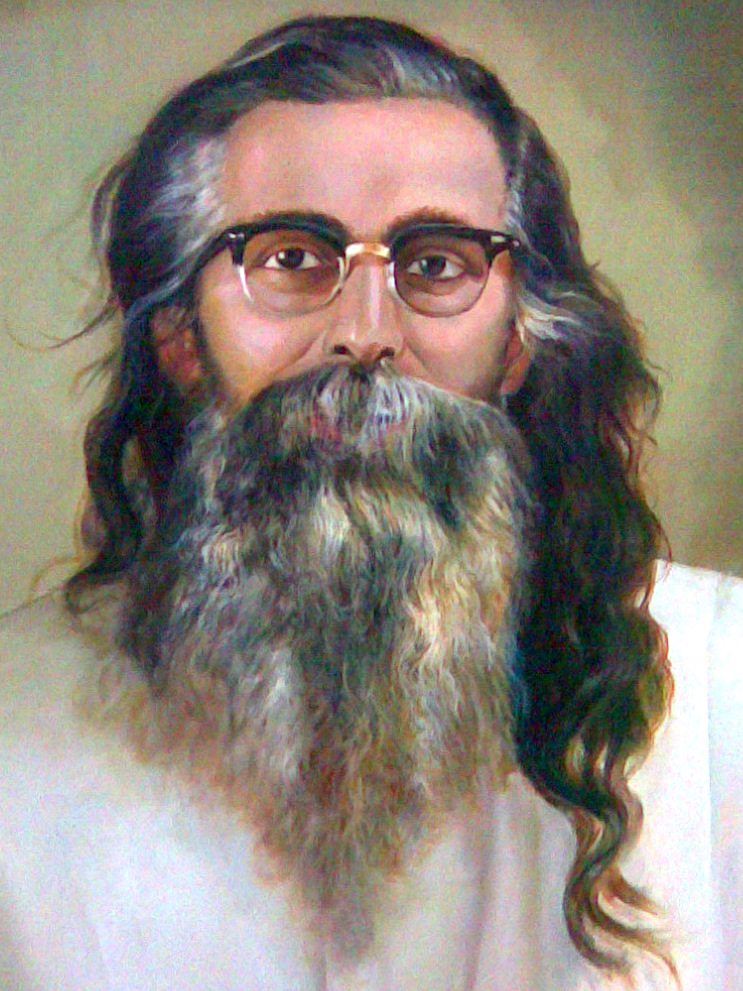
Guru Golwalkar (Image Courtesy Image003.jpg)

Writing on why Western nations marched towards secularism Golwalkar is pretty unerring, “for the general, Race it was considered profitable to assume a more tolerant attitude towards the various sects and religious persuasions, and leave the individual to choose whichever he liked, provided only, he did not, in following his beliefs, becomes a nuisance to his neighbors. To ban religion altogether from all public and political life is but one step forward and a natural one”. 

Anyone who has followed the debates concerning the place of religion in public spheres in today’s America will realize that Golwalkar’s only mistake was in assuming that the journey was unidirectional and would not slide back and forth. That said, Golwalkar’s desire of intertwining religion and politics hews closer to Gandhi and William Buckley and MLK Jr. William F. Buckley Jr, author of ‘God and man at Yale’, would’ve loved Golwalkar.

Buckley while graciously allowing that he did not want his alma mater, Yale university, to “treat her students as potential candidates for divinity school”, he asked pointedly “we can, without going that far, raise the question whether Yale fortifies or shatters the average student’s respect for Christianity”. One could hear a Hindtutva supporter cluck his tongue thinking of Indian academia similarly.

On Communism and Russia Golwalkar in unsparing prose nails it:

“To most, religion means a set of opinions to be dogmatically followed, for the good of the individual and of the society and for the attainment of God. Here we have a religion which does not believe in God. It is a Godless religion but a religion none the less. For the Russians, their prophet is Karl Marx and his opinions are their Testament.”

During the Great War Stalin forsook Communist orthodoxy against Nationalism and eagerly stoked a muscular Russian nationalism to rouse the masses against the invaders in a moment of existential threat. Golwalkar wrote “we rest satisfied with pointing out that Russia has its country, race, its materialistic godless religion, with its resultant culture and its language and stands out before the world a Nation in its complete Nationhood, shorn of its borrowed feathers of Internationalism.” Churchill would’ve agreed.

Arguing that secularism should mean equal treatment of all with no quarter for any preferential treatment to anyone Golwalkar wrote:

 “In secular life all citizens are equal; this principle should be strictly adhered to. We must cry a complete halt to forming groups based on caste, creed, etc., and demanding exclusive rights and privileges in services, financial aids, admission in educational institutions and all such other fields. To talk and think in terms of "minorities" and "communities" should be totally put an end to”. 

Samuel Huntington was indignant that Civil Rights leaders who demanded a Civil Rights Act to enshrine equality then turned around and used the very act to demand preferential quotas. Even black economist and intellectual Thomas Sowell has made the same argument. While Golwalkar presaged Huntington’s indignation both suffer from the same blindness that ‘equal opportunity’ and ‘positive discrimination’ are not antithetical and opposing goals and communities that had long suffered discrimination needed a helping hand before being able to compete on equal footing. However, the idea here is to only point out that an impartial reader can find many mainstream ideas in Golwalkar’s writings that have nothing to do with Nazism or Fascism.

Golwalkar was a patriot and a nationalist in the Bismarckian mould and could brook nothing that sowed the seeds of dissension and encouraged separatism. Though he always refers to Sanskrit as language of Gods he chides those who ridicule languages spoken by other Hindus in other parts of India. “In fact all our languages whether Tamil or Bengali, Marathi or Punjabi are our national languages. All these languages and dialects are like so many flowers shedding the same rich fragrance of our national culture”. He did think, though, that all languages were inspired by the “queen of languages, the language of gods-Sanskrit”. Golwalkar’s attitude to language is very close to the official position of Congress which was promoting the use of ‘Hindustani’, a hybrid of Hindi and Urdu, as a unifying language while local languages like Tamil are used locally. 

Ambedkar and Gandhi are not too far apart from Golwalkar on the issue of conversions. Ambedkar in a stinging observation said “what the consequences of conversion will be to the country as a whole is worth bearing in mind. Conversion to Islam or Christianity will denationalize the Depressed classes…if they embrace Sikhism they will not only not harm destiny of the country but they will help the destiny of the country. They will not be denationalized…Thus it is in the interest of the country that the Depressed Classes, of they are to change their faith, should go over to Sikhism”. True to his word when he did convert himself and legions of followers Ambedkar, much to the delight of generations of Hindutva followers, chose Buddhism over Christianity or Islam.

Here’s Golwalkar:

“Conversion of Hindus into other religions is nothing but making them succumb to divided loyalty in place of having undivided and absolute loyalty to the nation. It is dangerous to the security of the nation and the country. It is therefore necessary to put a stop to it. Conversion of an individual does not take place after a serious and comparative study of philosophies by him. It is by exploitation of poverty, illiteracy and ignorance, offering of inducements and by deceptive tactics that people are converted. There is no question of a true change of heart involved in this. It is but right that this unjust activity is prohibited. It is a duty we have to discharge towards protecting our brethren in ignorance and poverty.”


Gandhi conceded the good work of Christian missionaries but asked, quite fairly it must be said, “even such noble service loses nobility when conversion is the motive behind it. That service is noblest which is rendered for its own sake”. Ambedkar retorted that Gandhi wanted to get services from Christian missionaries without giving anything in return. Golwalkar in one of his writings indignantly cites a Christian missionary in North East as saying that all charity work is with a motivation to convert and increase the number of Christians in India. While the charge and anger is not without merit the controversies surrounding conversions are more complicated.

Question of nationalism:


“There is one point more which has been troubling me very much of late and one which I want you to think carefully and that is the question of Hindu-Mohamedan unity. I have devoted most of my time during the last six months to the study of Muslim history and Muslim Law and I am inclined to think, it is neither possible nor practicable. Assuming and admitting the sincerity of the Mohamedan leaders in the Non-cooperation movement, I think their religion provides an effective bar to anything of the kind.”


THAT was not Golwalkar but Lala Lajpat Rai in a letter to firebrand revolutionary C.R. Das

“Another very important factor which, according to the poet, was making it almost impossible for the Hindu-Mohamedan unity to become an accomplished fact was that the Mohamedans could not confine their patriotism to any one country. . . .The poet said that he had very frankly asked many Mohamedans whether, in the event of any Mohamedan power invading India, they would stand side by side with their Hindu neighbours to defend their common land. He could not be satisfied with the reply he got from them”


THE poet referred was not Golwalkar but Rabindranath Tagore.

The quotes are from Ambedkar’s ‘Thoughts on Pakistan’ in a section titled “Can Hindus count on Muslims to show national rather than religious loyalty?” 

“What is that 'common emotion', that common basis on which all can come together?” asks Golwalkar. Arguing that a Hindu’s view of Hindu-Muslim unity is ‘hallucination’ Ambedkar writes, “Are there any common historical antecedents which the Hindus and Muslims can be said to share together as matters of pride or as matters of sorrow? That is the crux of the question. That is the question which the Hindus must answer, if they wish to maintain that Hindus and Musalmans together form a nation. So far as this aspect of their relationship is concerned, they have been just two armed battalions warring against each other. There was no common cycle of participation for a common achievement. Their past is a past of mutual destruction—a past of mutual animosities, both in the political as well as in the religious fields.”

Golwalkar and Caste:


The author of an article cherrypicked a quote by Golwalkar to show that he supported casteism. Golwalkar had refuted the accusation that Hinduism, weakened by caste divisions, had fallen prey to Muslim invaders, by citing the fact that caste ridden states, unlike those where casteism was muted, had actually withstood the onslaught of Buddhism. The cherrypicking author stopped there and charged Golwalkar with prescribing a caste oriented system. Golwalkar was merely refuting the accusation with a factual basis and he proceeded further to say in an extended quote that is largely true and agreeable: 
“Today, of course, the caste system has degenerated beyond all recognition. Added to the perversity aggravated over the centuries, a new factor has been introduced into our body- politic which has further intensified the rigidity and perversity of castes by those very persons who are most vociferous in their denunciation of the system. During elections, their consideration for selection of candidates as also their appeal to the voters is mainly 'caste'. At the root of the rising tempo of caste hatred and rivalry lies this appeal to gross selfishness and love of power in the name of caste. Even the state machinery is being prostituted for further widening these dissensions. Separatist consciousness breeding jealousy and conflict is being fostered in sections of our people by naming them Harijans, Scheduled Castes, Scheduled Tribes and so on and by parading the gift of special concessions to them in a bid to make them all their slaves with the lure of money.”


Of course Golwalkar was not being magnanimous out of a milk of kindness. Ambedkar dissembles this desire for unity amongst Hindus and points to the real cause. The purpose of this blog today is not to rebut Golwalkar but to show how close to the mainstream he was. A rebuttal will follow soon.

Golwalkar and the Nazi Regime:


The most controversial and most cited quote of Golwalkar is the one passage concerning “Germany”.
“The other Nation most in the eye of the world today is Germany. This Nation affords a very striking example. Modern Germany strove, and has to a great extent achieved what she strove for, to once again bring under one sway the whole of the territory, hereditarily Possessed by the Germans but which, as a result of political disputes, had been portioned off as different countries under different states. Austria for example, was merely a province, on par with Prussia, Bavaria and other principalities, which made the Germanic Empire. Logically Austria should not be an independant kingdom, but be one with the rest of Germany.”
Koenraad Elst, a Hindutva ideologue, in a column that largely whitewashes Golwalkar’s demagoguery points out, quite correctly, that Golwalkar only talks of the nation of ‘Germany’ and not of Nazism or Hitler. Elst is indeed correct in saying that Adolf Hitler was admired by many Indians when Golwalkar wrote that passage. Let us not forget that Subhash Bose actually allied with Germany and shook hands with Hitler. 

Golwalkar proceeded to add,

 “Germany shocked the world by her purging the country of the Semitic Races—the Jews. Race pride at its highest has been manifested here. Germany has also shown how well-nigh impossible it is for Races and cultures, having differences going to the root, to be assimilated into one united whole, a good lesson for us in Hindusthan to learn and profit by.”
 The passage is being wildly misinterpreted to suggest that he was prescribing a Nazi like racial purge. He was, merely using an extreme example to point out the incompatibility of two diverse “races”, like Tagore and Ambedkar,  to cohabit in comity. Golwalkar’s use of the word ‘race’ is another hot topic but suffice it to say he was using it to denote two culturally different groups.

Elst is an apologist for Golwalkar seeking to minimize the awareness of Golwalkar of the nature of the Nazi regime and his attitudes towards the minorities. 


Golwalkar and Israel:


Golwalkar had only one focus, the formation of a nation that is homogenized in thought and soul and in that pursuit he lauded Nazi Germany and Zionism, equally, with no sense of irony. In the same “We or our nationhood defined” Golwalkar wrote of Zionism, “The Jews had maintained their race, religion, culture and language; and all they wanted was their natural territory to complete their Nationality. The reconstruction of the Hebrew Nation on Palestine is just an affirmation of the fact that Country, Race, Religion, Culture and Language must exist unequivocally together to form the Nation idea.” 

Savarkar, too, while pointing out that Jews and Germans could not live together supported Zionism. Writing as early as 1923 Savarkar said “if the Zionists’ dreams were realised, if Palestine became a Jewish State, it would gladden us almost as much as our Jewish friends”. Koenraad Elst helpfully notes that Hindutva should draw inspiration from Zionism.

Like many other positions of Hindutva this love for Zionism and Israel had nothing to do with rejoicing at Jews getting a homeland but a sheer joy at ideological vindication in the nation of Israel. That Israel was established amidst Islamic opposition was further cause for cheer. Even with all that the love for Israel is fraught with contradictions that I’ll outline subsequently.

Moonje and Mussolini:


It was B.S. Moonje who met Mussolini the fascist dictator and his admiration for both Mussolini and fascism is often used as a stick to beat him and Hindutva. A notorious quote by Moonje is the most cited to argue his adulation of Mussolini and fascism.

“Nothing better could have been conceived for the military organisation of Italy...The idea of fascism vividly brings out the conception of unity amongst people...India and par- ticularly Hindu India need some such institution for the military regeneration of the Hindus: so that the artificial distinction so much emphasised by the British of martial and non-martial classes amongst the Hindus may disappear. Our institution of Rashtriya Swayamsewak Sangh of Nagpur under Dr Hedgewar is of this kind, though quite independently conceived.”

Sure, Moonje admired Mussolini and fascism as is evident from the quote but the motivation is driven by less nefarious factors than is often recognized. The British Raj classified some sects of Hindus as “martial classes” and provided them better opportunities to serve in the army whereas all others were deemed unsuitable, hereditarily, to belong to the ‘martial classes’. Moonje’s desire of militarization is to obliterate this artificial division and rejuvenate a warrior attitude to overthrow the colonial yoke. Until Gandhi came such attitudes were common and despite Gandhi there was always a streak of violent revolution in India. Again, let us remember the example of much lionized Subhash Bose who colluded with Germany and Japan, two of the most repugnant regimes at that time, in an attempt to liberate India by war.

The admiration of fascism as being an ideology that welded a nation together and forged unity appealed to Moonje. This too was not out of the ordinary and is less a ringing endorsement of everything that the word Fascism as defined by Mussolini meant.


Conclusion:


There is little proof of Golwalkar cheering Nazism or Hitler. While one may call Golwalkar’s ideas as being akin to Nazism it is completely untrue and unfair to Golwalkar to say that he was inspired by Nazism or framed his ideas inspired by Hitler. He merely uses the German example to buttress his ideas concerning majority and minority in a nation. Those views were largely in vogue across Europe at that time as ‘nationalism’. However, ascendant notions of ‘liberalism’ was, in some countries, tempering the zealotry of ‘nationalism’. Tagore clashed with Gandhi precisely on that count. 

Golwalkar and the Hindutva ideas were suffused with contradictions and can easily be rebutted. I’ve in this blog only tried to show that Golwalkar was not out of the mainstream in many aspects. We’ve to contextualize his views, repugnant or not, with the turbulent times when notions of diversity and secularism were quaint or non-existent. I remain a staunch opponent of Hindtuva and I’ll rebut most of these ideas in a soon to follow blog.
The Sangh Parivar has recently started to distance itself from Golwalkar’s ‘We or our nationhood’ by arguing that it is the product of a young mind, he was 32 years old at that time, and that his later writings show nuance and maturity. Is it true? Await the next blog for rebuttals and more.


Some References:


Thursday, July 6, 2017

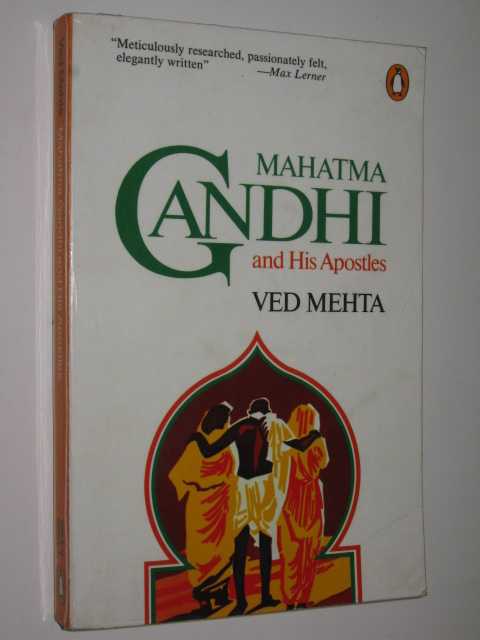
'Mahatma Gandhi and His Apostles' : An American Journalist in Search of Gandhi's Influence

Ved Mehta told an interviewer that his book 'Mahatma Gandhi and his apostles' sold out in 3 days in India and 60 members of India's parliament clamored for it to be banned and even burned it in the parliament. Mehta's book was published in 1976 after being serialized as a 3 part biographical essay in New Yorker. The previous two years saw the publication of 'Freedom at Midnight' by Larry Collins and Dominique Lapierre, 1975, and Nirmal Bose's 'My days with Gandhi' in 1974. Bose's book blew open a pandora's box that held within it the salacious details of Gandhi's Brahamacharya experiments.

None of those authors, to be fair to them, set out to right a tell-all biography to scandalize the Mahatma. The authors, especially Mehta and Bose, sought to tell a larger story within which they decided to be unflinchingly open about an extremely complex part of Gandhi's life and one that he himself had been open about.


"Why add to the pile", wrote Will and Ariel Durant in their preface to the final volume of their 11 volume 'Story of Civilization' that they called 'Age of Napoleon, referring to the nearly 100,000 volumes of books on Napoleon. Lives like that Napoleon's and Gandhi's are a biographer's delight irrespective of how well the field had been plowed. Mehta concedes the same by acknowledging the sweeping 9 volume biography of Gandhi by D.G. Tendulkar. What ground did Mehta, then, hope to uncover with his very slim attempt? What a Napoleon or a Gandhi does in his lifetime echoes into eternity and ricochets across the globe and Mehta attempts to catch a glimpse of Gandhi's echoes in the land he helped liberate.

It is said that the last Christian died on the cross but the Christian west, thanks to Romain Rolland, saw a Christ in Gandhi. Mehta uses the Christ metaphor and seeks to find how the apostles had carried forward the message of the messiah. At least a few key apostles of Gandhi, unlike Christ's, were still living in contemporaneous times.

An unnamed apostle details the life at Gandhi's ashram and vividly portrays Gandhi's daily habits. Gandhi, apparently, did nothing by himself. He was bathed, cleaned and fed by attendants, mostly female inmates. Abha cleaned the spittoon and even emptied the chamber pot used by Gandhi. The narrator bristles that some, including Gandhi himself, thought the inmates were misfits and 'mental-cases' and mentions how they worked hard to keep the ashram running. Coming to think of it none of Gandhi's famous lieutenants who carried on his political legacy in free India were ever inmates like Pyarelal Nayar or Mahadev Desai or Sushila Nayar. Sarojini Naidu probably had more pride in her to be like Sushila Nayar.

When Gandhi suggests to Sumitra, daughter of Ramadas, that she should be his secretary instead of going off to study she retorts "I don't want to become one of your inferior secretaries who wash your clothes and utensils". She told Mehta, "the really superior people, like Nehru, were never Gandhi's secretaries. The unnamed apostle also interestingly said that many ridiculed the inmates by saying "that healthy people like Jawaharlal Nehru, had no need of ashrams".

Mehta who had set out to understand how Gandhi's memories were preserved and propagandized goes in search of one of the most prodigious efforts to catalogue the voluminous writings of a man who lived more than three score years. He first met C.N. Patel, the deputy editor of what is now known as 'The Collected Works of Mahatma Gandhi' or CWMG. Patel is an unimpressive indolent gatherer of everything Gandhi wrote. Then Mehta meets K.Swaminthan, the editor of the series and who is widely credited for having brought the project to a creditable completion with the writings numbering 90 volumes.

Ved Mehta (Image Courtesy http://images.mid-day.com/2014/jan/ved.jpg)
The effort to collect Gandhi's writings was lavishly funded by the Indian government and Swaminathan commanded, he said, "fifty researchers, thirty clerks, just here in Delhi, and there are many others in Ahmedabad". Swaminthan is uncle to Indian writer Ramachandra Guha and gets a dedicated chapter in Guha's book "An anthropologist among Marxists'. Refuting a characterization of Gandhi by Guha, Swaminthan wrote to him that "he (Gandhi) taught us (as Jesus taught the Jews) that love is light and only love can overcome the dark evil, hate". Familial relationship blinds Guha to compare Swaminathan's efforts to that of Engels's and Boswell's.

Pyarelal Nayar's voluminous memoirs are sheer hagiography says Mehta. Pyarelal, who had stopped using his last name, tells Mehta that he intends to suppress Gandhi's views on Israel. Amongst the many controversial quotes of Gandhi one of the most notorious was his suggestion that Jews should commit mass suicide to appeal to Hitler's better senses. A perennial parlor game is to ask if Gandhi could've succeeded against a Hitler or a Stalin. He would not have and he never grasped the nature of their evil. Mehta wonders at the hagiographic instinct of Indians and concludes that it is possibly rooted in the Hindu culture in which "preserving of data are still something of a novelty" having "in the past traditionally neglected history in favor of speculation".

Chakravarti Rajagopalachari, called Rajaji, was hailed by Gandhi as his conscience keeper. Rajaji was an aging nonagenarian, a year away from his death, when Mehta met him in a South Indian city. Rajaji, for those who know his long and checkered career, had a reputation for being an acerbic wit. Rajaji's daughter had married Gandhi's son thus making them in-laws. Asked about Gandhi's Brahmacharya experiments Rajaji was blunt that Gandhi was "over-sexed". He also remarked dismissively that Gandhi's secretaries "did not share in his intellectual life" as he did. He also added that those who went around still propagating Gandhi's ideas were "mostly cranks".

Rajaji's observation is spot on when one reads about Gulzarilal Nanda who takes to astrology when he was marginalized from politics. V.S. Naipaul made withering dismissive remarks on Vinobha Bhave who earned a halo in India for making large landowners donate lands for the poor. Mehta concedes that of the nearly "4 million acres" that Vinobha Bhave got most were practically arid wastelands. Vinobha Bhave was no intellectual and never made any conscious effort to become one.

Many who read Mehta's book do not realize that Mehta wrote this as a three part essay in New Yorker in 1976 and as such it was meant for an American reader, primarily, written in the American journalistic tradition that take a theme, approaches it from the periphery, zooms in on it in the central part and then zooms out again. Likewise Mehta, after journeying through the memories of an unnamed apostle and the chroniclers of Gandhi, turns to brief biographical sketches in lengthy chapters with almost no new information. The biographical chapters have been written mostly sourced from other biographies. That said one has to give some credit to Mehta for fleshing out a succinct narrative for not just an American reader but for any Indian reader even today who does not have the patience to plow through other voluminous biographies of the Mahatma.


Indians rarely give credit to Gandhi's western influences and Gandhi himself actively ridiculed Western civilization while cheerfully borrowing from Thoreau, John Ruskin and most importantly from Tolstoy. Gandhi, Mehta sharply observes, loved not the nuanced Tolstoy of 'War and Peace' but the Tolstoy who turned a cranky old man of later years. Gandhi read 'Kingdom of God is within you' and imbibed the philosophy eagerly and obsessively. He had never read the major works of Tolstoy, unlike, perhaps Nehru.

Mehta touches, in the passing, Gandhi's genius for drawing in every section of people into the protests, especially women. Gandhi's genius and artistry was in devising protests unique to each situation and being extremely adaptive to quickly changing political settings. Only those readers who have had such an idea of Gandhi from previous readings could recognize those fleeting moments in Mehta's narration.

The limits of Gandhi's genius are evident from the fact that nearly nothing of what can be called Gandhian idea has survived today and were too promptly discarded in free India as fads. Referring to Gandhi's ideas on economics his most prominent financial backer, G.D. Birla, said those were nothing more than 'hallucinations'.

To Gandhi political emancipation ranked way below personal emancipation of India's millions who were mired in poverty and lived a subhuman existence. Nothing depressed Gandhi as much as the unsanitary habits of Indians. Time and again he would tell ashramites that the toilet should be so clean that one would not mind eating there. Mehta writes glowingly of Gandhi's 'Constructive Programme'.

The Constructive Programme, Mehta says, was to help the impoverished millions to live a life of self-sufficiency and with dignity. To that end Gandhi preached simple life that did not demand anything beyond bare essentials and any superfluity was to be eradicated from life. That, in Nehru's views, extolled poverty and extinguished any lofty ambitions to reach beyond the station of life. Both views have their merits, the latter more so. Wherever Gandhi preached abrogation of property many women donated their jewelry but once Gandhi moved on the people relapsed into whatever they were before Gandhi touched their lives. Jamnalal Bajaj's wife complained to Mehta that Muslims and Harijans were unclean and that she could not eat what they cooked. She used to eat food cooked by them in Gandhi's ashram.

Writing closely after Nirmal Bose and Larry Collins and Dominique Lapierre Mehta went to great lengths, unlike the previous authors, to interview the women who partook in Gandhi's Brahmacharya experiments.

Manu and Abha Gandhi were Gandhi's great-grand-nieces. Abha was married to Kanu Gandhi, Gandhi's grand-nephew. It appears that both Manu and Abha accompanied Gandhi during his tour in riot torn Naokhali. At Naokhali both teenage girls slept with Gandhi. Mehta specifically asks, as any good journalist should, Abha if she was naked. Abha replied that Gandhi requested her to remove her clothes but she still kept on her petticoat and blouse.

Sushila Nayar, sister of Pyarelal Nayar, was another famous participant in the experiments. Sushila, after an education in Johns Hopkins, headed the ministry of health in Nehru's cabinet. Though she did espouse Gandhi's ideas on celibacy as health minister she, in later years, popularized family planning and the use contraceptive device, 'the loop'. A Time magazine article in the 60s pays her a tribute for doing that in a socially conservative country like India. Sushila is blunt to Mehta that the excuse of 'Brahmacharya experiments' was invented by Gandhi after controversies arose.

Mehta goes to Austria in search of Madeleine Slade whom Gandhi had christened 'Mirabhai'. Mirabhai who had rediscovered her love of Beethoven bluntly said she did not want to talk about Gandhi. Raihana Tyabji, daughter of Abbas Tyabji (his daughter is the mother of historian Irfan Habib) who also shared the bed with Gandhi comes across, despite her aristocratic upbringing and learning, as a cranky sexpot.

All of these women came to Gandhi as broken or ignorant nubile teenagers and were swept in his aura. The women inmates of the ashram frequently bickered on who becomes Gandhi's favorite one. Mirabhai and Sushila literally become hysterical when Gandhi banishes them off and on. Gandhi's attempt to curb a simple natural impulse led him down a shameful road of deceit that remains a blot on his name.

K. Swaminathan tells Mehta that Gandhi "handed over the country to Nehru, who was an aristocrat, who had never lived in a village, who knew nothing about farming, so that today Gandhian ideas are completely forgotten by our government and society at large. Gandhi felt that ninety percent of our people didn't need to be governed. The only people who needed to be governed were the top five percent, made up of the avaricious, the hoarders....the rest were fit to manage their own affairs in the villages because they were godly men and women, the custodians of ancient Indian wisdom, of India's morality and religion".

That is arrant nonsense. Gandhi, too, never really lived in the villages and knew next to nothing on many things he so cheerfully pontificated upon. Gandhi's reading was sparse, whether it was on Hindu scriptures or anything else. Gandhi made up stuff as he went along from his ideas on medicine to diet to practically everything. This idyllic and utopian view of villages and villagers was in truth completely divorced from reality. This is typical Gandhian romanticization of a luddite lifestyle. Villages were cesspools of oppressive casteism and misogyny and the native farming methods, just to pick one, was backward. It is interesting to see how Nehru figures alternatively in the quotes of these apostles.

The greatest battles that Gandhi fought were Hindu-Muslim unity and the eradication of Hinduism's most ancient and most durable evil, untouchability. The blood and gore of partition showed that Hindu-Muslim unity will never be a settled question but an endeavor that required constant dedication. Likewise Gandhi's epic fast in 1931 that made upper caste Hindus to throw open temples to the lower caste who were hitherto prevented from entering was a turning point but not an enduring victory.

In 1915 Gandhi admitted Dudabhai Malji Dafda, called Duda, to his ashram. Duda belonged to the Dhed caste, dealers of animal carcasses and hides. Donors to the ashram stopped their donations and ashram inmates revolted. Gandhi did not yield. Mehta traces his daughter Lakshmi in Ahmedabad. Lakshmi was married to a Brahmin by Gandhi. In 1976 Lakshmi tells Mehta, "people here hold it against my children that their mother was born a Harijan". This is the reality.

Gandhi and Gandhians did not grasp governance or how a nation state interacts with its citizenry and could reorder social structures. This was alien to Indian tradition unlike England where such interactions sowed the seeds for something like Magna Carta. Nehru acutely grasped this difference in one of his writings on history.

Coming to the close of the book I wondered if Mehta should've included some Civil Rights leaders in America since they were as much Gandhi's apostles who, against an opponent much like the Colonial Raj, used Gandhian ideas. Beyond just non-violence Martin Luther King sent his confidant Bayard Rustin, as preparation for the March on Washington, to learn how crowds were controlled in Gandhi's rallies.

Nehru had clearly rejected Gandhi's ideas on economy and government directly to the Mahatma himself. Though Nehru is often vilified for walking away from Gandhi's shadow literally no one else, other than those Rajaji called cranks, were content to remain in that shadow or put to practice Gandhi's outlandish ideas.

Any discerning reader would consider the book a failure with sparse flashes of brilliance. A reader daunted by tomes could use the book to get a glimpse of who Gandhi was and progress to better biographies. Sadly we still have to rely on biographies or memoirs written by Louis Fischer, William Shirer or Joseph Lelyveld for readable versions. Ved Mehta is no historian or a biographer, much less an academic one, and it shows. I have access to archives of New Yorker and was able to locate the three issues in which the articles appeared in 1976. It is surreal to see a biographical article of Gandhi spread over many pages with opposing pages featuring ads for liquor and gambling.

The book is replete with very vivid descriptions of people, their faces, the dresses and the scenery. It'd not be surprising if one did not know that Ved Mehta is blind. Mehta lost his eyesight since age four. There have been controversies over how Mehta, in a way that suggests intentional over-compensating, gives vivid imagery despite his blindness. Publishers have never stated that Mehta was blind and this was seen as collusion to help fool the reader to believe what Mehta described. In extensive interviews in recent times Mehta has addressed this. He travels alone and has never used a cane that blind people use habitually. When he chose to leave for US to study, since India at that time would've been unsuitable for a blind school child, Jawaharlal Nehru personally gave a send off.

Men like Gandhi, just like a Buddha or a Christ, do not have a magic wand to change humanity forever but they leave humanity better than it was before they happened. While India may not have defeated inter-religious strife or caste oppression but it has certainly tamed them, largely and whenever it falls short the shadow of Gandhi shames their conscience. Unfortunately Mehta completely fails in leading a reader to appreciating Gandhi.

Mehta offers an expectant mea culpa in the foreword itself when he quotes Nehru, Gandhi's finest apostle and a fine student of history, to say that "no man can write a real life of Gandhi, unless he is as big as Gandhi". "Many pictures rise in my mind", wrote Nehru, "whose eyes were often full of laughter and yet were pools of infinite sadness. But the picture that is dominant and most significant is as I saw him marching, staff in hand, to Dandi on the Salt March in 1930. Here was the pilgrim on his quest of Truth, quiet, peaceful, regardless of consequence".

References:

Interesting interviews and articles on Ved Mehta

http://www.livemint.com/Leisure/TomLXHq2xUHLes0VoqbxsM/8216I-feel-I-belong-to-six-worlds8217.html

https://www.theguardian.com/books/2001/aug/25/biography.books

http://www.business-standard.com/article/beyond-business/the-mahatma-on-the-periphery-114022701270_1.html

https://www.telegraphindia.com/1140119/jsp/7days/17840229.jsp

http://www.rediff.com/news/report/slide-show-1-a-blind-brilliant-authors-reluctant-vision-of-india/20140226.htm#2