Showing posts with label Philosophy. Show all posts

Wednesday, September 30, 2020

A Ciceronian Treatise on Religion: Precursor to Western Ideas. Eastern Parallels.

"How to think about God: An ancient guide for Believers and Nonbelievers" is a selection from Marcus Tullius Cicero's "On the nature of the Gods" and "Dream of Scipio". Published by Princeton University the book is part of a series of bringing out selected prose from ancient thinkers, mostly Greco-Roman, that have relevance to contemporary world. Musing on the existence of Gods and the place of godhead in human life has a long tradition in human history across cultures. These selections from Cicero are about that. Separated by nearly a millennium it is surprising to see how much Greco-Roman heritage continues to echo in Western traditions and even more surprising is the parallels one could find with Hindu philosophy.

Marcus Tullius Cicero - From Wikipedia

From the Greek etymological roots the word philosophy simply means, 'lover of wisdom'. Sarvepalli Radhakrishnan, with help from Shakespeare, gives us an understanding of what we mean by a philosophical spirit. 
"When touchstone asks Corin in As You Like It, 'Has any philosophy in thee, shepherd?' Shakespeare means by philosophy not a system of abstract thought or a technical discipline of the schools but an attitude of mind which can best be described as 'idealistic'. Have you that spiritual dimension to your being, that mood of reflective inquiry and self-contemplation, that anxiety of mind to know the things spiritual in which is the true dwelling place of man?"

All ancient civilizations show a tradition of musing about God and religion and in some civilizations this reached into the higher echelons of philosophy and undoubtedly the Greco-Roman civilization was one of them. Of the Romans Marcus Tullius Cicero ( January 3rd BC - December 7th 43 BC) left behind an enviable body of work, both political and philosophical, and influenced many across the centuries "from St. Augustine and Dante to Voltaire and Alexander Hamilton". Having risen to become a consul in 63 BC Cicero was marginalized during the reign of Julius Caesar. It was then, in 45 BC Cicero wrote, "On the nature of Gods", an imaginary dialogue featuring an Epicurean, a Stoic and an academic debating the existence of God and his nature.

The selection in the book focuses on Quintus Lucilius Balbus (c100 BC) expounding on the nature of god or divinity. Translator Philip Freeman says the Latin word 'Deus' could be taken to mean 'divinity' or 'god' depending on context and thus render itself to very different meanings. Before Balbus could speak, in the fictitious debate that Cicero writes, Gaius Aurelius Cotta (124 - 73 BC), considered an academic, is invited to define his belief in gods. Cotta demurs saying that it is easier for him to "talk about what I disbelieve rather than what I believe". Hindu philosophy famously uses the principle of "not this, not this" (neti, neti). With that Balbus enters the dialogue.

Balbus says that the Stoic view of God has four parts. First, Gods exist; second, the nature of gods; third, how they govern the universe; and finally, their role in human affairs. On the question of existence of God Balbus uses an a priori approach and deduces that any contemplation of the heavens and nature around us should convince us, kind of axiomatically, that a higher intelligence "rules over this realm". Following such a line of logic he asks that the existence of the idea of God across the ages in the mind of man shows that time, the merciless sieve of useless ideas, has left behind this idea because it is valid and because god exists. 

"Prophecies and premonitions of things to come", is to Balbus, "proof that the future is being revealed, shown, portended, and foretold to human beings". Then Balbus emphasizes the importance of propitiating to the gods and beseeching good omens before large undertakings like wars. "Generals", Balbus adds, brought about good to the country when they "followed religious practices". Comparing Rome to other nations Balbus says that there are things that Rome may excel at or be inferior to but when it comes to "religion, that is, the worship of the gods" they are "far superior". I wonder how would a Chinese or Hindu react to that?

The appearance of a comet, to Balbus and Roman society, foretold a calamity. Shakespeare makes Caesar's wife Calpurnia plead with him, on the ill fated ides of March, that bad omen foretells a calamity if Caesar where to go to the senate. Referring to the sighting of a comet Calpurnia tells Caesar, "the heavens themselves blaze forth the death of princes". Ancient Tamil literature speaks of sighting a comet before Mantharan Cheral Irumporai, a chieftain, dies. A historical fiction, Ponniyin Selvan, also refers to sighting a comet before the murder of a prince.  Humanity, perhaps, has more in common than what divides us.

That comets exist and reoccur in intervals makes Cleanthes, a boxer turned philosopher and student of Zeno, argue for the existence of an intelligent power orchestrating it. Balbus, drawing up on Cleanthes, asserts, "the evidence of these celestial bodies should be enough to prove they are not the result of chance" but, "the result of an intelligent mind at work".

Cleanthes' and Balbus' idea of an "intelligent mind at work" governing the universe is central to the Judeo-Christian world that echoes even today in the evangelical war against Darwinian Theory of Evolution. God admonishes a grief stricken Job, in the Book of Job in Old Testament, "where were you when I laid the foundations of the earth? Tell me, if you have understanding.  Who fixed its measurements? Surely you know!" God then scolds Job for even thinking he knows how the world works and for questioning why the world works the way it works. Modern day deniers of Theory of Evolution have cooked up this theory of 'Intelligent Design' that is nothing but a Trojan horse for 'Creationism' based exactly on the premise that the universe could not be an accident but a purposeful creation of an intelligent Omniscient divinity. 

Hamlet mused in a soliloquy, 

"what a piece of work is a man! how noble in reason, how infinite in faculty! in form and moving how express and admirable! in action how like an angel, in apprehension how like a god! The beauty of the world. The paragon of animals".

That human beings, endowed with reasoning and intelligence superior to all other living beings, should possibly be the culmination of all life sounds arrogant to Balbus. He feels, Chrysippus, a student of Cleanthes, "the heavenly bodies in their eternal order cannot have been created by man. Therefore, that which created them is superior to man". The very reasoning and intelligence that characterizes a human being ought to be the result of a creation of an even more superior mind. Socrates asks in Xenophon, "where did we acquire the minds we have". "Nothing without spirit and reason", Balbus quotes Zeno," can give birth to an animate and reasoning being". An evangelical Christian in America, today, echoes that same thought across the ages.

Radhakrishnan, like other anthropologists, reasons that "when man is delivered from imminent peril, or realizes his utter dependence on the mighty forces of nature, he feels the reality of the presence of god. He hears the voice of God in the tempest and sees his hand in the stilling of the wave". God asks Job, as Radhakrishnan would've known, "who enclosed the sea behind doors when it burst forth from the womb?" "Naturalism and anthropomorphism seem to be the first stages of the Vedic religion" says Radhakrishnan and quotes Chrysippus, "the Sun, Moon and Stars and Law and Men who have turned into Gods". 

Chrysippus: Image Courtesy Wikipedia.

A striking parallel between the Greco-Roman worldview and the Hindu theology is the primacy assigned to fire. Heat has a tendency to destroy but heat within the human body and the sun is nourishing to life, a life preserver, a life giver. The Rg Veda, Radhakrishnan quotes, assigns to Agni, the Hindu god of fire, a primacy as creator. 

Balbus goes further in reasoning that since the sun and stars are "born in ether" untainted by man or earthly objects, are purer. And to Balbus, it is axiomatic, sun and stars have a life and their movements are volitional. They "move of their own free will and due to intelligence and divinity". A Hindu astrologer would applaud that sentiment. When Balbus says, "intelligence depends on food we eat. Stars live in ether nourished by vapors of land and sea...pure food" we see stunning parallels to Hindu beliefs concerning purity of food and its effect on human intelligence. 

On a side note, Radhakrishnan's acclaimed "Indian Philosophy" constantly draws parallels between Hindu and Indo-Iranian and Greek beliefs. Varuna is characterized in Rg Veda as omniscient, "knows the flights of the birds in the sky" and "not a sparrow can fall without his knowledge". The author of Book of Job would've been surprised at the oneness of vision. "Dyaus", to Radhakrishnan, "is not merely an Indo-Iranian deity but an Indo-European one. It survives in Greece as Zeus, in Italy as Jupiter". 

Speaking on the purpose of man's existence Balbus says, "humans have emerged for contemplating and imitating the universe. We are certainly not perfect, but we are part of perfection". In his Hibbert lectures Radhakrishnan says, "In a metaphor common to the Upanishads and Plato every unit of nature is a microcosm reflecting in itself the entire all-inclusive macrocosm". 

Balbus, having offered all the above arguments, concludes, "To sum up, the existence of the gods is so abundantly clear that I regard anyone who denies it as out of his mind". Tamil poet Bharathi, drawing upon a Vedic tenet, asks the reader to "believe" and "believing is indeed the path". ("நம்புவதே வழி என்ற மறை தனை நாம் இன்று நம்பிவிட்டோம்". "நம்பினார் கெடுவதில்லை நான்கு மறைத் தீர்ப்பு")

"Dream of Scipio" is the concluding part of a 6 part political work,  "On the Republic", by Cicero written between 54-51 BC. Only the Dream of Scipio is now available. The Dream is a fictional encounter between Scipio Amelianus (185 BC - 129 BC), known for his destruction of Carthage in the Third Punic war, and Scipio Africanus (236/235 BC - 183BC), his grandfather and legendary general who had defeated Hannibal in the Battle of Zama. 

The younger Scipio meets the elder Scipio in heaven in a dream and is taken upon a tour and lectured about the purpose of life and futility of glory. The elder Scipio advises that he who serves his country will be exalted and those who serve the country will find a place in heaven like the father and grandfather of younger Scipio. When the younger Scipio asks if heaven is the destination then why not he die and come sooner. He is admonished by the elder that the body that houses the soul of man is god's gift and only god can decide when the body dies. We see here the seed of Biblical injunction against suicide.

Mocking a life in pursuit of glory the elder Scipio cautions that glory will not "will not climb the Caucasus Mountains, which you see down there, or swim across the Ganges River over there? No one in the far eastern lands or the remote west or the northern or southern regions will ever so much as hear your name....Even among those who do know us, how long will your memory last?" "Place none of your hopes in human rewards. Let virtue herself by her own allurements draw you to true honor". "Keep striving and know this, that you're not mortal, only your body....The true self of each person is the mind. Know therefore that you are god". Here's an echo of 'That art thou'. The lines of H.W. Longfellow bears quotation here:

Life is real! Life is earnest! 
    And the grave is not its goal; 
Dust thou art, to dust returnest, 
    Was not spoken of the soul. 

Trust no Future, howe’er pleasant! 
     Let the dead Past bury its dead! 
Act,— act in the living Present! 
   Heart within, and God o’erhead! 

Lives of great men all remind us 
   We can make our lives sublime, 
And, departing, leave behind us  
    Footprints on the sands of time 

Amidst the tour the elder Scipio speaks of nine spheres and music emanating from melodious movements. One is reminded of Pythagoras's theory of the music of spheres.

What do we make of all this? While science has overturned all of the above what these reflections reveal is the aspiration of human spirit to understand life's purpose. While theology deems it impossible that our Earth could be an accident science teaches us that it is precisely that. 

Will Durant, writing on the purpose of philosophy, quotes Cicero, "There is nothing absurd but that it may be found in the books of the philosophers". Hamlet admonishes his friend Horatio, "There are more things in heaven and Earth, Horation, than are dreamt of in your philosophy". But then, as Durant teaches us there are pleasures in philosophy for only philosophy keeps alive the eternal human impulse of wanting to understand. For all his mocking of philosophy Cicero best exemplifies the spirit of Robert Browning that Durant gives as a reason for philosophy, "Life has a meaning, To find its meaning is my meat and drink".

After the assassination of Julius Caesar the triumvirate including Mark Antony pursued not just Caesar's assassins but their political enemies too and Cicero had invited the wrath of Antony. On 7th December 43 BC Cicero was executed. "On Antony's instructions his hands, which had penned the Philippics against Antony, were cut off as well; these were nailed along with his head on the Rostra in the Forum Romanum". Thus ended the life of one of the greatest Romans.

References:

  1. "How to Think About God: An Ancient Guide for Believer and Nonbelievers" -- Marcus Tullius Cicero; Selected, translated and introduced by Philip Freeman. Princeton University publication.
  2. The Story of Philosophy - Will Durant
  3. An Idealist View of Life - S. Radhakrishnan
  4. Indian Philosophy - Volume 1 - S. Radhakrishnan
  5. https://en.wikipedia.org/wiki/Cicero
  6. https://en.wikipedia.org/wiki/Writings_of_Cicero 
  7. https://en.wikipedia.org/wiki/Quintus_Lucilius_Balbus 
  8. https://en.wikipedia.org/wiki/De_Natura_Deorum 
  9. https://en.wikipedia.org/wiki/Gaius_Aurelius_Cotta 
  10. https://en.wikipedia.org/wiki/Cleanthes 
  11. https://en.wikipedia.org/wiki/Chrysippus 
  12. Dream of Scipio https://en.wikipedia.org/wiki/Somnium_Scipionis 
  13. https://en.wikipedia.org/wiki/Scipio_Aemilianus 
  14. https://en.wikipedia.org/wiki/Scipio_Africanus 


Wednesday, April 25, 2018

Audrey Truschke and Rama: An Academician Learns the Perils of a Trumpian Tweet

Audrey Truschke, Assistant Professor of South Asian History at Rutgers University, posted a tweet that, in her words, was a 'loose translation' of an exchange between two Sita and Rama, revered as gods, from the epic Ramayana and set off a furious exchange that continues unabated. Truschke's tweet was, to use a colloquial phrase like her, Trumpian. Her oped, published in The Wire, shows she still does not get it.

Audrey Truschke (Image Courtesy from Rutgers University s200_audrey.truschke.jpg)

We live in perilous times when academic researches are being debunked and maligned in both Trump's America and Modi's India. Academicians are under scrutiny for biases, conflicts and plainly mistakes that can be used to discredit not just their work but themselves and largely discredit academia itself. Audrey Truschke by committing what can only be called abject stupidity walked right into the trap.

Screenshot from Audrey Truschke's Twitter Feed taken on April 25th


The context, apparently, was the filing of a court case against a cartoonist for a cartoon in which Sita is telling Rama that she's happy that she was kidnapped by Ravana and not one of Rama's 'bhakts'. The cartoonist is alluding to the kidnap and gruesome rape and murder of 8 year old Asifa near Jammu by a group of Hindus who committed the heinous act at a temple. The cartoon, as cartoons will be, is biting. The cartoon or the filing of charges is not the debate today. Truschke took that incident and for whatever reason chose to connect it with Sita's criticism, if one can call it that, of Rama and chides what she saw as intolerance towards the cartoon. In attempting to buttress her claim she supplied a "loosely translated" verse from Ramayana. Truschke's loosely translated verse read, "Sita basically tells Rama he's a misogynist pig and uncouth". In a country where the building of a temple for Rama has engendered riots for over 20 years and spawned a fundamentalist movement this tweet was pouring gasoline over fire.

After fending off her detractors on twitter Truschke took to writing a self-serving oped in The Wire. The byline of the oped, borrowing from her text, piously declares that "reverence is not and should not be a requirement for describing or analyzing a religious text". True, but a tweet is not an analysis and lack of reverence is different from being contemptuously derogatory, that too without basis. An academician can be provocative or espouse a provocative view but provocation, as much as reverence should not be, should not become the driving reason in a discourse. One can be intentionally provocative but one should be prepared to reap the whirlwind too.

Truschke, from calling what she quoted as a loose translation, is now characterizing her quote as "failed translation", that too, "arguably". When a translation bears little relationship to text, even contextually, then it is not a 'failed' translation it is plain stupidity and it is fair for people to attribute it to prejudice.

When Truschke was pressed by many to cite her sources and Sanskrit original she, eventually, cited a translation by Robert P. Goldman. The right leaning Swarajya magazine calls Goldman as "one of the foremost Sanskrit scholars in the United State and translator of the Ramayana". I'd love to know who else Swarajya considers as foremost Sanskrit scholars in United States. An American resident got in touch with Professor Goldman and asked him about the veracity of the translation. The email exchange was published by Swarajya. Goldman shredded Trushcke's defenses.

Truschke bristles, a tad too piously, that a private email exchange was being shared in the public. She contends that Goldman, if he had aired a public view, might have calibrated his response that would have shown that "divergent interpretations are a matter of scholarly disagreement". She further says that she only differs with Goldman on how to "succinctly encapsulate Sita's remarks". This is nitpicking and it is plain that Truschke is flailing. Goldman might have been more circumspect in public is a matter of conjecture but circumspect or blunt there's no evidence to suggest he'd have not disagreed with her. Goldman disagrees, substantively, with Truschke's loose translation and essentially calls her out.

The use of the words "misogynist pig" to translate Sita's questioning of Rama, Truschke claims in her oped, was intended to "use contemporary language to bring the text alive to modern-English speaking audiences". Where does one begin to dissemble this idiocy? What next, will Truschke then have a crucified Christ yelling skyward "dude up there, these blokes don't know what they're doing". Will she, to bring the text alive to modern-English speaking audiences, add F-bombs too? Truschke, you just  plainly f***d up.

To make a case for her loose translation she then cites a work by Goldman. Goldman, in an essay included in "Ramayana Revisited" edited by Mandrakanta Bose, cites Sita as "lashing out provocatively" at Rama for thinking of leaving her behind during his exile in the forest. Sita, Goldman's translation says, calls Rama as acting like a 'pimp'. Goldman, knowing fully well, the incendiary nature of that quote deftly supplies the Sanskrit word that he had translated and refers to the exact verse. I referred the copy of that book I've in my collection. ('Sailusa'. That word an internet search reveals could be meant to identify a man "who exposes his wife for the public). Truschke, on the other hand, uses an American crudity that far exceeds the contextual words of Sita and actually perverts a poignant interaction that does no justice to the text or the character. Truschke is perpetuating a perfidy at this point by attempting to link her idiotic loose translation with the translation that another scholar had done. This is cheap. She adds that the example shows that stilted and formal english is not the only way to translate Valmiki. Goldman's choice of the word 'pimp' contemporaneous and succinct is neither at variance with the text nor violates the intent of the text. That's not what Truschke did.

Her "perceived irreverence", Truschke writes in Wired, was the cause of much of the anger. She's right but the irreverence was not just a perception and it was not mere academic lack of reverence but a provocative gas light. She argues that Rama was deified only later to the epic and that that is not taken into account when she approaches Rama with less than reverence. This is hogwash. It took a council to deify Christ as godhead does that mean she'd tweet about Christ like that? Lack of reverence or not being bound by reverence and adopting an academic detachment towards the subject is different from being irreverent. Irreverence is what street hustlers do, not academicians.

When Norton published its anthology of world religions, edited by Jack Miles, Wendy Doniger's use of a very provocative quote was removed by the publisher who felt that the provocative material did not add value to the point being made and would unnecessarily detract attention from the perspective.  Yale university when it published a book on the Danish cartoons about Prophet Muhammad, that inflamed half the world, after deliberations decided not to include the cartoons themselves in the book. This created its own debate of a university self-censoring, a development that did alarm academics. But Yale had to choose pragmatism. I'm sure many Hindus, including non-supporters of Modi, will bristle at this cowardice and double standards. But, as Norton showed, increasingly Western academics are being careful about being provocative. So far, at least, the they're only being cautious about provoking unnecessarily and choosing non-provocative articulations when a point could be made that way without sacrificing the intent of the articulation.

Feeling besieged and under threat Truschke has gladly shared support from all and sundry irrespective of whether arguments that were offered in her support were meritorious or not. One Anamika Reddy (@AnaMyID) had tweeted passages from Valmiki's Mahabharata which referred to Rama in unflattering terms. This supporter then claims, pretty stupidly, that if one calls Truschke as unscholarly then one should extend it to Vyasa. Oh Lordy. Should a mythical writer and a 21st century academician in a university be judged by the same standards. A mythical writer and his epic are not the same as an academician justifying a 'loose translation'.

Madhu Kishwar who was once known as a feminist is now known more for her blind support of Modi and Hindutva. That's her choice. Truschke, searching for support in every nook and corner, took an old excerpt from a work by Kishwar to make a point. Kishwar had said that Hindus have a tradition of looking at their gods as humans and do not "hesitate to pass moral judgment on them". "Their praiseworthy actions are neatly soften from those where the gods fail to uphold dharmic conduct. Such criticism and condemnation do not imply people are irreligious or irreverent; instead they acknowledge that even gods are neither perfect nor fallible".

Kishwar is absolutely correct in her observation. Her present day politics is of no concern in this context. What a common Hindu does in how he relates to religious deities and religious texts is, thankfully, elastic and capacious. Rama's act of asking Sita to prove her innocence after the slaying of Ravana has always been a topic of debate and many, scholars and laymen, offer their own explanations. But even they'd not put words into the mouth of Sita. That's prejudice and beyond the pale. One can characterize Rama's actions as misogynistic but one should not make Sita say it, especially when what Sita, according to the epic, said was different. That an academic has to find refuge in the words of Madhu Kishwar, that too after sort of perverting its intent, is shameful.

The Swarajya rebuttal was on the point and, for once, stopped just there without extending into conspiracy theories or plain abuse. Probably, Truschke being Jewish could've been a reason. Swarajya is a prominent supporter of Israel and Zionism, for obvious reasons. Truschke's luck stopped with Swarajya. She had to face a torrent of abuse, including ant-semitism, and even death threats online. Now, that's where her detractors walked right into her trap. This abuse provided the perfect cover for Truschke to be aggrieved and take to an oped to color her detractors broadly with one brush and use it to whitewash her stupidity.

A popular complaint of Indians is about how Western academics talk about India's heritage, its literature and past. Most criticisms will circle around whether texts, especially Sanskrit texts, were interpreted appropriately. When the Murty library was launched a chief difficulty faced by the project was finding good Indian translators. This is the parlous state of Indian academia. One of the chief reasons behind lack of critical translations of Sanskrit texts is the attitude of Indians towards the texts itself. I've been told on Facebook by several Brahmins that India's philosophical treatises, the Vedas, are not for the uninitiated and books that would be called 'popularizers' will do a disservice to those texts. This is complete nonsense. Will Durant took Spinoza and Kant to New York City laborers in lectures and later turned them into one of the most popular books on philosophy that continues to sell nearly a 100 years on. If Quantum physics and Kant can be explained in well written science and philosophy popularizers why not Katho Upanishad. There is more to this attitude of reserving wisdom for the chosen few than just apprehension of diluting the richness of the content.

At a time when India's universities are being peopled by the likes of Michel Danino and sanitizing India's checkered past has become a national project the need of the hour is unimpeachable scholarship of the highest merit. Life is unfair. The slightest misstep, an innocuous wrong quote, a verbal slip are all that the teeming jingoists need to discredit and shame a scholar. In such perilous times when an academician, or one who likes to be thought so, becomes Trumpian in choice of words the blowback can damage not only the person concerned but will tarnish so many more. Audrey Truschke owes an apology to Hindus and to her own academic fraternity.


References:

1. Swarajya Article - Contains screenshots of tweets. https://swarajyamag.com/culture/the-scholar-whom-audrey-truschke-cites-finds-her-tweet-shocking

2. Audrey Truschke's article in The Wire https://thewire.in/religion/the-many-criticisms-of-rama-and-the-anger-of-the-hindu-right

3. Meaning of the Sanskrit word 'Sailusa' https://www.wisdomlib.org/definition/shailusha


Tuesday, August 8, 2017

Varahamihira and the Eclipse: A Question of What is Science

Amidst all the Trump related shenanigans and the perennial scandal plagued 'Breaking News' about the American presidency a silver lining is the excited talk about the coming total eclipse. Today NPR (National Public Radio) featured a nice segment on obsessive eclipse watchers. As luck would've it I came across a blog about an ancient Indian astronomer that ended with a plea that Indian school boys should learn about such simple to learn science that India once had. I commented that only God can save science in India and naturally the brickbats came along. But here's why I said so.

The NPR segment on 'Eclipse chasers', also called, the anchor highlighted, 'umbraphiles' or 'shadow lovers' was interesting precisely because it brought to attention people obsessed with eclipse watching. Donald Liebenberg, 'a professor of astronomy at Clemson University in South Carolina', has seen more eclipses and spent more time in 'totality' than any one alive. He, NPR said, pioneered using aircraft to follow the shadow of the eclipse including one time the use of the famed Concord. Read the link in the reference for more interesting details.

Francis Bacon
NASA, of course, leads the efforts on public education regarding the eclipse with lots of material on its site. NASA also has sections devoted to study of eclipses across human history. An Irish astronomer has discovered an evidence in Ireland that shows precise knowledge of eclipse that might correspond to the one that occurred in November 3340 BCE!!! Babylonian and Assyrian astronomers, the page informs, were able to predict eclipses with fair accuracy in the 8th or 10th century BCE.

The Royal Society emblem with its motto 'Nullius in verba' (Take nobody's word for it)

Can the Greeks be far behind. NASA page quotes Archilochus' poetry, referring to the eclipse of 6th April 647 BCE, "Zeus, father of the olympians, made night from mid-day, hiding the light of the shining Sun". "Around 460 BCE, the Greek historian Herodotus wrote that Thales was able to predict the year when a total solar eclipse would occur. Details of how this prediction was made did not survive."

John Milton, who peered at the heavens using the telescope Galileo made, wrote in Paradise Lost "As when the Sun, new risen, Looks through the horizontal misty air, Shorn of his beams, or from behind the Moon, in dim eclipse, disastrous twilight sheds On half the nation and with fear of change perplexes monarchs".

The blog I came across was by, Rangarathnam Gopu, an admirer of Varamihira. Gopu has written a couple of other blogs I liked, about Lavoiseur and his touring of US for sites related to science. Varahamihira is more popularly known as the father of the pseudo-science astrology and Gopu is irked by that. He draws attention to few Sanskrit verses that Gopu underlines for Varahamihira's scientific temperament.

While most Indians explained eclipses, like the Chinese did, with myths about a snake swallowing up the moon Varahamihira 'reasoned' that it was merely a shadow passing. Let's pause here for a moment.

Astronomy is the most ancient science simply because man, across cultures, looked up at the heavens and worshipped the powers unknown and yet tried to understand what lay yonder. Will Durant differentiates between science and philosophy in "Story of philosophy". "Soon as a field of inquiry yields knowledge susceptible of exact formulation it is called science. Every science begins as philosophy and ends as art; it arises in hypothesis and flows into achievement".

The study of history of science tells us a story of the trajectory of ideas from speculation, then maturing into logical reasoning and finally becoming science when it fulfills the conditions of scientific framework.

Priyamvada Natarajan, professor of physics and astronomy at Yale, in her very readable book "Mapping the heavens: The radical scientific ideas that reveal the cosmos", traces the development of ideas and how they gained acceptance and what that arc tells of us in turn. "My goal", Privamvada states,  "is to recount how scientific ideas have been developed, tested, debated, and eventually accepted." "How scientists grow to accept new ideas and rewrite their knowledge maps not only reveals how science works but also provides insights into what catalyzes these shifts in belief".

In the history of science as an intellectual endeavor the most consequential tectonic shift happened with the establishment of the Royal Society in London in 1660. The founders of the society were inspired by the English philosopher Francis Bacon's ideas of experimentation and principles of science.

The Royal Society adopted as its motto, 'Nullius in verba', 'on the word of no one' or 'take nobody's word for it'. If nobody's word is to be taken then how are words, theories, to be judged? Here steps in the patron saint of Royal Society, Francis Bacon who had supplied the Society's founders with the principles to evaluate science. Experimentation and provability.

James Gleick in his biography "Isaac Newton" wrote about the formation of Royal Society, "dedicated to information flow. It exalted communication and condemned secrecy". "The society's founders explicitly worried about the use of any language. Philosophy had mired itself in its own florid eloquence. They sought 'not the artifice of Words, but a bare knowledge of things'. Now it was time for plain speaking, the most naked expression, and when possible this meant the language of mathematics."

Andrea Wulf in her critically acclaimed biography "The invention of nature: Alexander Von Humboldt's new world" writes about the Royal Society in Humboldt's day, "They conducted experiments, 'electrified' people, learned about new telescopes, comets, botany and fossils. They debated, exchanged results and read letters that has been received from scientifically minded friends and foreigners alike." Humboldt, a member, was thrilled and remarked after a meeting that "all scholars are brothers". Humboldt incidentally was obsessed with traveling to India but was scuttled by the East India Company for over 20 years. Wulf thinks the Company was probably wary of Humboldt visiting a colony.

Modern science or what can be called science today requires observation, recording of data, reasoned conclusions that are supported either by proven theories or mathematics or reproducible in a lab. If Gopu had stopped with talking about Varahamihira's verses as evidence of scientific 'temperament' in a different era I'd have had no problem with it but he advises school students to learn it as 'science'. No it is not. Science has long since moved much farther than what can be called 'speculation' or mere 'hypotheses'. If Varahamihra had tabulated observations or provided better reasoning, even if not absolutely mathematical by today's standards, it could be considered as the beginning of science. If Gopu had narrated Varahamihira's verses as part of a broad history of man's expanding understanding I'd have applauded but he lapses into a puzzling broadside that India's school children are taught as 'though only Europeans explained them'. He even invites college science teachers to use the blog material. Sigh. Sigh. Sigh.

Tamil chauvinists have used verses from Tamil literature to claim knowledge of atomic fission and Newton's Third Law etc. While I understand the common angst by many Indians that the common school boy grows up without knowing what a vibrant intellectual and scientific community India once was and thinks that everything 'scientific' originated only in Greece and later in Europe and recently in America. George Gheverghese Joseph's book "The Crest of the Peacock: Non-European roots of mathematics" could be recommended, a tad hesitatingly, for giving a sweeping narrative of contributions to mathematics by non-European civilizations. Interestingly he omits any mention of Varahamihira. I said 'hesitatingly' because the book, published by Princeton University Press, is authored by a person whose academic qualifications are not detailed beyond 'degrees in UK'. Reading his chapter on Indian math, far better than any most Indian enthusiasts write, I found it to be a little over-eager and less becoming of a book published by a university press, that too Princeton university.

While I'm all for laying out historical antecedents and for anyone to learn history in its totality and not exclusionary the urgent need in India is to understand science as a modern discipline. A recent ugly spectacle is the collective ululation about the scientific genius of Abdul Kalam, a man who cannot be called a scientist by any relaxed definition of that word. I'll give a list of wonderful books on science in the references. They're all a treat to read and sadly, most Indian students are not only blissfully unaware of such books many cannot even grasp why they're beautiful. The day an Indian student knows that John Gribbin's 'In search of Schrodinger's cat' is science while Fritjof Capra's 'Tao of physics' is not science he or she would become a beacon of hope in India.


References:


1. Rangaratnam Gopu's blog http://varahamihiragopu.blogspot.in/2014/10/varahamihiras-eclipse-proof.html
2. Kerala Mathematicians and Isaac Newton. Interview by George Joseph http://www.thehindu.com/features/friday-review/history-and-culture/dr-george-gheverghese-joseph-tsays-the-work-of-kerala-mathematicians-influenced-their-european-counterparts/article7818063.ece
3. Eclipses in history https://eclipse2017.nasa.gov/eclipse-history
4. Eclipses through traditions and cultures (NASA site, that includes a link to a Hindu site) https://science.ksc.nasa.gov/mirrors/gsfc/omni/eclipse99/pages/traditions_Calendars.html#India
5. Scientific method https://en.wikipedia.org/wiki/Scientific_method
6. Royal society https://en.wikipedia.org/wiki/Royal_Society
7. NPR segment on Eclipse chasers http://www.npr.org/sections/thetwo-way/2017/08/08/539553696/go-see-it-eclipse-chasers-urge-your-first-time-is-always-special

Recommended books on Science:


Disclaimer, I've not read all of the books below. Most are recommendations based on why I bought them for reading, hopefully some time.


  1. Structure of Scientific Revolution - Thomas Kuhn
  2. The Logic of scientific discovery - Karl Popper. Also certainly check out his 'Open society and its enemies'
  3. In search of Schrodinger's cat - John Gribbin. AMAZING MUST READ SIMPLE BOOK on quantum physics and its history.
  4. A brief history of time - Stephen Hawking. Obviously.
  5. Feynman Lectures - Richard Feynman. And his "Surely your'e joking Mr Feynman". Also check out other titles by him.
  6. The immortal life of Henrietta Lacks - Rebecca Skloot. Understand how medical science advanced and institutional racism in the then American medical fraternity.
  7. Ascent of man - Jacob Bronowski. A TV series turned into a thrillingly readable book. 
  8. Emperor of maladies - Siddhartha Mukherjee. Debut book that garnered the Pulitzer and a riotous read of scientific advancement in the taming of cancer.
  9. Selfish gene - Richard Dawkins
  10. What is mathematics - Richard Courant and Herbert Robbins
  11. Joy of X - Strogatz
  12. The Fellowship - John Gribbin. About the Royal Society
  13. The Sixth extinction - Elizabeth Kolbert. Critically acclaimed Pulitzer winner.
  14. The strangest man: The hidden life of Paul Dirac, Quantum genius -- Graham Farmelo
  15. Einstein - Walter Isaacson. (For the more scholarly, check out 'Subtle is the Lord' by Abraham Pais)
  16. The vital question: Energy, evolution and the origin of complex life - Nick Lane.
  17. Power, sex, suicide:Mitochondria and the meaning of life - Nick Lane
  18. Perfect Theory: A century of geniuses and the battle over general relativity - Pedro G. Ferreira. Lucid and gripping.
  19. The beak of the finch - Jonathan Wiener. Pulitzer winner.
  20. Why evolution is true - Jerry Coyne
  21. Faith vs Fact: Why Science and Religion are Incompatible -- Jerry Coyne
  22. Polio - David Oshinsky. Pulitzer winner for a grippingly told drama about the invention of vaccines that defeated a scourge of humanity.
  23. The Age of Wonder: How the Romantic generation discovered the beauty and terror of science - Richard Holmes. A literary and scientific tour-de-force.
  24. The idea factory: Bell Labs and the great age of American innovation - Jon Gertner. How individual giants like Shockley, Bardeen and an American corporation and American government colluded and competed to unleash an era of creativity.
  25. The man who knew infinity: A life of the genius Ramanujan -- Robert Kanigel. As always the best books on India and Indians are by westerners. Incidentally on even the competing movie versions it was Danny Boyle who made the better movie compared to a pathetic Indian attempt
  26. Cells to civilization: The principles of change that shape life - Enrico Coen. A chapter begins by discussing Cezanne's refusal to correct an imperfection in a painting and glides into an analogy of the complexity of life. It might take aeons for a book like this to come from an Indian university by an Indian professor. One can hope though.

Tuesday, January 19, 2016

Jeyamohan's Discourses on Gita and Shankara: Part Scholarship, Part Propaganda and Some Demagoguery

"There are Gita exponents who can expound on the text better than me but listening to them for 10 days will not prepare a listener to answer one simple question from a Communist". With those words Jeyamohan set the stage for his 4 day discourse on the Bhagavad Gita. His address, he said, was  not a mere expounding of an ancient text with blind worshipfulness but one which sets the text within with a socio-cultural and literary context to answer questions like "Gita encourages casteism" and "why should we learn a text that is an exhortation for killing". Jeyamohan faces down a strange triptych composed of those who venerate a text, those who vilify it for narrow partisan purposes and those who equally promote it for for narrow partisan purposes.

Locate and understand Gita within a historical context is the crux of the first lecture. In India history and folk lore jostle for attention and while both have their place in a cultural milieu one should separate the understandings derived from them. In another lecture he quotes that "there is no text, only context" (Barth / Derrida?) Krishna teaches that a person must do the duty of the varna that the person was born into. That line is the most cited one by critics to discredit Gita as the fountainhead of India's most notorious and most perpetuated iniquity. Yet, as Jeyamohan, points out that 'classification' of a populace was common place in civilizations around the world at that time. And, in the tradition of every Indian historian, Jeyamohan draws attention to a crucial distinction that varna and jati (caste) are not interchangeable terms. Drawing upon recent scholarship Jeyamohan dates the Gita circa 300 BCE.

Jeyamohan
Speaking on historicity Jeyamohan makes, in the passing, an important and rather very courageous exhortation. Not many realize that the famous 'commentaries' of Gita by Shankara, Ramanuja and Madhavacharya are not mere explanatory notes of an abstruse philosophical text. The 'commentaries' were written by each author drawing upon then existing explanations and then presenting their own philosophies in a systematic logical manner. That implies the famous and revered commentators have learned existing philosophies and created their own edifices within paradigms that were not flights of fancy but patient rational constructs. Jeyamohan underscores that the commentators wrote their commentaries based on their learning of the highest philosophies of the time especially Buddhism. Then he places, what I consider, a very courageous exhortation, by asking that a modern interpretation should likewise be based on today's philosophical peaks that including European and American philosophies. This would be sacrilege in the eyes of many and  partly explains why some of his usual friends pretended that a landmark discourse like this was a non-event.

Gita was indeed an interpolation into the Mahabharata. Given his deep understanding of India's philosophies and literary criticism acumen Jeyamohan beautifully explains that being an interpolation into an epic need not be a reason to look down on the text, then he situates the text based on linguistic styles and philosophic context. He points out importantly that Gita could be considered as written in the era after Buddhist nyaya-sastra was written. In another courageous moment he presents Krishna as not necessarily as an reincarnation but a chieftain the Platonic mould of a philosopher-king, much like Solomon of the Bible. Social historians have written about how Krishna cult was an evolution of later years. It does take a leap of imagination for most Indians to understand that Krishna could be a chieftain who was educated in the philosophical traditions and thus poised to play the teacher. It'd not be an exaggeration to say that this is not how Gita is spoken of commonly. Jeyamohan brings passionate knowledge and yet a modern understanding for an ancient text. 

The second lecture on Gita, in the lines of Richard Davis's 'Bhagavad Gita: A biography', focuses on the ebb and flow of how the text, now revered almost akin to an idol, was resurrected by Charles Wilkins's translation and achieves latter day popularity. Before Wilkins Gita has been commented upon, expounded over the centuries until it slowly faded from memory. Jeyamohan insists that Gita is not a canonical text for a religion like the Bible is and therefore open to interpretations mirroring the philosophical mores of the time and the personalities of the commentators. He explains how Gita draws upon the six systems of Indian philosophies and progresses as a philosophical text. This is an important focus. Again, this shows a society where philosophical discourses were common place and a learning society were a traffic of ideas existed. 

The third lecture delves into an outline of Samkhya Yoga, Karma Yoga and Jnana Yoga as the Gita lays them out. Of the 4 lectures this is the most dense lecture but here, from my understanding, he pretty much hews close to traditional explanations of the 3 paths. 

The fourth lectures starts meanderingly with a digression into India's ancient Gurukul system of education and then progresses on how to learn Gita with an emphasis on Guru-parampara after touching briefly on 'svadharma'. Jeyamohan places emphasis on how one 'progresses' from Karma Yogi to being a Jnana-Yogi. He opines that the converse does not happen. One can understand it simply that one progresses into wisdom and having progressed cannot regress. This does place Jnana Yoga at a higher plane compared to Karma Yoga. Listening to this I was reminded of Milton's sonnet 'On his blindness'. Milton, facing an onset of blindness, is torn apart that being blind he cannot serve the Lord with his intellect and then consoles himself in the end, with the most famous lines of any sonnet, 'they also serve who only stand and wait'. I remembered how my good English professor K.G. Seshadri, a bi-lingual scholar, would've happily discussed Milton and the author of Gita. While I was lost in those thoughts I got word that the octogenarian professor had passed away. 

The lecture on Shankara is a personal favorite of mine after the first two lectures on Gita. Those three lectures together show case Jeyamohan at his literary and philosophical best mixed with some contentious and acidic moments.

Jeyamohan brilliantly and succinctly situates Shankara in a historical context. Shankara fashions his monistic non-dualism (Advaita) even as Buddhism and Jainism were fast losing ground to Mimamsa. Buddhism had degenerated into corrupt Tantric practices. Purva Mimamsa with its emphasis on rituals and specific de-emphasis on godheads provides, in contrast to the monotheistic Buddhism and Jainism, an umbrella for various sects to unite without sacrificing their gods. This is a vital cultural development that provided a platform to unify various faiths. Mimamsa provides the scaffolding for Shankara to construct the progression into non-dualism. 

Not much is known of Shankara, circa 800CE, until Vidyaranya resurrects Advaita and along with it Shankara in the 14th century. There is, Jeyamohan underscores, a near total omission of Shankara's name for nearly 500 years in contemporary sources. In a rambling lecture Jeyamohan outlines how Hinduism responded to invasions and survived by creating diversified mutts as local entities to transmit knowledge and tradition and how Mimamsa, followed by Advaita, provided a fundamental framework for the Vijayanagara empire. Given that we know little of Shankara's life with authority the much revered mutts supposedly created by him were probably established later. Interestingly Jeyamohan omits mentioning Kanchi mutt as one established by Shankara. 

Vidyaranya, according to legend, converts two Muslim brothers back to Hinduism, Harihara and Bukka, and introduces them to Shankara's Advaita. Advaita, Jeyamohan explains, has come to us through Vidyaranya clothing it in rituals and through the mutts thus making it an easily relatable form. The price that we've paid is Advaita has degenerated into obsession over rituals. Advaita, in the hands of Vidyaranya, becomes a tool to unify disparate sects into a coherent religious entity that was translated into political entity that finally congealed into a fabled empire, the Vijayanagara empire. Like he did with Gita Jeyamohan again pleads to peel back the layers of myths and to confront Shankara as a philosopher.

When I read Davis's book on Gita and David Gordon Davis's "Patanjali's Yoga Sutra" I often checked out Jeyamohan's writings and sought clarification. While he has a well earned reputation in Tamil literature for an envious and unprecedented body of work spanning several genre what is less appreciated, especially by those who are turned off by his politics, is his knowledge of Indian philosophical traditions. A sharp literary mind and a tutelage under nationalist philosophers has uniquely prepared Jeyamohan to be an exponent of philosophy. After listening to his lecture on Shankara I bought "Shankara and Indian Philosophy" by Natalia Isayeva. The chapter on Shankara's biography is practically a transcript of Jeyamohan's lecture. It's admirable if one considers the fact that not many books are readily available on this topic and practically none threads the facts into a masterful narrative of socio-political context as Jeyamohan does. If one reads Radhakrishnan's magnum opus 2 volume 'Indian Philosophy' it is evident that Jeyamohan's lectures present a landscape that is rarely, if at all, portrayed and coherently so.

The lectures are not without some unedifying moments and questionable scholarship that are naked propaganda and some are clearly, sad to say, in the area of demagoguery. 

In an address with a specific mission to demythologize philosophy and to place it in a critical context some questionable or arguable cause and effect relationships are regrettable. Talking about how Mimamsa, with its emphasis on rituals and catholicity towards god-heads allowed various sects to come into an unifying fold all the while happily bringing along their own gods Jeyamohan contrasts it with the restrictive 'pantheon' of Buddhism and Jainism. Here Jeyamohan is straining to avoid the word 'monotheism' because in his circles that word is used to denote the parochial nature of Abrahamic religions. With a touch of jingoistic pride he opines that incoming sects were not asked to abandon their beliefs as a precondition to join the umbrella. This is questionable. The Purva Mimamsa placed an emphasis on rituals and almost atheism as a reaction to the philosophies of the time. Denial of gods and indifference to god-heads was their core philosophy which provided an unintended consequence of allowing disparate sects to unify. Unification of sects was not the aim. To present it as such is propaganda.

While Jeyamohan is welcome to explain as to why Gita has always attracted commentary writers from Shankara to Aurobindo he is wrong in presenting the Bible as a canonical text which is treated as authoritative. Also in his zeal to present Gita as a philosophical text that is open to interpretation he ties himself in knots over what is a canonical text and what is canon. Unnecessary hair splitting. He is wrong when he claims that Christianity excluded pagan beliefs. On the contrary a simple example like 'speaking in tongues', glossolalia, can be cited as continuation of pagan tradition that stretches all the way back to the Oracle of Delphi. Christianity and Islam have, more than is often recognized, taken on and assimilated local beliefs. Put simply a Tamil Christian and a Methodist in New Jersey have little in common. Anyone familiar with Biblical literature could've helped him understand the steady stream of commentaries on not just the Bible but interpretations of the commentaries themselves. Libraries can be filled with doctrinal battles over the Bible.

Amongst the critics of Indian education system are those, including my beloved author, who yearn for the idyllic era of Gurukul teaching. This is nostalgia for a utopia that is mistakenly thought of as more consonant with Indian heritage. Gurukul's were cess pools of casteism and rote learning. No gurukul could've produced Radhakrishnan or Dasgupta or Gandhi or Aurobindo. Both Dasgupta and Radhakrishnan wrote their magnum opuses under the aegis of western universities. No veda-pathsala has produced any philosopher or teacher of note. K.A.N. Sastry in his book 'Colas' says that then schools were centers of just rote learning.This is a topic for another day.

It is an article of faith amongst many, especially the stridently Hindutva crowd, that in ancient India everything was discussed and debated in a civic manner. The implied contrast is with the supposedly intolerant Abrahamic religions. "I am a jealous god" declares Yahweh. "No god but god" declares Allah. In a part that is both propaganda and demagoguery Jeyamohan blames supposed sacking of Nalanda university by Bhaktiyar Khilji as one of the water shed events that eventually caused the demise of Buddhism.

In his own earlier blog 'சங்கரப் புரட்சி' Jeyamohan ascribes the decline of Buddhism prior to the advent of Shankara to them losing their way into corrupt practices and notorious Tantric exercises thus losing their philosophical mooring.

Contrary to this sanguine imagery of gentleman debate and discussion various philosophies rose and fell by courting political patronage or losing it.The rise of Bhakti movement in the south had more to do with Jainism declining than any Islamic invasion. The conflict between Jains and the savants of Bhakti movements were anything but civil. Both sides composed verses disparaging and mocking the beliefs of the other. A Bhakti verse even called for beheading Jain worshippers. Jains, Paul Dundas narrates in detail in his book 'The Jains', had very colorful and very obscene tales of Hindu gods, particularly Siva.

A regrettable moment during the lectures is when Jeyamohan declares "but for Vijayanagara empire we would not be standing here as Hindus today". A raucous applause followed. I wondered if I was hearing one of those infamous caste rallies that are now notorious in Tamil Nadu. Dismissing what he calls the canard of Marxist historians he disputes the idea that Hinduism and Brahmin revivalism destroyed Buddhism. He contends that no religion can be so easily wiped out. But he gladly believes that Hinduism would've been wiped out but for the Vijayanagara empire. Even in North India where the Mughal empire held sway for over half a millennia Hinduism was not wiped out. In fact the Mughal empire flourished only when strategic co-option of Hindu regimes existed.

It is interesting how proudly Jeyamohan traces Vidyaranya resurrecting a philosophy to serve as a framework of political unity thus forming the ideological basis of an empire. He also adds how the Harihara-Bukka brothers and their descendants formed the empire with subsequent conquests and made it a firewall against Islamic invasions. Astute observation and magnificent summary but little does it strike him that he is essentially talking about a period of conquests that served to provide religious unity. If European kings undertook invasions at the behest of ensuring religious and political unity that is evidence of a violent era for him but not so when it is Vidyaranya and Bukka.

Much is made of how bloody the Islamic invasions were and often the implied sub-text is "our kings were not blood thirsty". Sure the Islamic and later Christian invasions were bloody and that is partly due to the fact that they were hardy desert or mountain tribes unlike the agrarian kings of India. To be sure we know too well of the blood soaked invasions because they were recent and documented far better. Writing about a Chola expedition K.A.N. Sastry says the army "set fire to considerable area" and "killing some of the Sinhalese chieftains of the locality". We know more about the Peloponnesian war and the 300 at Thermopylae than we do of the expeditions of the Chola kings or the conquests that gave rise to the Vijayanagara empire. This absence of history is often used as proof of absence of violence. Not many know that practically slavery existed in the Chola empire.

The most reprehensible moment of the lectures and one which is clearly demagoguery is when Jeyamohan confronts the canard of characterizing Gita as a text that encourages killing because the Lord tells Arjuna "therefore thou shalt kill" ('ஆகவே கொலை புரிக'). Yes, it is a canard because it takes out of context a phrase and besmirches a philosophical text. Gandhi would later assert that the Lord was merely telling Arjuna to do his duty, which in the battlefield, happened to be killing his enemies. Unfortunately Jeyamohan puts the canard as a question from a Christian and uses the opportunity to throw the kitchen sink at Christianity.

Indignantly Jeyamohan continues, he says he asked the Christian questioner, "show me how many genocides could be traced to the Gita, unlike the Bible. Cortes's expedition in Mexico unleashed a genocide and paved the way for colonization and he even let loose a plague. Hitler and Stalin killed millions". For nearly three to four centuries the European states raced across the globe in a zeal to colonize entire nations and peoples. Blood flowed freely in brutal conquests were the colonizer and the resistant populations freely indulged in blood lust. As reprehensible as Cortes or Columbus was let us not pretend they were killing pastoral communities. American historian Bernard Bailyn recently published a definitive history of America's blood origins. Both the settlers and natives had a penchant for barbarity. The conversions and the necessity of using religion as a tool to subjugate and assimilate a conquered population was not all together unlike how Raja Raja Cholan recognized the use of religion as binding forces in a far flung empire and exported Hinduism to vanquished Lanka. The worst part of the indignant reply was laying the blame for the millions killed by Hitler and Stalin at the doorstep of the Church. 'பின் தொடரும் நிழலின் குரல்' எழுதியவருக்குத் தெரியாதா ஸ்டாலினின் கொலைக்களன்களுக்கு காரணம் மார்க்சியமென்று? Hitler and Stalin espoused atheist philosophies and their factories of death had not only nothing to do with the Church but absolutely nothing to do with the Bible. It is a travesty to say otherwise.

While I completely agree that the Gita should be understood contextually and that it is interesting to note that both the teacher and the taught had freely married outside of their clans though the text calls for avoiding mixing of clans and of course for doing one's own varna defined duty half better than doing somebody else's duty better than that person. But it is undeniable that verses like that within Gita and Manu Smriti have brought about the deepest and most enduring societal divisions in all of human history.

The most famous story of Gandhi's life is how he clutched the Gita gained emotional strength after being thrown off the train and on to a cold platform in a South African train station. What is little known, until recent controversies opened it to scrutiny, is how Gandhi, that student of Gita, looked at native South Africans as infidels and believed they were inferior to Indians. Bal Gangadhar Tilak, as every school boy knows, asked for self governance as birth right. He too, like Gandhi after him, wrote a commentary on Gita but believed firmly that the low caste must not learn the vedas. European historians have cheerfully connected the Crusades to Biblical texts and rightfully so. While Jeyamohan enjoys that connection he steadfastly refuses to not only make a similar arc from Gita to what has become the most notorious fact of life in Hinduism, its persistent casteism. Gandhi's life, unlike Tilak's,  was a trajectory that eventually bent towards universal emancipation.

Ironically it is the militant Hindutva group that today shouts from the rooftops that the Gita helped steel Arjuna to kill. The implied subtext is for Hindus to do the same. Subramanian Swamy and Gurumurthy have written and spoken to that effect.

The warts not withstanding the lectures are an intellectual tour-de-force. If the addresses are published in text form, sans the demagoguery, the book would fill a very lamentable intellectual vacuum in Tamil philosophical and literary canon.

I'd like to emphasize that I've probably spent more words in debunking the questionable parts than in appreciating the scholarly parts only because it is rebuttals that are more scrutinized and only they require more elaborate reasoning. Criticisms have to be done more carefully than praises. I'd like to place on record that I've spent considerable time listening to the lectures, taking notes, referencing other books in order to write this. If all I was interested in was debunking I need not have bothered. The regrettable and deplorable state of intellectual discussions in Tamil Nadu is one has to accept blindly and praise uncritically or go to the other extreme of throwing the baby with the bathwater for the warts. It's an all or nothing approach. I don't think that that's what Jeyamohan desires.

Yet again let me reiterate that Jeyamohan's provocative line of writing has compelled me to re-evaluate Indian philosophical traditions with a more friendly approach. As I was listening to the lecture on Shankara I realized that I need to find books to read about a man who easily ranks along side Aristotle and Kant. I do have books by Radhakrishnan and Dasgupta but they did not, as I wrote earlier, provide a landscape as Jeyamohan did. The Shankara book referred earlier does provide such a backdrop.

As much as I appreciate Stephen Greenblatt's book with its contentious parts I've no problem in enjoying Jeyamohan's lectures. Now, a question to confront is, "if such mistakes exist how should we evaluate it and are we not better off to ignore it". No. And, No. Aristotle's writings on science have all now been shown to be nonsense but Will Durant teaches us that "to ask the right questions is already half knowledge". There is much that one can learn from these lectures and if curious progress to better texts. Jeyamohan, more than anybody, is well aware that the lectures are a success when listeners to go in search of deeper scholarship.

Before I conclude, I don't know why Jeyamohan underplays his oratorical skills. I've listened to Jeyakanthan in person twice and read a few of his speeches, especially the legendary speech on Annathurai. Jeyakanthan, unlike Jeyamohan, had a stage presence, a voice that often roared and a body language that was captivating. That said Jeyakanthan sometimes speaks like the typical Dravidian party speaker. I remember how Jeyakanthan spoke of Bharati. It was theatrical and replete with quotes of entire passages and a surfeit of pedestrian rhetorical flourishes. Our audiences are usually taken up by speakers who reel of lengthy quotes irrespective of whether there is an over-arching coherent theme or not. Today, having read and listened to Jeyamohan I think back to that speech on Bharati. Jeyamohan most certainly would not have roared quotes but he'd have been a cartographer of a bygone era setting Bharati within his era and sweeping back and forth to show the difference he made for the ages to come. I truly found the lectures captivating, specifically the first two Gita lectures and the one on Shankara. If only I had listened to my professors with such rapt attention I may indeed have become a true crorepathi instead of a plodding employee by day and blogger by night.


References:


  1. Gita lectures  http://jeyamohanav.blogspot.in/2015/12/geethajemo.html
  2. Shankara lecture https://archive.org/details/SankararJeyamohan
  3. சங்கரப் புரட்சி http://www.jeyamohan.in/54775#.Vp3EeTbijoo
  4. Vidyaranya https://en.wikipedia.org/wiki/Vidyaranya
  5. The Colas - K.A. Neelakanta Sastry
  6. The Jains - Paul Dundas. Refer to Pg 233-244 for Jain relationship with Hindus and Buddhists.
  7. Shankara and Indian Philosophy - Natalia Isayeva. Good read.
  8. Indian Philosophy - S.Radhakrishnan


Friday, December 11, 2015

Lucretius, a Lost Poem and Western Civilization

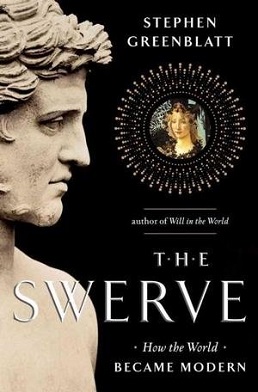
In January 1417 an Italian scholar, Poggio Bracciolini, discovered in a German monastery a long lost poem, 'On the nature of things', by the Greek philosopher Titus Lucretius that Stephen Greenblatt, American author and professor, thinks altered the course of Western Civilization. Greenblatt's book "The Swerve: How the world became modern", awarded a rare combination of the Pulitzer and the National Book Award, takes the reader in a flight of fancy across monasteries, the papacy, libraries in Rome and Alexandria, a racy recount of the conflict of Christianity with paganism, the advent of the Humanists ushered in by Petrarch and the art of book hunting.

Epicurus, circa 300 B.C, in the footsteps of the atomist Democritus, enunciated a materialist philosophy that made a moral case for pursuing pleasure, or better still, avoiding pain. In populist notion Epicurus is identified, a tad too simplistically, with pleasure seeking as a goal and the philosophy has come to be eponymously called Epicureanism or hedonism. Lucretius (c 99 B.C - c 55 B.C)immortalized Epicurianism in a tract he called "De Rerum Natura" (On the nature of things). Who was Lucretius? 

Greenblatt, in one of his plethora of surmises, suggests that Bracciolini probably encountered the first biographical sketch of Lucretius from a note authored by Father St Jerome who wrote that Lucretius wrote books amidst bouts of insanity and finally committed suicide. The myth of a licentious suicidal Lucretius was further cemented by the English poet Tennyson. 

Father Jerome's colorful sketch of Lucretius was probably driven by a need to not just denigrate an author but to discredit what the Church came to see as a dangerous philosophy. Epicureanism "scoffed" and called the idea of incarnation a "particularly absurd idea". "Why should the humans think of themselves as so superior" that "god should take their form" and why, "among al varieties of human beings, should he take have taken the form of a Jew". Two millennia later Bertrand Russell would suggest that if animals could paint their gods would look like them much like how human beings think god was made in their image. Greenbelt summarizes the key parts of Lucretius poem, in a bullet list no less.


The world, Lucretius wrote, was made of invisible particles called atoms, "neither creation nor destruction ever has the upper hand; the sum total pf matter remains the same". Santayana called the idea of "ceaseless mutation", "the greatest thought that mankind has ever hit upon". With staccato precision Greenblatt lists the postulates, "the universe has no creator or designer", "the universe was not created for humans","the soul dies", "there is no afterlife", "all organized religions are superstitious delusions", "the highest goal of human life is the enhancement of pleasure and the reduction of pain".

As if all that was not sufficient Lucretius lowers the boom in "religions are invariably cruel". Greenblatt in one of the many polemical passages of the book asserts, "the quintessential emblem of religion-and the clearest manifestation of the perversity that lies at its core-is the sacrifice of a child by a parent". Greenblatt recounts the myths of Agamemnon sacrificing his daughter Iphigenia and Abraham who almost kills his son Isaac to please Yahweh. Being unfamiliar with Hinduism he does not add the story of a devout couple killing and cooking their son to appease God.

In words that come close to echoing the Buddha Lucretius, Greenblatt sums up, suggests that "the principal enemies of human happiness are inordinate desire" and "gnawing fear". "The answer, Lucretius thought, had to do with the power of imagination". Man fears infinite pain in the afterlife as payment for a sinful life and on the other hand, in a passage "of remarkable frankness" observes, "in the very act of sexual consummation lovers remain in the grip of confused longings that they cannot fulfill".

In a world when ebooks and internet did not exist the story of how ideas spread is a thrilling story. Lucretius's Roman contemporary Cicero read his book and wrote to his brother that it was "rich in brilliant genius". Ovid was ecstatic and wrote that the words of Lucretius will "perish only when a single day will consign the world to destruction". The best part of the book is where Greenblatt takes the reader on a tour through how books were written, stored, published, advertised and how libraries came about.

The uterine lining of an aborted calf, called vellum, was the best material to use for writing and it was used to transcribe famous works. When monasteries took to copying out books scribes were a treasured tribe. Killing a scribe carried a penalty equal to killing a bishop. Julius Ceasar, inspired by what he saw in Egypt, inaugurated the era of public libraries in Rome. "By the 4th century CE there were twenty eight public libraries in Rome". Wealthy intellectuals collected books, sometimes by the thousands. Grammarian Tyrannion was "reputed to have had 30,000 volumes".

Lucretius's poem had been all but forgotten by the time Poggio discovered it in January 1417. The story of why it was forgotten and lost between its publication and its discovery many centuries later is where Greenblatt constructs a contentiously polemical edifice that forms the other part of the book 'Swerve'. 

Between 1752and 1754 an excavation at Herculaneum, a city which stood at the foot of Mt.Vesuvius, turned up a villa with an elaborate collection of papyri. It took another 235 years for modern technology to enable a papyrologist, Knut Kleve, to exclaim "De rerum natura has been discovered". The polemical edifice of Greenblatt I cited above traces how Lucretius tract ended up in a Roman villa. In the days of the Roman empire it was common practice for Roman aristocrats to invite Greek philosophers to tutor their children, build personal libraries and partake in philosophical discourses. The villa supposedly belonged to a Lucius Calpurnius Piso who is thought to have brought the philosopher Philodemus to that seaside villa. Now, Philodemus was a contemporary of Lucretius. 

Nowhere did the two great civilizations, Greek and Roman, get intertwined so much as it was in Egypt. Egypt is also where the hitherto pagan culture engaged in a civilization shaping contention with a new religion, Christianity. It was in Alexandria that Euclid, Archimedes and Galen created their immortal works. The library of Alexandria, a wonder of the ancient world, was where "generations of dedicated scholars developed elaborate techniques of comparative analysis and painstaking commentary" to identify original texts. "At its height the Museum contained at least a half million" papyrus rolls.

Greenblatt marshals his arguments for how Lucretius's philosophy came to undermined and erased from memory by stitching together several events. The decay of Alexandrian civilization was due to several reasons. First, was of course war. Only part of the library was destroyed, accidentally by Ceasar's army. Once Constantine embraced Christianity the fragile peace between polytheistic pagans and the monotheistic Abrahamic religions began cracking and finally was torn asunder by Theodosius's edicts outlawing pagan worshipping practices. Not too later an internecine fracturing between Jews and Christians broke out. In that mayhem Hypatia, 'one of the museum's scholar-in-residence', was dragged from her home and flayed alive inside a church. Historian Amiantus Marcellinus, Greenblatt says, lamented the decline of Alexandrian intellectual culture into 'febrile triviality'. "Compared to the unleashed forces of warfare and of faith, Mount Vesuvius was kinder to the legacy of antiquity".

A civilization like that of Alexandria does not vanish in a moment. It has to decay and be undermined actively. Well into the 4th century Christian scholars were well versed in ancient pagan literature and especially Latin literature. Hebrew and Aramaic, the languages of the new faith, were considered too crude. Jerome, who wrote that blurb on Lucretius, once had an apparition where God condemned him for reading Pagan texts. A chastised Jerome vowed to never to do so again. A culture of abandoning pagan literature and of high-brow literature began. St. Benedict was praised for abandoning classical learning. Greenblatt hypothesizes that Christians feared ridicule, being laughed at, by the pagans for their 'exaltation of divine humiliation and pain conjoined with an arrogant triumphalism". It was easy for somebody like Father Tertullian to hurl back the ridicule by returning the favor about pagan religious beliefs. But faced with Epicureanism, which was devoid of material to be ridiculed, The Church was left defenseless.

Now Greenblatt zeroes in on what he thinks was a pivotal moment but one which he kind of exposed on the reader because he really is on thin ice here. The Epicurean emphasis on pleasure and the human tendency to minimize pain was identified as the idea to be defeated by the Church. Laughter and pleasure, the Church postulated, was the anti-thesis of pain as a higher moral. Pain, was presented as the goal, the aspiration and higher good. St.Benedict once punished himself when he had a flicker of a temptation. He flung himself, naked, onto sharp thorns and stinging nettles to punish his flesh. The practice of punishing the flesh seeped into monastic rules. "In one of the great cultural transformations in the history of the West, the pursuit of pain triumphed over pursuit of pleasure". The Swerve happened. "If Lucretius offered a moralized and purified version of the Roman pleasure principle, Christianity offered a moralized and purified version of the Roman principle". "As every pious reader of Luke's Gospel knew Jesus wept, but there were no verses that described him laughing or smiling, let alone pursuing pleasure". Here let's recall Lord Krishna and the laughing Buddha statues. Interesting. But then Gandhi, a devout Hindu, tortured himself like St. Benedict to punish his flesh and for the same reason too.Anyone who has studied in Indian schools run by missionaries can fondly recall the penchant of teachers to mete out corporal punishment. Greenblatt traces it to this glorification of pain as atonement. In the pagan world inflicting pain or suffering pain was an indignation but in the Christian world it was ennobling to administer pain and to receive it.

In a world wracked by war and glorification of pain Epicureanism and Lucretius had no place and they were forgotten. Lucretius's tract went out of fashion and survived in a few monasteries until they were discovered by a book hunter named Poggio Bracciolini.

The Church not only destroyed books but in an ironic twist also ensured the survival of thousands of books through its monasteries where reading a book and copying books were mandated activities. Modern Western education lays an emphasis on 'humanities' the roots of which can be traced to a 15th century book hunter and member of the clergy, Petrarch. Petrarch is considered the father of what we now call 'humanism". Petrarch famously discovered a long forgotten work by Cicero and thus is credited with inaugurating the Renaissance. Petrarch was an avid book hunter who obsessed over returning the Latin texts back into vogue. He had one issue though. The script that was in use at that time was unfriendly to readers. Poggio Bracciolini looking to make his fortune in Florence invented a script, a type face we now call 'Roman', to write legibly. That was his ticket to the inner circle of the very papal offices as secretary.

Greenblatt's lurid narration of the venality of the clergy gives a picture of the corruption and immorality that plagued the papacy. Poggio even authored a very salacious book called "Facetiae" filled with ribald jokes shared by papal secretaries. Needless to say the book was a best seller. In what was common to those intrigue filled days of the papacy Poggio soon found himself out of a job because the pope he served was deposed and imprisoned. Greenbelt suggests that witnessing the gruesome burning at the stake of Jerome of Prague, a Hussite, probably tormented Poggio to the extent that he sought recompense in finding lost texts, or to put it another way texts imprisoned, in monasteries across Europe. In one such quest Poggio discovered the "complete text of Quintillian's Institutes, the most important ancient Roman handbook on oratory and rhetoric". Then in January 1417, at probably the Germanic monastery in Fulda, he discovered 'T.Lucreti CCari De Rerum Natura".

In compressed narrative Greenblatt then traces the fortune of Lucretius's poem into the 17th century. For nearly 300 years the poem, now in circulation in Florence and elsewhere, influenced the works of Machiavelli, Thomas More, Giordano Bruno and finally Galileo Galilee. But by then the Catholic church, already under assault from the Protestants led by Luther, struck at the poem forbidding it to be taught. Yet, the poem survived in Europe. Translations appeared. Newton subscribed to atomism. Thomas Jefferson, Greenblatt says, 'owned at least five Latin editions' of the poem. Is it any wonder then that the phrase 'pursuit of happiness' is found in America's most sacred document, 'The Declaration of Independence' authored by Jefferson.

What do we make of such a book that won two of the most prestigious literary prizes of America?

Readers should enjoy the book for its engaging ideas and the sheer excitement of coming to know a bygone era that is lovingly and engagingly written. That said, the book, as a reviewer in Los Angeles Times points out, is freighted with issues. Greenblatt simplifies a little too much the complexities of the conflicts of that era. For example the murder of Hypatia and the incidents leading up to it are very complex with competing interests, warring factions etc. The biggest complaint that the LATimes reviewer had was that Greenblatt, a professor at Harvard, makes a cardinal mistake of a layman in characterizing the medieval era as the 'dark ages', a characterization that goes back to Petrarch but is now widely debunked. The reviewer also points out that Greenblatt makes too much of the flagellation practice which was actually too common. 

Authors who formulate an over-arching theory to explain, usually, an entire era and the world after that or those identify a set of events as pivotal to the course of the history of the world often fall prey to stitching  together tenuously related causes. Having identified a theory or event that an author thinks changed the world forever authors rarely let counter-evidences bother them because it would spoil their narrative. Also, having identified a theory or an event as pivotal authors tend to connect anything and everything thereafter in their writings to that pet theory or event. For instance Donald Kagan, an authority on the Peloponnesian war, always sees the world only through that prism. Readers should take Greenblatt's book or at least its central claim with a liberal pinch of salt.

Given that many events have to be conjectured, like for instance that Poggio probably went to the monastery at Fulda in Germany, there are too many 'would've', 'should have' and it is tiring. Sometimes it is irritating to see conjectures piled upon one another. If Poggio going to Fulda itself is a conjecture why pile on it another one by saying Poggio might've endeared himself to the abbot by talking about Rabbanus Maurus who lived at Fulda and was a prolific writer. 

Like the LATimes reviewer said this is actually two books, one which deserved the prize and another that did not. The part that deserved the prize was about the history and the part that did not deserve the prize was the polemicizing on Church history. Also, the reviewer is spot on when he drily points out that the notes and bibliography section of the book runs to nearly 60 pages, one fifth of the book, making it appear that the book is less originally researched than an impressive stringing together of details from laborious reading of hundreds of books.

A good and interesting read nevertheless.


2. LA Review of Books "Why Stephen Greenblatt is wrong" https://lareviewofbooks.org/review/why-stephen-greenblatt-is-wrong-and-why-it-matters#
3. A review that further questions the assumptions http://www.history.ac.uk/reviews/review/1283#author-response