Showing posts with label Science. Show all posts

Tuesday, August 8, 2017

Varahamihira and the Eclipse: A Question of What is Science

Amidst all the Trump related shenanigans and the perennial scandal plagued 'Breaking News' about the American presidency a silver lining is the excited talk about the coming total eclipse. Today NPR (National Public Radio) featured a nice segment on obsessive eclipse watchers. As luck would've it I came across a blog about an ancient Indian astronomer that ended with a plea that Indian school boys should learn about such simple to learn science that India once had. I commented that only God can save science in India and naturally the brickbats came along. But here's why I said so.

The NPR segment on 'Eclipse chasers', also called, the anchor highlighted, 'umbraphiles' or 'shadow lovers' was interesting precisely because it brought to attention people obsessed with eclipse watching. Donald Liebenberg, 'a professor of astronomy at Clemson University in South Carolina', has seen more eclipses and spent more time in 'totality' than any one alive. He, NPR said, pioneered using aircraft to follow the shadow of the eclipse including one time the use of the famed Concord. Read the link in the reference for more interesting details.

Francis Bacon
NASA, of course, leads the efforts on public education regarding the eclipse with lots of material on its site. NASA also has sections devoted to study of eclipses across human history. An Irish astronomer has discovered an evidence in Ireland that shows precise knowledge of eclipse that might correspond to the one that occurred in November 3340 BCE!!! Babylonian and Assyrian astronomers, the page informs, were able to predict eclipses with fair accuracy in the 8th or 10th century BCE.

The Royal Society emblem with its motto 'Nullius in verba' (Take nobody's word for it)

Can the Greeks be far behind. NASA page quotes Archilochus' poetry, referring to the eclipse of 6th April 647 BCE, "Zeus, father of the olympians, made night from mid-day, hiding the light of the shining Sun". "Around 460 BCE, the Greek historian Herodotus wrote that Thales was able to predict the year when a total solar eclipse would occur. Details of how this prediction was made did not survive."

John Milton, who peered at the heavens using the telescope Galileo made, wrote in Paradise Lost "As when the Sun, new risen, Looks through the horizontal misty air, Shorn of his beams, or from behind the Moon, in dim eclipse, disastrous twilight sheds On half the nation and with fear of change perplexes monarchs".

The blog I came across was by, Rangarathnam Gopu, an admirer of Varamihira. Gopu has written a couple of other blogs I liked, about Lavoiseur and his touring of US for sites related to science. Varahamihira is more popularly known as the father of the pseudo-science astrology and Gopu is irked by that. He draws attention to few Sanskrit verses that Gopu underlines for Varahamihira's scientific temperament.

While most Indians explained eclipses, like the Chinese did, with myths about a snake swallowing up the moon Varahamihira 'reasoned' that it was merely a shadow passing. Let's pause here for a moment.

Astronomy is the most ancient science simply because man, across cultures, looked up at the heavens and worshipped the powers unknown and yet tried to understand what lay yonder. Will Durant differentiates between science and philosophy in "Story of philosophy". "Soon as a field of inquiry yields knowledge susceptible of exact formulation it is called science. Every science begins as philosophy and ends as art; it arises in hypothesis and flows into achievement".

The study of history of science tells us a story of the trajectory of ideas from speculation, then maturing into logical reasoning and finally becoming science when it fulfills the conditions of scientific framework.

Priyamvada Natarajan, professor of physics and astronomy at Yale, in her very readable book "Mapping the heavens: The radical scientific ideas that reveal the cosmos", traces the development of ideas and how they gained acceptance and what that arc tells of us in turn. "My goal", Privamvada states,  "is to recount how scientific ideas have been developed, tested, debated, and eventually accepted." "How scientists grow to accept new ideas and rewrite their knowledge maps not only reveals how science works but also provides insights into what catalyzes these shifts in belief".

In the history of science as an intellectual endeavor the most consequential tectonic shift happened with the establishment of the Royal Society in London in 1660. The founders of the society were inspired by the English philosopher Francis Bacon's ideas of experimentation and principles of science.

The Royal Society adopted as its motto, 'Nullius in verba', 'on the word of no one' or 'take nobody's word for it'. If nobody's word is to be taken then how are words, theories, to be judged? Here steps in the patron saint of Royal Society, Francis Bacon who had supplied the Society's founders with the principles to evaluate science. Experimentation and provability.

James Gleick in his biography "Isaac Newton" wrote about the formation of Royal Society, "dedicated to information flow. It exalted communication and condemned secrecy". "The society's founders explicitly worried about the use of any language. Philosophy had mired itself in its own florid eloquence. They sought 'not the artifice of Words, but a bare knowledge of things'. Now it was time for plain speaking, the most naked expression, and when possible this meant the language of mathematics."

Andrea Wulf in her critically acclaimed biography "The invention of nature: Alexander Von Humboldt's new world" writes about the Royal Society in Humboldt's day, "They conducted experiments, 'electrified' people, learned about new telescopes, comets, botany and fossils. They debated, exchanged results and read letters that has been received from scientifically minded friends and foreigners alike." Humboldt, a member, was thrilled and remarked after a meeting that "all scholars are brothers". Humboldt incidentally was obsessed with traveling to India but was scuttled by the East India Company for over 20 years. Wulf thinks the Company was probably wary of Humboldt visiting a colony.

Modern science or what can be called science today requires observation, recording of data, reasoned conclusions that are supported either by proven theories or mathematics or reproducible in a lab. If Gopu had stopped with talking about Varahamihira's verses as evidence of scientific 'temperament' in a different era I'd have had no problem with it but he advises school students to learn it as 'science'. No it is not. Science has long since moved much farther than what can be called 'speculation' or mere 'hypotheses'. If Varahamihra had tabulated observations or provided better reasoning, even if not absolutely mathematical by today's standards, it could be considered as the beginning of science. If Gopu had narrated Varahamihira's verses as part of a broad history of man's expanding understanding I'd have applauded but he lapses into a puzzling broadside that India's school children are taught as 'though only Europeans explained them'. He even invites college science teachers to use the blog material. Sigh. Sigh. Sigh.

Tamil chauvinists have used verses from Tamil literature to claim knowledge of atomic fission and Newton's Third Law etc. While I understand the common angst by many Indians that the common school boy grows up without knowing what a vibrant intellectual and scientific community India once was and thinks that everything 'scientific' originated only in Greece and later in Europe and recently in America. George Gheverghese Joseph's book "The Crest of the Peacock: Non-European roots of mathematics" could be recommended, a tad hesitatingly, for giving a sweeping narrative of contributions to mathematics by non-European civilizations. Interestingly he omits any mention of Varahamihira. I said 'hesitatingly' because the book, published by Princeton University Press, is authored by a person whose academic qualifications are not detailed beyond 'degrees in UK'. Reading his chapter on Indian math, far better than any most Indian enthusiasts write, I found it to be a little over-eager and less becoming of a book published by a university press, that too Princeton university.

While I'm all for laying out historical antecedents and for anyone to learn history in its totality and not exclusionary the urgent need in India is to understand science as a modern discipline. A recent ugly spectacle is the collective ululation about the scientific genius of Abdul Kalam, a man who cannot be called a scientist by any relaxed definition of that word. I'll give a list of wonderful books on science in the references. They're all a treat to read and sadly, most Indian students are not only blissfully unaware of such books many cannot even grasp why they're beautiful. The day an Indian student knows that John Gribbin's 'In search of Schrodinger's cat' is science while Fritjof Capra's 'Tao of physics' is not science he or she would become a beacon of hope in India.


References:


1. Rangaratnam Gopu's blog http://varahamihiragopu.blogspot.in/2014/10/varahamihiras-eclipse-proof.html
2. Kerala Mathematicians and Isaac Newton. Interview by George Joseph http://www.thehindu.com/features/friday-review/history-and-culture/dr-george-gheverghese-joseph-tsays-the-work-of-kerala-mathematicians-influenced-their-european-counterparts/article7818063.ece
3. Eclipses in history https://eclipse2017.nasa.gov/eclipse-history
4. Eclipses through traditions and cultures (NASA site, that includes a link to a Hindu site) https://science.ksc.nasa.gov/mirrors/gsfc/omni/eclipse99/pages/traditions_Calendars.html#India
5. Scientific method https://en.wikipedia.org/wiki/Scientific_method
6. Royal society https://en.wikipedia.org/wiki/Royal_Society
7. NPR segment on Eclipse chasers http://www.npr.org/sections/thetwo-way/2017/08/08/539553696/go-see-it-eclipse-chasers-urge-your-first-time-is-always-special

Recommended books on Science:


Disclaimer, I've not read all of the books below. Most are recommendations based on why I bought them for reading, hopefully some time.


  1. Structure of Scientific Revolution - Thomas Kuhn
  2. The Logic of scientific discovery - Karl Popper. Also certainly check out his 'Open society and its enemies'
  3. In search of Schrodinger's cat - John Gribbin. AMAZING MUST READ SIMPLE BOOK on quantum physics and its history.
  4. A brief history of time - Stephen Hawking. Obviously.
  5. Feynman Lectures - Richard Feynman. And his "Surely your'e joking Mr Feynman". Also check out other titles by him.
  6. The immortal life of Henrietta Lacks - Rebecca Skloot. Understand how medical science advanced and institutional racism in the then American medical fraternity.
  7. Ascent of man - Jacob Bronowski. A TV series turned into a thrillingly readable book. 
  8. Emperor of maladies - Siddhartha Mukherjee. Debut book that garnered the Pulitzer and a riotous read of scientific advancement in the taming of cancer.
  9. Selfish gene - Richard Dawkins
  10. What is mathematics - Richard Courant and Herbert Robbins
  11. Joy of X - Strogatz
  12. The Fellowship - John Gribbin. About the Royal Society
  13. The Sixth extinction - Elizabeth Kolbert. Critically acclaimed Pulitzer winner.
  14. The strangest man: The hidden life of Paul Dirac, Quantum genius -- Graham Farmelo
  15. Einstein - Walter Isaacson. (For the more scholarly, check out 'Subtle is the Lord' by Abraham Pais)
  16. The vital question: Energy, evolution and the origin of complex life - Nick Lane.
  17. Power, sex, suicide:Mitochondria and the meaning of life - Nick Lane
  18. Perfect Theory: A century of geniuses and the battle over general relativity - Pedro G. Ferreira. Lucid and gripping.
  19. The beak of the finch - Jonathan Wiener. Pulitzer winner.
  20. Why evolution is true - Jerry Coyne
  21. Faith vs Fact: Why Science and Religion are Incompatible -- Jerry Coyne
  22. Polio - David Oshinsky. Pulitzer winner for a grippingly told drama about the invention of vaccines that defeated a scourge of humanity.
  23. The Age of Wonder: How the Romantic generation discovered the beauty and terror of science - Richard Holmes. A literary and scientific tour-de-force.
  24. The idea factory: Bell Labs and the great age of American innovation - Jon Gertner. How individual giants like Shockley, Bardeen and an American corporation and American government colluded and competed to unleash an era of creativity.
  25. The man who knew infinity: A life of the genius Ramanujan -- Robert Kanigel. As always the best books on India and Indians are by westerners. Incidentally on even the competing movie versions it was Danny Boyle who made the better movie compared to a pathetic Indian attempt
  26. Cells to civilization: The principles of change that shape life - Enrico Coen. A chapter begins by discussing Cezanne's refusal to correct an imperfection in a painting and glides into an analogy of the complexity of life. It might take aeons for a book like this to come from an Indian university by an Indian professor. One can hope though.

Wednesday, June 8, 2016

Manjul Bhargava, Sanskrit, Indian Mathematics and a Question of Relevance.

Several readers understood my last blog, regarding how science diverged from philosophy and progressed beyond the ancient philosophical paradigms, Indian or Western, appropriately. The readers also understood that I was not rejecting a study of any philosophy but only rejecting the notion that modern science and knowledge could still function within those paradigms. However, several readers took issue with the blog and misconstrued that I was rejecting the contributions of Indian, specifically Hindu, philosophy. A reader pointed out to Manjul Bhargava, Indian-American recipient of Fields medal, crediting his knowledge of Sanskrit for providing key insights, based on ancient Indian works, into mathematics. Yes, that's true but that's not the whole truth.

First, let me categorically state that I agree with the many studies that point out to the importance of a knowledge of liberal arts for any graduate. Study after study has pointed out that students must have an introduction to classical literature, philosophy and music. University education in America, unlike India, lays a heavy stress on liberal arts. Indian students of engineering and medicine would do well to learn Kalidasa, the upanishad and many other local variants of literature and philosophy in addition to at least an introduction of Plato, Socrates and Shakespeare. 

Second, I fully and completely support books of unimpeachable academic quality that explore ancient India's contributions to science and arts. If a beautifully academic book on how Baudhayana's math presages Pythagoras can be written I'd happily buy it. 

That said, what irritates and angers me are twofold. One, wallowing in wooly mysticism and connecting everything modern in science to ancient wisdom turning a blind eye to tenuous connections. Two, showing an interest only in the jingoism of establishing what the world learned from India and not even bothering to inquire into the possibilities of any influence from outside on Indian wisdom.

India has arrived on the world stage as an economic power, a strategic partner and a key exporter of talent but Indians still belabor under an inferiority complex showing an undue and ugly eagerness to grab credit for achievements of not just Indian expatriates but even those of Indian descent. This ugliness becomes more despicable when achievements by Indians could be tied to Indian heritage of yore. 

Manjul Bhargava, born in Canada to Indian parents, enjoyed a tsunami of publicity when he won the very prestigious Fields medal, one of two highest honor in mathematics, awarded to mathematicians under the age of 40 who've made a significant contribution. The very boyish looking mathematician has a stellar resume that boasts of winning honors like he was collecting candy and a tenured professorship at Princeton at 30 years of age. 

Manjul Bhargava - Image Courtesy Wikipedia
Indians went crazy over interviews of Bharghava that mentioned how he was thrilled to find mathematical ideas from Sanskrit texts of ancient Indian mathematicians.When Bharagava said he saw mathematics in everything including Sanskrit and the tabla music he played Indians, to  put it mildly, almost had a collective orgasm. When Bhargava came to India he was feted and everywhere he went he was asked to speak on how great Sanskrit was. Sanskrit institute located in, where else, Mylapore felicitated Bhargava and had him lecture on, what else but, "Sanskrit and Mathematics".

Amidst the din what was lost is there's much more to the Bhargava story than just Sanskrit and tabla. Bhargava's grandfather was a Sanskrit scholar who had jotted down excerpts from ancient texts but, let us painfully remind ourselves, was nowhere close to winning a Fields medal. Bhargava is a typical product of western education and a story that's almost impossible to be replicated in India, under both its current and past education system.

Bhargava's mother was a mathematician at the Hofstra university in Long Island, NY and played an instrumental role in turning the boy's interest in mathematics into a career. Bhargava is not the first and nor would he be the last genius from the western world who takes a multi-disciplinary approach to the chosen subject. American university system lays a stress on diversified thinking and drawing inspiration from as many sources as  possible. This western approach is why a Schrodinger could easily see in Vedanta a spark for his quantum theory while no Indian philosopher or Indian scientist could connect the dots similarly. Bhargava's theory that won him the Fields medal was inspired by the Rubik's cube and was the result of a journey from Bhramgupta to Gauss. 

That Bhargava won prize after prize in America shows a society where meritocracy rules (along side affirmative action). A 27 year old Bhargava was a visiting scholar in that most American of research institutes, The Institute for Advanced Study. The Institute for Advanced Study was established in Princeton by Abraham Flexner who had played a vital role in reforming medical education in America. Flexner's article, published in 1939 in Harper's Weekly, titled "The usefulness of useless knowledge" is an intellectual tour-de-force and sets the objectives of the Institute where Fellows could indulge in anything that might fancy them without the pressure of having to invent anything or create anything in particular responding to any external demand. A Harvard professor , Flexner recalls in the article, who was given a stipend wrote to Flexner asking "what are my duties" and Flexner replied "you have no duties. only opportunities". This is where Bharagava flowered.

Bhargava to his credit has been clear that while he'd like to see books about contributions of Indians he insisted that it should be accurate."It's not your agenda to show everything originated in India. It's your agenda to show what originated in India in an accurate and clear way". 

I wish Bhargava had been asked to speak about research topics in mathematics but Indians were interested in only thing, to get a Fields medal awardee to speak in glowing terms of an ancient heritage and nothing more.Once any Indian expatriate wins any award abroad the Indian government of the day will make a despicable show of awarding some Padma award. Bhargava was awarded the Padma Bhushan. V.S. Naipaul, most acerbic and acidic critic of India, wrote in his 'India: A wounded civilization' about how India treated Har Govind Khorana, "India invited him back and feted him; but what was most important about him was ignored. 'We could do everything for Khorana,' one of India's best journalists said,'except do him the honor of discussing his work.' "

A reader pointed to an interview by George Geverghese Joseph's interview in 'The Hindu' which spoke about how possibly work done mathematicians in Kerala could have traveled to Europe and influenced Isaac Newton's conceptualization of the infinite series. Incidentally I had bought Joseph's critically acclaimed book "The Crest of the Peacock: Non-European roots of mathematics", published by Princeton University.

Joseph's book speaks of ancient Indian mathematics and in addition has lengthy chapters on Egyptian and Chinese contributions but the interviewer from 'The Hindu' chose to ask him only about how great Kerala's mathematicians were. My reader complained, borrowing from Joseph, about a Euro-centric view on the history of sciences that ignores contributions, probably more significant, by non-Europeans.

Many Indians who are critical of India's education system and yearn for what they consider the fabled past of ancient Indian education system without fail gnash their teeth about Macaulay's imperialist comment that a shelf of European literature is worth more than a library of oriental literature. A recent controversy over Professor Sheldon Pollock, editor of the Murty library of Indian literature, cited a passage from a speech of his that appeared insulting to India. The protest letter was signed by professors from all and sundry universities of India including professors of Sanskrit who, unlike Pollock, had no publication. A simple google search revealed that Pollock's statement was deliberately torn out of context and twisted. The age of colonial imperialists like Macaulay is long gone but Indians, including Joseph, recycle statements of a bygone century to present a world at war. 

Indians do not realize that many books that document India's rich heritage are courtesy of Westerners. A sharp reviewer of Joseph's book points out that Joseph draws a connection between Euclid's legendary book 'Elements' and Panini's grammar but he fails to credit Frits Staal who first wrote about such a connection.  The reviewer also accurately picks issue with Joseph broad generalization every unsympathetic view as "western" and almost intentionally ignoring other westerners who worked to give a more honest history of ideas. It is also unfair to charge that but for an Indian author like Joseph the oriental contributions would not receive their due. The reviewer points to several examples by European authors in that regard.

To circle back, demanding an accurate history to be written is fair and necessary too. However, it appears that Indians are more interested in writing history, that too an exaggerated one, than in worrying about the pathetic state of Indian education and academics today. Several of the signors on the protest letter against Pollock teach in IITs and JNU, including Makarand Paranjape, and all of them are just plain guilty of witch hunt of a good professor of unimpeachable academic credentials. 

Bhargava is also the recipient of the "Ramanujan Prize" from SASTRA university (my alma mater). While 3 Indians figure on the list of Ramanujan Prize since it was instituted in 2005 not one of them did their work in any Indian university. Ironically, at SASTRA a tech festival was held for which a computer science student wrote a blog about how a weapon used in Mahabharata was the precursor of modern day Inter-continental-ballistic-missile. This is how Indian universities are being run.

While India went insane over Bhargava and his love of Sanskrit it was conveniently ignored that there were 3 other awardees for the Fields medal. Amongst the other awardees were an Iranian woman and a Latin American mathematician. I'm sure that those two have no idea of Sanskrit or Tabla and still won the Fields medal. 

When Indian's count Indian Nobel laureates they often include Amartya Sen, Venky Ramakrishnan, Har Govind Khurana and S. Chandrasekhar. Though Sen won the prize as an Indian, unlike the others, he too did his work in foreign universities and was, like the others, a product of western universities. 

For unsurprising reasons Venky Ramakrishnan's name is rarely mentioned unlike Bhargava's name. Ramakrishnan, as usual, was feted by India after he won the Nobel and he too was given the Har Govind Khorana treatment. Ramakrishnan was invited to attend the Indian Science Congress, a venerable institution that stretches back to the Colonial era actually. Aghast at seeing paper presentations about how ancient Indian epics had the precursor of modern flights Ramakrishnan said "the Indian science congress is a circus" and that he'd never ever attend it again. After his Nobel prize it was rumored that Ramakrishnan took up a job in a premier Indian lab, he vehemently refuted it saying "Nobody has approached me about an offer to work in India. However, I can categorically state that if they did so, I would refuse immediately".

It is laughable when an Indian author, known for his militant fundamentalist outlook in favor of Hinduism, called Hindutva, asserted that J.C. Bose could arrive at the conclusion that plants respond to stimuli because his Indian worldview is, unlike the western, is a holistic one. Andrea Wulf's critically acclaimed biography of Alexander Von Humboldt quotes Humboldt, "In this great chain of causes and effects no single fact can be considered in isolation". Wulf, continues, "with this insight he invented the web of life, the concept of nature as we know it today". Humboldt, Wulf points out, influenced a wide array of intellectuals. Thomas Jefferson, Charles Darwin, William Wordsworth, Coleridge and Henry David Thoreau were influenced by Humboldt. Wordsworth, incidentally, also was in awe of Isaac Newton. Goethe, who admired Humboldt, wrote 'The Faust', laid the foundations of morphology and a treatise on light, "Theory of colors". Vladimir Nabokov wrote 'Lolita' and researched butterflies. Nabokov's theory on the evolution of butterflies was recently proved correct. While it is difficult to list Indian thinkers who showed diverse interests or achieved in diverse fields it is common to see such personae in the western intellectual tradition.

Alexander Von Humboldt - Image Courtesy Wikipedia


Write history all you want but the more urgent need for India today, is not in proving that Bhaudhayana was better than Pythagoras but in creating an institutional framework that can produce a Manjul Bhargava. 

References:

  1. Manjul Bhargava https://en.wikipedia.org/wiki/Manjul_Bhargava
  2. SASTRA Ramanujan Prize https://en.wikipedia.org/wiki/SASTRA_Ramanujan_Prize
  3. Fields Medal https://en.wikipedia.org/wiki/Fields_Medal
  4. Institute for Advanced Study https://en.wikipedia.org/wiki/Institute_for_Advanced_Study
  5. Abraham Flexner https://en.wikipedia.org/wiki/Abraham_Flexner
  6. Flexure's article "The usefulness of useless knowledge" https://www.ias.edu/ideas/usefulness-useless-knowledge
  7. "The Crest of the Peacock" by George Gheverghese Joseph https://en.wikipedia.org/wiki/The_Crest_of_the_Peacock:_Non-European_Roots_of_Mathematics
  8. Review of "Crest of Peacock" by Clemency Montelle http://www.ams.org/notices/201311/rnoti-p1459.pdf
  9. Venky Ramakrishnan on Indian Science Congress http://www.firstpost.com/india/indian-science-congress-is-a-circus-wont-attend-it-nobel-laureate-v-ramakrishnan-2572268.html
  10. "I'll not accept any job in India" - Venky Ramakrishnan http://articles.economictimes.indiatimes.com/2009-10-13/news/27645273_1_nobel-laureate-venkatraman-ramakrishnan-venki-ramakrishnan-nobel-prize
  11. Goethe's Scientific work https://en.wikipedia.org/wiki/Johann_Wolfgang_von_Goethe#Scientific_work
  12. "Nabokov Theory on Butterfly Evolution is Vindicated" - New York Times http://www.nytimes.com/2011/02/01/science/01butterfly.html?_r=0
  13. "The Invention of Nature: Alexander Von Humboldt's New World" - Andrea Wulf
  14. Manjul Bhargava's Theory (an explanation) https://www.quantamagazine.org/20140812-the-musical-magical-number-theorist/
  15. About Bhargava's award http://www.business-standard.com/article/beyond-business/a-professor-who-sees-common-thread-in-sanskrit-music-and-mathematics-114081400051_1.html
  16. "India has to be its own cultural ambassador, but it has to be scientific about it" - Manjul Bhargava -- Lecture on "Connection between Sanskrit and Mathematics" http://thewire.in/2016/01/19/india-has-to-be-its-own-cultural-ambassador-but-it-has-to-be-scientific-about-it-manjul-bhargava-18524/
  17. Another blog on the same lecture http://varahamihiragopu.blogspot.com/2016/01/manjul-bhargava-on-sanskrit-and.html
  18. "Nobel, Nationality and Venky Ramakrishnan" - My blog in 2009 http://contrarianworld.blogspot.com/2009/10/nobel-nationality-and-venky.html
  19. Alexander Von Humboldt https://en.wikipedia.org/wiki/Alexander_von_Humboldt
  20. George Joseph's interview in 'The HIndu' http://www.thehindu.com/features/friday-review/history-and-culture/dr-george-gheverghese-joseph-tsays-the-work-of-kerala-mathematicians-influenced-their-european-counterparts/article7818063.ece


Monday, June 6, 2016

Isaac Newton and the Divorce of Philosophy and Science

A recent Tamil book makes the case that Erwin Schrodinger was inspired by Vedanta in formulating his theories on quantum physics. The authors then proceeded to speciously argue for the continued relevance of Hindu Philosophy, knowledge systems, to today's world. In this backdrop it is pertinent to trace the point at which science roared forward unmoored from philosophical speculations and in the process creating its own paradigms. Isaac Newton marks the clear point at which science divorced itself from what was hitherto called philosophy.

Concluding the chapter on Aristotle Will Durant wrote "all the world awaited the resurrection of philosophy". Starting with Roger Bacon in the 13th century Europe saw a fervid efflorescence of genius. Tyco Brahe, Kepler, Copernicus, Galileo, Vesalius and Harvey took human knowledge into new frontiers. "It was an age of achievement, hope, and  vigor; of new beginnings and enterprises in every field; an age that waited for a voice". The voice was embodied in Francis Bacon.

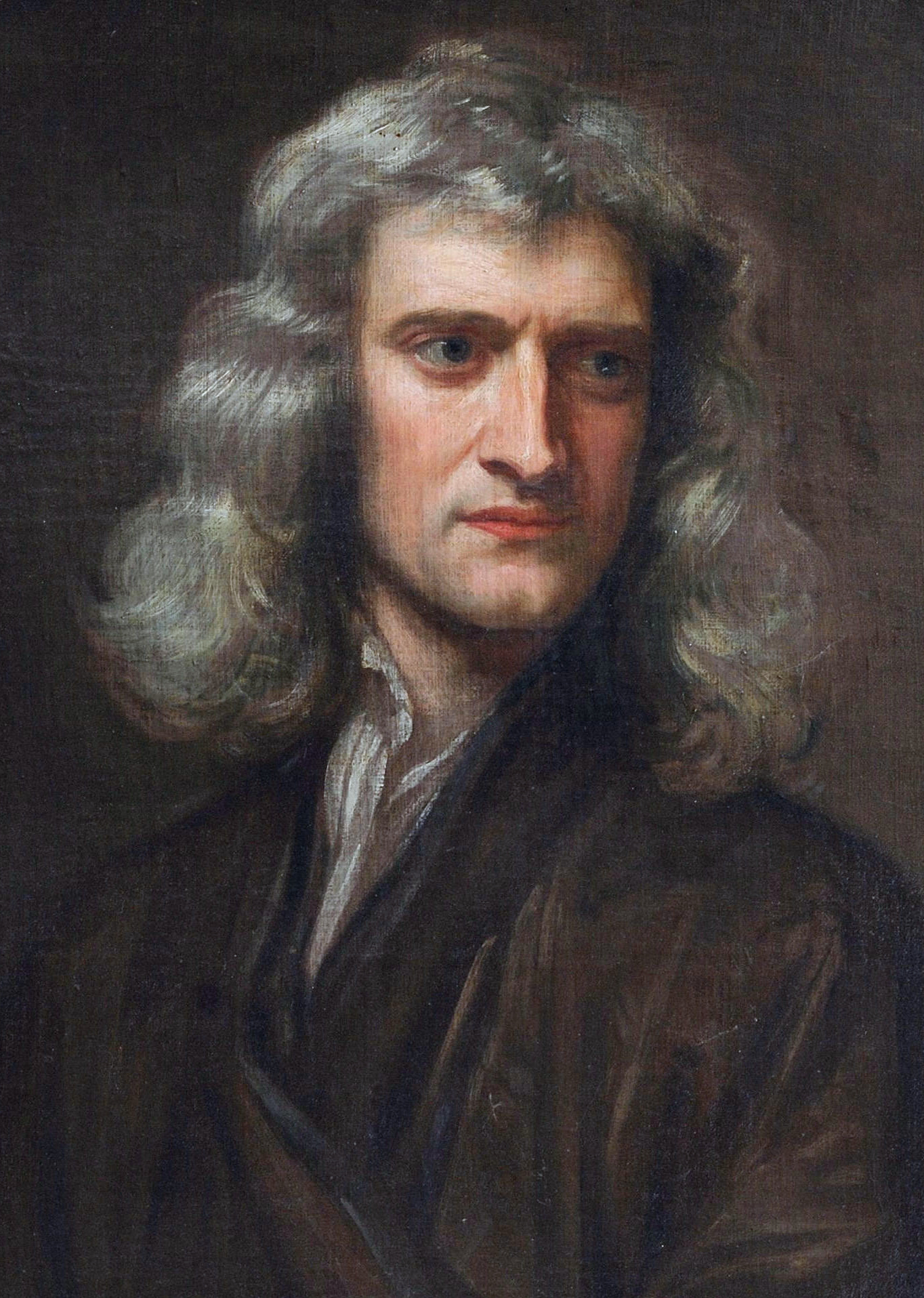
Isaac Newton(Image Courtesy Wikipedia)
The explosion of knowledge that accompanied what Durant called "Age of Reason" was unprecedented in human history. Sir Thomas Bodley who established the Bodleian Library (1598) in Oxford "obtained from the Stationers Company a grant whereby the Bodleian Library that he had established at Oxford (1598) was to receive a copy of every book published in England". France and Germany saw similar libraries. Germany made elementary education compulsory for both sexes in 1565, rapidly other European cities followed. The Church which receives a justifiable rap for its confrontation with science nevertheless played a vital role in furthering the goal of education. "In France every parish had to maintain an elementary school". "In 1685 the Christian Brothers opened what was probably the first modern institutions for the training of elementary school teachers". Nearly two hundred universities were opened between 1550s to late 17th century.

Isaac Newton, born on Dec 25th 1642 in Woolsthorpe, entered a world where slowly but surely science, thanks to Francis Bacon, was stepping out of the shadows of philosophy. Bacon, James Gleick's biography of Newton says, lamented "all the philosophy of nature which is now recieved, is either the philosophy of the Grecians, or that other of the alchemists...The one is gathered out of a few vulgar observations, and the other out of a few experiments of a furnace. The one never faileth to multiply words, and other ever faith to multiply gold". Bacon, Gleick points out, "argued for experiment".  When the Royal Society was established in 1660 with the motto 'Nullius in verba" Bacon was adopted as the patron saint. The age of telescope and microscope had arrived. "It (the Royal Society) exalted communication and condemned secrecy".

Robert Hooke who served as the Curator of Experiments in the Royal Society wrote in his "Microphagia", tat science should now "return to the plainness and soundness of Observations" and away from what it was hitherto, a "work of the Brain and Fancy".

A society for science dedicated to communicate faced the question of which language to use. Though Latin was the obvious choice the members felt "it was time for plain speaking, the most naked of expression, and when possible this meant the language of mathematics". The Royal Society was not alone, soon Europe saw a host of societies established where, most importantly, men of science congregated and debated without the constraints of social status. Gleick quotes an entry from Samuel Pepys's diary on how the Society organized science exhibitions for Londoners. This was a quantum leap. Let's return to Newton's story.

Thanks to Stokes, the schoolmaster at Grantham where Newton attended school, and his uncle, a rector, Isaac Newton was sent to Trinity college at the University of Cambridge for further studies. A civil war, plague, a rebellion and a regicide (if hanging Cromwell's corpse could be called so) formed the climate in which Newton attended college. Newton read avidly, particularly Aristotle. Aristotle idea of "motion" was elastic enough to consider a "piece of bronze becoming a statue" as motion. That meant, Gleick says, "philosophers were not ready to make fine distinctions between velocity and acceleration". Aristotle had famously said "Plato is my friend, but truth my greater friend". Newton added Aristotle to that and wrote in his notebook "Plato amicus Aristoteles magic amica veritas".

Descartes had earlier married algebra to geometry yielding a new discipline. "He treated one unknown as a spatial dimension, a line; two unknowns thus define a plane....Equations generated curves; curves embodied equations". To that Newton added the question of motion which embraced the infinite and the infinitesimal together. "To measure curvature was to find rate of change".

In 1665, soon afterNewton graduated, Cambridge was closed due to plague ravaging England. Back in Woolsthorpe Newton worked alone and laid the foundations of calculus, theories on gravitation and light. Newton returned to Cambridge in 1667 and was elected a fellow. He took the oath to "embrace the true religion of Christ with all my soul". "Chastity was expected. Marriage was forbidden". In 1669, at the age of 27, Isaac Newton became the Lucasian Professor of Mathematics. The mathematician's heart was in physics though.

Newton's paper on the nature of white light was read in the Royal Society in 1672. Newton, Gleick says, "declared triumphantly-"that light consists of Rays different refrangible". Hooke objected to Newton's theory that proposed light was "corpuscular" in nature, particles. Newton responded that "that followed from his theory and not the other way round". Dutch scientist Christiaan Huygens also joined the debate on the "wave theory" side. Newton felt insulted and wanted to withdraw from the Royal Society. "He had tried to show how science is grounded in concrete practice rather than grand theories". As these debates raged Newton, in 1675, reached another milestone. In the seventh year of his fellowship Newton was required to take the "holy orders and be ordained to the Anglican clergy". Gaelic notes "England's universities were above all else instruments of Christianity". Newton was spared the ordeal by the King who exempted the "Lucasian professorship, in perpetuity, from the obligation".

Hooke and Newton would clash again when the "Principia Mathematica" was published. Both Hooke and Newton had rejected the Cartesian idea of "vortices" to explain planetary motion. Both were circling around the ideas that "a body orbiting another in an inverse-square gravitational field" would trace an elliptical curve. Conversely, they also realized that a gravitational force law to describe a body tracing an elliptical curve around another body can only be a "inverse-square law". Hooke did not have mathematical proof but Newton did. Edmund Halley and Flamsteed who were calculating data about meteors supplied Newton with theories and data. Newton, Gleick shows in scintillating pages, went where no philosopher or philosophy went. Book III, The System of the World, "gathered together the phenomena of the cosmos. It did this flaunting an exactitude unlike anything in the history of philosophy". Gone are the flights of fancy of a philosopher or dreary sophistries of reasoning and in its place science arrived with exactitude. Hooke wanted credit for the inverse square law, which in reality was nothing more than a guess until Newton supplied the mathematical proof. Newton was irked and he called philosophy a "litigious lady that a man had as good be engaged in law suits". Halley published the Principia out of his funds.

Newton was charged with promoting atheism, a dangerous charge in that era.Will Durant writes "he appended to the second edition a general scholium on the role of God in his system". Though Newton kept up the appearances of a devout Christian in private he was anything but. Gleick says he preferred writing "AC (after Christ) instead of AD". Newton questioned the idea of trinity, a heretical and dangerous sacrilege then. To Newton Christ was less than God the Father. Though celibate Newton confessed to not only sexual thought but charged his friend Locke of having tried to entice him with women.

Hooke died in 1703 and Newton ascended to the power at the Royal Society. In 1704 Newton published his next major work "Opticks" which revolutionized the understanding light. Along with Opticks Newton published  a paper "On the Quadrature of Curves" that laid down the fundamentals of Calculus.  German mathematician Leibniz who had corresponded with Newton on what he called "fluxions" claimed that he too was the inventor of this new mathematics. As president of Royal Society Newton was judge, jury and prosecutor. Newton literally forged documents in his favor. History has now declared both Leibniz and Newton as co-inventors of Calculus.

What did Newton, specifically the Principia, achieve? James Gleick is categorical, "Newton had made claims that could be tested". In 1733 the French Academy of Scoences proved Newton was correct that the earth was "broader at the equator". Gleick is emphatic, "The Principia marked a fork in the road: thenceforth science and philosophy went separate ways". "By mathematizing science science, he made it possible for its facts and claims to be proved wrong". Conceding that Einstein's Relativity shook the world of Newtonian determinism Gleick cites Thomas Kuhn who suggested that "Einstein had turned science to problems and beliefs". However, Gleick cautions, "Einstein did shake space-time loose from pins to which Newton had bound it, but he lived in Newton's space-time nonetheless: absolute in its geometrical rigor", "he happily brandished the tools Newton had forged".

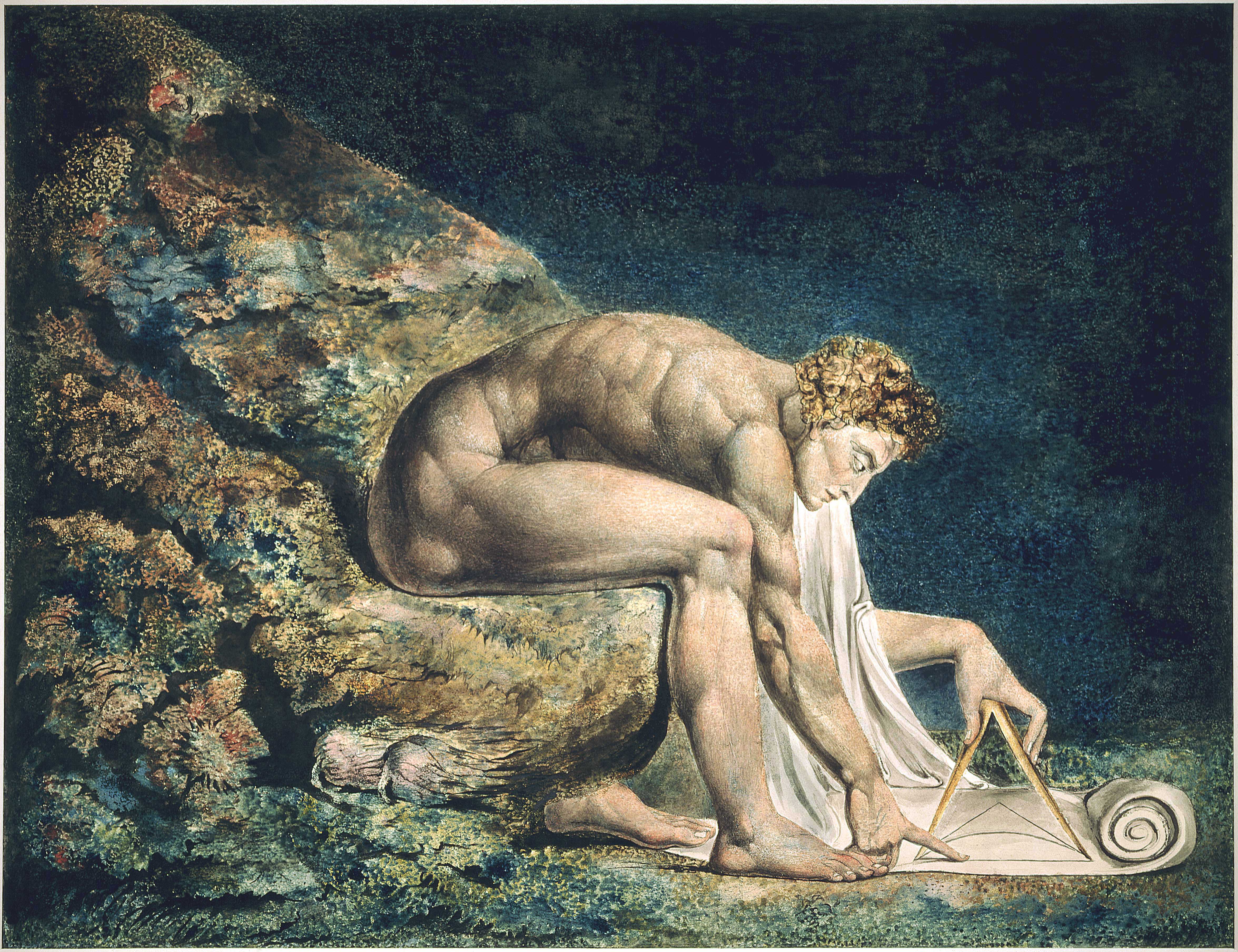
Isaac Newton was celebrated in prose by Alexander Pope and Wordsworth, William Blake drew a portrait of him, Voltaire studied him and literally proselytized for him in France, he was knighted and when he died nobles were his pall bearers and he was interred in the Westminster Abbey.

Portrait of Newton by William Blake (Image courtesy Wikipedia)


"Nature and Nature's laws lay hid in the night
God said, "Let Newton be!", and all was light" --- Alexander Pope

"Newton with his prism and silent face
The marble index of a mind for ever
Voyaging through strange seas of thought alone" --- William Wordsworth

Science has decisively outpaced philosophy and America, the land of pragmatism, which became the leader of science, had little use for European style sophistry. No one embodied the American spirit of science better than Richard Feynman. In Feynman was a spirit of irreverence and absence of philosophy unlike Einstein who read Kant as a child. Philosophy does not even provide the questions anymore let alone answers. Schrodinger owed to illicit sex as much as he owed to Vedanta for inspiring his theories.

The questions that the authors of the Tamil book failed to ask where: Why is it that it took an Austrian scientist to find the ideas in Vedanta that could inspire a scientist and not any Indian scientist? What in the Austrian scientist's Viennese education enabled him to see in Vedanta what no Indian scientist did? How many Indian exponents of Indian philosophy arrive at the same conclusions? Above all what paradigms of the Vedic era are relevant for science today? I'll write a detailed review and rebuttal of the book later.

The traffic of knowledge across the European continent is staggering in scope and requires a meditated appreciation for the scope at which it occurred. Ideas, amidst turmoils of wars, flowed in all directions. Ideas from Frances, Netherlands, Germany and England all collided and created a new world. That books written in France, Germany and England were translated, shipped to other countries and debated in scientific circles providing a magnificent intellectual stirring is a fact that should astound us, those who live in this modern social media age, on a grand scale. What is even more important is how they were eager to learn from others and not mired in petty nationalist chauvinisms. That too, given the kind of era it was, passes comprehension.

This was to be a book review of James Gleick's "Isaac Newton" but morphed into a different tone. Gleick's book is very mediocre. The narrative is uneven and his extensive quotes in the English of that era are irritating to read. What is really a letdown is Gleick's inability to explain science in a more lucid manner. This is shocking considering that Gleick's biography of Richard Feynman, "Genius", was critically acclaimed both for the sensitive portrayal of Feynman and for the lucidity of explaining esoteric concepts like Quantum Dynamics. I read portions of Will Durant's magisterial 11 volume "Story of civilization", specifically, volumes "The age of Reason" and "The age of Louis XIV" after I finished Gleick's book. Durant, who wrote nearly 40 years ago and was no scientist, covered all the material that Gleick, writing in 2003, covers. Durant's explanations of the theories and their significances are spot on. And, as only Durant can do, he provides a panoramic perspective of that era. Gleick's book should be read only because Durant's 11 volume series is out of print.

Science has marched forth from the shadows of philosophy and education has been liberated from the clutches of Church and State paving the way for what we call today 'secular education'. Both of those achievements are now under siege from the Hindutva camp.


References:


  1. Isaac Newton - James Gleick
  2. The Age of Reason -- Will and Ariel Durant
  3. The Age of Louis XIV -- Will and Ariel Durant
  4. Isaac Newton https://en.wikipedia.org/wiki/Isaac_Newton
  5. The Royal Society https://en.wikipedia.org/wiki/Royal_Society
  6. Francis Bacon https://en.wikipedia.org/wiki/Francis_Bacon
  7. New York Times Book Review of "Schrodinger: Life and Thought" by Walter Moore -- This addresses briefly the role of Vedanta in Schrodinger's life - http://www.nytimes.com/1990/01/07/books/the-lone-ranger-of-quantum-mechanics.html?pagewanted=all


Friday, August 28, 2015

ISRO & Othisaivu Ramasamy: How NOT to write about ISRO

Apparently a storm has been raging on account of my email to Jemo on Bharathi Tamil Sangam. I came to know of it only today. I'll respond later to that. Meantime there was a note by Jemo about Othisaivu Ramasamy's blog on the unsung heroes of ISRO. Naturally I had to check it out.

Ramasamy's blog on ISRO is pure 'he-said, she-said' kind without any specific detail and is plainly breast-beating type. The blog was empty boasting.

Ramasamy only talks of a tour of ISRO that he was able to get thanks to some contacts with insiders. I, for one, do not know Ramasamy's academic or professional qualifications to make the kind of sweeping statements he makes. He asserts, without any detail, that ISRO employees are better than Boeing and GE. I am sure there are brilliant employees in ISRO, possibly Nobel Prize material too. But how does that matter? I am sure in Ethiopia there's an Einstein. No Indian company can be compared with Boeing for the latter's achievements in aviation is in a realm that no comparable Indian corporation, private or public, can dream to touch. Nor should Boeing (or GE as for that matter) be compared with ISRO. Ideally it is NASA that should be compared to ISRO. Sure, ISRO has its share of achievements but the crucial question is how does it measure up against NASA today? What can one say of ISRO vs NASA 20 years ahead of today?


We're told to admire the practical implications that ISRO puts its technologies to use. I understand the yearning for Ramasamy to make Indians appreciate the fact that the hundreds of crores plowed into a research organization is not in vain and that it has a direct impact on the lives of the everyday man but this is a dangerously simplistic approach. I wish he had added nuance to that contention with details on how esoteric theories find practical applications in due course of time. Even Einstein the author of mass-energy equivalence did not believe that an atom bomb was possible though it was predicated on his own theory. The bomb came before reactors became a reality. While assailing the common man's understanding of science Ramasamy himself falls prey to it and attempts to play to the peanut gallery.


In another passage Ramasamy passionately states how ISRO gathers information via it's payloads and how ISRO's audit processes ensure little or no wastage. Again, frustratingly, there is no citation of any example let alone more details. The reader is basically asked to trust the author on his judgment and take assertions at face value. 

Thankfully Ramasamy corroborates one of my chief complaints that "money" is often a misleading factor in excusing the sloppiness of Indian institutions. I'd say that ISRO gets more eager and uncritical support from Indian government than NASA gets from US congress.

Ramasamy nonchalantly says that one of the issues that plagues ISRO is an abysmally low degree of documenting research. That, in my view, is a shameful admission about a space research org and that too a 'glowing one'. This is where I earn the sobriquet of 'India-hater'.

It is fashionable to scold the poor Indian citizen for everything the intellectuals think should be praised sky high. This is nonsense. Ramasamy concedes that ISRO as an org is loath to advertise what it does and then he scolds the citizen for thinking ISRO is flying Deepavali rocket. Compare this with the public educational efforts that NASA funds and undertakes? A digression here on the space race and what a Carl Sagan can do to a society.

Nikita Kruschev lit a fuse under the defense and space exploration related establishments of USA by launching Sputnik. The ensuing space race, that culminated in Neil Armstrong taking a small step that was a leap for mankind, gripped an entire nation in a scientific fervor. Let's also conceded that many Americans probably understood less of the science than the fact that patriotism compelled them to yearn for the yankees to beat the Reds. Now we've NASA beaming images from Hubble telescope, the telescope itself is a staggering scientific achievement, from the Voyager that has gone into the farthest reaches of space and even the repair of malfunctioning equipment on the Hubble was news. Then there was the shuttle era that even when it ended in tragedies it served to raise scientific consciousness. In how many countries would a scientist like Richard Feynman establish, in front of cameras, how a simple O-ring malfunctioning could lead to an explosion of the shuttle?

I cannot overstate the importance to society of having scientific persona like Feynman and Sagan. "Bliss was it in that dawn to be alive, but to be young was very heaven". Carl Sagan's legendary TV Series "Cosmos",wikipedia says, has been watched by 500 million so far. That's HALF-A-F**ing-Billion. Sagan and Feynman fired up the nation with their geniuses not just for science but as popularizers and showmen. All that India had was Abdul Kalam. Yikes. And, remember I've not even started talking about Isaac Asimov and Ray Bradbury. Ask Tamils who is a science popularizer and the answer will Sujatha, he who was famously obsessed with scatalogical jokes about a Mexico-laundress . To be fair to the Soviets the space race engendered a culture of yearning for scientific achievement in the Kruschev era.

Interestingly Ramasamy chides the employees, the same glowing employees, for mostly indulging in gossip based on drab weeklies. One of my friends, a patriotic Indian who returned to India with an American PhD, observed the same at another premier scientific established. He was appalled at the gossip quality of conversations at lunch break and other interactions outside of strictly official environments.

Badri Seshadri's blog, which inspired Ramasamy to write a lengthy feedback and later turn it into a blog, itself has interesting ironies.  On the one hand Seshadri says, correctly, that NASA's funding by US government has been cut and as a result NASA is relying of Russia and private companies like Space X for launching satellites and on the other hand he wants Indian government to double it's current budgetary allocation to ISRO in order to make it able to compete with the likes of SpaceX. A very disappointing sleight of hand from a free-marketer. Seshadri's blog unlike Ramasamy's blog is more judicious in appreciating ISRO. Seshadri concedes that India lags behind China and SpaceX's Elon Musk does not even think of India's space establishment when he thinks of his competitors. So much for Ramasamy's glowing ISRO.

Seshadri, too, falls prey to obsessing over practical use of space explorations. He says he, too, is not very enamored of sending probes to Mars. While this attitude is understandable this is a very simplistic view of science and the implications of a Mars probe. I'd invite readers to ponder on Abraham Flexner's, the guiding spirit for 'The Institute for Advanced Study', a uniquely American institution,  amazing article "The usefulness of useless knowledge".

Of course I've given enough ammunition to the legions who blame me of being anti-Indian. I care two hoots for such criticisms. If anything I've said is not true or unfair comparisons then come at me. In fact I'd argue that India cannot find a better patriot than me for I, unlike its jingoistic crowd, at least keep pointing out what the shortfalls are. If people are really interested in making India better they'd spend less time wondering about my attitudes towards India or my motivations for criticism and spend more time redressing the shortcomings. As for my obsession over glorious America I fully stand by my assertions of American uniqueness unless anybody can disprove me on why a Research University or an institute like IAS or a scientist like Feynman is possible only in America.

In conclusion Ramasamy's blog can be characterized with the very words that Jeyamohan uses to ridicule the science illiterate journalists of India. Maybe Ramasamy can do better and maybe he will write a better but for now this is not a blog to be held up as an example of how to write about a space research organization it is rather, sadly, an example of how not to write on ISRO.

References:

1. Ramasamy's blog https://othisaivu.wordpress.com/2015/08/27/post-544/
2. Badri Seshadri's blog http://www.badriseshadri.in/2015/08/blog-post_21.html
3. Abraham Flexner's article https://library.ias.edu/files/UsefulnessHarpers.pdf

Thursday, April 24, 2014

Swaminarayan Temple Vs Dalits, Chandrayaan, Nehru, Hindutva Ideologues and Aravindan Neelakandan's Axe Grinding

Quite a few responses to my last blog had asked why I objected to Aravindan Neelakandan delivering a lecture at IIT-Chennai and why I thought he was not academic enough. As luck would have it Neelakandan himself provided fodder the next day with his email to Jeyamohan. In that mail he tried to establish that Hindutva ideology boasts of stellar thinkers and that there is an intellectual tradition fostered by those thinkers. It is essential to debunk that mail and while doing so I'll establish the differences between academic and partisan thinking.


Swaminarayan Temple Vs Dalits

Neelakandan cited the case of Swaminarayan temple in Mumbai where courts granted Dalits (then referred to as Harijans) the right to enter the temple on the basis that it was a Hindu temple. He traces the court's decision, classifying Swaminarayan sect as Hindus, to what he claims Hindutva inspired definition of who is a Hindu. Ambedkar famously gave the negative definition of who is a Hindu, in the constitution, as 'one who is not a Christian or Muslim or a Jew or a Parsi'. Neelakandan contends that Ambedkar was inspired by Savarkar's writing that "only those who consider Bharat as their ancestral land, blessed land and the birthplace of his religion, are hindus". Thus drawing a tenuous connection he takes credit for providing the legal basis which the court used to allow Dalits to enter the temple.

A close perusal of the judgment shows that the cause and effect are incorrectly tied. The temple authorities did contend that the Swaminarayan sect were not Hindus and therefore could not be controlled by the Bombay Hindu places of worship act. The Bombay High court did not just blindly use the Ambedkar definition but rather it went to great lengths to establish that the Swaminarayan sect were indeed Hindus by virtue of the philosophy and tradition. There is nothing here for Neelakandan to take credit for. The court further went into Article 25 to establish equality as principle within practitioners of the same faith.

My itinerant research on this topic showed that the Untouchability Offences Act (UOA 1955) is very restrictive in scope. The act very narrowly says that if a temple allows Hindus of other castes then it cannot differentiate against Dalits. Time and again Jain and other temples have gone to court to claim exemption from the act with respect to admitting Dalits by saying that their temples admit only Jains and that they are not Hindus and as such Dalits cannot claim parity.

Temple entry movement is a long and cherished part of India's glorious freedom struggle. The Tamil Nadu Temple entry act of 1939, pre-dating the Ambedkar citation of Savarkar in 1941, signed by Rajaji was the result of Vaidyanatha Iyer leading an agitation for Dalits to enter temples. Savarkar and his Hindutva acolytes, then and now, try to embrace every religion born in India as Hindus to counter what they see as the inimical presence of Semitic religions. This all embracing politically convenient love for Buddhists, Jains and Sikhs is not true and is driven by ulterior motives.

How to balance religious freedom with civic rights is a contentious topic till today including a country like US. The Bombay High court admirably walked that tight rope and delivered a stinging verdict that was later re-affirmed by the Supreme Court. The case was decided on more than just simply saying "you are Hindus".

Taking a complicated case and presenting it shorn of its multi-layered dynamics is what a person with an axe to grind will do and Neelakandan does it with unflagging vigor.

The charm of Neelakandan is his pummeling the reader or listener with arcane facts and dazzling the receiver with a raft of augments that sounds reasonable and seemingly appears built on an edifice of facts and logic while he would be skating on very thin ice.

Neelakandan invariably takes a moderately strong case and conflates it with other blocks of overarching theory giving everything a panache of legitimacy borrowed from that one case where he could be arguably correct. Having started off with the Swaminarayan case he then proceeds to fantasies. He claims credit for raising the marriageable age of girls and even combating apartheid in South Africa. The Hindu Reform movement, that includes a very gentle intellectual like Raja Ram Mohan Roy, which spear headed many reforms concerning Hindu girls and marriage, including abolishing of Sati, had nothing to do with the likes of Savarkar or Hindutva. India's stand against apartheid was driven more by left wing leaning Indira Gandhi etc than due to any Hindutva ideologue.

Suraj Bhan and Ashok Singhal

Neelakandan exults that VHP President Ashok Singhal supported Dalit leader Suraj Bhan in excising uncharitable references to Dalits in ancient Hindu texts. This is true but it's nothing to be proud of. This is the kind of idea that a partisan hack would relish but no academician would even contemplate.  And even there he says that Singhal was ready to discard Manu Smriti because, in his opinion, it was written after the era of Pushyamitra. That some people were considered to pollute others by their mere shadow and that it was sanctioned by religious texts is not something to be bowdlerized and whitewashed. A tyranny that stretches over a millennia and to even today is not to be wished away by erasing history. I'll not belabor this further.

Ambedkar and Arun Shourie

I've read parts of Arun Shourie's 'Worshipping False God's', a scathing vitriolic attack on Ambedkar. Shourie repeatedly contrasts Ambedkar with Gandhi and casts the former mostly as an eager collaborationist with the colonial regime while the latter fought it. There is more than element of truth in that. But Arun Shourie is just an English speaking suave Magsaysay award winning journalistic version of Neelakandan himself. The Gandhi versus Ambedkar struggle was of epic proportions and too complex. Ambedkar, like Jinnah, resented Gandhi's overweening piety and above all his attitude to re-interpret Varnashrama without attempting to discard it completely. Ambedkar, justifiably, felt that most of the Congresswallahs, many of who were upper caste, will at the first available opportunity revert back to the original Varnashrama. In fact when Nehru wanted to pass the Hindu Code it was his fellow congressmen that opposed him most.

I saw this on a FB post.
Ambedkar resigned as Law minister largely disgusted by the obstruction within Congress for passing Hindu Code bills. Rajendra Prasad and few others were instrumental in weaseling out of having to pass the bills. Prasad wrote to Nehru that the constituent assembly lacked the mandate to pass such a bill. Nehru then took it upon himself vowing to campaign on it in India's very first general election and campaign he did. Having won the mandate Nehru then worked like a master legislator to pass the reforms in four bills. It is a legislative accomplishment that can only be compared with what Lyndon Johnson would do nearly 14 years later for the Civil Rights Act in US Congress. Unsurprisingly Neelakandan forgets to credit Nehru for passing that but cheerfully takes credit for what it aided in accomplishing through the courts in the Swaminarayan temple case.

Today Neelakandan and others are eagerly embracing Ambedkar out of a shared animosity towards Gandhi and out a desire to fashion unified Hindu front as a rampart against the Semitic religions. Ambedkar, conveniently for the Hindutva brigade, espoused a lot of anti-Islam views and even subscribed to the two nation theory. A recent wall poster by a Hindutva group thanked Ambedkar for restricting reservation system to only Hindu Dalits.

Neuro-theology - Murali Manohar Joshi

Neelakandan nonchalantly claims that Hindutva thinkers were the ones who took Gandhian ideas to its next level. Gandhi, as a thinker, comes under withering criticism and is in fact blamed for the many ills of post-independence India especially with regard to partition, by Hindutva ideologues. Having criticized a man as responsible for India's problems Neelakandan takes credit for taking his ideas to the next level.

The likes of Deen Dayal Upadhyaya, K.R. Malkani and others are known for vacuous opinions that masqueraded as 'theories'. Not satisfied with presenting them as thinkers Neelakandan proudly presents one Ram Swarup as the precursor of what is now known in the west as neuro-theology. Neuro-theology is patented pseudo-science. It is Hindutva brigade that often takes umbrage at Indians citing Western sources as validation and he now writes in the vein of 'even the Westerners themselves...'. I guess that being a precursor of even a pseudo-science is worth taking pride only by a partisan ideologue not an academic.

Murali Manohar Joshi became the butt of widespread ridicule when he sought to make astrology a degree course. Neelakandan refutes that and repeats his favorite anecdote of Joshi asking Kasturirangan of ISRO if indeed, as he said in a speech just then, that India could send a probe to the moon at low cost and if so that he, as minister, will support it fully. The implication in repeating the episode is that Joshi, far from being a atavistic pseudo-scientist, was a man of science.

Chandrayaan mission was a great achievement of India's science establishment but there is no proof of Joshi having done anything concrete beyond a good natured banter. ISRO, like every other institute of science and research that India takes pride in, was due to the efforts of Jawaharlal Nehru. It was Nehru, inspired by the Soviet example, partnering with India's scientific geniuses like C.V. Raman, Homi Bhabha and Vikram Sarabhai who ushered in an era of government funded premier science institutes. ISRO's moon launch was an achievement that was many years in the making and most of which were under the auspices of Congress regimes. In the least one can say that BJP government just happened to be in power to provide the final round of funding and public support. Americans thank JFK for moon landing not Nixon in whose presidency it actually happened.

The old saw, of Indian science containing miracle cures that Western science only recently discovered, is brought out again by citing Dr Mashelkar's article 'Blending traditional wisdom and modern science'. Mashelkar, Director General of CSIR, recycled an old speech of his as an article in honor of Joshi's 75th birthday. This is just sycophancy. The article contains the usual worthless shibboleth of greatness of ancient Indian science. Every culture and every civilization had strains of science and discoveries. Mashelkar proudly declares that CSIR is the 'largest chain of publicly funded  industrial R&D centers in the world'. He is proud that Indian texts spoke of acetylcholine receptors for rabies before T.L. Lentz wrote of it in the premium scientific journal 'Nature'. Yet, there is not a single modern day cure for any major disease that we can credit the CSIR for. India is in the midst of a contentious battle in the WTO for its blatant plagiarism of western medicines using 'process patents' as opposed to 'product patents' thats widely used.

Nehru-Stalin

Nehru was enamored and inspired by the Soviet model and communism in general. Nehru saw India, a country of depressing poverty and a very large section of the population mired in feudal backwardness, as akin to Czarist Russia. In the 50's there were few who were not impressed by the strides being made by Soviet Russia, especially with respect to its industrialization and advances in science. For all his admiration of Communism and Russia Nehru, like his mentor, Gandhi,  roundly rejected their violent means. To tag Nehru with Stalin's name is sheer partisan propaganda that has no bearing in history.

Jeyamohan and Neelakandan

Jeyamohan had once called Neelakandan as one who spews Hindutva hatred. This email by Neelakandan was prompted by Jeyamohan castigating Hindutva ideologues as intellectually empty. Having said that Jeyamohan published Neelakandan's email without comment or argument leading it open for debate as to whether he takes back what he wrote or is just providing space for a protege to disagree. I've come to believe that Jeyamohan moderates his Hindutva stances conveniently depending on situation and Neelakandan is a useful foil for Jeyamohan to present himself as the saner version of blatant hatred.

A partisan dilettante

What can we say in conclusion? Each of the sections above can be written at length with even more depth and even more decisive debunking. This is only to substantiate where I am coming from when I chided IIT for inviting Neelakandan to speak. Almost every time I've found that he cherry picks facts and stitches his own fantasy cloth. He is a skillful propagandist who knows that cherry picked facts and half truths are more effective than blatant lies.

My grouse with Neelakandan is that he not only selects facts but that he intentionally whitewashes the contexts often. Failure to contextualize or look at the broad picture or blur the subtle multi-layered complexities are all what make him, in my eyes, as unfit for any academic discussion. A caveat here about the word 'academic'. By the word 'academic' I don't just mean having a degree or a PhD. Most notably, Paul Krugman, Nobel Laureate in Economics, is now considered, as a conservative host put it effectively, a polemicist rather than as an economist. I use the word 'academic' in a catch all manner for anybody capable of reasonable debate with an honest intention to strive for seeking truth.


References:

1. Neelakandan's email to Jeyamohan http://www.jeyamohan.in/?p=53956
2. Swaminarayan temple case - Bombay High Court - http://indiankanoon.org/doc/1336275/
3. Swaminarayan temple case - Supreme Court - http://indiankanoon.org/doc/1336275/
4. Temple entry and the untouchables offense act - Includes several cases, especially by Jains, pf temples filing law suit claiming exemption on the basis they were not Hindus http://marcgalanter.net/Documents/templeentryandtheuntouchabilityact.pdf
       a) Case of Bhaichand Tarachand - Jains vs Dalits - http://indiankanoon.org/doc/1842396/
5. Tamil Nadu Temple - 'Reliving the historic temple entry' - 'The Hindu' news article - http://www.thehindu.com/news/cities/Madurai/reliving-the-historic-temple-entry/article4897572.ece
6. Dr Mashelkar's article in honor of Murali Manohar Joshi's 75th birthday - http://drmmjoshi.in/blending-traditional-wisdom-modern-science/
       a) Original speech delivered in 2001                                                                                                               http://www.csir.res.in/external/heads/aboutcsir/leaders/dg/dgsp2.pdf
7. Neuro Theology - http://en.wikipedia.org/wiki/Neurotheology
8. ISRO http://en.wikipedia.org/wiki/Indian_Space_Research_Organisation


Thursday, November 29, 2012

Berlin: City Of Museums

A German colleague once told me that I'd need ten days to tour Berlin's museum. He was right. The country which had the birth of printing press, the Reformation movement, cradle of Western Classical music, more Nobel laureates than US and UK combined until 1931, country of Goethe, Schilling and Nietzsche, Nazism, Communism, Holocaust has museums for all and it would very well take ten days to satiate a curious mind.

On the day I arrived in Berlin I trekked to Checkpoint Charlie which was 15 minute walk from the Marriott I stayed in. Only when I stood there in a street could I envisage what a brutal gash through a city the Berlin Wall was. Imagine any city you grew up in and then imagine a wall bisecting it abruptly in the middle. A private museum displays all artifacts from that era including a sub-compact car in which a fully grown adult would stuff himself/herself in the trunk to escape from East Berlin. Before I went to Berlin I browsed through Tina Rosenberg's , Pulitzer and National Book Award winner, 'Haunted Lands'. Rosenberg details the devastation of Eastern Europe by USSR. She details how unified Germany is now prosecuting erstwhile soldiers of East Germany who would shoot at fleeing East Berliners.

The Berlin Wall museum details how Peter Fechter was shot on 17th Aug 1962 by East Berlin soldiers when Fechter attempted a futile escape. The US soldiers on West Berlin stood helpless and watched Fechter bleed to death. The soldiers who shot Fechter were prosecuted in the 90's. Note that it is a contentious prosecution because the soldiers did what was legal in that country at that time.

That architecture plays an integral role to a building and particularly to a museum as thematic as Jewish museum was evident when I went to the Daniel Libeskind designed Jewish Museum in Berlin. Given the shadow of a grotesque tragedy it is natural that the architect tries to evoke a poignant gloom but balance is maintained such that the tragic sense is not overwhelming making the visitor run out in despair. The museum has geometrical alleys and narrow rectangular slices for windows with a cement pathway all intended to evoke a concentration camp feeling. A holocaust tower which has large iron doors and absolute darkness transports the visitor to a grim era.

The genius of Jewish Museum's curator is in ensuring that the museum is not only a tribute to an unspeakable tragedy but in also ensuring that a visitor gets an idea that Jews in Germany lived a culturally rich life contributing to the rich tapestry of the country. That the German Jewish community was an intellectually vibrant community and every inch German citizens is clearly brought out by unique exhibits like the glass mannequins that represent German Jews who fought on behalf of Germany in World War I.

The museum traces artfully the history of persecution of Jews in the centuries before holocaust across Christian Europe. 'Salomon bar Simson', a narrative Hebrew history, recounts the persecution of jews in Germany during the first Crusade 1096 AD. Details of how jews were stereotyped and prohibited from various professions are vivid to learn how hatred seeps into minds. Many Jews would change their last names such as 'Cohn' to 'Coen' to escape persecution. Amongst the many geniuses celebrated was Karl Marx too. Marx was of jewish lineage but his father had converted to Christianity. Marx himself wrote very harshly of Jews that he was accused of anti-semitism.

The most interestingly curious display was a collection of 'detective reports'. A prospective groom was investigated in detail by a detective from the bride's side. The notes include whether the groom had a good job, his salary and even about his mother. This museum is a must visit for any one desirous of learning Jewish cultural contribution to Germany and the world in general.

The DDR museum showcases life in East German days. Every house needed to maintain a 'house book' to record guests staying over 3 days. In libraries supposedly subversive works would be kept separately and labeled 'Poison of thought'. One needed a 'poison pass' to read any of those books. School children practiced throwing grenades and girls had to undergo 'Lehre' or compulsory apprenticeship. Oh by the way East Germans hated abortion more than today's GOP in USA, there was only one 'no' vote against a March 1972 law regulating abortion. Communist economy fixed a professional Engineer's salary at 1470 Marks (1988) and a Bricklayer's salary at 1370 Marks (1988). A chemist earned 1300DM whereas a mineworker earned 1444DM (1988).

The German history museum is breathtaking in scope and could very well take one full day by itself. Indians always haughtily talk of what they 'taught' the world. One exhibit in this museum spoke of what Germans 'learned' from technologically advanced Orient. The city of Augsburg in 1526 regulated aid for poor ensuring they are not dependent on charity by the church. Interesting exhibits on Luther and Reformation impress the vast scope of how the world was changed. Modern day unions have their roots in professional guilds that were established centuries ago for the same purposes. The guilds regulated who practiced a profession in order to stifle competition. Workers guilds practiced pretty much what todays trade unions do.

One very little known museum is the 'Medical History Museum' named after the father of Pathology 'Rudolph Virchow'. This museum has very little exhibits that have an English note. Students of medicine can benefit from a visit. Here too the German's unflinchingly face up to the the dark chapter of medical experimentation in the Nazi era. Twisted beliefs in Darwinism and eugenics led doctors to kill disabled and the mentally challenged in addition to evil experiments on children in Auschwitz and elsewhere.

I'll cover Hitler's last bunker, Holocaust museum and Topography of terror in my next post for the sake of readability.

Sunday, July 15, 2012

An Evening With Quantum Physics At NYC.

Nearly a month before FeTNA I visited the 'World Science Festival' held in NYC. It was the most pleasant weekend I had in a long time. The festival underscored what I would call as the essence of America, America's intrinsic strength. Imagine an auditorium with 800 people listening to a lecture on quantum physics for 90 minutes in total silence, followed by a Q&A, followed by a demonstration of quantum levitation.

The festival is the brain child of celebrated bestselling author, physicist and teacher at Columbia University,NYC Brian Greene. Greene, wikipedia says, got the idea from a festival he saw in Genoa. In an interview with 'Scientific American', another great American institution, Greene spoke about his motivation for such a festival citing an op-ed by NYT columnist Nicholas Kristof, "The hubris of the humanities", "in educated circles if you say, "I've never heard of that guy Shakespeare" or "Beethoven who?" people would be, like, that's odd. But in those very same circles, if you say, "What's a quark?" and "Quasars, what are those?" and "Square root, what's that about?"—in those circles, that's okay. In fact, for some people, that's a badge to be proud of, that you stayed away from the science. I think if you have a celebratory environment around science—one that gains a critical mass of great scientists, the general public, and media attention—you can begin to influence that cultural perspective".


I came to know of this festival pretty late so I could not go to many lectures I'd have loved to. Biologist E.O.Wilson's lecture was sold out as was Brian Greene's lecture on quantum physics. I went to a couple of book talks and signing. 


Investigative journalist Peter Pringle presented his book "Experiment Eleven: Dark secrets behind the discovery of a wonder drug". Streptomycin was the miracle antibiotic that cured tuberculosis and its 'supposed' discoverer Selman Waksman, Rutgers University, NJ, won the Nobel for that. Tuberculosis is a scourge that had killed millions and was considered a fatal disease, notable victims include Kamala Nehru. Pringle's book is about how Waksman was not the actual discoverer but it was Waksman's student Albert Schatz who discovered the drug. It is now legally recognized that Schatz was the discoverer. Pringle took us through an entertaining tale of deceit and hubris. A PhD student in the audience lamented about how professors steal students' work. As a true American she has filed a law suit too!!!


The show stealer was Professor Lawrence Krauss who talked about his latest book "A universe from nothing: Why there is something rather than nothing". Krauss gave an entertaining lecture complete with self deprecatory humor, a risqué joke, a poke at republicans and Fox TV etc. During Q&A a student asked Krauss why he refuses to recognize the much discussed 'string theory'. Krauss is also the author of 'Quantum Man' a biography of Nobel laureate and bestselling author Richard Feynman. The festival organizers had organized book stalls selling the relevant books. Krauss had a signing session. I had bought both of his books. I am a big fan of Feynman. When my turn for signing came up I asked Krauss how does his biography compare with James Gleick's bestseller biography 'Genius:The life and science of Richard Feynman'. I had read Gleick's book in 90's. Krauss said "Gleick's book is a wonderful one but I've attempted a scientific biography hope you will find it likable". I gave him my driver's license so he could write my name properly. Krauss wrote "Aravindan, thanks for coming to hear me". 


It is amazing to see these guys, so famous, come and go without any pomposity. Questioners ask them any question and do so on equal footing without elaborate meaningless prefaces likes "with all due respect" etc. There are no hangers on to these professors. They just stroll in and take the podium. A black car waits to take them back to hotel or to another venue. Nobody runs around carrying their bag and waiting on them like they are demigods. I've a reason to specify all this. 


Brian Greene's lecture 'Spooky Action: The drama of quantum mechanics' was a tour-de-force. The hall was jam packed. If I had not read John Gribbin's 'Schrodinger's cat' I'd be lost in that lecture. Greene was entertaining, humorous and maintained a level for the lecture. A Princeton university professor came on stage to demonstrate quantum levitation. Usually I lament about my school teachers for their utter lack of knowledge and creativity, apparently the teachers in USA are only a little better according Krauss's book on Feynman. Greene, though, is loved by his students for his lectures.


The concluding day has a science fair. I took Rowena for that. What a fair it was. Rutgers University physics professor and his students demonstrated basic physics concepts including how a corpulent professor can lie on a bed of nails. 


I cannot admire Greene enough for this but his interview in Scientific American highlights the greatest part of all this. Educating kids. Krauss sends a person like Leon Lederman, Nobel laureate, to schools where kids can 'interview' him. Krauss explains what a charm it is to have kids do an interview, "Kids don't necessarily move on if they don't get it. And since a lot of the audience may not be getting it, too, it's wonderful for the audience to see this happen, to make them recognize they're not the only ones. It is an opportunity for the scientist to try to describe things in five or six different ways".Many schools take part in the fair and we saw teams presenting robotics. 


The whole event was taking place in the NYU (New York University) halls and neighboring Washington Square park in downtown NYC. Yet the number of Afro-Americans in the audiences was not significant. The audience was mostly Caucasian and Asian.


The event depends heavily on volunteers, many of whom worked under 100F heat in NYC. Yet the program was professionally managed, always on time etc. The budget is $5 million. Before anyone can say "oh well they got money" I'd like to add that the production costs are considerable for the science shows and when you invite people like Krauss, E.O.Wilson, Stephen Hawking, you have to spend a lot on their accommodation etc. When the screen parts and the show starts it does not matter if the show was run with volunteers what matters is if the presentation met a standard. 


Money will not generate vision. The vision and intellectual integrity of the show depends on Brian Greene and others. It is that integrity which draws even a person like Hawking. Greene makes use of actor Alan Alda who is an avid science guy too. Visiting a show like this leaves one intellectually satisfied and you feel like at the end of 2 days you are a better human being than you were on Friday evening.

Thursday, September 1, 2011

Born-Einstein Letters: Physics and Friendship in Uncertain Times


S.Ramakrishnan, noted contemporary writer in Tamil Nadu, visited a book fair and listed the books he had bought. "Born-Einstein Letters 1916-1955:Friendship, Politics and Physics in Uncertain Times" was a very unlikely inclusion in that list. I always love to read anything by or about Einstein.

The 'letters' is an easy read but nevertheless rich one. Two great scientists living in a very politically tumultuous time exchanged letters over nearly 40 years of which for nearly 20 years they never saw each other. The letters are not just between Max Born and Einstein. Max Born's wife Hedi also corresponds with Einstein with lively exchanges.

The letters do not have any explosive content, not much that is unknown to general informed reader. However the first hand accounts of persecution, some rivalries, attitude of Governments toward science and state of scientific institutions all provide very valuable insights for the discerning reader. As I pointed out in my earlier blog Soviet Russia persecuted scientists just for teaching 'Theory of Relativity' .

The period covered by the letters, 1916-55, is the most tortuous time in Germany spanning two World Wars and the rise of Nazism. Born and Einstein are Jews and the drama plays out in many letters. Born, writing about the lack of job prospects for Epstein, says "as a Jew and a Pole (he) will therefore be strongly rejected". Born, Einstein, Bohr, Neumann and scores of other giants of science fled Nazi Germany, mostly to USA. The University of Gottingen, home to Math geniuses like Hilbert and Courant, lost all its crown jewels due to anti-Semitism. Courant fled Gottingen to NYU in New York. Courant is credited with creating the finest math department in USA. Neumann fleeing University of Berlin comes to 'Institute of Advanced Studies" in Princeton and played a key role in the development of the atom bomb along with other emigrant scientists. Born recounts how Philipp Lenard spearheaded an attack on Einstein fueled by anti-semitic hatred. Born credits Lenard with inventing the "difference between 'German' and 'Jewish' physics". Born also indicts another scientist, Johannes Stark, as being "responsible for the removal of all Jewish scholars".

Born met Henry Goldman of Goldman Sachs. Born admires Henry whose Jewish parents had emigrated from Europe and arrived penniless to USA. Henry's grandfather was a door-to-door salesman who finally ended up owning a small bank. The rest if history. Today, in 2011, Goldman Sachs is the most hated financial firm in Wall Street. When I hear snide remarks about Jews controlling Wall Street, Hollywood and USA I recoil. How many realize that Goldman Sachs was not created in a day?

Any student who has a love of Physics would find it enjoyable to read about names that we learn of as remote geniuses. Born tells that Max Planck suffers great tragedies losing his two daughters in childbirth. The book has an introduction by Heisenberg (Uncertainty Principle). Heisenberg's work in Nazi Germany was the most controversial. Born's writes a letter in which he remarks that Heisenberg is "Nazified". However Born who added notes to the letters in the 50's retracts that as too harsh a judgment. In another letter Born states that Heisenberg did not know much about matrices in math when Heisenberg worked under him. (The concept of matrices and the non-commutativity of matrix multiplication is the root of Heisenberg's revolutionary 'Uncertainty Principle'). I found it notable that though Heisenberg wrote an introduction letters critical of him are left intact.

Born is very open in admiring younger scientists, especially his assistants Pauli and Heisenberg. He practically admires them both. Pauli, we learn, is a lazy assistant who needed to be woken up from bed. In his note to a letter from Einstein congratulating him for his belated Nobel (Born was awarded the Nobel in 1953) Born concedes that he was very wounded for not getting the Nobel in 1932 along with  Heisenberg. Very graciously he writes "I got over it, because I was conscious of Heisenberg's superiority".

It is Hedi who provides relief in this collection. She upbraids Einstein for falling prey to a publicity stunt and sternly tells him to dissociate with a publisher. In another letter Hedi insists that Einstein "must read Rabindranath Tagore's novel 'Home and the World' ". I do not know how they read Tagore, in English or German. Note that the letters were originally written in German. In fact all three did not have great felicity with English as a language. All scientific papers were written only in German those days. After her visit to India Hedi published a book of sonnets about India.

Einstein's letters are mostly short. Ronald Clark's classic biography of Einstein has a chapter titled "Stateless Person" referring to a period of Einstein's life when he really did not belong to any country, he had no valid passport of any country. Advising Born to take up a position in Gottingen Einstein adds that as a 'rootless person' he is ill qualified to advise such a step. He says he buried his father in Milan, Mother is buried Germany, children living in Switzerland and he in Germany. Einstein worries about the world, wonders if Woodrow Wilson will make the 'League of Nations' a robust institute.

Einstein is supposed to have read Kant as a schoolboy. He writes to Born that Kant's 'Prolegomena' is not as good as Hume's books. Hume, as Will Durant notes, is credited with waking up Kant from his 'dogmatic slumber'. Such intellectual pastimes, especially reading an Indian author or a British philosopher , are wonderful especially in an age when there was no internet or Amazon.com or wikipedia.

Einstein is a warm man but not an intimate person. Writing from Princeton during winter Einstein says he is hibernating like a bear and adds that he feels lonely after the loss of his 'mate'. Thats it. His wife's death is an added line to his hibernating like a bear as if he was adding a line about having cold, not even fever. Born, despite having known Einstein for 40 years, is perturbed and it is he who draws attention to this fact in his explanatory note to the letter.

One thought which came to my mind was the wonder of progress in science in Germany in those years. Indians mostly complain about beurocracy, government control, lack of funds for research, lowly salaries for academicians as reasons for lack of scientific output. Most scientific institutions in Germany were run by the government, strapped for funds during the period 1916-1955 (in fact Germany was a pauper then), politics and racial tensions all plagued the scientific establishment. Yet it was the apogee for scientific research. Notably most progress was made in theoretical science, not experimental. Born who fled to Edinburgh writes that his salary was pittance, no pension even.

Born has very interesting anecdotes of Sir C.V.Raman. Born alleges that Raman encouraged his pupils to attack Born's theory concerning structure of crystals, in the pre-eminent scientific journal 'Nature'. Raman had invited Born to IISc-Bangalore, that Raman created. After that visit they fell out. Later during a meeting at a Nobel ceremony Born says Raman just stomped out telling Hedi that Max Born had insulted him. S.Chandrasekar's (nephew of Raman) biographer Kameshwar C. Wali writes in "Chandra" that Chandrasekhar's mother told Chandra to keep away from Raman's orbit.

Another interesting anecdote narrated by Born is about a Jewish physicist in Aligarh Muslim University. Born credits that physicist with establishing a fine physics department in AMU. Born says that the new Vice Chancellor, a Muslim, kicked out all non-Muslim staff.

As the 50's rolls in both Born and Einstein have aged considerably and the turmoil of fleeing their homeland takes it toll. Born, much to Einstein's disapproval, returned to Germany. Einstein never set foot in Germany after leaving it in the 20's. Now its cold war. Courant, now at NYU, invites Born to USA. Meantime McCarthyism rages in USA. People suspected of being communist had their careers broken, lives became hell. Born wrote that since he was born on the far side of the Iron Curtain he would not get a visa.

In their final days Born and especially Einstein became pacifists. Einstein agonized over his letter to FDR that kicked off the Manhattan project became a pacifist. Born says he would not like to visit UC-Berkley was because Edward Teller the father of atom bomb was there.

The letters end in 1955. Einstein passed away in April 1955 in Princeton NJ. I recently took my dad to the street where Einstein lived. 112 Mercer Street. Its a private home now. The gate had a small board "Private Residence".