Tuesday, June 10, 2014

Jeyamohan on Ayn Rand - 1: A Struggle to Understand

Jeyamohan is very capable of stirring new controversies, but, for reasons unknown, he recently re-published those Ayn Rand blogs and as far as I can say, with no changes or fresh insights. Nearly 5 years back I came across Jeyamohan's blog when he wrote a series on Ayn Rand, my most favorite writer. Not knowing anything of Jeyamohan at that time I wrote an ill constructed and intemperate email pointing out some errors. Using the intemperate parts he deftly, with little effort, brushed aside the valid objections with ridicule. Using the occasion of a new round I'll make amends to what I failed to do in 2009.

Disagreeing with Rand is Jeyamohan's liberty. What is at issue is whether he understands correctly and then disagrees. Jeyamohan's blogs on Rand are littered liberally with misunderstandings, misinterpretations and some slander too. Since I am often charged with negativity I shall, for once, try to first outline what are valid interpretations of Ayn Rand though I disagree with his critique.


Jeyamohan proudly declared that he has read nothing by Ayn Rand except 'Fountainhead'. Ayn Rand was a writer who matured slowly over two decades reaching her intellectual apogee in 'Atlas Shrugged' from the grotesquely Nietzchean and autobiographical 'We the living'. Jeyamohan snidely refers to Ayn Rand as one who 'ran away' from Russia. What Jeyamohan intends as an insult, albeit a fact, Ayn Rand would wear on her sleeve with pride saying 'I chose to be an American'.

Ayn Rand has always been ridiculed by literary establishment of America. No list of great books to read in a lifetime will ever include her books. She did not win any literary prize. American academia always chuckled at students who mentioned her books just as Jeyamohan does. Yet, more than 50 years since she published her books they continue to sell by the tens of thousands every year.

Even those who loved her ideas and books were quick to identify that her characters were like cardboard. Howard Roark, John Galt. Ellsworth Toohey, Peter Keating were all vehicles for her ideas and little else. Jeyamohan is absolutely correct in saying that none of her characters were lifelike. In fact my father used to say that her heroes and heroines will be invested with heroic qualities, even look beautiful, athletic and fiendishly focused on their ambitious goals whereas her villains were ugly looking and with no redeeming quality whatsoever.

Rand, ironically, modeled her characters after famous living personalities. Howard Roark was inspired by Frank Lloyd Wright (Jeyamohan never got that correct, he claimed Roark was modeled 'probably' after Wittgenstein), Toohey resembled left wing academic Harold Laski, Gail Wynand resembled newspaper baron William Randolph Hearst, Robert Stadtler in Atlas Shrugged was drawn from physicist Robert Oppenheimer. Interestingly Rand denied Roark was Frank Lloyd Wright and Wright himself indignantly said 'I deny the paternity and refuse to marry the mother'. Rand took those living beings, bored into what she considered their towering core, as in the case of Wright, or their fatal flaws, as in the case of Laski, and proceeded to invest her characters with nothing else. Though Rand claimed that the fact her books were published were 'proof enough that men like that existed' this unidimensional characterization made it easy for detractors and admirers alike to say "well, such men are unreal and therefore living like them is impossible".

The intellectual climate in which Ayn Rand wrote those books is unfathomable today. Bernard Shaw and Walter Duranty denied the horrors of Stalinism. In FDR's America the New Deal was passed with help of racist Democrats and as a price segregation was institutionalized. Woodrow Wilson would watch racist pictures in the White House. Isaac Deutscher was keen in unmasking Stalin while whitewashing Trostsky. Rand sought to strip away the nuances and masks to show the unvarnished core of people.

Jeyamohan adroitly zeroes in on Rand's central theme of absolute rejection of religious or communist idea of negation of the self in favor of absolute realization of the self as the only path to happiness. Rand considered the striving for such a happiness as the only reason for existence.

'Fountainhead' was published in 1943 when Che Guevara was a 15 year old and he would not become  known for another 13 years until the 1956 Cuban revolution. Jeyamohan, in his role as arbiter of literature, suggests that Rand should've considered Che, whom he considers as the paragon of selfless sacrifice, as the ideological antipode if she really aspired to write a book of literary quality. Unbeknownst to him Jeyamohan offers an example in Che who proved that Rand was brilliantly prophetic. Rand's theory that a man willing to sacrifice his 'self' will more than willingly sacrifice others for his ideas was proved by Che's ruthlessness and blood lust in killing those he considered enemies. Che was known to organize summary executions after kangaroo trials in the forests. Che Guevara and Castro liberated Cuba from a murderous regime only to institute their own totalitarian and equally murderous regime enslaving a people for 6 decades.

William F. Buckley Jr, the intellectual godfather of the then nascent religion based conservatism in America, is joined at the hip with Jeyamohan in his fear of a doctrine of individualism that preached happiness as realizing one's self and nothing beyond. Buckley and Jeyamohan are aghast that a man should be happy in himself to the negation of others. To both individualism not circumscribed by, what they considered, as a superior purpose in life, a higher calling from beyond, is recipe for sowing the seeds of a tyrannical mindset.

Very tellingly Jeyamohan says that man who rises above boundaries of nationalism and other defining 'isms' should do so only as part of an aspiration of mystical renunciation from worldly bindings. Buckley ripped into John Lennon's utopian song 'Imagine', which waxes eloquent about an utopian society in which 'there's no country, nothing to kill or die for, and no religion too', for what he saw as naive nihilism.

I, for one, side with Ayn Rand but it is not my purpose to convince others of such an idea in this blog. Suffice it to say in Rand's view and her portrayal a man who values his 'self' will never seek to undermine the 'self' of another.

One of the main debates,indeed the most important, of the 2008 Presidential election in US was about how much credit does an individual deserve in his achievements and how much credit can a society take in providing the environment that made success possible. Jeyamohan bristles at credit being given, wholesale, to Roark for his revolutionary ideas on architecture. Roark, Jeyamohan contends, arrives at his new ideas, like Newton, standing on the shoulders of giants and if that is the case can Roark claim anything special for himself on account of his ideas?

It is classic Marxist objection to deny any 'special' role for an individual. Nobody is inevitable. Sure, Newton and Einstein 'stood on the shoulders of giants' and owed their predecessors much for their earth changing theories. In fact in science it is rare to see the individual researcher instead we see corporatized research in teams. Rand would point out in Fountainhead that even in a committee each must bring to the table their own mind and without it there would be nothing to arrive at a consensus for or against. The primacy of an individual thinking on his own is inviolate. 'Cogito ergo sum'.

It is possible that another Newton or Einstein might have indeed come up with those theories and humanity may still have progressed. But, to deny their achievements, to deny an individual his/her place in history is a slippery slope that inexorably slides towards a society of animals.

If George  Washington had been Napoleon would America have happened? If Nehru had been Stalin would India be what it is today (India in 1947 had every reason to become like 1930s USSR)? How does a tongue tied unsuccessful lawyer find his voice as a destiny maker in a South African train platform?

To be sure many other countries would've their own Steve Jobs and Bill Gates and Rockefeller but it is in America that they became titans and changed the course of human history. A French analyst once said that a Steve Jobs will never happen in France for only in America is such a story possible. By the same token, thousands others went to the same schools and colleges as Jobs and Gates and yet they were all unexceptional. These are tough questions to resolve.

For a woman who wrote about the sanctity of the individual Ayn Rand encouraged and luxuriated in a notorious group of admirers who called themselves, alas, 'the collective'. Jeyamohan is right in pointing out towards the end of her life Ayn Rand had withdrawn into a cocoon of uncritical and adulatory readers who lost their sense of individualism. Rand was so tyrannical that whoever she considered irrational, for instance Brahms, should be shunned by everyone in the collective. Anyone who dared to enjoy Brahms would invite scorn and even a stern lecture. Rand was Stalin to her collective. Interestingly I've seen Jeyamohan's own fan club shows similar blind worship. I even received a racist tweet from one of his popular defenders. Later, ashamed of it, the reader deleted it.

As Jeyamohan says Ayn Rand's affair with Nathaniel Branden was disastrous and in fact undercuts her preaching of 'rationality'. Unlike what he says, though, the affair was not done in secret. Ayn Rand called her husband and Branden's wife to a meeting and corralled everyone into agreeing to it. In fact its the openness and the rationalization that makes it even more grotesque than if it had been a secret. I am always loathe to dismiss ideas solely because their proponents themselves might live a life that contradicts it or falls short. An idea must be defeated on its own demerits.

Ayn Rand did not die in a disillusioned manner or any such thing. In fact Rand bounced back from the disastrous affair and continued to address universities and sold out shows. Tens of millions watched her debate on TV. On the contrary it is Gandhi who died disillusioned. Asked what can Jews do against an enemy like Hitler Gandhi suggested 'mass suicide'. Gandhi counseled the British to give up their island to Hitler. Thankfully Churchill did not listen to Gandhi. What is worse, independent India unified the country with military help when the British sought to Balkanize the country.

Other than the few observations above Jeyamohan completely misstates and misunderstands Ayn Rand. He devoted an entire blog to show that Rand's choice of architecture as the profession of the hero was to signify her hero's inflexible dogmatic attitude. He then drew tenuous connection to Hitler's love of architecture in an attempt to discredit Rand's hero as a subliminal Hitler. Rand's heroic characters in 'Atlas Shrugged' dealt with molten metals and locomotives. In Rand's 'Fountainhead' unlike CN tower or Raja Raja Chola's belittling gargantuan temple the skyscrapers have a purpose. Roark's buildings are for people to live and function. I've been on top of CN tower and have wondered at the absolute worthlessness of such a building. I'd never say that of Empire State Building or World Trade Center. In fact Rand would've frowned on the new World Trade Center architects arguing for the title of the tallest building based on height that includes the lighting conductor atop the building. Rand would've argued that a building which climbs to 1776 feet just for arrogance is a sham. It is here that Jeyamohan failed to understand the central theme of 'Fountainhead' architect. And thats only one of many other failures as we shall see in coming blogs.


References:
1.விதிசமைப்பவர்கள் http://www.jeyamohan.in/?p=14305 (has links to other Ayn Rand blogs by Jemo)
2. My email to Jeyamohan in 2009 http://www.jeyamohan.in/?p=3464
3. Che Guevara http://en.wikipedia.org/wiki/Che_Guevara
4. John Lennon's 'Imagine' http://www.azlyrics.com/lyrics/johnlennon/imagine.html

Tuesday, June 3, 2014

Smriti Irani, India's Sarah Palin.

If Narendra Modi had chosen Smriti Irani for finance ministry it would have sent shock waves through Dalal street and the investment community, which played a big role in his victory, would've reacted with horror. The care that Modi showed in selecting a suave educated Arun Jaitley for finance ministry is matched by the carelessness in the choice of minister for education.

In an ugly spectacle a panoply of voices, ranging from Ramachandra Guha to Shobaa De and techies in top notch companies abroad. a sickening indignation arose against those who were appalled by the choice of a lady who failed to graduate and can at best be described as twelfth grade pass out. It is disgusting to see a pestilence of anti-intellectualism sweep across India.

It is ironical that Guha, who is often mistaken for a historian, biographer of Gandhi, plumbed the depths of intellectual dishonesty when he cited Lewis Mumford as an example for those who do good intellectual work despite not having a degree. Mumford had indeed joined a college but could not finish his degree due to illness and was later called to serve in World War I. In his post-war career Mumford worked his way to becoming an architecture critic. A story possible in the pre-World War II America. The point is Mumford educated himself and had to prove himself by working his way up in an intellectual atmosphere. Equating Mumford with Irani was chicanery.

In a cringeworthy remark, journalist Swapandas Gupta asked, "which university did Rabindranath Tagore go to? did he not create a university?" Tagore is India's true Renaissance man in the classical sense of that word. Only an intellectually corrupt journalist would equate Tagore and Irani. Tagore, to state the obvious, educated himself ceaselessly and led a life of learning in a deeply intellectual climate.


Smriti Irani - Courtesy Wikipedia
One Indian after another trooped to cite names, ironically, mostly American, to justify Irani's appointment. Steve Jobs, Henry Ford, Bill Gates, Steven Spielberg and Mark Zuckerberg were cited. What no one cared to mention was that none of them, except Spielberg, would hire anybody less than a degree holder to run their companies. Spielberg actually went back to college and graduated in 2002 after wining two Oscars. Ford, Gates, Jobs and Zuckerberg were too good for college but they maintain strong ties to academic institutions. Jobs, Gates and Zuckerberg became innovators at their expense first. Their dropping out of college was a risk they took. Bill Gates, as philanthropist and influencer of policy making, lays heavy emphasis on education. Closer home are the examples of Dhirubhai Ambani and even Adani. Ambani, like Ford, was an innovator who spent years learning in the best college that is life. But Ambani's rise was fueled by shady deals and corruption. That a businessmen like Adani is even offered as an example shows the intellectual bankruptcy of India.

It is not an accident that India's glorious freedom struggle was led by highly educated erudite intellectuals. Revolutions are not born out of illiterate minds. The 1857 Sepoy mutiny, led by a rag tag of feudal chieftains, lacked the intellectual firepower of Gandhi's Satyagrahis. To be sure India experienced an intellectual turmoil in the half century before Independence. So many competing ideologies about the nation we are to become, the idea of nationhood, the idea of what it is to be an India, the very idea of India, ideas of state and many other ideological conflicts between some of the finest minds ever to walk on Indian soil took place. Tagore called Gandhi a Mahatma and then opposed his ideas of nationalism. Nehru, Gandhi's disciple, would reject Gandhian economics. Associates and comrades-in-arms of Nehru would part ways later clashing with him on so many ideas. Ram Manohar Lohia, Subhas Bose and Rajaji carried on an ideological feud with Nehru. Today we are asking what good is a degree? What a shameful state.

Of Nehru's cabinet several like Rajagopalachari, C.D. Deshmukh, Gopalasami Ayyangar and Shanmukham Chetty left a mark for generations to come as not just ministers but as thinkers too. Patel was in a league of his own as India's Bismarck. Then there was B.R. Ambedkar, alumnus of Columbia University, the architect of India's constitution and one of India's political giants. The choice of Abul Kalam Azad, prodigy and a fine intellect that Nehru adored, as India's first education minister was a no-brainer. Whatever that is good in India's educational infrastructure was the work of Nehru and Azad. Nehru and Azad fashioned a nascent republic's intellectual foundation. UGC, IITs, IISc, Research centers and more were the brain child of Nehru and Azad. They changed India's educational landscape as Lincoln changed America's nearly a century before.

Amongst the many ills that plague India, the framework of academia, laid down by Nehru and Azad, despite its many shortcomings remains the brightest spot and the beacon of hope for India. Indians do not realize the vision behind IIT and Bhaba Atomic Research Center. That such institutions were dreamed of in a country that was mired in poverty, born amidst a civil war and sorely lacked financial capital, is something that is awe inspiring. Many countries that were born like India lacked such a vision and for that reason alone lack the hopes that Indians harbor today for their country. Nehru and Bhabha's correspondence sheds light on how involved India's prime minister was in forming research institutions. Nehru addresses "my dear Homi", to which Bhabha replies "my dear bhai". Nehru made it a point to attend every session of Indian Science Congress which was established in 1914 by Sir Ashutosh Mukherjee. I shudder at the prospect of Irani addressing such a gathering.

Today Smriti Irani, a twelfth grade pass out, adorns the office that was once occupied by Abul Kalam Azad. She will appoint Vice Chancellors, preside over how to educate India's hundreds of millions, decide whether or not to allow foreign universities, how to invite investment for research, rejuvenate the notorious teach-for-test Indian education and confer with educationists on myriad issues that defy easy solutions.

Kamaraj, illiterate chief minister of Tamil Nadu, is credited with revolutionizing school education in Tamil Nadu. Born into grinding poverty and losing himself in the freedom struggle Kamaraj did not attend school and remained illiterate. However, his illiteracy bred in Kamaraj the sensitivity to educate every child, especially those in poor villages. Kamaraj provided a clean administration and is fondly remembered for his welfare schemes. This example is often cited in favor of not looking down upon illiterates. And then there are Mulayam and Laloo, both namesake graduates, who are corrupt, have no idea of anything intellectual and yet wielded power as chief ministers of large states and as cabinet ministers of key portfolios like railways and defense.

Kamaraj was an exception who made up for his lack of intellect with earthy common sense and sincerity. Faced with the prospect of becoming India's prime minister Kamaraj, in cahoots with Nijalingappa, chose to foist Indira Gandhi simply because he felt diffident. Now, Indira too, was no graduate but was seen as 'groomed' for international leadership under the tutelage of her legendary father. Indira's legacy was one of destroying or distorting or corrupting every institution that her father had created.

The limits of earthy common sense led administration can be seen in Kamaraj's ideas on education. Beyond common sense ideas of how to provide school education he had no vision about higher centers of learning or science and research. A Kamaraj would not have dreamt of IIT or BARC.

Mulayam and Laloo, both namesake graduates, who are corrupt, have no idea of anything intellectual and yet wielded power as chief ministers of large states and as cabinet ministers of key portfolios like railways and defense.To be fair to Irani, Arjun Singh, a corrupt and venal politician, was an unedifying choice too and he caused ruckus in his position only to serve his political itch of wanting to be India's Prime Minister. Anbumani, a doctor by education, was a disaster as minister of health. In the previous BJP administration Murali Manohar Joshi, a Physics professor, alarmed educationists with his penchant to rewrite textbooks and indulge patently pseudo-science.

Corrupt and incompetent leadership by many, who held degrees, has made it is easy and palatable for Indians to argue "why not try a twelfth grade pass out?" This is travesty of the highest order.

What is forgotten in this ridicule of people like Arjun Singh or Cambridge educated Manmohan Singh is that the bigotry and corruption of the learned can be exposed only by the learned not the illiterate. Whether it is unmasking Nazism or Bofors or 2G scam it takes a historian with integrity or an honest journalist to combat the ills perpetrated by the well educated.

Tamil Nadu has paid a high price for the fact that the last chief minister with a college degree died in 1969. Since 1969 Tamil Nadu has been ruled by politicians who were not graduates and two were matinee idols. Yes, Tamil Nadu leads on many human welfare indexes but the reasons are many. Karunanidhi, a seventh grader, is indeed an able administrator and born out of a movement that laid stress on ideology he and his successors have ushered in key welfare ideas. All that said it is a blunt fact that almost all the government run colleges, Engineering and medical, were constructed before 1967. Between 1967 and the privatization era of MGR in 1980's no government college was opened. The state completely ceded its role in education to private operators. Public schools in Tamil Nadu, like elsewhere in India, are pathetically run.

Karunanidhi, who in a forgettable dirigible verse scorned the use of education, sought to reform the many confusing streams of school certification and in the process created a very watered down syllabus that is spawning highly inflated grades in school exams. According to a survey of Indian government only 17% of Tamil Nadu's engineering graduates, amongst thousands, are fit for employment at an MNC. Muthukrishnan who led the committee for syllabi reform lamented that of the many recommendations to revamp education, including upgrading etcher training institutes, the government took just the easiest one to implement and ignored the rest.

When Azhagiri, another corrupt and barely educated politician, was made Union Minister for drugs and fertilizers I wrote that it is a shame. India faces severe challenges in world forums on account of flouting patent norms to provide cheap medicines. There are many complex key issues that a minister of drugs has to deal with and Azhagiri had zero intellectual capabilities.

Cheap comments like 'so what is the qualification for a minister for family planning?" or "so should a minister for civil aviation be a pilot too?" are asked. I am appalled at such trivializing and in fact its shamefully disgusting. When I read Narayana Murthy's book on education I wondered if our education ministers even knew half of what the industrialist was writing about. Expecting the education minister to at least have a degree is not to suggest that he/she should be a subject matter expert. Arguments like 'should a minister of mining have been a miner' is idiotic. Irrespective of any ministry it is imperative to have an educated minister who can analyze issues, seek opinion across the ideological spectrum and finally make up one's own mind.

During the Cuban Missile crises the top brass in US army wanted JFK to invade Cuba. JFK would sensed that that would start World War III. Army generals and even Dean Acheson, former secretary of state and considered a Russia expert, told Kennedy that an invasion would be a success without any allowance for disasters or surprises. Later Kennedy confided to his inner circle about how the French army made the same hubristic mistake in World War I. JFK cited Barabara Tuchman's legendary bestseller 'Guns of August'. Bob Woodward in 'Obama's wars' detailed how the Pentagon would try hard to hoodwink Obama in sending a bigger force to Afghanistan than he intended. Reading it will show anyone why a leader must have an intellect of his own. And such an intellect is born out of education or by educating oneself. Irani has done neither.

It is laughable to see Indians heap scorn on formal education just because Manmohan, a Cambridge alumnus, left office with his popularity in the dump. George Bush, Yale graduate, left the presidency with abysmal job approval rating and is considered as probably one of the worst US Presidents. Yet, I've not heard Americans say "lets go elect Sarah Palin, enough of Ivy League grads". Rather, many Americans, including me, were apalled by Palin's vapid intellect. Columbia and Harvard graduate Barack Obama romped home to the Oval office against a ticket that was seen as pathetically unintellectual. I had then written "Go home Palin. And you too McCain". Palin offers the closest parallel to Irani.

A doctor, no less, cheerfully posted a video of Irani at an 'India Today Conclave', hosted by the magazine 'India Today',  that supposedly showed an articulate person. The implication was 'if she can speak so fluently in English and swat away the brickbats can she not be a good minister'. Sarah Palin can deliver stem winding red meat speeches that can bring down an entire stadium and yet, with good reason, Americans rebuffed her candidacy so much that, despite much expectation, she did not even bother running in 2012. If one viewed the conclave event in full one can see that many others on that stage, equally unintellectual, were indeed articulate. No one on the stage had any original ideas though. Irani just recycled template talking points. I am yet to read anything intelligent by Irani.

The department of education, in a country like India, carries huge challenges and great complexities. Indian students emigrating to study, mostly to US, costs Indian exchequer a lot. Harvard website boasts that India ranks 4th amongst international students. Harvard even has a regional office in India and its President Drew Gilpin Faust frequently visits India. Yet, the question of foreign universities in India is an issue fraught with complexity. The list of issues that cry out for attention is pretty long. "Will not bureaucrats help? Should she be a subject matter expert?" This is plain recipe for a minister becoming a puppet in the hands of India's fabled and loathsome bureaucracy. Just to make one point, bureaucrats, propelled by self interest, could give conflicting advice and it is the minister who needs to make up her mind and provide an impartial decision.

Smita Irani is no consummate politician who, say, like Karunanidhi, at least shows a flair for leading and canny political savvy. Having lost the election she even lacks political capital of her own. Within the party she is not known for any great organizational ability that can be arguably supplanted in running the ministry thus giving us confidence despite lack of academic credentials.

Indian political system was designed with avenues to bring in talent that cannot come through the rumble tumble electoral politics of Lok Sabha. In fact Irani will now need to be nominated to the Rajya Sabha to continue as a minister. Modi, who earned immense political capital, could have sought out a good educationist and brought him or her through the Rajya Sabha but he chose bring in a political operative and a dilettante at that.

In the run up to the election one of the many articles that fawned over Modi's unorthodox managerial methods gushed that when he took over as chief minister he sent emails to business men and corporate leaders asking for advice on how to make Gujarat investor friendly. I pointed out elsewhere that Modi did not send one email to an educationist or a health care professional to ask how to improve education and health care, two areas that Gujarat continues to lag other states. Thankfully the current choice for health ministry is spoken of as credible choice.

Economist magazine once wrote that British prime minister David Cameron invites intellectuals and thinkers for a chat. One of the invitees was Joshua Foer, bestselling author of 'Moonwalking with Einstein'. That article was suitably sub-titled "Despite Britain tradition of anti-intellectualism, Westminster has become a cerebral place'. I've seen America's 'Governors Association' invite MIT President, other academics, top journalists like Thomas Friedman, bestselling authors like Malcolm Gladwell to address them during their annual retreats.

Richard Nixon's nominee for ambassadorship to Sri Lanka fumbled during his confirmation hearings and knew nothing about Sri Lanka. Historian Richard Hofstadter became livid at that mockery and penned his Pulitzer awarded "Anti-Intellectualism in America". Recently Obama nominees were ridiculed for similar ignorance. Nobody said "oh he'll have officials to help". It is sad that in a country which has a goddess for learning that education is being ridiculed. Where is India's Richard Hofstadter?

To add to the ignominy of not being a graduate and heading the department of education it appears that Smriti Irani allegedly claimed being a graduate in one of her affidavits submitted to the election commission during an earlier election. Of course, in a country where corruption takes place in the thousands of crores by a single minister a lie in an election affidavit will not only barely register but invite a scornful, 'get a life, that's no bog deal'.

Modi's choice for another very important ministry, Water resources, is ex-chief minister Uma Bharati, a sixth grade school drop out. Two Indian states, Karnataka and Tamil Nadu, often come close to riots due to water sharing disputes that run for nearly half a century. The unification of rivers, a complex and gargantuan undertaking, is another much talked about promise of Modi and the minister is a sixth grade dropout who is known for fire brand speeches like torching Walmart if it set up shop in India.

Former ambassador T.P. Sreenivasan exults in Rediff.com that Sushma Swaraj, the new minister for external affairs, is like Hillary Clinton. Other than the fact that Swaraj shares gender and nature of office with Clinton she is nowhere near the former first lady turned senator turned secretary of state. Both Clintons are legendary for being policy wonks. Hillary can lecture, very creditably, to an audience of experts on a variety of topics. Sreenivasan pins hopes for Swaraj's success as foreign minister on her being popular with NRI's and for being present with Modi when he 'read the riot act' to Nawaz Sharif. A typical fawning bureaucrat who thinks an intellectual lightweight like Sushma Swaraj is good only because he is probably thinking to himself "after all, people like me will be there to advise her. She just needs to listen". I'll be surprised if Sushma Swaraj had read Barbara Tuchman.

The only plausible explanation that comes out for the broad support against formally educated officeholders is the low esteem in which Indians themselves hold Indian educational system. The notorious rote learning that characterizes Indian education scarcely prepares any graduate for a career much less an intellectual life as a thinking citizen.

To be fair to Modi other Prime Ministers have had equally unsavory characters in their cabinets. When R.M. Veerapan became minister for education in Tamil Nadu my disgust was worse than what I feel now. That a history sheeter like K.K.S.S.R Ramachandran was minister for department of health is an ignominy that still makes me angry. That an aging matinee idol like Shatrughan Sinha was union minister for health is a travesty that Modi is yet to commit. If blogging had been a forum in those circumstances my opinions would be the same as it is now.

The most disquieting aspect in this affair is seeing how Indians loathe education and look down upon education as a life shaping force.

References:

1. Smriti Irani at India Today conclave https://www.youtube.com/watch?v=DFsaGtz0Pks
2. Lewis Mumford http://en.wikipedia.org/wiki/Lewis_Mumford
3. 'Bill Gates's riskiest project: Fixing education' -- CNBC http://www.cnbc.com/id/101059801
4. 'Westminster has become a thinking capital' - Economist on David Cameron meeting Joshua Foer - http://www.economist.com/node/18618772
5. Uma Bharati http://en.wikipedia.org/wiki/Uma_Bharti
6. 'An agenda for India's Hillary Clinton' -- former ambassador T.P. Sreenivasan on Sushma Swaraj - http://www.rediff.com/news/column/tp-sreenivasan-an-agenda-for-indias-hillary-clinton/20140602.htm
7. My blog on Kamaraj's and MGR's role in education compared to Karunanidhi http://contrarianworld.blogspot.com/2013/05/tamil-nadus-debt-to-kamaraj-and-mgr-on.html
8. My blog 'Go home McCain (and Palin first) http://contrarianworld.blogspot.com/2008/09/go-home-mccain-and-palin-first.html
9. My blog on why Sarah Palin's 'folksy' speaking style is unintellectual and un-presidential http://contrarianworld.blogspot.com/2008/10/sarah-palin-is-no-vp-material-or-prez.html

Sunday, May 4, 2014

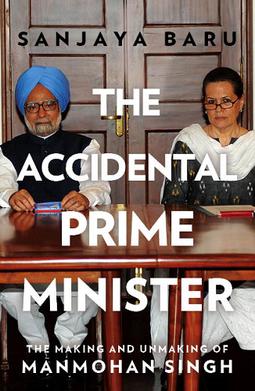
The Accidental PM and An Accidental Biographer

Manmohan Singh had greatness thrust upon him. The Indian voter had delivered a stunning verdict in 2004 that denied a mandate to the then ruling party, BJP, which, riding on a wave of economic resurgence, had blanketed the country with ads touting 'shining India'. More than their loss what drove the BJP crazy was the notion that Italy born Sonia Gandhi could lay a claim to the mandate and eventually unfurl the tricolor flag from the ramparts of the Red Fort. Even many voters who voted for Congress did not really imagine that that could be a result of their vote. An unfair groundswell of opposition rose to deny Sonia, who had led her party to victory almost singlehandedly, the office that she was constitutionally entitled to. In a stroke of surprise Sonia Gandhi, while refusing the office, ignored eager aspirants in her kitchen cabinet and called on Manmohan to lead the country despite the fact that he had not even contested the election. Manmohan became, as he himself confessed in many occasions to anyone who cared to listen, the accidental Prime Minister.

As a grieving widow of a gruesomely murdered man Sonia turned down the offer of Congress leadership. Seeing the party disintegrate she was later drafted to become the leader and save the party. It is chauvinism to keep referring to her as an 'Italian' as her opponents do. She has paid a very high price for marrying a man with the the surname 'Gandhi'. She is as much Indian as any Indian. The conflicts between the Prime Minister and the leadership of the party dates back to the Nehru-Tandon days. Not even Nehru, a charismatic leader with a reservoir of political capital, could avoid the antagonism with various factions of the party that had chosen him as their leader in legislature. Vajpayee -Advani rivalry and the internecine bickering that Vajpayee had with the hardliners of RSS and VHP is not a secret.


Sonia did occupy a certain grey area after the death of Rajiv during the days of the Narasimha Rao administration. Though she had no constitutional position visiting heads of state would pay her visit. During her hand picked Manmohan's administration she posed further ticklish problems because she was now an MP but came to be looked at as not just an MP. Something as simple as breaking protocol for her seating during a Republic Day parade became issues.

Sanjaya Baru was Manmohan's 'media adviser' and has released this book timed to cash in on the election season. He told a New York Times interviewer that he had 'promised a lot of people' that the book will be released only post-election but was compelled by the publisher to advance the publication for obvious reasons. The book does not contain any new revelations or bombshells since Baru takes cover behind the official secrets act. Written by a former aide the book suffers from a common malaise of any book by former officials in any regime across the world. Such books, unlike those written by a journalist, cannot rely on unnamed sources or even allude to them. Much of the book, therefore, is just a rehash of what is very commonly and plainly known to all those who have read newspapers.

Manmohan lacked political legitimacy because he was plucked out of anonymity by Sonia and it was compounded by the fact that he was not directly elected to the Lok Sabha and instead chose to be nominated for a Rajya Sabha seat ion order to fulfill constitutional requirements of being an MP. The lack of political capital crippled Manmohan from the word go. What is puzzling is Manmohan's refusal to contest even in 2009 when he was seen as a decisive leader coming off from surviving a vote of confidence forced by the truculent Communist party that had withdrawn support over the largely popular nuclear deal that India signed with US. Baru repeatedly points out that this lack of assertion was the prime cause of a listless administration that is headed towards electoral disaster. Sonia remaining in the background and influencing policy made her the de facto extra constitutional PM while Manmohan was the figure head. This was plain to the country and Baru's book has no whistle blower quality on that score.The book repeatedly circles around the Manmohan-Sonia tangle.

Baru says that ever since Manmohan lost the candidacy for an MP seat in 1999 he had a distaste of contesting elections. Baru attributes the defeat of Manmohan to his characterization of the genocidal anti-Sikh riots of 1984 as the handiwork of not just Congress but of RSS too. In Delhi, which bore the brunt of those riots, the remarks created a furore amongst the Sikh community which duly saw Manmohan for what he was, an eager power hungry politician. The riots were engineered by Congressmen and, ironically, it was RSS which even attempted to save lives. That a man in pursuit of electoral office would tell blatant lies about a riot in which his fellow community members were massacred tells volumes of his character.

Since 1989 coalition governments have been the order of the day in India. Many times the governments were a hodgepodge of power hungry parties coming together in a post-poll alliance jockeying for plum ministries. Political parties, as a rule, lack principles but they have a pressing need to satisfy their vote blocs and in a coalition government where alliances are stitched together there is little commonality in the prerogatives of the voting blocs thus resulting in a policy stalemate. Manmohan's government was no exception. Decision making became a process that made sausage making look more edifying. There was the GoM (group of ministers) and then there was the EGoM (Empowered Group of Ministers) above the various committees. All of that was done just to keep passing the buck and not take any responsibility for decision making. "At one point in 2007 there were over 50 GoM's".

Baru's book focuses only on his time in the administration which was just the first term of Manmohan. Manmohan's first term was marked by the landmark nuclear deal with US, building better rapport with US and as a result losing support from the Communist parties for whom hating US is a fetishistic obsession.

Distrust of US and Capitalism go hand in hand in Indian thinking and that permeates the body politic of India beyond the bureaucrats down to the common citizen. This despite the fact that the US consulates in India are the busiest in the world granting US visas to Indians. George Bush, in a post 9/11 world, looked to cultivate good relationship with India as part of what is now called in America as the 'Asian pivot'. Bush, unilaterally, sought to breakdown the decades old nuclear-apartheid by the nuclear-club that discriminated against new entrants to nuclear-weapons-club. The only good part of the book is where Baru details the efforts of Bush to bring India and US together on signing the nuclear deal. Of course, no revelations but just plain coherent telling of, possibly, the only achievement of Manmohan's first term.

Though a treaty was signed, Indian officials, in thralldom to their Soviet dream, dragged their feet endlessly into 2007. Senator John Kerry visited India and told the dithering Indian officials that the next President, most probably a Democrat, would not do what Bush was 'ready and willing to do' for India. A prophecy that came true with Barack Obama who let the treaty languish. Obama did not take Bush's pivot to India any further beyond a nominal state dinner for Manmohan. Manmohan, too, for his part, re-elected in 2009 did nothing in the foreign policy space. Baru laments that Manmohan did not capitalize on the one area where he had space, which is, foreign policy.

The reflexive hatred of US by the foreign policy establishment and the communist party is told at some length. Prakash Karat gets some, very justifiably, unflattering portrayal for his willingness to push the country to the brink of political certainty just to satisfy his crusty anti-imperialism credentials and to be a knight in shining armor for his comrades.

The dominance of left-wing thinking in policy circles, particularly amongst economists is underscored by Baru's confession that, as an economist, he used to pooh-pooh the growth of countries like South Korea. No economic model, save the Stalinist, was deemed relevant for India. Baru does his best to project Manmohan's feeble attempts at articulating a foreign policy vision as ground breaking. Manmohan's lack of follow through on any vision frustrated Baru.

A revealing moment in the book is when Baru registers that Manmohan felt that Natwar Singh, whose son was blamed by a UN investigation committee report as having used the UN food program for Iraq to make money, was being thrown under the bus by the Congress party. Here is a man indicted by an international investigation of bribery in a program meant for a people under a sanctions regime and Manmohan feels that the party must have backed that corrupt man. This willing tolerance of corruption will become Manmohan's undoing later. Incidentally, Baru does not flinch that the PM was trying to defend a corrupt minister.

The book unwittingly portrays the chaotic structure of especially the security agencies. India is a country hemmed in by hostile powers that are actively seeking to undermine the country by supporting insurgencies across the land and yet the security setup is pathetic at the organizational level. Internecine bickering between the newly constituted agencies, turf wars and a lack of clarity of which organization should report to whom all disconcertingly portray a country that is yet to learn how to build institutions.

Arun Shourie once wrote a column on the notorious obsession of Indian bureaucracy for who can use which color ink. When Baru makes a file note with red ink he is pulled up by J.N. 'Mani' Dixit because only 'service chiefs can use red ink'.

Like any book written by an official who was part of a regime this book suffers from numerous flaws. Officials write books to exaggerate their roles, to embellish their contributions and to make money. Sanjaya Baru does all three. Baru was only a 'media adviser' to Manmohan and as such he was not an intrinsic part of major policy decisions. His understanding of democracy and democratic institutions is appallingly elementary.

Like any bureaucrat he wants to shine up his boss's image while writing a book that he knows full well could become fodder for his boss's political opponents. Commending that Manmohan wakes up early and watches BBC Baru says the Prime Minister learned of the 2004 Tsunami from BBC before his officials could brief him. India's PM had to learn from a foreign broadcaster about a devastation which killed thousands and displaced tens of thousands. And that too, we are told, thats because the PM gets up early and watches BBC.

Baru does not blink when describing the Intelligence Bureau chief Narayanan as Edgar Hoover. Narayanan, Baru writes, 'earned his spurs' unseating the world's first elected Communist government in Kerala. Narayanan used to keep tabs on credit card spending of editors of major dailies and snooped on political leaders. None of this is recorded by Baru with any concern or alarm. In another attempt to shine up his boss Baru says Manmohan stopped asking for intelligence reports. In a puzzling comment Baru writes "he (Manmohan) not only resisted this temptation to spy on his colleagues, but gave up even the opportunity to be offered such information by declining to take a daily briefing from the intelligence chiefs". This makes it appear that intelligence briefings were almost entirely nothing beyond snooping on political opponents. Is India a modern day democratic republic or a Roman Republic of the days of the Caesars?

The 'Right to Information'(RTI) act was one of the genuinely progressive achievements of Manmohan's tenure. Baru opposed the act as he felt that "the glare of public scrutiny would not scare corrupt and inefficient officers, who would always, fine new means of playing old tricks, but it would certainly discourage honest officers from stating in writing views that might later be used to question their motives". Now, if an officer is honest, why would he/she worry about his/her views coming out in the open? If an honest officer had indeed reflected an honest opinion why would it be impossible to defend against questioning motives? These are old hat excuses of a crusty bureaucracy that was loathe to expose itself.

As 'media adviser' Baru's views of the role of free press in a democracy is shocking. Baru was also a journalist and that makes his views all the more deploringly shameful. Baru had asked for direct access to the PM if he is to function effectively and  to 'feed a hungry media something or the other all the time'. Managing the media is the chief task of any 'media adviser' but to look at it as feeding a 'hungry media something or the other' shows a complete disdain for a critical part of a democracy, the free press. Its almost Stalinist.

Baru does not think twice about asking TV interviewers to 're-record' if he thought the PM 'made a mistake'. The media adviser becomes a media-enforcer when he writes, patting himself, that 'once recording was done only the final approved version was available for telecast'. Tipping off the PM about possible questions to be asked in an interview is par for the course. The PM reading a written statement during an interview to a burning corruption scandal is nothing to be outraged about. All of the above practices would be considered sacrilegious in US or UK.

In US, given the cost of covering the President, news organization adopt a practice of 'pool reporting' whereby any news that the 'pool reporters' get while covering the President is shared equally. The 'pool' almost always accompanies the President when he travels to any place including a golf outing. When Obama team failed to include the 'pool' during a gold outing the press bristled. The point being that access to President is considered inviolate by US press. Indian press is far behind such defense of the role of press's role in a democracy.

US Presidential meeting appointments, especially those at the White House, are public knowledge and access to the list of meetings is a privilege that the press guards zealously. Baru cheerfully records how a Pakistani diplomat used to visit the Race Course Road secretly and how his visits were never recorded in the 'daily programme sheet'.

That the era of political correctness is yet to dawn in India is very evident from the brazenly communal stereotypical remarks that Baru drops nonchalantly. A personal assistant who simply does his job of taking care the boss has his lunch is commended as doing it in the 'best tradition of Malayalee personal assistants'. Baru exults that Narayanan paid him the 'highest compliment a Malayalee' could possibly offer by saying 'I always thought Tamil Brahmins were the cleverest chaps, but youTelugu Brahmins have proved to be cleverer'.

Sanjaya Baru, certified the 'clever Telugu Brahmin' by a 'Malayalee', disdainfully observes that several ministers and officers were appointed to ensure diversity of race or religion or gender instead of merit. It does not cross his mind for one minute that in a county of a billion its easy to find meritorious people across any caste or gender criteria and that diversity need not be implemented at the cost of efficiency. Its only paucity of imagination to think that when Brahmin males are overlooked that only bad choices are made in the attempt to diversify. Baru, again nonchalantly, by now with irritating regularity, observes how Vajpayee picked a 'fellow Brahmin' for an office.

That Sanjaya Baru is a man of very limited intellectual abilities is evident when he fawningly rates Manmohan's ascension to the top position as being above that of Barack Obama becoming America's first black president. Its plain sycophancy typical of a bureaucrat who has not outgrown a clerical mind. At another place Baru prides himself on making fine liquor available for journalist aboard the Prime Minister's plane though he rescinded other undue favors that were extended to journalists of favor in the previous Vajpayee regime.

In his prefatory remarks Baru expresses admiration for Sharada Prasad and especially for the latter's reticence in talking about his days as an administration official. In US it is common for both Presidents and officials to write self-serving accounts of their days in office. The redeeming part is most of them bequeath their papers to some institution and a journalist or historian like Robert Caro could write a detailed impartial biography. Sometimes, as George Kennan or even Steve Jobs did recently, biographers will be commissioned and given complete access to record albeit with the understanding that there will be no interference in how the book is written. Such writing is unheard of in India and thats sad.

The book is a success because it is an easy read and for once gives a simplistic albeit coherent narration of the workings of a government. The failure to delve any deeper on policies or philosophies of governing is a let down only for the serious reader. To be fair to Baru he does indeed portray Manmohan in a flattering light and the criticisms are only there to give it a semblance of balance and ensure that there is a selling point.The memoirist is as much accidental as the subject is and the writing shows it.

Thursday, April 24, 2014

Swaminarayan Temple Vs Dalits, Chandrayaan, Nehru, Hindutva Ideologues and Aravindan Neelakandan's Axe Grinding

Quite a few responses to my last blog had asked why I objected to Aravindan Neelakandan delivering a lecture at IIT-Chennai and why I thought he was not academic enough. As luck would have it Neelakandan himself provided fodder the next day with his email to Jeyamohan. In that mail he tried to establish that Hindutva ideology boasts of stellar thinkers and that there is an intellectual tradition fostered by those thinkers. It is essential to debunk that mail and while doing so I'll establish the differences between academic and partisan thinking.


Swaminarayan Temple Vs Dalits

Neelakandan cited the case of Swaminarayan temple in Mumbai where courts granted Dalits (then referred to as Harijans) the right to enter the temple on the basis that it was a Hindu temple. He traces the court's decision, classifying Swaminarayan sect as Hindus, to what he claims Hindutva inspired definition of who is a Hindu. Ambedkar famously gave the negative definition of who is a Hindu, in the constitution, as 'one who is not a Christian or Muslim or a Jew or a Parsi'. Neelakandan contends that Ambedkar was inspired by Savarkar's writing that "only those who consider Bharat as their ancestral land, blessed land and the birthplace of his religion, are hindus". Thus drawing a tenuous connection he takes credit for providing the legal basis which the court used to allow Dalits to enter the temple.

A close perusal of the judgment shows that the cause and effect are incorrectly tied. The temple authorities did contend that the Swaminarayan sect were not Hindus and therefore could not be controlled by the Bombay Hindu places of worship act. The Bombay High court did not just blindly use the Ambedkar definition but rather it went to great lengths to establish that the Swaminarayan sect were indeed Hindus by virtue of the philosophy and tradition. There is nothing here for Neelakandan to take credit for. The court further went into Article 25 to establish equality as principle within practitioners of the same faith.

My itinerant research on this topic showed that the Untouchability Offences Act (UOA 1955) is very restrictive in scope. The act very narrowly says that if a temple allows Hindus of other castes then it cannot differentiate against Dalits. Time and again Jain and other temples have gone to court to claim exemption from the act with respect to admitting Dalits by saying that their temples admit only Jains and that they are not Hindus and as such Dalits cannot claim parity.

Temple entry movement is a long and cherished part of India's glorious freedom struggle. The Tamil Nadu Temple entry act of 1939, pre-dating the Ambedkar citation of Savarkar in 1941, signed by Rajaji was the result of Vaidyanatha Iyer leading an agitation for Dalits to enter temples. Savarkar and his Hindutva acolytes, then and now, try to embrace every religion born in India as Hindus to counter what they see as the inimical presence of Semitic religions. This all embracing politically convenient love for Buddhists, Jains and Sikhs is not true and is driven by ulterior motives.

How to balance religious freedom with civic rights is a contentious topic till today including a country like US. The Bombay High court admirably walked that tight rope and delivered a stinging verdict that was later re-affirmed by the Supreme Court. The case was decided on more than just simply saying "you are Hindus".

Taking a complicated case and presenting it shorn of its multi-layered dynamics is what a person with an axe to grind will do and Neelakandan does it with unflagging vigor.

The charm of Neelakandan is his pummeling the reader or listener with arcane facts and dazzling the receiver with a raft of augments that sounds reasonable and seemingly appears built on an edifice of facts and logic while he would be skating on very thin ice.

Neelakandan invariably takes a moderately strong case and conflates it with other blocks of overarching theory giving everything a panache of legitimacy borrowed from that one case where he could be arguably correct. Having started off with the Swaminarayan case he then proceeds to fantasies. He claims credit for raising the marriageable age of girls and even combating apartheid in South Africa. The Hindu Reform movement, that includes a very gentle intellectual like Raja Ram Mohan Roy, which spear headed many reforms concerning Hindu girls and marriage, including abolishing of Sati, had nothing to do with the likes of Savarkar or Hindutva. India's stand against apartheid was driven more by left wing leaning Indira Gandhi etc than due to any Hindutva ideologue.

Suraj Bhan and Ashok Singhal

Neelakandan exults that VHP President Ashok Singhal supported Dalit leader Suraj Bhan in excising uncharitable references to Dalits in ancient Hindu texts. This is true but it's nothing to be proud of. This is the kind of idea that a partisan hack would relish but no academician would even contemplate.  And even there he says that Singhal was ready to discard Manu Smriti because, in his opinion, it was written after the era of Pushyamitra. That some people were considered to pollute others by their mere shadow and that it was sanctioned by religious texts is not something to be bowdlerized and whitewashed. A tyranny that stretches over a millennia and to even today is not to be wished away by erasing history. I'll not belabor this further.

Ambedkar and Arun Shourie

I've read parts of Arun Shourie's 'Worshipping False God's', a scathing vitriolic attack on Ambedkar. Shourie repeatedly contrasts Ambedkar with Gandhi and casts the former mostly as an eager collaborationist with the colonial regime while the latter fought it. There is more than element of truth in that. But Arun Shourie is just an English speaking suave Magsaysay award winning journalistic version of Neelakandan himself. The Gandhi versus Ambedkar struggle was of epic proportions and too complex. Ambedkar, like Jinnah, resented Gandhi's overweening piety and above all his attitude to re-interpret Varnashrama without attempting to discard it completely. Ambedkar, justifiably, felt that most of the Congresswallahs, many of who were upper caste, will at the first available opportunity revert back to the original Varnashrama. In fact when Nehru wanted to pass the Hindu Code it was his fellow congressmen that opposed him most.

I saw this on a FB post.
Ambedkar resigned as Law minister largely disgusted by the obstruction within Congress for passing Hindu Code bills. Rajendra Prasad and few others were instrumental in weaseling out of having to pass the bills. Prasad wrote to Nehru that the constituent assembly lacked the mandate to pass such a bill. Nehru then took it upon himself vowing to campaign on it in India's very first general election and campaign he did. Having won the mandate Nehru then worked like a master legislator to pass the reforms in four bills. It is a legislative accomplishment that can only be compared with what Lyndon Johnson would do nearly 14 years later for the Civil Rights Act in US Congress. Unsurprisingly Neelakandan forgets to credit Nehru for passing that but cheerfully takes credit for what it aided in accomplishing through the courts in the Swaminarayan temple case.

Today Neelakandan and others are eagerly embracing Ambedkar out of a shared animosity towards Gandhi and out a desire to fashion unified Hindu front as a rampart against the Semitic religions. Ambedkar, conveniently for the Hindutva brigade, espoused a lot of anti-Islam views and even subscribed to the two nation theory. A recent wall poster by a Hindutva group thanked Ambedkar for restricting reservation system to only Hindu Dalits.

Neuro-theology - Murali Manohar Joshi

Neelakandan nonchalantly claims that Hindutva thinkers were the ones who took Gandhian ideas to its next level. Gandhi, as a thinker, comes under withering criticism and is in fact blamed for the many ills of post-independence India especially with regard to partition, by Hindutva ideologues. Having criticized a man as responsible for India's problems Neelakandan takes credit for taking his ideas to the next level.

The likes of Deen Dayal Upadhyaya, K.R. Malkani and others are known for vacuous opinions that masqueraded as 'theories'. Not satisfied with presenting them as thinkers Neelakandan proudly presents one Ram Swarup as the precursor of what is now known in the west as neuro-theology. Neuro-theology is patented pseudo-science. It is Hindutva brigade that often takes umbrage at Indians citing Western sources as validation and he now writes in the vein of 'even the Westerners themselves...'. I guess that being a precursor of even a pseudo-science is worth taking pride only by a partisan ideologue not an academic.

Murali Manohar Joshi became the butt of widespread ridicule when he sought to make astrology a degree course. Neelakandan refutes that and repeats his favorite anecdote of Joshi asking Kasturirangan of ISRO if indeed, as he said in a speech just then, that India could send a probe to the moon at low cost and if so that he, as minister, will support it fully. The implication in repeating the episode is that Joshi, far from being a atavistic pseudo-scientist, was a man of science.

Chandrayaan mission was a great achievement of India's science establishment but there is no proof of Joshi having done anything concrete beyond a good natured banter. ISRO, like every other institute of science and research that India takes pride in, was due to the efforts of Jawaharlal Nehru. It was Nehru, inspired by the Soviet example, partnering with India's scientific geniuses like C.V. Raman, Homi Bhabha and Vikram Sarabhai who ushered in an era of government funded premier science institutes. ISRO's moon launch was an achievement that was many years in the making and most of which were under the auspices of Congress regimes. In the least one can say that BJP government just happened to be in power to provide the final round of funding and public support. Americans thank JFK for moon landing not Nixon in whose presidency it actually happened.

The old saw, of Indian science containing miracle cures that Western science only recently discovered, is brought out again by citing Dr Mashelkar's article 'Blending traditional wisdom and modern science'. Mashelkar, Director General of CSIR, recycled an old speech of his as an article in honor of Joshi's 75th birthday. This is just sycophancy. The article contains the usual worthless shibboleth of greatness of ancient Indian science. Every culture and every civilization had strains of science and discoveries. Mashelkar proudly declares that CSIR is the 'largest chain of publicly funded  industrial R&D centers in the world'. He is proud that Indian texts spoke of acetylcholine receptors for rabies before T.L. Lentz wrote of it in the premium scientific journal 'Nature'. Yet, there is not a single modern day cure for any major disease that we can credit the CSIR for. India is in the midst of a contentious battle in the WTO for its blatant plagiarism of western medicines using 'process patents' as opposed to 'product patents' thats widely used.

Nehru-Stalin

Nehru was enamored and inspired by the Soviet model and communism in general. Nehru saw India, a country of depressing poverty and a very large section of the population mired in feudal backwardness, as akin to Czarist Russia. In the 50's there were few who were not impressed by the strides being made by Soviet Russia, especially with respect to its industrialization and advances in science. For all his admiration of Communism and Russia Nehru, like his mentor, Gandhi,  roundly rejected their violent means. To tag Nehru with Stalin's name is sheer partisan propaganda that has no bearing in history.

Jeyamohan and Neelakandan

Jeyamohan had once called Neelakandan as one who spews Hindutva hatred. This email by Neelakandan was prompted by Jeyamohan castigating Hindutva ideologues as intellectually empty. Having said that Jeyamohan published Neelakandan's email without comment or argument leading it open for debate as to whether he takes back what he wrote or is just providing space for a protege to disagree. I've come to believe that Jeyamohan moderates his Hindutva stances conveniently depending on situation and Neelakandan is a useful foil for Jeyamohan to present himself as the saner version of blatant hatred.

A partisan dilettante

What can we say in conclusion? Each of the sections above can be written at length with even more depth and even more decisive debunking. This is only to substantiate where I am coming from when I chided IIT for inviting Neelakandan to speak. Almost every time I've found that he cherry picks facts and stitches his own fantasy cloth. He is a skillful propagandist who knows that cherry picked facts and half truths are more effective than blatant lies.

My grouse with Neelakandan is that he not only selects facts but that he intentionally whitewashes the contexts often. Failure to contextualize or look at the broad picture or blur the subtle multi-layered complexities are all what make him, in my eyes, as unfit for any academic discussion. A caveat here about the word 'academic'. By the word 'academic' I don't just mean having a degree or a PhD. Most notably, Paul Krugman, Nobel Laureate in Economics, is now considered, as a conservative host put it effectively, a polemicist rather than as an economist. I use the word 'academic' in a catch all manner for anybody capable of reasonable debate with an honest intention to strive for seeking truth.


References:

1. Neelakandan's email to Jeyamohan http://www.jeyamohan.in/?p=53956
2. Swaminarayan temple case - Bombay High Court - http://indiankanoon.org/doc/1336275/
3. Swaminarayan temple case - Supreme Court - http://indiankanoon.org/doc/1336275/
4. Temple entry and the untouchables offense act - Includes several cases, especially by Jains, pf temples filing law suit claiming exemption on the basis they were not Hindus http://marcgalanter.net/Documents/templeentryandtheuntouchabilityact.pdf
       a) Case of Bhaichand Tarachand - Jains vs Dalits - http://indiankanoon.org/doc/1842396/
5. Tamil Nadu Temple - 'Reliving the historic temple entry' - 'The Hindu' news article - http://www.thehindu.com/news/cities/Madurai/reliving-the-historic-temple-entry/article4897572.ece
6. Dr Mashelkar's article in honor of Murali Manohar Joshi's 75th birthday - http://drmmjoshi.in/blending-traditional-wisdom-modern-science/
       a) Original speech delivered in 2001                                                                                                               http://www.csir.res.in/external/heads/aboutcsir/leaders/dg/dgsp2.pdf
7. Neuro Theology - http://en.wikipedia.org/wiki/Neurotheology
8. ISRO http://en.wikipedia.org/wiki/Indian_Space_Research_Organisation


Tuesday, April 22, 2014

Hindutva in Academia and Brahmin Hegemony in Arts

As one who has consistently written against class hatred of Brahmins, as a community, largely by adherents and supporters of Dravidian political ideologies, I'd like to speak of another side as a critic and member of the human race. In the vitiated political atmosphere that Tamil Nadu became, thanks to nearly 70 years of hate propaganda that took the place of much needed reform ideas, it is easy to tarnish any non-Brahmin who speaks against class hatred as 'Brahmin stooge' or 'apologist of Brahminism' and it is easier to lump one such person as 'Dravidian political hate monger' when one criticizes trends in a community. I hate the term 'non-Brahmin' because it defines a  person by what he is not rather than what he is. I'd rather take the label of 'gadfly'.

The many details of this blog, as it always happens, have been swirling in my mind for some time the catalyst in making me write this today is the news that Aravindan Neelakandan, a purveyor of Hindutva brand of hatred, spoke at India's premier educational institute, IIT-Chennai delivering an 'Extra-Mural lecture' on 'Exploring the cultural roots of India: A neuro-cultural approach'. God knows what is a 'neuro-cultural approach' is. He is no academically trained sociologist or anthropologist or any 'ist', nor does he have any publication to his credit in a peer reviewed journal of note. Here, 'peer-reviewed' does not mean reviewed by his cohorts who spew venom in 'Tamilhindu.com'. Neelakandan is the kind of person that no institute with respect for academic rigor should allow to even be an announcer at a meeting let alone deliver a lecture. IIT-Chennai is now a den of a militant brand of Brahminical Hindutva.

Picture taken from VSC-IIT. The image file was named 'VSC_Sena.jpg'. Sigh!!
IITs were established by Nehru, the bete-noire of Neelakandan, with the sole purpose of creating an MIT in India. No other leader of Independent India had such a vision. IIT's have occupied the place of pride in Indian educational system. Cultivated as 'islands of excellence' IITs were exempt from the full component of reservation policies. Though I oppose reservation I fully agree that IITs cannot be islands. If we disregard merit or take a nuanced view of what constitutes merit in how doctors, who treat thousands, are selected and engineers, who build roads and bridges, are selected then how can we exclude one institute that is now more notorious for being a feeder to American universities than for anything else. I fully support reservation in IIT. Also these so called islands of excellence have not only not turned up a single Indian Nobel laureate, their share of alumni, on a global scale, creating groundbreaking theories is pathetic. Yet these IITs, dominated by a Brahmin student population, are coveted even amongst seekers of grooms in Brahmin families.

Thanks to social media and youtube I've watched lectures by IIT-Chennai professors, almost all Brahmins, and I can say that I no longer wonder why IITs rank abysmally on World rankings. 'Vivekananda Study Circle IIT-Madras' is a communal and blatantly Hindutva organization functioning within the auspices of IIT and patronized by their professors. All topics, in the name of Indian culture, are exceptionally Hindu topics and many are plain nonsense like 'spirituality in student life'. These colleges that Nehru and Homi Bhabha dreamed of becoming India's MITs are now nothing more than parochial Brahmin ghettoes (agraharam). Neelakandan was felicitated by Prof L.S. Ganesh who once spoke on 'purpose of education'. Ganesh's speech is aboriginal in intellectual comparison with Cardinal Newman's 'idea of university' or even 'The uses of University' by Clark Kerr.  Another professor's speech on 'spirituality in student life' is plain drivel. I'd say that I've not yet come across a single good speech, including one delivered by the the Director of IIT, organized under the auspices of the saffron brigade at VSC. Check out Dr N. Gopalakrishna's, not an IIT faculty, speech 'lecture on Indian science' at IIT-Chennai ( https://www.youtube.com/watch?v=EngwxT8xY10) . Any university worth its salt should disband this organization and put a stop to such nonsense within its premises.

The common thread in all the speeches is a frighteningly parochial view of India where 'Indian culture' always comes to mean 'Hindu culture'. To those who protest my labeling such topics as 'Hindu' the response is simple 'why do you stop there and as long you stop at the banks of Ganges alone I'll insist on calling it as religious in nature and not Indian'. One can see this in other Brahmin run institutions, whether it is a school like Padma Seshadri or a deemed university like SASTRA (my alma mater) I see an incursion of resurgent Brahmin ideology clothed in Hindutva duplicity and masquerading as 'Indian'.

SASTRA conducted a tech meet, yes it was supposed to be one such, on Mahabharatha. A computer science student blogged that Mahabharatha teaches us about 'weapons of mass destruction' and 'in-vitro fertilization'. I puked and then pitied her. Creation of the atom bomb was an intellectual feat that not even Einstein had believed was possible. Einstein had to be coaxed by other scientists to write that fateful letter to FDR to start an atom bomb project. To control a fission process, weaponize it and then to unleash it was a process that challenged the collective wisdom of many a Nobel laureate and here is a student nonchalantly comparing fantasy weapons in a mythology to what later became the scourge of humanity. Even today IVF (in-vitro fertilization) is more art than science. The results are neither predictable nor controllable. To compare a great leap of modern science, again, to a shred of mythology, is pathetic. These are not passing fads to be ignored. If this is how engineers at a highly ranked university (in Indian rankings) are exposed to the miracles of science it is no wonder Indian colleges turn out foot soldiers of technology.

SASTRA's annual tech fete is called 'Kuruk-sastra'. Really!! I mean really? IIT calls its tech meet as 'Shaastra'. SASTRA held a symposium on law and titled it "Tarka Saastra", written in Devanagri script.

Murali Manohar Joshi, during the last BJP regime, sought to introduce astrology as a course of study in Indian universities. Even today it is common to find, mostly Brahmins, arguing that astrology is science. Sujatha is often considered a writer of science and science fiction by those who know neither. Sujatha, a Brahmin, remained imprisoned in his Brahminical soul even when discussing Big Bang theory or Quantum physics. He can never speak of science without finally rounding it off with "as our own ancient Indian scripture says". To be fair, P.A.Krishnan, also, incidentally, a Brahmin, wrote a wonderful article on 'what science is'.

An article, in a website where Neelakandan and his cohorts often write, baselessly claimed that Muslim invaders, lacking any modicum of culture or civilization, destroyed Hindu kingdoms. The first known autobiography of an Indian ruler was by Babur and it is a much acclaimed one on par with Ceasar's commentaries. Jahangir's 'Tuzuk-i-Jahangairi' too is a delightful read. Can one speak of Hindusthani music or Indian architecture without thinking of Mughal influence. India, to the chagrin of those charlatans, is known through Taj Mahal to the wide world.

Even non-Brahmins tend to look up at Carnatic music and Bharathanatyam as classical art forms and this is a propaganda victory of unprecedented nature, without parallel, by Brahmins. Sowmya, a Brahmin and Carnatic singer, ran a website for carnatic music where she, an IIT graduate, claimed that music originated from a Hindu god. Yes there is mythology around that but is that what a graduate, from an engineering institute, should regurgitate? It is a complete myth that Carnatic music 'happened' with Thyagaraja. The complete obfuscation of native musical traditions, that Thyagaraja drew from, is propagandist victory that even Goebbels could not achieve.

Rukmini Devi Arundale took the native lusty 'sathir' and bowdlerized it to create Bharathanatyam. Shorn of its lustiness today every Brahmin girl dreams of beckoning Krishna at least once in her life on stage. The fetish for staging the maiden dance ('arangetram') is both amusing and disgusting.

Music and dance were the province of the lower caste with Brahmins disdaining to even practice them let alone become proponents of them. Even today there are parts of a Carnatic musical, like playing some instruments, that Brahmin students would shrink from even thinking of becoming a student of.

The smugness of Brahmins who profess love for Carnatic music is something to be experienced for its fathomless depth. Most have no idea of any music beyond what Thyagaraja gave and even if they do take a peek at Western classical they would shrug it off. I'd like to compel every student of Carnatic music to read the pages on comparing Western classical and carnatic music by Jeyakanthan in his 'Parisukku Po'.

Carnatic musicians and the legions of its lovers like to think of it as 'Indian' music and not strait jacketed as 'Hindu' music. When a group of Christians came up with the idea, actually its an old tradition, to compose Christian hymns with Carnatic raga the Times of India noted "purists too are not averse to the idea". Who are the purists not averse to the idea? Bombay Jayashree, TOI quoted, "music is a religion and singing Christian songs in Carnatic style is an interesting way to combine two religions". Poor Jayashree, she has not heard of Abraham Pandithar and Vedanayagam Sastriyar.

There was a time when Sabhas used to advertise Carnatic music performances saying "Not for Shudras". Sabhas assiduously practiced segregation to levels that make Jim Crow American South look more hospitable. In Jim Crow South blacks could at least enter a theater to watch a performance, whereas, in Mylapore Sabhas low caste Hindus could not even enter. Carnatic music teachers relish dropping innuendos to non-Brahmin students about how they may not suit learning the music. Of course there are always exceptions, including a very good gregarious friend of mine. A carnatic music lover once smugly told me "who is preventing others from learning". Poor man he did not know that low caste non-Brahmins were not even allowed into temples where most performances happened until Sabhas mushroomed in Chennai. A wife of a carnatic musician recently wrote about music in Chennai, where else but 'The Hindu' newspaper, and she could not think of anybody but Brahmins, the 'pattu maami', teaching and learning carnatic music.

T.M. Krishna, a wannabe rebel in the carnatic music scene, lectured an audience that one can even be an atheist and sing Thyagaraja Kritis about Rama. Actually I'd disagree on that score. Yes, an atheist could probably deliver but for a music system that emphasizes 'bhava' (emoting) it might help to be a believer in some God, if not Rama. Neither Krishna nor Ilayaraja, who pays obeisance to carnatic music more than he does to Mozart, took music to the slums. Only A.R.Rahman does that. Krishna is loosening the informal but dogmatic caste hold on the music to scour practitioners for an art that is still in the margins of the daily life of citizenry despite its assigned place of pride in the cultural pantheon.

The shrill anti-Brahminism of Dravidian politics, spear headed by the irascible EVR, was a reaction to the sweeping hegemony in arts, culture, education and jobs by Brahmins. Prof Neelakanta Sastry, considered the doyen of Indian historians, happily wrote the following in the opening paragraph of a chapter on South Indian literature: "Sanskrit was the language of higher culture throughout South India......All these literatures (referring to native, including Tamil) owed a great deal to Sanskrit, the magic wand whose touch alone raised each of the Dravidian languages from the level of a patois to that of a literary idiom". Mr Sastry wrote that as a Sastry than as a historian. Of course one kind of charlatanism begets another. Today we've a former Vice Chancellor claiming that the entire world civilization originated in Lemuria. We now have lessons for school students that claim Einstein's and Newton's theories are in ancient Tamil literature. Speak to most Tamil professors today you will hear how Kamban predicted atomic fission.

Between religious and linguistic chauvinism academic rigor and scientific values have all but vanished in Tamil Nadu today. Ramayana is a great epic produced by a great civilization but when speakers pretend that it is 'history' one can see the absence of academic rigor. The worst is when somebody claims Vyasa is the first known biographer of the world. Vyasa is just a person that is considered to be the author of the epic. In fact when we consider Ramayana to be some work of one individual in a given period, instead of streams of civilization across ages by several authors, we lose sight of why it is a rich document of a great country. A group called 'Tamil Heritage club' recently had a talk titled 'Historical Rama'. Other than Islam and Sikhism I cannot think of any ancient religion that can speak with certainty of the historical nature of its key figures. I am not averse to any 'historical' discussion based on facts and findings. But these discussions often degenerate into pathetic illogical theoretical constructs that would not stand the mildest of academic scrutiny.

My favorite author Jeyamohan  today weighed in on Hindutva ideologues and their intellectual vacuity. Jeyamohan cribs, justifiably, about the dominance of Marxist adherents in institutes that have arrogated to themselves to be the intellect of India. He then suggests that Hindutva drivel was a reaction to asserting native identity against Marxist intellectuals who, held in thrall by Western ideas, looked down on our own culture and history. Though he respects Nehru Jeyamohan has always complained that India's cultural institutions became dominated by Marxist intellectuals thanks to Nehru who was both a Marxist and an anglophile. It is true only in parts and the missing part is crucial. Nehru was not a blind anglophile, far from it. Rejecting Nehruvian idea of history Jeyamohan holds up Vivekananda, Narayana Guru and Nithya Chaitanya Yathi. The missing name, notably, is Dr S.Radhakrishnan.

Nehru, to be fair, was not a blind anglophile. He had a very healthy respect for India's hoary civilization. Anyone who reads 'Discovery of India' can see the depth of his love for the soul of India at its people. At the same time he was a modern man too. Nehru's scientific temper remains unmatched in all subsequent Prime Ministers of India including his progeny. The vision in establishing premier educational universities and research organizations were his own. And yes he had a disdain for the exceeding 'religiosity' of India.

Jeyamohan always holds up Vivekananda as a shining example of India's ancient intellectual tradition and proponent of Indian philosophy. Vivekandanda has the aura and romance of young radiant ascetic. Yet for all his brilliance he remains a Hindu mystic with no academic credentials or modes of exponentiation. The rejection of Nehru and Radhakrishnan, while embracing ascetics, by Jeyamohan is driven more by his innate Hindutva leanings that abhors the scientific temper and avowed secularism of both. It is strange that I never see Radhakrishnan mentioned by the likes of Jeyamohan. It was Radhakrishnan, in the tradition of Max Mueller, who gave an academic sheen to Indian philosophy which was looked down upon as theology.

It is a common complaint in America that liberals dominate the academia. Jeyamohan's complaint of Marxist domination is not entirely without merit. However, he glides by a key caveat of not judging rubbishing the likes of D.D. Kosambi and Romila Thapar based on their political allegiances and historical outlook. Both Thapar and Kosambi are great scholars of merit. If their historical work or interpretation, tinged or not with Marxism, is found faulty then call them out on it but to sweep them aside is chicanery.

Is Marxist interpretation of history all that wrong? Not always. Ambedkar who hated Muslims made political hay on the Moplah Rebellion when thousands of Hindus were forcibly converted to Islam or butchered or raped by Keralite Muslims. Gandhi struggled to hold together his cherished Hindu-Muslim unity in the face of that massacre. Citing the rebellion Ambedkar happily suggested that both communities are incompatible for any collective future. A Marxist interpretation would be that it was an agrarian rebellion which used religion to intimidate. All the landowners were upper caste Hindus and all the laborers, almost without exception, were poverty stricken Muslims.

A point here about inviting Marxists. I'd frown on Arundhati Roy too. People like Roy are activists. There is no 'grey' in their world. They like to see everything in black and white. As a fan of Ayn Rand I like the principle 'A is A'. I don't like when people seek to validate all contradictor views as equally valid. Thats patented nonsense. Open mindedness is often confusingly defined as being so open as to accept all arguments as valid. No. Human mind is not a sewer to accept everything indiscriminately. We should be open enough to consider competing arguments and then decide one way or the other depending on whether sufficient data are available. When left wing Princeton professor Cornel West courted arrest in a 'occupy wall street' protest I considered it bad academic activity. A professor becomes less of a professor when he becomes an activist. An activist has no skepticism or nuance, essential characters of a teacher. Do activists have no place at all in academic portals? No. What matters is the forum and what kind of intellectual challenge happens in that event.

The likes of Neelakandan do not believe in academic discussion or even intellectual jousting. That hate monger gleefully posted on Facebook on Easter Sunday that it is nothing but a pagan festival. On Christmas day he sought to inform Christians that Mithra was the original Christ. DK's Veeramani used to write columns denigrating Hindu gods on the occasion of Hindu festivals. Neelakandan is just his counterpart. Any Westerner with a modicum of knowledge in history would know that Dec 25th is a pagan festival. Nobody seriously believes that the good Lord came with a birth certificate and Dan Brown disabused anyone still thinking of Christmas as anything holy. Elaine Pagels, who wrote bestseller 'Gnostic Gospels' and 'Beyond Belief: The secret Gospel of Thomas', is a professor of religion at Princeton University. She is the clear example of how religion can be studied within the academic framework. All these IIT professors who blather on culture, ethos and other such vacuous terms cannot hold a candle to her. Incidentally, the Mithra cult was prevalent during the days of Emperor Hadrian as Marguerite Yourcenar tells in her prodigiously researched 'Memoirs of Hadrian'.

Wendy Doniger and many others run into one problem when they write on Hinduism. Hinduism lacks theologians, students who study theology as an academic discipline, and Indian universities do not study 'religion' as an academic course. Hence the rudimentary rules of academic discussion are unknown to the many who take umbrage at less than flattering narration of Hinduism especially when it is by westerners.

Jeyamohan argues that we call as 'academic' and 'scientific process' are constructs of Western education which are 'prejudiced' and cultivates a 'self-loathing' amongst Indians. That is untrue and skates on lot of thin ice. First, Indians look at university education and everything under that amorphous terms as 'western' and therefore alien. Much of what we call education today was recent even in the West. Historical interpretations today are radically different from even 50 years ago. Modern ideas of secularism and political correctness have tempered many past assumptions in Western academia. The concept of 'education' is an ever changing one and one in which India can be both a participant and shaper of the discussion if it chooses.

When we say that for a concept to be called 'scientific' it has to adhere to basic principles of what is scientific, including 'falsifiability' we don't see, for instance, Americans shun the principles saying 'it is European we need to invent American scientific idioms'. That would be idiotic.

Nothing has angered the Hindutva crowd more than the Western concept of 'nation-state' under which India is considered by western and Marxist academics as having been born on Aug 15th 1947. They are correct in rejecting a western template. India has a cultural unity, brought about by many reasons, across centuries. Yet, India was not always India too. I'd agree we need to fashion an 'Indian' definition of 'nation-state'. Ironically, as Sunil Khilnani points out in his densely written 'Idea of India', that these same Hindutva brigade then beseeches to fashion an India along the lines of Western nation-state of one religion, one people, one civil code etc.

Often times the call for 'Indian' definitions degenerates into disguised Hindutva as Jeyamohan amply demonstrates. He calls on thinkers to draw on 'Indian intellectual traditions' and then specifies which streams he considers as part of such a tradition: Hindu, Buddhism, Jainism, Sikhism, Sufi Islam.

Aravindan Neelakandan is a blunt instrument and too crude and therefore easily identifiable. Jeyamohan works more subtly and far more deviously. He omits, unsurprisingly, Christianity. What is worse he selects not all of Islam but a sect of Islam, Sufism, which is considered very eclectic and friendly towards Hinduism, as part of Indian tradition. Whereas Hinduism, Buddhism, Jainism and Sikhism he includes without caveats. Buddhist monks in Sri Lanka and Myanmar are the powers behind genocides while Sikh Separatism was the most serious threat to India in the 80's. Hindu fundamentalists destroyed a Mosque in twentieth century and then proceeded to inflame all of North India in a series of communal riots. Yet, Jeyamohan does not even think twice of excluding any parts of those religions. THIS is precisely why I'd still prefer Marxist dominance of education to any attempt, however justified, to balance the prejudices of Marxism. Every attempt, in the name of Indian culture, to redress intellectual corruption always degenerates into Hindu fundamentalism.

To their credit EML-IIT invites an eclectic cast of speakers of all mix like A.Patwardhan, Teesta Setalvad (to the ire of many), Jeffrey Archer and many others.

Modi becoming a Prime Minister scares me far less compared to the agony of seeing India's supposed citadels of higher education become vehicles of parochialism and a breeding ground for charlatans. Rescuing the IITs from such a clique is more urgent than preventing Modi from reaching 7 Race Course Road, New Delhi.

References:

1. Prof L.S. Ganesh lecture 'Purpose of education' https://www.youtube.com/watch?v=Bvz5VIMif58
2. Prof C. Lakshmana Rao lecture on 'Spirituality in Student Life' https://www.youtube.com/watch?v=_tglBUorpfY
3. Prof Bhaskar Ramamurthy on 'Indian culture' https://www.youtube.com/watch?v=AUDjkL5GK04
4. Vivekananda Study Circle - Archive of lectures - http://www.vsc.iitm.ac.in/Home/?page_id=56
5. Aravindan Neelakandan - 'Science and Spirituality' - https://www.youtube.com/watch?v=ouai7DXfmcI
6. Jeyamohan on Marxist intellectuals and Hindutva http://www.jeyamohan.in/?p=53857

ஆகவே இன்றையதேவை ஐரோப்பியநோக்கின் சாதனைகளை கருத்தில்கொண்டு அதிலிருந்து விலகி சுயமாகச் சிந்திக்கமுடியுமா என்று பார்ப்பது. இந்துத்துவம் என்றபேரில் இந்தியசிந்தனைமரபை எளிய அரசியல் வாய்ப்பாடுகளாக குறுக்குவதற்கு முற்றிலும் எதிரான நிலைபாட்டை எடுப்பது.இந்தியசிந்தனைமரபின் அனைத்துக்கூறுகளையும் [இந்து,பௌத்தம்,சமணம்,சீக்கியம்,சூஃபி இஸ்லாம்] உள்வாங்கிக்கொண்டு சிந்திப்பது. எந்நிலையிலும் ஆக்கபூர்வமாக மட்டுமே யோசிப்பது

7. 'Carnatic Music gets a Christian touch' - Times of India - http://timesofindia.indiatimes.com/city/chennai/Carnatic-music-gets-a-Christian-touch/articleshow/5286038.cms?referral=PM

"Purists too are not averse to the idea. Carnatic vocalist Bombay Jayashri says, "Music is a religion and singing Christian songs in Carnatic style is an interesting way to combine two religions. Christians all over the world adapt local customs and sing prayer songs in local languages." "