K. Balachander, a director of modest talent and a very limited intellect, passed away on Dec 23rd 2014 in Chennai. Balachander, awarded India's highest honor for a movie artiste, the Dadasaheb Phalke award, rose from very humble beginnings to become the story teller of the 70s middle class in Tamil Nadu.
Balachander's personal story is a very unremarkable one except for the fact that a boy born into Brahmin household in a small town, Nannilam in Thanjavur, went on to become a government employee, a typical middle class aspiration. He nevertheless retained his love for the theater which was to become his avocation later. The wikipedia entry for K.B., as he was called, aptly divides his career into the 60s, 70s, 80s and later era.
K.B. who was staging dramas got a break in films when one of his plays, Server Sundaram, was brought to the screen courtesy of AVM as producer and the director duo Krishnan-Panju. Jnanpith awardee and Tamil literature's perennial rebel Jeyakanthan took issue with the propaganda of Dravidian party speakers in characterizing Tamil as the language of three arts, music, prose and drama. Jeyakanthan cribbed that Tamil did not a drama tradition akin to Shakespeare, Shaw and Ibsen. He ridiculed the attempts to call 'Manonmaniam' as drama. From those days till today Tamil dramas are an insult to the word 'play'. K.B. produced pathetic dramas whose only redeeming quality was the contemporary nature of it and the social criticism that he wove into those. That his dramas were pathetic is evident from his early movies where he brought to celluloid his stage productions without any alteration as if the dramas were recorded live on camera. K.B. took nearly a decade to understand that movies are a different art form.
After the success of 'Server Sundaram' K.B. became the director for subsequent movies. Nagesh, a comedian, became the unlikely hero of K.B's movies. To make a scrawny and pockmark faced comedian a hero in the days of Sivaji Ganesan and M.G.R was a gutsy move. Wanting to plough his own lonely furrow away from the then reigning demi-gods of Tamil cinema K.B. cemented the idea of a movie standing on the strength of its script and acting.
In quick clip Ethir Neechal, Bama Vijayam and Iru Kodugal established K.B. as a director to reckon with. 'Iru Kodugal' centered around a hero who, based on wrong information, would've abandoned his wife only to later find himself working as a subordinate to her and the movie revolved around the awkwardness of the circumstance and the complications that arise. Overall a silly movie made sillier with what was then considered the skill of the dialogue writer, for example the scene where they argue about 'file' and 'life' with both punning on the words for tortuous minutes, would end in a sexist climax with his one time wife and current wife reconciling themselves to be in a bigamous relationship. Beyond his overrated skills as director a persistent myth of K.B. is that he is a feminist who made movies about strong women as lead characters. K.B. was out and out a sexist and nothing less.
The years 1973-75 with Arangetram, Sollathaan Ninaikkiren, Aval oru thodarkathai and Apoorva Ragangal were the best years for K.B. as director. He was now a household name. Arangetram and 'Aval Oru Thodarkathai' had a common theme, a woman who works and shoulders an entire brood of family. In Arangetram a Brahmin girl would end up becoming a prostitute in order to support a very large family. Her family then casts her out and then a neighbor and one-time paramour, tellingly a non-Brahmin, would marry her. 'Aval Oru Thodarkathai' is the most cited movie to support the myth of K.B. 'the feminist'.
In 'Aval Oru Thodarkathai' the heroine is a strong woman only in so much as that she is the bread winner and runs her family in a titular manner. Her family consists of a missing father, a widowed sister, an unmarried sister, a drunkard as brother and the brother's family with two boys, of whom one is visually impaired. One need not ask for more readymade recipe for pathos in a middle class family. The movie had all of K.B. hallmarks. Over the top histrionics, predictable screenplay, innovative camera work, sprinkling of talent and daring (as in showing a hastily dressing up heroine hurrying off to office) and a typical K.B. style contrived climax that would have tragedy thrust in. In a later remake titled 'Manathil Urudhi Vendum' all would repeat.
The common streak in 'Arangetram', 'Aval Oru Thodarkathai' and 'Manathil Urudhi Vendum' is that the heroines go to work only as sacrificial lambs for a pretty much thankless family. The heroines do not show any passion for career or have intellect to strive towards anything that can be called a career. They are all waiting to throw the yoke away and become 'housewives'. K.B. would reach the nadir in his later year failed venture 'Kalki'. In 'Kalki' a woman is spurned because she is barren and yet her only yearning in life is to become, not just a mother, but mother of a child through her abusive ex-husband. And the woman used to be an accomplished singer. Of course, all that does not matter because she can never be a mother. To add to the humiliation the woman is aided by a girl who goes out to seduce the villainous husband only so she could be a surrogate mother and help her new-found friend realize her life's mission. In 'Sindhu Bhairavi' the wife herself prepares a second marriage for her husband with his mistress. Of course, again, the mistress, 'gifts' a child to the barren couple and walks away. Balachander does not know the ABC of feminism and in its place he served crass sexism. It is irritating to read obituaries claim that K.B. created 'strong women characters'. Bollocks. For all those who wax eloquent about 'Aval Oru Thodarkathai' my request is to watch Satyajit Ray's 'Mahanagar'. Ray was a master in portraying the predilections of the middle class at a scale that K.B. could not even comprehend.
Balachander was a pretend rebel and a wannabe iconoclast because he could never bring himself to break taboos. If supporting widow remarriage and a woman going to work is considered revolutionary then yes he is one too. 'Apoorva Ragangal' caused a flutter with its middy Oedipal theme of a young boy falling in love with a mature woman. The screen play gets tangled in a comedy of errors when the woman's nubile daughter runs away only to fall in love with the boy's father. Now, the father intends to marry the young girl thus throwing into a tizzy the boy's plan to marry the woman. In a ridiculous scene the father would hector the boy asking "will you now become my father in law, and will my wife become your step-mother". Conveniently the elder woman's estranged husband will turn up in the climax only to die waiting to be re-united thus making her a widow. Bowing to tradition everyone comes to their senses and all part amicably. The movie is now considered a watershed moment in movie history for the memorable acting by Kamal Hassan and the cameo by Rajinikanth, both of whom are now the reigning kings of Tamil cinema.
K.B. played a big role in establishing Kamal Hassan as an actor and star. Kamal became a hero in K.B.'s first color film 'Manmatha Leelai, a story spun around a womanizer. The movie was a forgettable drivel of skin show and tawdry humor. K.B.'s role in Rajini becoming a super-star was trivial. Rajini starred only in a few movies as K.B.'s actor but he starred in many of K.B.'s productions whenever K.B. had to recoup his losses from his artsy movies. K.B. had a despicable habit of hiring 'masala' directors to make commercial movies. This drew a derisive comment from another director (Balu Mahendra?), 'if I intend to do prostitution I'd be the prostitute myself'.
Love stories were never Balachander's forte though he churned out two highly successful romances. 'Ek Thuje Ke Liye' a remake of his own 'Maro charitra' was a blockbuster in Hindi opening the doors of Hindi movies to Kamal. 'Punnagai Mannan', also featuring Kamal, was a successful venture with good music from Ilaiyaraja and lyrics by Vairamuthu. Kamal the hero was less captivating than Kamal as 'Chaplin Chellappa'. If one judges both movie on artistic merit both would come out as infantile romances with K.B. style contrived tragedies becoming the climaxes.
Balachander had moderate success on his politically themed movies 'Varumaiyin Niram Sivappu', 'Thanneer Thanneer' and 'Achamillai Achamillai'. They tackled issues of unemployment and political corruption. All of them were cynical and probably mirrored the cynicism of the late 70s in India.
Music, particularly Carnatic music, played an integral role in Balachander's movies: A mridangam player as protagonist in 'Apoorva Ragangal', the ups and downs of a Carnatic singer in 'Sindhu Bhairavi', the scion of an orthodox upper caste Carnatic vocalist in 'Unnal Mudiyum Thambi', a Carnatic vocalist in 'Kalki' and a saxophone playing hero in 'Duet'. Balachander had a ear for music. Since he titled his movie 'Apoorva Ragangal' he compelled the music director M.S. Visvanathan to write a tune that was unique. The song was admirably supported by lyricist Kannadasan and wonderfully acted out by both Kamal and Sri Vidya. But, did Balachander 'understand' music as an art form?
Balachander, based on his interviews and his films, does not come across as an erudite man much less that of an intellectual. It was widely rumored that his confidant Ananthu was the brain behind his movies. A rumor that was supported by the abysmal failures and crass movies that Balachander cranked out after Ananthu died in 1998. Balachander, a Brahmin, sought to portray himself as the rebel by taking a dig at the orthodoxy and casteism of Carnatic music in movies like 'Sindhu Bhairavi' and 'Unnal Mudiyum Thambi'.
In 'Sindhu Bhairavi' a concert attendee, the heroine, will get embroiled in a challenge to sing 'folk song' in front of a Carnatic singer. The lyric, penned by poetaster Vairamuthu, will ask indignantly "what is new in your ragas that the (illiterate) women folk performing chores did not know". The clamor for 'Tamil music' as opposed to singing the Telugu songs in Carnatic concerts was a political movement. 'Tamil music' is not necessarily just 'folk songs' and to reduce it thus is a travesty. And to equate folk songs, with their own richness, and classical music is an insult that only a pathetic intellect can inflict upon Thyagaraja. Balachander's addled ideas about musicians responsibility to 'take' music to the masses were downright silly. He'd repeat the caricatures in 'Unnal Mudiyum Thambi'.
The last movie that Kamal and K.B. collaborated was 'Unnal Mudiyum Thambi', 1988. The movie was based on real life activist Udayamoorthy. The tone was preachy and the movie had a surfeit of what was by now called 'Balachandarisms'. For instance in 'Sindhu Bhairavi' the hero, a singer, would jokingly tell his wife 'well to you music is?' and the scene would cut to the wife asking a vegetable vendor "what is the price of a kilo brinjals?'. Apparently Kamal had a falling out with his mentor during the filming. The movie was a commercial disaster and essentially marks the beginning of K.B.s end as a director.
Balachander and Ilayaraja had a falling out in 'Puthu Puthu Arthangal' in 1989. Raja who was by then ruling Tamil film music as a titular head could not complete scoring music in time for release and K.B. used a potpourri of Raja's music that was available with him. Raja had increasingly becoming very arrogant and antagonistic. He alienated pretty much every good director including childhood friend Bharathiraja. In 1992 A.R. Rahman debuted as music director in K.B. produced and Mani Ratnam directed movie 'Roja'. The fall of Raja from the throne was swift and decisive.
The 90s saw a tepid success for K.B. in the Mamootty starring 'Azhagan' followed by complete box office failures in quick succession. After Ananthu passed K.B. made just two more movies which bankrupted their producers. The years 1973-1985 were Balachander's halcyon days. By the late 80s his method of film making was hackneyed and boring. A brief foray into T.V serial making was successful for a short while when he shined by contrast compared to the drab serials that the state run T.V. was churning out then.
I'd rate the likes of Mahendran, Balu Mahendra and Bharathiraja as being more consequential and trendsetting than K.B. Bharathiraja, particularly, was more successful than Mahendran or Balu Mahendra and far more influential. Bharathiraja also brought more newcomers than K.B. did and thus outranked K.B. as spotter of talent. Arguably it is Bharathiraja's debut film '16 Vaiyathinele' that put Kamal Hassan, Rajinikanth, Sri Devi and Ilaiyaraja on the path to stardom than anything by K.B. While K.B. presented muddled portrayals of middle class Bharathiraja took Tamil cinema to its earthy villages outside the crappy studio sets.
Balachander has his place amongst the pantheon of film makers of the 80s who ushered in a new era in Tamil film making but he is being overrated as a director. May his soul rest in peace.
Balachander's personal story is a very unremarkable one except for the fact that a boy born into Brahmin household in a small town, Nannilam in Thanjavur, went on to become a government employee, a typical middle class aspiration. He nevertheless retained his love for the theater which was to become his avocation later. The wikipedia entry for K.B., as he was called, aptly divides his career into the 60s, 70s, 80s and later era.
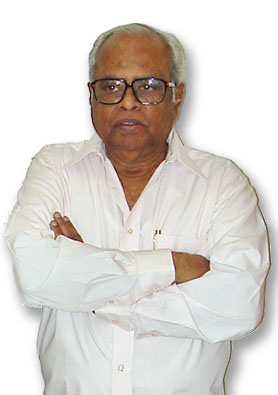 |
| K. Balachander 9th July 1930 - 23rd December 2014. Image courtesy Wikipedia |
After the success of 'Server Sundaram' K.B. became the director for subsequent movies. Nagesh, a comedian, became the unlikely hero of K.B's movies. To make a scrawny and pockmark faced comedian a hero in the days of Sivaji Ganesan and M.G.R was a gutsy move. Wanting to plough his own lonely furrow away from the then reigning demi-gods of Tamil cinema K.B. cemented the idea of a movie standing on the strength of its script and acting.
In quick clip Ethir Neechal, Bama Vijayam and Iru Kodugal established K.B. as a director to reckon with. 'Iru Kodugal' centered around a hero who, based on wrong information, would've abandoned his wife only to later find himself working as a subordinate to her and the movie revolved around the awkwardness of the circumstance and the complications that arise. Overall a silly movie made sillier with what was then considered the skill of the dialogue writer, for example the scene where they argue about 'file' and 'life' with both punning on the words for tortuous minutes, would end in a sexist climax with his one time wife and current wife reconciling themselves to be in a bigamous relationship. Beyond his overrated skills as director a persistent myth of K.B. is that he is a feminist who made movies about strong women as lead characters. K.B. was out and out a sexist and nothing less.
The years 1973-75 with Arangetram, Sollathaan Ninaikkiren, Aval oru thodarkathai and Apoorva Ragangal were the best years for K.B. as director. He was now a household name. Arangetram and 'Aval Oru Thodarkathai' had a common theme, a woman who works and shoulders an entire brood of family. In Arangetram a Brahmin girl would end up becoming a prostitute in order to support a very large family. Her family then casts her out and then a neighbor and one-time paramour, tellingly a non-Brahmin, would marry her. 'Aval Oru Thodarkathai' is the most cited movie to support the myth of K.B. 'the feminist'.
In 'Aval Oru Thodarkathai' the heroine is a strong woman only in so much as that she is the bread winner and runs her family in a titular manner. Her family consists of a missing father, a widowed sister, an unmarried sister, a drunkard as brother and the brother's family with two boys, of whom one is visually impaired. One need not ask for more readymade recipe for pathos in a middle class family. The movie had all of K.B. hallmarks. Over the top histrionics, predictable screenplay, innovative camera work, sprinkling of talent and daring (as in showing a hastily dressing up heroine hurrying off to office) and a typical K.B. style contrived climax that would have tragedy thrust in. In a later remake titled 'Manathil Urudhi Vendum' all would repeat.
The common streak in 'Arangetram', 'Aval Oru Thodarkathai' and 'Manathil Urudhi Vendum' is that the heroines go to work only as sacrificial lambs for a pretty much thankless family. The heroines do not show any passion for career or have intellect to strive towards anything that can be called a career. They are all waiting to throw the yoke away and become 'housewives'. K.B. would reach the nadir in his later year failed venture 'Kalki'. In 'Kalki' a woman is spurned because she is barren and yet her only yearning in life is to become, not just a mother, but mother of a child through her abusive ex-husband. And the woman used to be an accomplished singer. Of course, all that does not matter because she can never be a mother. To add to the humiliation the woman is aided by a girl who goes out to seduce the villainous husband only so she could be a surrogate mother and help her new-found friend realize her life's mission. In 'Sindhu Bhairavi' the wife herself prepares a second marriage for her husband with his mistress. Of course, again, the mistress, 'gifts' a child to the barren couple and walks away. Balachander does not know the ABC of feminism and in its place he served crass sexism. It is irritating to read obituaries claim that K.B. created 'strong women characters'. Bollocks. For all those who wax eloquent about 'Aval Oru Thodarkathai' my request is to watch Satyajit Ray's 'Mahanagar'. Ray was a master in portraying the predilections of the middle class at a scale that K.B. could not even comprehend.
Balachander was a pretend rebel and a wannabe iconoclast because he could never bring himself to break taboos. If supporting widow remarriage and a woman going to work is considered revolutionary then yes he is one too. 'Apoorva Ragangal' caused a flutter with its middy Oedipal theme of a young boy falling in love with a mature woman. The screen play gets tangled in a comedy of errors when the woman's nubile daughter runs away only to fall in love with the boy's father. Now, the father intends to marry the young girl thus throwing into a tizzy the boy's plan to marry the woman. In a ridiculous scene the father would hector the boy asking "will you now become my father in law, and will my wife become your step-mother". Conveniently the elder woman's estranged husband will turn up in the climax only to die waiting to be re-united thus making her a widow. Bowing to tradition everyone comes to their senses and all part amicably. The movie is now considered a watershed moment in movie history for the memorable acting by Kamal Hassan and the cameo by Rajinikanth, both of whom are now the reigning kings of Tamil cinema.
K.B. played a big role in establishing Kamal Hassan as an actor and star. Kamal became a hero in K.B.'s first color film 'Manmatha Leelai, a story spun around a womanizer. The movie was a forgettable drivel of skin show and tawdry humor. K.B.'s role in Rajini becoming a super-star was trivial. Rajini starred only in a few movies as K.B.'s actor but he starred in many of K.B.'s productions whenever K.B. had to recoup his losses from his artsy movies. K.B. had a despicable habit of hiring 'masala' directors to make commercial movies. This drew a derisive comment from another director (Balu Mahendra?), 'if I intend to do prostitution I'd be the prostitute myself'.
Love stories were never Balachander's forte though he churned out two highly successful romances. 'Ek Thuje Ke Liye' a remake of his own 'Maro charitra' was a blockbuster in Hindi opening the doors of Hindi movies to Kamal. 'Punnagai Mannan', also featuring Kamal, was a successful venture with good music from Ilaiyaraja and lyrics by Vairamuthu. Kamal the hero was less captivating than Kamal as 'Chaplin Chellappa'. If one judges both movie on artistic merit both would come out as infantile romances with K.B. style contrived tragedies becoming the climaxes.
Balachander had moderate success on his politically themed movies 'Varumaiyin Niram Sivappu', 'Thanneer Thanneer' and 'Achamillai Achamillai'. They tackled issues of unemployment and political corruption. All of them were cynical and probably mirrored the cynicism of the late 70s in India.
Music, particularly Carnatic music, played an integral role in Balachander's movies: A mridangam player as protagonist in 'Apoorva Ragangal', the ups and downs of a Carnatic singer in 'Sindhu Bhairavi', the scion of an orthodox upper caste Carnatic vocalist in 'Unnal Mudiyum Thambi', a Carnatic vocalist in 'Kalki' and a saxophone playing hero in 'Duet'. Balachander had a ear for music. Since he titled his movie 'Apoorva Ragangal' he compelled the music director M.S. Visvanathan to write a tune that was unique. The song was admirably supported by lyricist Kannadasan and wonderfully acted out by both Kamal and Sri Vidya. But, did Balachander 'understand' music as an art form?
Balachander, based on his interviews and his films, does not come across as an erudite man much less that of an intellectual. It was widely rumored that his confidant Ananthu was the brain behind his movies. A rumor that was supported by the abysmal failures and crass movies that Balachander cranked out after Ananthu died in 1998. Balachander, a Brahmin, sought to portray himself as the rebel by taking a dig at the orthodoxy and casteism of Carnatic music in movies like 'Sindhu Bhairavi' and 'Unnal Mudiyum Thambi'.
In 'Sindhu Bhairavi' a concert attendee, the heroine, will get embroiled in a challenge to sing 'folk song' in front of a Carnatic singer. The lyric, penned by poetaster Vairamuthu, will ask indignantly "what is new in your ragas that the (illiterate) women folk performing chores did not know". The clamor for 'Tamil music' as opposed to singing the Telugu songs in Carnatic concerts was a political movement. 'Tamil music' is not necessarily just 'folk songs' and to reduce it thus is a travesty. And to equate folk songs, with their own richness, and classical music is an insult that only a pathetic intellect can inflict upon Thyagaraja. Balachander's addled ideas about musicians responsibility to 'take' music to the masses were downright silly. He'd repeat the caricatures in 'Unnal Mudiyum Thambi'.
The last movie that Kamal and K.B. collaborated was 'Unnal Mudiyum Thambi', 1988. The movie was based on real life activist Udayamoorthy. The tone was preachy and the movie had a surfeit of what was by now called 'Balachandarisms'. For instance in 'Sindhu Bhairavi' the hero, a singer, would jokingly tell his wife 'well to you music is?' and the scene would cut to the wife asking a vegetable vendor "what is the price of a kilo brinjals?'. Apparently Kamal had a falling out with his mentor during the filming. The movie was a commercial disaster and essentially marks the beginning of K.B.s end as a director.
Balachander and Ilayaraja had a falling out in 'Puthu Puthu Arthangal' in 1989. Raja who was by then ruling Tamil film music as a titular head could not complete scoring music in time for release and K.B. used a potpourri of Raja's music that was available with him. Raja had increasingly becoming very arrogant and antagonistic. He alienated pretty much every good director including childhood friend Bharathiraja. In 1992 A.R. Rahman debuted as music director in K.B. produced and Mani Ratnam directed movie 'Roja'. The fall of Raja from the throne was swift and decisive.
The 90s saw a tepid success for K.B. in the Mamootty starring 'Azhagan' followed by complete box office failures in quick succession. After Ananthu passed K.B. made just two more movies which bankrupted their producers. The years 1973-1985 were Balachander's halcyon days. By the late 80s his method of film making was hackneyed and boring. A brief foray into T.V serial making was successful for a short while when he shined by contrast compared to the drab serials that the state run T.V. was churning out then.
I'd rate the likes of Mahendran, Balu Mahendra and Bharathiraja as being more consequential and trendsetting than K.B. Bharathiraja, particularly, was more successful than Mahendran or Balu Mahendra and far more influential. Bharathiraja also brought more newcomers than K.B. did and thus outranked K.B. as spotter of talent. Arguably it is Bharathiraja's debut film '16 Vaiyathinele' that put Kamal Hassan, Rajinikanth, Sri Devi and Ilaiyaraja on the path to stardom than anything by K.B. While K.B. presented muddled portrayals of middle class Bharathiraja took Tamil cinema to its earthy villages outside the crappy studio sets.
Balachander has his place amongst the pantheon of film makers of the 80s who ushered in a new era in Tamil film making but he is being overrated as a director. May his soul rest in peace.

