Sunday, December 28, 2014

Badri Seshadri's Brahminical Angst Meets Neo-Nazi Lynching and Stereotyping (pro and anti)


A Tamil movie, 'Jeeva', lamented, justifiably, that cricket teams in India are dominated by Brahmins. The movie was applauded and many took to, where else, social media to vent their ire on the 'disproportionate' dominance of Brahmins, who constitute a minority in the state, in the game. Now, here is another statistic. In 2004 out of the much coveted 1400 MBBS seats in Tamil Nadu just 28, barely 2%, was taken by Forward Community students (not just Brahmins but the so called FCs in general) whose population far exceeds the paltry 2%. Of course there is no movie to lament the latter or even accept the grotesque injustice of Tamil Nadu's grossly perverted and fraud ridden quota based reservation system. In fact the latter statistics is welcomed with unreserved glee and a smug "deserves you right" attitude. Being born to a middle class Forward community is the closest to a death penalty that a new-born gets in Tamil Nadu. Brahmins have been marginalized politically and economically leaving just the cricket team and a few music sabhas in Mylapore to dominate.

Many would be livid that I'd choose to characterize being born in a middle class FC family as death sentence. What is life worth today when, first, education and, as a consequence, good paying jobs are beyond the reach of a human being on account of nothing but caste and for no sin except those that of his forefathers more than a century ago?

Popular publisher and entrepreneur Badri Seshadri wrote a very short op-ed in Times of India titled 'The angst of the Tamil Brahmin: Live and let live'. Subject to caprices of the editor and the tyrannical limit of word count Seshadri highlighted that Brahmins have been completely emasculated (my word) of political and economic influence, especially in Tamil Nadu. More than the marginalizing of his community his angst was the continued, as Karunanidhi does with relish, vilification of Brahmins as the fountainhead of all that plagues Tamil Nadu. I've written several blogs on Dravidian politics and anti-Brahminism before and I'd invite the reader to bear with some repetition. Also, given the explosive nature of the topic, this being a blog, I shall dwell at length and with caveats to make things as clear as I could.

Reservation System: 

Seshadri is certainly wrong in calling the long history of Brahminical oppression of lower caste as a 'putative theory'. He is, nevertheless, spot on in ridiculing the skewed, perverted and fraudulent reservation system built on fancy claims of upper castes denying education for 2000 years. Modern education was a very recent entrant to India, thanks to the British, in less than 200 years. Of those 200 years reservation system has existed in some form or the other for over 100 years.

Reservation system, as a tool to ensure that weaker sections of the society have access to education and jobs, is always effective in the short term and without fail eventually trends towards becoming counter productive and a politically convenient panacea to all ills. Reservation system is offered as a solution to every inequality to the exclusion of any serious government efforts to address the real underlying issues like access to quality education. Between 1967, when DMK came to power, and 1984, when MGR allowed private professional colleges just two or fourdigit medical or engineering college (combined) was started by any government. The private colleges initiative has done far more in providing access to education than the quota system could ever dream of.

The Sattanthan commission had categorically stated that reservation should be restricted to "one or at most two generations of affluence". He further emphasized "modern society and modern scholarship will not admit that there can be any environmental or social handicap which cannot be remedied in a generation". Yet, we are informed, with mouths foamed, that "a 2000 year injustice cannot be undone in a few generations". Essentially this is an argument for quotas in perpetuity. Already the pernicious effect is evident in that the cut offs for BCs is pretty close to that of FCs. It is not uncommon to see third or even fourth generation beneficiaries of quotas and that too of kids who are born with a silver spoon.

When the reservation system was debated by the framers of the Indian constitution Ambedkar was single minded in ensuring that the benefits were reserved exclusively for SCs and STs of Hindu religion only. He rejected the claim of Sikhs to be considered for reservation. Today Hindutva supporters proudly thank Ambedkar for ensuring that only Hindus are eligible for quotas. 

A Hindu association poster thanking Ambedkar for making reservations exclusive to Hindus.
Amongst the many myths about FCs is that they are all rich and could address through alternate avenues the lack of opportunities imposed by the quota system. Also it is assumed that FCs, without distinction, have a network of support and knowledge reservoir in navigating the labyrinth that is the educational system.While there is strong justification for defining backwardness in terms of caste that it was done exclusively in terms of caste with no latitude for economic backwardness remains the most unjust part of the quota implementation. A recent Wall Street Journal article titled "Reversal of fortune isolates India's Brahmins" cites a study saying that 50% of Brahmins actually live on $100 a month.

One of the reasons behind the paltry 28 candidates in MBBS is that FCs have started shunning MBBS simply because even if a student surmounted the odds of gaining an MBBS seat it is near impossible for an FC to get a good PG course. The same is true for Engineering too where the groups one can study is further decided on caste basis. I still remember my Brahmin friend, from a very middle class family, crying when he came to know that he was assigned to Civil engineering course whereas girls and boys of 'suitable' castes sailed into EEE. One such student failed to graduate.

Reservation system remains the bane of FCs and the most important tool that can easily be called genocidal in its impact. I am sure many will roll their eyes at that characterization and many more will be indignant. When I enrolled in my Plus one class the clerk asked my dad for my caste in order to categorize. When my dad specified the caste (a non-Brahmin FC caste) the clerk chuckled and said 'finished'. He was prescient.

Not many realize that the classification Forward community is not restricted to Brahmins alone it encompasses a good number of non-Brahmin upper castes too. However, non-Brahmin FCs are notorious for fudging their castes using the myriad close sounding BC counterpart castes to escape the Nazi jackboot strangulation of quotas. It is also due to this loop hole that even non-Brahmin FCs cheer for quotas and participate with equal frothing in anti-Brahminism of BCs/MBCs etc.

An interesting irony is how the implementation of quotas, for the very same reasons that the Dravidian parties cite in Tamil Nadu, in Sri Lanka contributed to 25 years of bloodshed. The rationale of Sinhalese governments in implementing quotas was exactly similar to that enunciated by the Dravidian parties in Tamil Nadu. The litany of complaints and justifications by the Sinhalese majority against minority Tamils mirrored the Tamil Nadu scene. Tamils, the Sinhalese charged, a minority dominated education and jobs. Dravidian party stooges make a big deal of the plight of Sri Lankan Tamils (and accuse Brahmins of not sharing the sympathy) while turning a blind eye to the fact that the very policies that Sri Lankan Tamils hated are being stuffed down the throats of FCs in Tamil Nadu. The irony becomes tragic if one realizes that the Sri Lankan system of quotas was not only far less oppressive than the Tamil Nadu version it was, in later years, even mitigated. Put simply Sri Lankan Tamils suffered far less under the quota system than Tamil Nadu FCs. Incidentally Tamils in Malaysia took part in a rally to protest against reservations that the Maylaysian government enacted to protect the natives. Apparently the only place in the world where Tamils love reservations is in Tamil Nadu because thats the only place where a large section of them stand to benefit. The rationale for quota system remains the same through out the world it is the beneficiaries that change.

A persistent pernicious campaign against Brahmins is about their ability to adapt and survive. A DMK stooge and blogger today wrote that Brahmins have moved away from MBBS to courses like chartered accountancy. What does he expect? Even a unicellular organism like amoeba adapts to survive. Does the lunatic expect people to live like sacrificial goats? And it is completely erroneous to say Brahmins have 'moved away' from MBBS. No. FCs have been systematically excluded thanks to a genocidal policy. That is because on top of the stifling 69% quota there are rules for giving marks, gratis, to so called 'service candidates' proportionate to the years a candidates spends whiling away time in some primary health center. This is how doctors are produced in Tamil Nadu. No wonder that Karunanidhi and his family come running to US and UK for medical treatment.

The Dravidian movement's relentless propaganda that Brahmins will swamp the academia without quota system to hold them in check has given rise, counter-intuitively, to the myth that Brahmins, by virtue of being Brahmins, are intelligent. Jeyamohan's stereotyping, of Brahmins being 'natural teachers' and that a mediocre teacher is an exception amongst Brahmins, is patently false and every bit racist too. I studied 11th and 12th grades and later college in Brahmin run institutions where the teachers were almost 100% Brahmins. I can count on one hand the good teachers. In fact my botany teacher was notorious for vulgar double entendre that he freely dished out in a co-education class. My chemistry teacher was a rowdy. The physics teacher famously failed in his MSc physics exam 8 times and never understood physics.  College was no different.

My advice  to Forward Community in general and Brahmins in particular is to leave India until the hydra headed monster that is reservation is reformed. Beg, borrow or steal but find a way to leave the country and when you leave hold your head high that you are forging ahead for a better tomorrow. Patriotism, as Johnson taught us, is the refuge of the scoundrel. I make no apologies for quitting India. If anything, India owes me an apology for having made it inhospitable for a citizen to live and prosper. 

Brahmins and Chennai IIT

Amongst the Tamils who enter Chennai IIT and other IITs Tamil Brahmins are a dominant section and of course this too raises the ire of others. “Whither social justice” ask the anti-Brahmins with their habitually blood shot eyes and at the top of their lungs. I say to them “blame yourself and the likes of Karunanidhi”. Karunanidhi took the politically palatable part Sattanathan commission report, to increase quantum of reservation to 49%, and ignored the less politically convenient parts recommending identification and removal of creamy layer. As a result of the reservation policies Brahmins started moving out of Tamil Nadu or at least out of Tamil Nadu government jobs (from which they were excluded) and migrating mostly to Central government jobs. The move had the corollary effect of those families educating their children in CBSE schools. Tamil Nadu State Board curriculum look aboriginal compared to the CBSE curriculum. Karunanidhi, with much fanfare, promulgated the ‘uniform curriculum system’ in his last administration and abolished the Matriculation schools which had a marginally better curriculum. School curriculums were now reduced to the ‘lowest common denominator’, called with politically correct terms as ‘village school friendly’. I know DMK supporters who cheered this ‘lowering of the bar’ and they cheered loudly when students scored high marks willy nilly. The phrase ‘grade inflation’ is unknown to such people. Recently at Guindy College of Engineering a vast number of engineering students, many of who had scored centimes in the much lauded ‘uniform curriculum’, failed in mathematics. A study undertaken by government of India said that only 16% of Tamil Nadu’s engineering graduates were suitable for employment. I’ve read the textbooks of ‘uniform curriculum’ and can say that students studying those will not enter IITs or IIMs for ages to come. It is no wonder that Tamil Nadu students from non-CBSE streams face a great challenge in succeeding in the All India entrance exams such as those for IIT, IIM, AIIMS, AFMC, JIPMER etc.

When Rajiv Gandhi wanted to introduce the Navodaya school system Karunanidhi cried hoarse that it was imposing Hindi by the backyard. Never mind that the Maran brothers studied Hindi in a posh private convent in Chennai and later when one of them was nominated to the ministry his Hindi fluency was cited as an advantage. The Navodaya schools were modeled to deliver high quality education to village schools. They have a track record of sending pupils to IITs. Tragically, Thirumavalavan, a Dalit leader and politician, took pride that he played a role in preventing Navodaya schools in Tamil Nadu. Only Tamil Nadu, thanks to the politicians, lacks a Navodaya school infrastructure in all of India. Of course after depriving the poor people of a good choice every politician sent his children to expensive private schools.

Though I remain an avowed and determined opponent of reservation system I fully support reservation being implemented in IITs and IIMs. If we accept that the notion of 'merit' has to be elastic beyond just marks and if we accept that merit, based on test scores, is negotiable for how we produce a neuro surgeon in a government medical college then I see no reason behind exempting the so-called 'islands of excellence' from the quota system. IITs and IIMs have been mostly feeders for American universities unlike the doctor and engineer produced from other colleges who treat thousands of fellow Indians and construct bridges that thousands more use everyday in India. And, to be fair to the quota supporters, the much vaunted IITs, IIMs and IISc, with all their meritoriousness, are still rated at the bottom of the world rankings. So much for being islands of excellence. Madras IIT is pretty much an 'agrahaaram' and a den of Hindutva politics. The youtube lectures organized by the Vivekananda Study Circles are notoriously Hindutva and many are of patently abysmal academic quality and smack of quackery. IIT Chennai will lose nothing with a dose of Mandal.

Badri Seshadri and the Hindutva question

The rise of BJP and Hindutva has given, without a doubt, Tamil Brahmins a political platform and a channel for their grievances. Tamil Brahmins, barring a few, have embraced Hindutva with alacrity and eagerness. Jeyamohan had lamented how Brahmins are ill treated in offices but he forgot how institutions like State Bank of India, Brahmin dominated, functions like an agraharam. To enter SBI or BHEL during Navarathri is akin to sauntering in an agraharam. India’s bane is that all castes and religions practice mobocracy, a crude majoritarianism, wherever their cohorts dominate by numbers. Princeton University Chapel recently hosted a Diwali function. I cannot expect that at a chapel in a Christian institution in India or at Muslim college as much as I cannot expect a Brahmin run institution to celebrate Christmas or Ramadan. 

It is common to see Brahmin run institutions like Padma Seshadri and SASTRA to propagate a Hindutva culture albeit under the garb of ‘oh we are just teaching Indian culture’. India’s top award for architecture is named, what else, ‘Viswakarma’ after the mythical Hindu architect and not after the Muslim king who gave India its most famous architectural marvel. The buildings in SASTRA are exclusively named after mythical Hindu names or Hindus about whom there is more myth than historicity. That’s why I saw buildings named as ‘Vasishta’ and ‘Chanakya’. I wish they had named their law college buildings after Ambedkar. 

I’ve often felt that Badri Seshadri was a closet Hindutva person who cloaks his support of Narendra Modi in his desire to see economic progress and better governance. Seshadri is part of a group that hosts lectures on Tamil heritage and of course ‘heritage’ has never included the contributions of other religions, religions which have existed in Tamil Nadu for over 400 years. Whether it is the ‘Thyagaraja festival in Cleveland’ or Padma Seshadri or SASTRA one can safely assume that, where Brahmins dominate, the idea of heritage is defined almost exclusively in Brahminical terms. The only defense on their part is, like on other issues, the other castes are no different when they get an upper hand. Tamil Sangams dominated by non-Brahmins are blatantly blasé about anti-Brahminism and a muddled idea of Tamil identity. 

Seshadri, for whatever reason, decided to pursue a course in Vaishnavism in Madras University. What he chooses to study is his personal liberty but I wish he had decided to study something either of a broader ambit or of something unfamiliar as in theology of another religion or even theology of a religion like Buddhism or Jainism, something beyond what he was born into. To be fair to Seshadri many who criticized him for that or use that to take pot shots at him are no more broad minded or inquisitive themselves. When reports of a UK school teaching Sanskrit surfaced many, particularly Brahmins, took pride in it and shared it widely on Facebook. I found it distasteful because what that shows is that British schools are broad minded to learn an alien language, that too one which is not in vogue even in the native land but Indians reacted smugly to it without crediting the British and I predicted that Indians would not learn an alien language with the same respect. Now, the education minister (or should I say uneducated minister) has decreed that Indian schools should stop teaching German and instead teach only Indian languages. 

All that said, from his public writings and remarks, Seshadri does not come across as a bigot or a racist. A much discussed tweet of Seshadri was one where he said that as a then student of Cornell he supported the demolition of Babri Masjid and even went to the extent of trying to form a friends-of-BJP forum in Cornell. What was conveniently left out was that he had added that those were his ideas at that time and ideas that he no longer supports or advocates. Seshadri was being honest and even daringly courageous in openly talking about his intellectual evolution knowing full well how such things matter less in Tamil Nadu where his original sin of being a Brahmin is all that counts for his opponents. In a similar episode a self styled Tamil activist (Leena Manimekalai?) quoted Gandhi from his own letters and cried hoarse about how Gandhi referred to native South Africans as ‘kafirs’ and how he looked down upon them. Gandhi was in his twenties when he wrote those letters and later lived a life dedicated to the upliftment of the untouchables. Like my father says, ‘confessions are good for your soul but bad for your reputation’. Unlike many Brahmins and non-Brahmins when Seshadri wanted to rent an apartment he owned he had advertised ‘caste/religion no bar’. But hey who cares, he’s a Brahmin, lets pelt him.

Not even Seshadri’s private publishing enterprise was spared. A fellow Brahmin, a progressive one nevertheless, sought to ‘expose’ Seshadri’s Hindutva agenda and discovered that nearly 20% of the titles published by his firm had an anti-Islamic (and therefore a pro-Hindutva) stance. In a post 9/11 world many books relating to Islamic terrorism were published and Seshadri, as businessman, is entitled to not just his profits and freedom but also presenting, as he deems fit, books of a certain view. My complaints about his firm are pretty much the same as what I feel about every other vernacular publisher and his caste is not relevant to that.

Brahmins and Arts:

A vituperative propaganda by Dravidian politicians is how Brahmins are not just antagonistic to Tamil but actively undermine its richness and usage. Nothing is further from truth. Many of the Tamil texts that Dravidian politicians take pride in would not have survived but for the herculean efforts of U.Ve. Swamitha Iyer. That one man has done more for Tamil than all the Dravidian politicians combined.

Even amongst non-Brahmins there is a certain respect, even if a grudging one at that, for how Brahmins have assiduously protected and propagated the classical arts. Seshadri underscores this in his article. While this is certainly true there is a seedy underbelly to this aspect in my view.

Brahmins have succeeded very admirably in perpetuating that what they have come to consider 'classical' is indeed the only 'classical' in arts. And in so doing they have with great efficiency effaced the efforts of others and eclipsed anything folksy as unworthy of occupying a place of pride. It is easier for country music to find a place in the top music halls of the west but it would never be in the vicinity of Madras Music Academy or Kalakshetra.

Rukmini Arundale bowdlerized the lusty 'Sathir Aattam' and created a victorian version called Bharathanatyam. Until then dance was an art form reserved for women who were betrothed to temples and called 'Thevar Adiyar'. Brahmin women would dare not dance in public. While Arundale changed that she also eclipsed, ably supported by the Brahminical dominance of the then media, the earlier traditions and castes which upheld them.

The so called Carnatic music trinity completely eclipsed those who are now called the Tamil trinity. Jeyamohan in his review of T.J.S. George's biography of M.S. Subbulakshmi detailed how caste rules music. Today popular vocalist T.M. Krishna is openly critical of Brahmin hegemony in Carnatic music. That a singer, because he was not Brahmin, could be prevented from singing in Music Academy in the recent 80s shows how caste ridden Carnatic music was and is. Incidentally Brahmins may be surprised to learn how much Carnatic music is imbued in Tamil Christian hymnals. They may be surprised further to know that it was Abraham Pandithar who wrote a treatise on music.

It is common to see Carnatic music teachers drop snide remarks about the abilities of non-brahmin students to learn, especially when they come from households that have no knowledge of music. The accident of math genius Ramanujan being a Brahmin made a Brahmin openly tell my cousin "well your daughter may do good in studies but she will never be as good as my son in math".

Most of the early Tamil novelists were Brahmins and most of their works were mediocre. Thanks to his clout Rajaji masqueraded as a litterateur. Kalki wrote mediocre history and was hailed as a novelist par excellence. Sujatha was another overrated writer. Especially the aura about Sujatha being a science popularizer is completely undeserved. But in a state where Annathurai and Karunanidhi parade around as literary creators one can pardon the hubris of Rajaji, Kalki and Sujatha. Pa.Raghavan who peddles screen play and dialogues for pathetic T.V. serials once listed writers he liked to read and all were Brahmins with even Jeyakanthan being omitted. Such smugness and clannishness appropriately drew the ridicule on Facebook but to be fair to him he is in good company with other caste members. Sujatha, till the end, could never outgrow his Brahmin roots even when he discussed science. I still remember the drab and pathetic dramas of the likes of Abaswaram Ramji, Kathadi Ramamurthy etc that dominated the Doordarshan days. Today S.Ve.Sekhar and Crazy Mohan are insult incarnates to the art of drama.

Brahmins as a community served a different purpose for Jayakanthan. In the staid and victorian 1969 Jayakanthan shocked his readers with a story based on Oedipus complex. The magazine that featured the story series stopped it abruptly and apologized to its readers. Later Jayakanthan brought it out as a book. He could write such a story because the characters were Brahmins. If Jeyakanthan had written such a story with other communities as the background he may never have been able to write again. Time and time again Jeyakanthan would use Brahmin households as the backdrop for his stories. Jeyamohan reasoned that Jeyakanthan too saw in the Brahmin community an ethnic group that was capable of being progressive while a majority of themselves were mired in orthodoxy. Also, the tolerance of Brahmins as a community was uncharacteristic of any other community. The past few days of protests by a non-Brahmin community against a novel (மாதொருபாகன்) by Perumal Murugan underscores that point.

Tamil filmdom on the other hand felt comfortable ridiculing Hindus in general and Brahmins in particular. It is common to present crass and crude caricatures of Brahmins in movies. From Bhagyaraj to Kamal Hassan Brahmins have borne the brunt of being the butt of ridicule and criticism. In a movie Bhagyaraj, playing the son of a barber, would marry a Brahmin girl by cheating her father into believing that he was a Brahmin too. Then Bhagyaraj would make a virtue of putting the hapless father on the mat for his casteism in opposing the marriage. Brahmin filmmaker Ananthu criticized, justifiably, Bahgyaraj for using Brahmin as the sacrificial bogie. In real life when a Vanniyar girl married a Dalit boy an entire village was ransacked and the boy died under mysterious circumstances.

Self-Critical Brahmins and Self-flagellating Brahmins

Amongst Jews, especially after the establishment of Israel, two kinds of critics emerged, one was a section that criticized Israel fairly and the second was a section of Jews who went overboard and pretty much assumed that Israel, by its very existence and Jews by being Jews, were the problem. The latter are pejoratively referred to as ‘self-loathing Jews’.  Amongst the Brahmins I see such a schism. By virtue of being the most educated community it is not an accident that Brahmins, along with other upper castes, came to play a pivotal role in the freedom struggle and formed a majority of its leadership. While the progressiveness of a freedom struggle spilled over into a social upheaval it is equally undeniable that leaders like Rajendra Prasad, Srinivasa Sastry etc were practically reactionaries as much as Gandhi and Nehru were revolutionaries.

Bharathi was unsparing in his criticism of Brahmins. Dravidian party leaders would gleefully quote Bharathi in a vein of ‘even a Brahmin born Bharathi said so’. Bharathi wrote “the Brahmin is a greedy one indeed” (பேராசைக்காரனடா பார்ப்பான்) , “the Brahmin policeman has his kickback” (போலீசுக்கார பார்ப்பானுக்குண்டதிலே பீசு) and he even dreamed of Independent India being egalitarian where “a Brahmin will no longer be suppliantly called an ‘iyer’” (பார்ப்பானை ஐயரென்றக் காலமும் போச்சே). Lamenting of how his father had lost his way in pursuit of riches he wrote “It is the Kaliyug and the Brahmin has become wayward in relentless pursuit of wealth”. Unfortunately there is no Bharathi today amongst the other castes to sing of how they too have become no just avaricious but patently violent too towards whom they consider as lesser castes. Yet, thanks to Bharathi, the caricature lives on as comfortable quotes that one can repeat on a stage to applause by those incapable of reflecting how they lack a Bharathi in their midst today. 

On the other end of the spectrum is somebody like Rajan Kurai, himself a Brahmin, who scolds Brahmins for even showing the slightest agony of victimhood and lectures that Brahmins should be eternally apologizing for their role in untouchability without even a murmur of how so many other castes were guilty of the same and not only escaped blame but enjoy the benefits of scapegoating Brahmins. Another Brahmin, an IIT graduate no less, wondered why at all we need ‘economic criterion’ in reservation and worried about fraud and difficulty of implementing it. In her opinion Brahmins had nothing to complain about. These are the groveling, self-flagellating and self-loathing Brahmins. 

Lumpen Dravidian party supporters often indignantly say “oh we don’t hate Brahmins we only hate Brahminism and by the way have not our leaders had personal relationships with Brahmins. What about EVR and Rajaji?”. If E.V. Ramasamy Naicker had poured his vitriol over any other community he’d not have seen anyone from those communities be friends with him. It was the generosity and large heartedness of Rajaji and Kalki that they were friends with a person of the likes of EVR. A section of Brahmins seeking to appear as egalitarians and progressives played second fiddle to DMK whose leadership employed every trick in the book of political skullduggery in the single minded pursuit of power and money. Even these progressive Brahmins were perpetually under the microscope and eternally watched for any deviance of the orthodoxies that the whims and fancies of the DMK leadership pursued. At the slightest sign of disagreement the Brahmin sympathizers were acidly reminded of their caste. Hindu N. Ram, a communist, a supporter of reservation policies, vocal supporter of DMK and even appeared on DMK stages, opponent of fellow Brahmin Jayalalitha, first employer of Karunanidhi’s daughter Kanimozhi, is often pilloried simply because he differs with the Dravidian party on LTTE and Sri Lankan separatism. Never mind that Karunanidhi himself has heaped abuses on Prabakaran but that Ram calls him a terrorist is reason enough to call Ram a ‘paarpan’ his other views notwithstanding.

E.V. Ramasamy Naicker and the venom of anti-Brahminism: 

Both RSS ideologues like Golwalkar and E.V. Ramasamy Naicker cited Adolf Hitler in support of their views with respect to minorities that they thought were responsible for all the ills of the society. To Hitler it was the Jews, to Golwalkar it was the religious minorities and to EVR it was the Brahmins. Naicker, called by his motley group of admirers as 'Periar', famously asked Tamils, when they see a Brahmin and a snake together, to hit the Brahmin first. When 44 Dalits, all women and children were burned alive, by a zamindar from a so called backward caste Naicker wrote two articles blaming, unsurprisingly, Brahmins (see the complete text of EVR's articles in the bottom of this blog in the References section). Goebbels would have been proud of his Indian Ekalavya.

Cartoon in Murasoli issue for 'Pongal 1962'
Ironically, the man, who railed against the supposed intellectual superiority of Brahmins, all his life, sought out the archetype Brahmin leader Rajaji to ask whether or not an old widower like him should marry a far younger woman. Tamil poet Bharathidasan in one of his expansive moods wrote that the world marveled at the brain of Periar. Apparently that brain took a holiday when it came to deciding for himself. Poor Maniammai meekly married a man who could not even make up his own mind when it came to marrying her. No girl has ever masochistically suffered a great ignominy.

Naicker spawned a whole movement around hating Brahmins. His protege C.N. Annathurai wrote a propaganda drivel titled "Arya Maayai". The book had as its cover a Brahmin with a contorted visage and evil glare. The purveyors of the 'Protocols of elders of zion' would've approved of Annathurai as their disciple from afar. Annathurai, a poetaster, wrote crass verses calling the Brahmin as "ye who is fork tongued". In later years Annathurai the politician would make the fork tongued look far more principled and less hypocritical thanks to the many somersaults he'd do in his craven pursuit of power.

The upending of Brahminical hegemony was already underway thanks to Gandhi and the egalitarianism that permeated the freedom struggle. EVR instead of emulating Gandhi chose Hitler as his mentor. The allure of hatred is easy and more long standing than a message of non-violent reconstruction of society. Naicker's acolytes learned to love the colonial ruler more than their Brahmin cousins.

The myth making of Naicker as a champion of the oppressed was a highly successful project assiduously undertaken by his handpicked protege Veermani. All that we've to do is go to Karunanidhi's own cartoons, ridiculous un-artistic and half baked aesthetically, in his rag sheet Murasoli to read of Naickers blatantly racist comments about Dalits. Commenting on the price rise of cloth Naicker said that it is so because Dalit women have started wearing undergarments. Commenting on quotas for Dalits Naicker railed that this will impinge on the benefits for BCs. Naicker, like Ambedkar, had no idea of what justice means in a broad based level.

Karunanidhi, elected as constitutional head not once but 5 times, in the occasion of the centenary of the founding of 'Madras united league' in 2012, quoted one of its founders saying "the aim of this organization is to make Brahmins quake in fear" ( பார்ப்பனர்கள் நடு நடுங்க வேண்டும் ). For the sin of Kapil Sibal, a Brahmin, the then Minister for Education calling for entrance exams as a criterion for candidates Veeramani called for a war of such magnitude that "never in the future would a member of the upper caste should become a minister for education". On a day when Hindus, India's majority, celebrated the birth of Lord Krishna Karunanidhi's son and chief-minister aspirant posted on Facebook a message wishing all Hindus. Later he disavowed it as the work of an over-eager underling but continues to wish Muslims and Christians for their functions. Prof Naganathan, chief of planning commission, a constitutional post, wrote a diatribe decrying Diwali, Hindus most holy festival, as a Brahminical conspiracy and called for Tamils not to spend money in Brahmin shops. Welcome to Tamil Nadu.

Much of the critical opposition to Seshadri were by the lumpen elements of Dravidian political ideology and keeping in line with Naicker's tradition of threatening violence many threatened to cut Seshadri's sacred thread. This cutting of sacred thread as form of protest was a notorious invention of EVR. Little did it strike his stunted thinking that that is a violation of individual liberty. Interestingly Ram Manohar Lohia who had an axe to grind with Nehru voiced his support of such an agitation. In the 90s I think such an agitation again reared its head. Father of one of my Brahmin friends who was a correspondent for a newspaper was waylaid in Tanjore and had his sacred thread cut off. I don't think he even approached a police station to file an FIR.

Every year on December 24th Facebook would be deluged with craven praises for Mr. Naicker and caricatures of Brahmins would freely float. Tamils hate Brahmins more than the British colonizers or any other invader or conqueror. A caricature I recently saw was a picture depicting Naicker’s walking stick tugging at the hair tuft of a Brahmin. The picture also shows the Brahmin’s feet in shackles with the shackles, also, tied to the walking stick. The Brahmin, essentially, is portrayed tied, head to toe and literally imprisoned. The post appeared on my timeline because a Brahmin, the progressive one mind you, was tagged to the post. Another caricature accompanied an article by Ambedkar showing a pot bellied Brahmin walking haughtily while his tuft of hair extends like a snake with its mouth open and ready to devour a, supposedly, low caste man. Of course, the stereotyping extends crudely to show the Brahmin as light skinned with the low caste man as dark skinned. The post, sadly, was shared by columnist Gnani, a Brahmin and a self-identified atheist at that. The two caricatures capture the legacy of Naicker very aptly. Naicker was no Gandhi and was nothing more than a man of vengeance who just succeeded in poisoning the well for generations to come. His followers confuse vengeance with justice. It is not without reason that nothing of what Naicker preached took root as much as his virulent hate filled propaganda against Brahmins. In fact EVR’s success, if one can call it that, is literally limited to the agenda of anti-Brahminism with abject failure in almost all other areas.

When I wrote a blog on anti-Brahminism in Tamil Sangams in US a relative was angered. She wrote me comment after comment contesting what to many was plain knowledge. Finally she pressed me to concede that it was Brahmins who invented the pernicious practice of untouchability and caste tensions. Jeyamohan who wrote a lengthy blog, with contentious stereotyping, on the Seshadri article had traced the history of anti-Brahminism at great depth. He also puts to rest the charge that Brahmins were the creators of caste untouchability. He pointed out that ironically in Naicker's birthplace Erode Dalits are subjected to the notorious 'two-tumbler' system. Today it is probably easier for Dalits to walk through the few remaining Agraharams than through colonies of some so-called backward communities. Even Dalit children have to walk bare feet when passing through some of those colonies. As Jeyamohan and many others point out backward community leaders have used the bogey of Brahmin dominance to cloak their own well entrenched pyramid like dominance of lower castes. A case in point is how DMK administrations, dominated by the so called backward communities, has given the short shrift to Dalits while crying hoarse about Brahminism.

Cartoon picked from Facebook on Dec 24th 2014.
The government runs hostels for Adi-Dravidas and those hostels are all practically dilapidated and unfit for human habitation. On December 21st 2010 Adi-Dravida students in Chennai brought the city’s traffic to a standstill by choking off an arterial road with a dharna. Their demand was that their hostels be made suitable for humans. ‘The Hindu’s sister publication ‘Frontline’ called the hostels ‘hell hole hostels’ in a detailed article. DK’s Veeramani who relishes in his role as EVR’s protege was not so strangely silent. Ravikumar, a Dalit MLA, invited controversy by highlighting the anti-Dalit attitudes of EVR. 

Cartoon from Ambedkar article. From Facebook.
Guess who calls for an abrogation of the “Prevention of atrocities against SC/STs” law? No, it is not a Brahmin. It is Vanniyar Sangam founder and leader of PMK Dr.S. Ramadoss who rails against a law, a feebly enforced one at that, that was written to prevent grotesque atrocities that were commonly enacted against Dalits. Guess which community left an entire village in an exodus when a high court ruled that Dalits, too, can enter a temple? No, it is not Brahmins. It was Vanniyars living around Cuddalore who left some villages in protest against Dalits entering temples during June 17th-21st 2014. Yep, that’s this year. Now, no prizes for guessing which community protested against a Dalit cook from cooking meals for their children provided in schools as part of the government’s mid-day meal scheme. Is it not ironical that people who could not feed their kids and depend on government largesse nevertheless have the arrogance and bigotry to protest at the cook’s caste? Yet, of one reads through Veeramani’s rag sheet ‘Viduthalai’ one would think that but for Brahmins Tamil Nadu would have been Eden.When some Brahmin advertised for a rental that his house is only for Brahmin tenants the ad did the rounds on social media with the usual dose of self-righteous condemnations. I've heard a Mudaliar housing secretary proudly declare "I ensure that houses for rent are taken only by Mudaliar tenants". I can go on and on put simply the vices of Brahmins are not unique to them. Let he who is without blame cast the first stone.

Dalit Children walking bare feet (with slippers in the hand) through an 'upper caste' colony. Note, the upper caste is often not named unless it is Brahmin.
Legendary Tamil writer Asokamithran created a flutter when he compared the plight of Brahmins with that of Jews in Nazi Germany. The rabid Brahmin haters set upon him immediately and asked indignantly "have Brahmins been killed in Tamil Nadu? have we not 'allowed' you to live peacefully?" As a student of holocaust history I too will disagree with Asokamithran. His remark is facetious on some counts. That said was he completely wrong? No. He was only offering an analogy. Let's remember that the cutting of sacred thread was no different from Nazis cutting of the locks of hair of Jews. Let's remember that much of the rhetoric of anti-Brahminism resembles neo-Nazi rhetoric. Above all, holocaust, the physical act of killing, is no worse than denying education and jobs, on account of birth, to a people. In the modern world what is a man worth without education and jobs? He might as well have been gassed. Holocaust lasted only for 10 years whereas quotas have been in vogue for over a century and with no end in sight.

Dalit leader warmly surrounded by Brahmin priests with an ornate shawl and garland denoting respect. He must be thinking of the contrast with other castes.
Whenever caste violence by BC or MBC communities is pointed out the indignant replies are that Brahmins while not physically violent they adopt more devious methods of violence. Just naming a government run bus corporation after a Dalit caused all of Madurai to erupt in violence. Vasanthi, writer and editor of Tamil India Today, toured the riot struck areas and was shocked to hear a 10 year old boy say, with blood shot eyes, "would we step into a bus named after a Dalit?". It is easy to make a Sri Rangam tea shop owner change his shop's name from "Brahmin cafe" to something else rather than run a bus named after a Dalit.

Brahmins and political power

A persistent myth about Brahmins is their political clout, directly and indirectly. In their hurry to perpetuate this myth many claim that Brahmins wielded power most often indirectly, as puppet masters, through a pliant monarchy or democratically elected leaders who nevertheless relied on the Brahmin dominated bureaucracy to rule. Of course it unwittingly goes to prove that over centuries that a vast majority of the rulers did not have a mind of their own and relied on their priests. That a Brahmin has to plead in an oped for others to “live and let live” shows the pathetic nature of Brahmin political power today in Tamil Nadu.

Another myth, the Chankaya myth of single minded focus, is about their ability to protect their interests. Nothing illustrates the effete Brahmin inability to protect anything vital to them is the abject surrender of the community in regards to reservation policy. It is K.M. Vijayan, an individual, who is fighting in the Supreme Court for 20 years, for every year, to ensure that Tamil Nadu MBBS admissions adhere to the 50% cap. Vijayan went to the Supreme Court to protest that Tamil Nadu’s 69% went against the Supreme Court directive of capping quotas at 50% in the Mandal case. In yet another irony it was Brahmin born Jayalalitha as Chief Minister who bamboozled the Central Government into protecting the 69% quota by including it in the 9th schedule of Indian constitution. The 9th schedule was originally enacted to place the land reformation acts as beyond the purview of judicial review in order to protect a reform but now it is a basket for anything the rulers want to shield from judicial review. DK’s Veeramani exulted and called Jayalalitha as “heroine protector of social justice”. In another twist in later years Karunanidhi would engage Brahmin lawyer Parasaran, a race traitor one could say, to defend Mandal quota in the Supreme Court. He would turn to another Brahmin lawyer, Jethmalani, to protect his daughter in a corruption case. Incidentally Karunanidhi’s personal ophthalmologist was a Brahmin doctor. The Brahmin association TAMBRAS not only failed to muster any coherent legal challenge to the travesties of reservation they are also mute in challenging the many ridicules that Karunanidhi and Veeramani hurl at Brahmins continuously. Brahmins have no political power in Tamil Nadu, period. Seshadri was absolutely correct in observing this fact.

Today almost every non-Brahmin caste, particularly the so called Backward castes, flex their political muscle as dominant factions within political parties or as political parties themselves. The forward castes and especially Brahmins have been very effete in staking a political clout owing their pathetic numbers. There is not a single Brahmin MLA in most assemblies in Tamil Nadu over the recent decades in each election. While this is not intrinsically a bad thing it is a test of democracy. A mature democracy is one where every minority can live without fear and prosper and on that score what has happened in Tamil Nadu is not just democracy but a tyranny of the majority. And, this is a message for Tamil Brahmins who stridently support the anti-minority positions of Hindutva. In fact the propaganda methods of Hindutva is strikingly very similar to anti-Brahminism. DK and RSS are two sides of the same coin. Both DK and RSS adopt very similar strategies. They both harp on the past, however distant, to enact policies today, injustices of the past are arguments for injustices today, truths serve only to further the cause of propaganda falsehoods, minorities are often reminded that they are ‘allowed to exist’ and minorities are perpetually put through a litmus test to prove their ideological fealty. At the end of the day whether it is Nazism or Anti-Brahminism or Hindutva they are all similar because they are all vehicles of hatred.

Given that the Brahmin and Jews comparison is popular I’d extend it to another area. Incidentally Brahmins dominated the early leadership of communism in India just as Jews were a dominant force in world communism. While there are sociological reasons behind how international Jewry warmed up to Communism the advent of Brahmins as leading communists belies the narratives about Brahmins that was propagated by anti-Brahmins. When Karunanidhi had to spar with a Brahmin communist party leader he, of course, without fail, reached for the only thing the habitual hate monger would reach for, the caste of his opponent. Karunanidhi wrote a hate-filled verse where he pejoratively referred to his opponent’s caste and said “they (Brahmins) are still a challenge for us” and referred to Brahmins as scorpions. Yet, no Brahmin lawyer sought to drag Karunanidhi to court using the many provisions that exist in Indian law against spreading hatred about a community. 

Why I oppose anti-Brahminism

I am a great admirer of Gandhi and Nehru from my school days and I consider them to be the greatest gifts bestowed on India. Gandhi strides like a colossus even today. It is no wonder that Martin Luther King Jr and the Civil Rights Movement drew not just inspiration from the Mahatma but even studied his methods like a student. From the sit-in protesters at the segregated lunch counters of Greensboro, NC to the march in Selma the shadow of Gandhi looms large. MLK Jr was a better leader than Malcolm X because he was a student of Gandhi and unlike Malcolm X MLK Jr refused to peddle hatred. I’d oppose the hegemony of any caste with everything I can but I’ll equally oppose making a villain out of everyone. I’ve been asked many times if Brahmins would ever accept me, a non-Brahmin, as their equal. I am comfortable enough in my skin to think I am the equal of any human being by virtue of being a human being alone. Once when I asked a Tamil Sangam member, on Facebook, why not have a quiz on Nehru in observance of Children’s day instead of some cinema related stuff, the member, a US resident, got a call from Tamil Nadu asking “who is this Brahmin stooge?”. The member asked his friend “well can the person not be a Brahmin himself?”. The friend from Tamil Nadu replied “well his last name does not sound Brahminical and therefore he can only be a Brahmin stooge”. All that for just asking why not teach kids about Nehru, one of India’s greatest sons who incidentally was a Brahmin. Poor Nehru lived his life as a westernized atheist with only one identity, an Indian and yet he is not seen as anything beyond the caste he was born into. This question of “why defend Brahmins when you are not one” has been asked of Jeyakanthan too. Writer Charu Nivedita in his weekly Q&A in an online magazine defended Brahmins and the publisher added a caveat under the lengthy reply “this is Charu’s personal opinion” as if the rest were the opinion of the publisher. Such is the poisonous climate in Tamil Nadu and for that I squarely blame E.V. Ramasamy Naicker and his proteges. 

‘Live and Let Live’

As my father used to say, ‘let us learn to hate hatred’. Seshadri’s plain request of “live and let live” is simple enough and needs no embellishment. If one observes the anti-Brahmin arguments it is unsurprisingly the same as anti-Dalit rantings. No one, Dalit or Brahmin or anybody, should be judged based on what caste a person is born into. All, Brahmins included, have a right, a human right, to live and prosper in the country of their birth. If denying a Dalit education because he/she was Dalit is despicable then so is denying a Brahmin an education or job because he/she is Brahmin. 

Amongst the deluge of articles, mostly against Seshadri, I observed a few common factors. First, Tamil Nadu lacks real sociologists of academic standing. Most reactions, including mine, are largely based on personal experiences and lack empirical data. I’ve tried to be factual as far as possible and provided empirical data at least where it really counts, reservation policies and economic status of Brahmins. Second, many quoted Ambedkar and E.V. Ramasamy forgetting that more than half a century has passed since many of the writings were originally written and the world has changed a lot since then. One of the few sensible demands by Dr Ramadas is to conduct a caste based census. The last one was conducted in 1930. His request though is highly selective in order to prove that his community needs more quotas. Rather, a comprehensive demographic survey of socio-economic indicators broken down on caste lines is required. It is useless to argue against caste based census while very vital policies relating to jobs and education are based on caste as criteria. Third, a perennial illness of Indians is to indulge freely in stereotyping.

More than anything it is on ‘stereotyping’ that we as human beings can make a difference because we can do it starting with ourselves. The human mind loves simplicity and hates complexity. Human mind, Will Durant writes in his chapter on Herbert Spencer, loves to categorize and label instead of looking at things individually or as a nebulous entity. This has its advantages and even necessities too. I’d even say that stereotyping does not arise in vacuum. Even the US Department of Justice which prohibits cops from racial stereotyping accepts that the Homeland Security is free to do it. However, we as individuals when trying to judge anyone let’s try to look at them as individuals and not as a unit of a larger, albeit sectarian, mass alone. 

Fourth, diversity in classroom and workplace is an essential goal. Diversity should not degenerate into tokenism or diversity for the sake of diversity enforced by quota policies. There should be diversity whether it is a cricket team or a music hall or an MBBS classroom. Outreach and access to quality education are two cardinal principles in ensuring diversity. 

Finally, crass majoritarianism will eventually erode the roots of democratic impulse. Minorities, of all hues, need to be encouraged and protected.

In the past few weeks America has learned painfully and at great price that the leviathan of racism is yet to be slain. A just and an egalitarian society is a journey and not a one-time destination. India has to go a very long way before it can even call itself an egalitarian society in the making. The cynic in me says that such a day is centuries away but the humanist in me wishes India ‘good luck’. 

References:
  1. Badri Seshadri's blog http://timesofindia.indiatimes.com/city/chennai/The-angst-of-the-Tamil-brahmin-Live-and-let-live/articleshow/45408151.cms
  2. Jeyamohan's blog on Brahmins https://www.jeyamohan.in/67150.
  3. Charu Nivedita's Q&A on the issue http://idlyvadai.blogspot.in/2014/12/7_22.html . The site http://idlyvadai.blogspot.in has a collection of blogs in the series titled "நீயொரு பாப்பானா" 
  4. Karunanidhi's quote from Dravidian party founder on the occasion of centenary celebrations பார்ப்பனர்கள் நடு நடுங்க வேண்டும் http://thanneerkunnam.blogspot.com/2012/02/blog-post_25.html
  5. http://en.wikipedia.org/wiki/Reservation_policy_in_Tamil_Nadu
  6. Sattanathan Commission Report http://www.google.com/url?sa=t&rct=j&q=&esrc=s&source=web&cd=3&cad=rja&uact=8&ved=0CC8QFjAC&url=http%3A%2F%2Fwww.youthforequality.com%2Faffirmative-actions%2Fsattanathan%2520commission.doc&ei=yzGOVMbJLrXLsASpxYKABA&usg=AFQjCNHc3AqqARnr5oUzOBRNUXOI2KFirQ&sig2=ajmMd0izGSP3e9kwIMMZQA&bvm=bv.81828268,d.cWc
  7. Wall Street Journal article on Brahmins http://www.wsj.com/articles/SB119889387595256961?mobile=y
  8. Dalits and Vanniyar temple in Cuddalore area http://www.thehindu.com/news/national/tamil-nadu/dalits-assert-their-right-to-take-part-in-temple-festival/article6090545.ece
  9. Adi-Dravida Hostel Plight http://www.frontline.in/static/html/fl2802/stories/20110128280209000.htm
  10. Issue of Dalit cook at Kadayampatti union and two-tumbler system http://www.thehindu.com/todays-paper/tp-national/tp-tamilnadu/dalits-decry-twotumbler-system-in-mookanur-village/article3944319.ece
  11. Karunanidhi's 'poem' on Brahmin Communist leader http://idlyvadai.blogspot.com/2008/08/blog-post_7983.html
  12. Anna University students failing in Mathematics http://www.thehindu.com/features/education/college-and-university/at-anna-university-results-fail-to-add-up/article4375769.ece
  13. Another article on Anna university students failing http://www.thehindu.com/features/education/issues/engineering-students-fail-in-maths-computing/article2985482.ece
  14. Tamil Nadu graduates at the bottom of IT employability -- The research has holes but worth considering - http://www.thehindu.com/news/cities/chennai/tn-graduates-at-bottom-of-it-employability-list-study/article2951560.ece
  15. Navodaya schools mission http://www.nvshq.org/display_page.php?page=Mission%20and%20Vision
  16. E.V. Ramasamy Naicker on Jews, Hitler etc http://thamizhoviya.blogspot.in/2014/09/blog-post_55.html
My earlier blogs on related topics:
  1. E.V.R to Kaduvetti Guru: A saga of Hatred, Selective outrage and hypocrisies http://contrarianworld.blogspot.com/2013/05/evr-to-kaduvetti-guru-saga-of-hatred.html
  2. Thiruma and Ramadoss: Perils of Caste Politics http://contrarianworld.blogspot.com/2011/04/thiruma-and-ramadoss-perils-of-caste.html
  3. "திராவிட இயக்கம் என்ன செய்து கிழித்தது": Tamil Nadu's Debt to Kamaraj and MGR on education http://contrarianworld.blogspot.com/2013/05/tamil-nadus-debt-to-kamaraj-and-mgr-on.html
  4. Radhakrishnan, Stalin and Mathimaran's hatred http://contrarianworld.blogspot.com/2013/09/radhakrishnan-stalin-and-mathimarans.html
  5. EVR, Rajagopalachari, Kalki: Who is to be credited with magnanimity http://contrarianworld.blogspot.com/2008/09/evr-rajagopalachari-kalki-who-is-to-be.html
  6. Anti-Brahminism and racism amongst Tamilians in USA http://contrarianworld.blogspot.com/2011/03/anti-brahminism-and-racism-amongst.html
  7. Gandhi and Lincoln: A life of evolving ideas http://contrarianworld.blogspot.com/2011/04/gandhi-and-lincoln-life-of-evolving.html
  8. Hindutva in Academia and Brahmin Hegemony in arts http://contrarianworld.blogspot.com/2014/04/hindutva-in-academia-and-brahmin.html

E.V. Ramasamy on Keezhvenmani massacre: This is from Facebook. If that friend wishes to be credited I've no issues. 


கீழ்வெண்மணியில் கோபால கிருஷ்ண நாயுடு என்ற உயர்சாதி நிலச்சுவான்தார் 25.12.1968 அன்று தன் அடியாட்களுடன் சேர்ந்து 40க்கும் மேற்பட்ட வர்களை குடிசைக்குள் அடைத்து உயிரோடு தீவைத்து கொளுத்திய‌ சம்பவம் குறித்து 28.12.1968 அன்று ஈ.வெ.ரா இரண்டு அறிக்கைகள் விடுகிறார்.
ஜெயமோகனின் பார்ப்பன எதிர்ப்பு Vs பார்ப்பன வசை குறித்த கட்டுரை படித்தவுடன் இந்த‌ அறிக்கைகள் ஞாபகம் வந்து, மீண்டும் படித்து பார்த்தேன்.
தாராளமாக பார்ப்பன வசை நிறைந்திருக்கும் இவ்விரு அறிக்கைகளிலும், 42 பேரை படுகொலை செய்த நாயுடுவை குறித்தோ, பரிதாபமாக‌ இறந்து போனவர்கள் குறித்தோ ஒரு வார்த்தை கூட பேசப்படவில்லை.
====
அறிக்கை 1 -
ஜனநாயக ஆட்சி உள்ளவரை யோக்கியர் மறைந்து போக வேண்டியதுதான்; அயோக்கியர்கள் ஆட்டம் போட வேண்டியதுதான். இந்திய மக்கள் காட்டுமிராண்டிகள்; இந்திய தர்மம் குற்றப் பரம்பரையர்கள் தர்மமேயாகும். மநுதர்மவாதிகள் உள்ளவரை நாடு ஒழுக்கம், நேர்மை, நாணயம், நீதி பெற முடியாது. வெள்ளையன் வெளியேறியவுடன் நாடு அயோக்கியர்கள் வசமாகிவிட்டது. காந்தியார் பார்ப்பனர்களுக்கு நல்ல பிள்ளையாகித்தான் ஒரு மகானாக ஆவதற்கு எண்ணி என்றைய தினம் மக்களை சட்டம் மீறும்படித் (அயோக்கியர்களாகும்படி) தூண்டி விட்டாரோ, அன்று முதல் மனித சமுதாயம் ஒழுக்கத்தில் கீழ் நிலைக்குப் போய் விட்டது!
சட்டம் மீறுதல் மூலம் சத்தியாகிரகம் என்னும் சண்டித்தனம் செய்தல் மூலம் காரியத்தை சாதித்துக் கொள்ள, மக்களுக்கு காந்தி என்று வழி காட்டினாரோ அன்று முதலே மக்கள் அயோக்கியர்களாகவும், காலிகளாகவும் விட்டார்கள். ‘புழுத்துப்போன பண்டத்தின் மீது நாய் வெளிக்குப்போன´ மாதிரி மக்களை அயோக்கியர்களாக ஆக்கிவிட்டு, ஜெயிலையும் உடம்பைத் தேற்றிக் கொள்ளும் ஓய்விடமாகப் பார்ப்பனர்கள் என்று ஆக்கினார்களோ, அன்று முதலே யோக்கியர்கள் எல்லாம் அயோக்கியர்களாக ஆகவேண்டியவர்களாகி விட்டார்கள். யோக்கியர்கள் மானத்தோடு வாழ இடமில்லாமல் போய்விட்டது.
எந்த மனிதனும் அயோக்கியனாக ஆனாலொழிய வாழ முடியாத நிலை ஏற்பட்டு விட்டது. ‘சட்ட விரோதமான குற்றங்களைச் செய்தவன்தான் ராஷ்டிரபதியாகவும், பிரதமராகவும், முதல் மந்தியாகவும் மற்றும் மந்திகளாகவும், பெரும் பதவியாளர்களாகவும் ஆக முடியும்' என்ற நிலைமை ஏற்பட்டவுடன் அரசியலில் யோக்கியர்களுக்கு இடம் இல்லாமலே போய்விட்டது. அயோக்கியர்களுக்கே ஆட்சி உரிமையாகிவிட்டது.
இந்த நிலையிலும் இந்தத் தன்மையிலும் நாட்டுக்கு ‘சுதந்திரம்' கிடைத்து இருபது ஆண்டுகளில் நாட்டில் செல்வாக்குப் பெறாத அயோக்கியத்தனம், அக்கிரமம், கொள்ளை கொலைகாரத்தனம், நாச வேலைகள் என்பவைகளில் ஒன்றுகூட பாக்கியில்லாமல் செல்வாக்குப் பெற்று, தினசரியில் நடைபெற்று வருகின்றன. அவை எந்த அளவுக்கு வளர்ந்தன என்றால்:
1.காந்தியார் கொல்லப்பட்டார்.
2.தலைவர் காமராஜரைக் கொல்ல முயற்சிகள் செய்யப்பட்டன.
3.போலிஸ் அதிகாரிகள் கட்டிப் போட்டு நெருப்பு வைத்துக் கொளுத்தப்பட்டனர்.
4. நீதி ஸ்தலங்கள், ரயில் நிலையங்கள் கொளுத்தப்பட்டன. ஜெயில் கதவு உடைக்கப்பட்டது. பல வாகனங்கள் (பஸ்கள்) கொளுத்தப்பட்டன. வழிப்பறிகள் நடந்தன. மற்றும் நிலங்களில் துர் ஆக்கிரகமாகப் பயிர்கள் அறுவடை செய்து கொண்டு போகப்பட்டன. விவசாயிகளின் வீடுகள் கொளுத்தப்பட்டன.
5.கடைசி நடவடிக்கையாக நேற்று முன்தினம், தற்காப்புக்கு ஆக ஓடி ஒரு வீட்டிற்குள் ஒளிந்து கொண்ட ஆண், பெண், குழந்தைகள் உட்பட 42-பேர்கள் பதுங்கிக் கொண்ட வீட்டைப் பூட்டிவிட்டுக் கொளுத்தி, 42-பேரும் கருகி சாம்பலாக்கப்பட்டிருக்கிறார்கள். இவ்வளவும் அரசியல் கட்சிக்காரர்களால் பட்டப் பகலில் வெட்ட வெளிச்சத்தில் வெளிப்படையாகவே செய்யப்பட்ட காயங்களாகும்.
சட்ட விரோதமான, பலாத்காரமான, நாசவேலைகளான காயங்களைச் செய்து, அதன் மூலம் பலன் பெறுவதற்கென்றே ஏற்படுத்திக் கொண்ட ஸ்தாபனங்களாலேயே, அவற்றின் பலனாகவே செய்யப்பட்ட, நடைபெற்ற காயங்களாகும். இவைகளை அடக்கப் பயன்படும்படியான போதிய சட்டமில்லை; சட்டம் செய்வது மூலாதாரக் கொள்கைக்கு விரோதமாக இருந்து வருகிறது.
சட்டத்திற்கும், நீதிக்கும் சம்பந்தமில்லாத நீதிஸ்தலங்கள்தான் நிறைந்திருக்கின்றன. சட்டங்களின் யோக்கியதை இப்படி இருக்க பழிவாங்கும், ஜாதி உணர்ச்சி கொண்ட, சுயநலத்தையே முக்கியமாய்க் கருதுகிற நீதிபதிகளே 100-க்கு 90-பேர்களாக இருக்கிறார்கள். அமைச்சர்களும், ஆட்சியாளர்களும் இந்த நிலையை மாற்ற, அடக்க ஆரம்பித்தால் நமது பதவிக்கு ஆபத்து வந்து விடுமே என்று பயந்தவர்களாகவே இருந்து வருகிறார்கள் என்பது மாத்திரமல்லாமல், அமைச்சர்கள் ‘நாங்கள் செய்வதையெல்லாம் மாற்றி தங்களுக்கு அவமானம் உண்டாக்கும்படியான நீதிஸ்தலங்களும், நீதிபதிகளும் ‘எங்களுக்கு மேலாக' இருப்பதால் எங்களால் மக்கள் அமைதிக்கும் பாதுகாப்புக்கும் ஒன்றும் செய்ய முடியவில்லை´ என்கிறார்கள்.
மற்றும் லஞ்சம், ஒழுக்கக்கேடு, நேர்மை அற்றத்தன்மை இல்லாத அதிகாரிகள் மிக மிக அரிதாகவே இருக்கிறார்கள்.அவற்றைக் கண்டுபிடித்தால் சிபார்சு வருகிறது. அதை அலட்சியம் செய்து நடவடிக்கை நடத்தினால், நீதிஸ்தலங்கள் பெரிதும் அவர்களை குற்றமற்றவர்களாக ஆக்கிவிடுகின்றன. ஜாதி காரணமாக, சிபாரிசு காரணமாக அரசாங்கத்தைப் பழிவாங்கும் காரணமாக எப்படிப்பட்ட ஒழுக்கக்கேடான அதிகாரியும் நீதிஸ்தலங்களில் தப்பித்துக் கொள்கிறார்கள்.
===
அறிக்கை 2 -
இந்தியர்கள் ஆட்சி புரியும் வரை மநுதர்மம்தான் கோலோச்சும்!
"பார்ப்பனருக்கு வசதியான, பொது நலத்துக்கு கேடான, நீதிக்குக் கேடான குற்றமான காரியங்கள் நிறைந்த, தர்மங்கள் கொண்ட நூல், எப்படி மத (மநு) தர்மமாக இருக்கிறதோ, அதுபோல் சமுதாயக் கேடானதும் பார்ப்பனருக்குக் கேடாயிருந்தால் ஆட்சியையே பாழ் பண்ணக் கூடியதுமானத் தன்மைகள் நிறைந்ததே அரசியல் (சட்ட) தர்மமாக இன்று விளங்குகிறது. ஒன்று பார்ப்பனர், இல்லாவிட்டால் தமிழர் அல்லாதவர், இல்லாவிட்டால் பார்ப்பன தாசர் தவிர, வேறு யாரும் பதவிக்கு வரடியாததானத் தன்மையில் அரசியல் சட்டம், நடவடிக்கை இருப்பதால், என்றென்றும் திருத்த முடியாத தன்மையில் ‘ஜனநாயக ஆட்சி தர்மம் இருந்து வருகிறது.
இவற்றிற்கு ஒரு பரிகாரம் வேண்டுமானால், ‘ஜனநாயகம் ஒழிக்கப்பட்டு, அரச நாயகம் ஏற்பட வேண்டும். அது எளிதில் முடியாத காரியமானால், தமிழ்நாடு தனி முழு சுதந்திரமுள்ள நாடாக ஆக்கப்பட வேண்டும். அது முடியவில்லையானால், இந்தியா அன்னியனுடைய ஆட்சிக்கு வர வேண்டும். இந்தியாவானது ‘இந்தியர்கள்' ஆட்சி புரிகிறவரை, மேல்கண்ட மாதிரியான மநு தர்மம் தான் ஆட்சி தர்மமாக இருக்க முடியும்.
ஆதலால் மக்கள் மனிததர்ம ஆட்சியில் இருக்க வேண்டுமானால், இந்தியாவுக்கு அன்னிய ஆட்சிதான் தகுதி உடையதாகும். அதுவும் ரஷ்ய ஆட்சி அதாவது ரஷ்யரால் ஆளப்படும் ஆட்சிதான் வரவேண்டும்; அல்லது பிரிட்டன், அமெரிக்கா போன்ற வெள்ளையரின் ஆட்சிதான் வேண்டும். அப்படியில்லாமல் இந்தியாவை இந்தியன் ஆள்வது என்றால், அது பார்ப்பன நலத்துக்கு ஆக ஆளப்படும் சூழ்ச்சியாட்சியாகத்தான் அதாவது, இன்றுபோலத்தான் இருக்கும், இருந்து தீரும். மக்களும் தாங்கள் சூத்திரர்கள் என்பதை ஒப்புக் கொண்டவர்களாகத்தான் இருக்க முடியும்.
எனவே, இன்றைய இந்த நிலை மாற வேண்டுமானால் முதலாவது குறைந்தது
1.காங்கிரஸ், திராவிட முன்னேற்றக் கழகம் என்கின்ற இரண்டு கட்சிகளைத் தவிர, அரசியல் சம்பந்தமான எல்லா கட்சிகளையும் இல்லாமல் ஆக்கிவிட வேண்டும்.
2.சமுதாயக் கட்சிகள் இருக்க வேண்டுமானால் அவைகளின் கொள்கைகளில், நடப்புகளில் சட்டம் மீறுதல், பலாத்காரம் ஏற்படுதல், ஏற்படும்படியான நிலைமை உண்டாக்குதல் ஆகியத்தன்மைகள் இல்லையென்று உறுதிமொழி பெற்ற பிறகே அவைகள் அனுமதிக்கப்பட வேண்டும்.
3.எந்தக் கட்சி ஸ்தாபனம் ஏற்படுத்துவதானாலும் அரசாங்க அனுமதி பெற்றுத் தொடங்க வேண்டும். அந்த அனுமதியும் முதலில் ஒரு ஆண்டுக்கு, பிறகு இரண்டாண்டுக்குப் பிறகு மூன்றாண்டுக்கு என்று அனுமதி கொடுத்து, இந்த ஆறாண்டு காலத்தில் ஒரு தவறு, எச்சரிக்கைப் பெறுதல் இல்லையானால் தான் காலவரையின்றி அனுமதி கொடுக்க வேண்டும். கம்யூனிஸ்டுகள் என்கின்ற பெயரால் எந்தக் கட்சிக்கும் அனுமதி அளிக்கக் கூடாது. இப்போது இருப்பவைகளைத் தடுத்துவிட வேண்டும். சமுதாய - பொருளாதார சம உரிமைப் பிரச்சார ஸ்தாபனம் என்பதாக மேற்கண்ட நிபந்தனைகளுக்கு உட்பட்டு இருக்கலாம். கட்சிகளைத் தடுக்கவோ, ஏற்படுவதை மறுக்கவோ, சமாதானம் சொல்ல வேண்டிய அவசியம் இருக்கக்கூடாது என்பவை போன்ற நிபந்தனை மேற்பார்வை இருக்க வேண்டும்.
பத்திரிகைகளைப் பெரும் அளவுக்குக் கட்டுப்படுத்த வேண்டும்.முடிவாக, ஜெயில்களில் வகுப்புகள் இருக்கக்கூடாது. ஒரே வகுப்புதான் இருக்க வேண்டும். இப்போதைக்கு இந்த நிபந்தனைகள் இருக்கலாம். அரசாங்க அதிகாரிகள் மீது அரசாங்கம் எடுத்துக் கொள்ளும் நடவடிக்கைகளுக்கு கவர்னர் முடிவே முடிவானது என்றும், கோர்ட்டுகளுக்கு அதிகாரமில்லையென்றும் திட்டம் செய்துவிட வேண்டும். எந்தக் காரியத்திற்கும் சட்டம் மீறுதல் இருக்கக் கூடாது. மீறுவதை அசல் கிரிமினல் குற்றமாகவே பாவிக்கப்பட வேண்டும்.
இப்படியான பல திருத்தங்கள் செய்தால் தான் இந்தியாவை இந்தியர் ஆளலாம். அதுவும் அன்னியர் ஆட்சி ஏற்படும் வாய்ப்பு ஏற்படும் வரைதான். இந்தியாவைப் பொருத்தவரையில், இந்த நிலையில் எப்படி இருந்தாலும் ‘நம் நாட்டை நாம்தான் ஆள வேண்டும் என்பது, அயோக்கியர்களும் காலிகளும் வாழத்தான் வசதி அளிக்கும்.
"Patriotism is the last refuge of a scoundrel. "
"தேச பக்தி என்பது அயோக்கியனின் கடைசிப் புகலிடம்." - [ஜான்சன்]
- [கீழ்வெண்மணியில் 42 - தலித் மக்கள் கொல்லப்பட்டதையொட்டி, பெரியார் விடுத்த அறிக்கை, ‘விடுதலை', 28.12.1968]


Tuesday, December 23, 2014

K. Balachander: A Life of Modest Talent, Dramas as Movies and Sexism as Feminism.

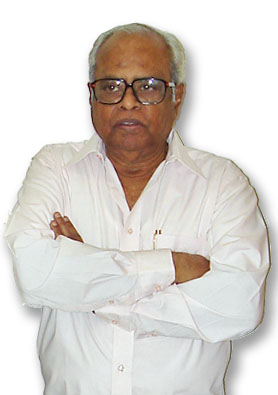
K. Balachander, a director of modest talent and a very limited intellect, passed away on Dec 23rd 2014 in Chennai. Balachander, awarded India's highest honor for a movie artiste, the Dadasaheb Phalke award, rose from very humble beginnings to become the story teller of the 70s middle class in Tamil Nadu.

Balachander's personal story is a very unremarkable one except for the fact that a boy born into Brahmin household in a small town, Nannilam in Thanjavur, went on to become a government employee, a typical middle class aspiration. He nevertheless retained his love for the theater which was to become his avocation later. The wikipedia entry for K.B., as he was called, aptly divides his career into the 60s, 70s, 80s and later era.

K. Balachander 9th July 1930 - 23rd December 2014. Image courtesy Wikipedia
K.B. who was staging dramas got a break in films when one of his plays, Server Sundaram, was brought to the screen courtesy of AVM as  producer and the director duo Krishnan-Panju. Jnanpith awardee and Tamil literature's perennial rebel Jeyakanthan took issue with the propaganda of Dravidian party speakers in characterizing Tamil as the language of three arts, music, prose and drama. Jeyakanthan cribbed that Tamil did not a drama tradition akin to Shakespeare, Shaw and Ibsen. He ridiculed the attempts to call 'Manonmaniam' as drama. From those days till today Tamil dramas are an insult to the word 'play'. K.B. produced pathetic dramas whose only redeeming quality was the contemporary nature of it and the social criticism that he wove into those. That his dramas were pathetic is evident from his early movies where he brought to celluloid his stage productions without any alteration as if the dramas were recorded live on camera. K.B. took nearly a decade to understand that movies are a different art form.

After the success of 'Server Sundaram' K.B. became the director for subsequent movies. Nagesh, a comedian, became the unlikely hero of K.B's movies. To make a scrawny and pockmark faced comedian a hero in the days of Sivaji Ganesan and M.G.R was a gutsy move. Wanting to plough his own lonely furrow away from the then reigning demi-gods of Tamil cinema K.B. cemented the idea of a movie standing on the strength of its script and acting.

In quick clip Ethir Neechal, Bama Vijayam and Iru Kodugal established K.B. as a director to reckon with. 'Iru Kodugal' centered around a hero who, based on wrong information, would've abandoned his wife only to later find himself working as a subordinate to her and the movie revolved around the awkwardness of the circumstance and the complications that arise. Overall a silly movie made sillier with what was then considered the skill of the dialogue writer, for example the scene where they argue about 'file' and 'life' with both punning on the words for tortuous minutes, would end in a sexist climax with his one time wife and current wife reconciling themselves to be in a bigamous relationship. Beyond his overrated skills as director a persistent myth of K.B. is that he is a feminist who made movies about strong women as lead characters. K.B. was out and out a sexist and nothing less.

The years 1973-75 with Arangetram, Sollathaan Ninaikkiren, Aval oru thodarkathai and Apoorva Ragangal were the best years for K.B. as director. He was now a household name. Arangetram and 'Aval Oru Thodarkathai' had a common theme, a woman who works and shoulders an entire brood of family. In Arangetram a Brahmin girl would end up becoming a prostitute in order to support a very large family. Her family then casts her out and then a neighbor and one-time paramour, tellingly a non-Brahmin, would marry her. 'Aval Oru Thodarkathai' is the most cited movie to support the myth of K.B. 'the feminist'.

In 'Aval Oru Thodarkathai' the heroine is a strong woman only in so much as that she is the bread winner and runs her family in a titular manner. Her family consists of a missing father, a widowed sister, an unmarried sister, a drunkard as brother and the brother's family with two boys, of whom one is visually impaired. One need not ask for more readymade recipe for pathos in a middle class family.     The movie had all of K.B. hallmarks. Over the top histrionics, predictable screenplay, innovative camera work, sprinkling of talent and daring (as in showing a hastily dressing up heroine hurrying off to office) and a typical K.B. style contrived climax that would have tragedy thrust in. In a later remake titled 'Manathil Urudhi Vendum' all would repeat.

The common streak in 'Arangetram', 'Aval Oru Thodarkathai' and 'Manathil Urudhi Vendum' is that the heroines go to work only as sacrificial lambs for a pretty much thankless family. The heroines do not show any passion for career or have intellect to strive towards anything that can be called a career. They are all waiting to throw the yoke away and become 'housewives'. K.B. would reach the nadir in his later year failed venture 'Kalki'. In 'Kalki' a woman is spurned because she is barren and yet her only yearning in life is to become, not just a mother, but mother of a child through her abusive ex-husband. And the woman used to be an accomplished singer. Of course, all that does not matter because she can never be a mother. To add to the humiliation the woman is aided by a girl who goes out to seduce the villainous husband only so she could be a surrogate mother and help her new-found friend realize her life's mission. In 'Sindhu Bhairavi' the wife herself prepares a second marriage for her husband with his mistress. Of course, again, the mistress, 'gifts' a child to the barren couple and walks away. Balachander does not know the ABC of feminism and in its place he served crass sexism. It is irritating to read obituaries claim that K.B. created 'strong women characters'. Bollocks. For all those who wax eloquent about 'Aval Oru Thodarkathai' my request is to watch Satyajit Ray's 'Mahanagar'. Ray was a master in portraying the predilections of the middle class at a scale that K.B. could not even comprehend.

Balachander was a pretend rebel and a wannabe iconoclast because he could never bring himself to break taboos. If supporting widow remarriage and a woman going to work is considered revolutionary then yes he is one too. 'Apoorva Ragangal' caused a flutter with its middy Oedipal theme of a young boy falling in love with a mature woman. The screen play gets tangled in a comedy of errors when the woman's nubile daughter runs away only to fall in love with the boy's father. Now, the father intends to marry the young girl thus throwing into a tizzy the boy's plan to marry the woman. In a ridiculous scene the father would hector the boy asking "will you now become my father in law, and will my wife become your step-mother". Conveniently the elder woman's estranged husband will turn up in the climax only to die waiting to be re-united thus making her a widow. Bowing to tradition everyone comes to their senses and all part amicably. The movie is now considered a watershed moment in movie history for the memorable acting by Kamal Hassan and the cameo by Rajinikanth, both of whom are now the reigning kings of Tamil cinema.

K.B. played a big role in establishing Kamal Hassan as an actor and star. Kamal became a hero in K.B.'s first color film 'Manmatha Leelai, a story spun around a womanizer. The movie was a forgettable drivel of skin show and tawdry humor. K.B.'s role in Rajini becoming a super-star was trivial. Rajini starred only in a few movies as K.B.'s actor but he starred in many of K.B.'s productions whenever K.B. had to recoup his losses from his artsy movies. K.B. had a despicable habit of hiring 'masala' directors to make commercial movies. This drew a derisive comment from another director (Balu Mahendra?), 'if I intend to do prostitution I'd be the  prostitute myself'.

Love stories were never Balachander's forte though he churned out two highly successful romances. 'Ek Thuje Ke Liye' a remake of his own 'Maro charitra' was a blockbuster in Hindi opening the doors of Hindi movies to Kamal. 'Punnagai Mannan', also featuring Kamal, was a successful venture with good music from Ilaiyaraja and lyrics by Vairamuthu. Kamal the hero was less captivating than Kamal as 'Chaplin Chellappa'. If one judges both movie on artistic merit both would come out as infantile romances with K.B. style contrived tragedies becoming the climaxes.

Balachander had moderate success on his politically themed movies 'Varumaiyin Niram Sivappu', 'Thanneer Thanneer' and 'Achamillai Achamillai'. They tackled issues of unemployment and political corruption. All of them were cynical and probably mirrored the cynicism of the late 70s in India.

Music, particularly Carnatic music, played an integral role in Balachander's movies: A mridangam player as protagonist in 'Apoorva Ragangal', the ups and downs of a Carnatic singer in 'Sindhu Bhairavi', the scion of an orthodox upper caste Carnatic vocalist in 'Unnal Mudiyum Thambi', a Carnatic vocalist in 'Kalki' and a saxophone playing hero in 'Duet'. Balachander had a ear for music. Since he titled his movie 'Apoorva Ragangal' he compelled the music director M.S. Visvanathan to write a tune that was unique. The song was admirably supported by lyricist Kannadasan and wonderfully acted out by both Kamal and Sri Vidya. But, did Balachander 'understand' music as an art form?

Balachander, based on his interviews and his films, does not come across as an erudite man much less that of an intellectual. It was widely rumored that his confidant Ananthu was the brain behind his movies. A rumor that was supported by the abysmal failures and crass movies that Balachander cranked out after Ananthu died in 1998. Balachander, a Brahmin, sought to portray himself as the rebel by taking a dig at the orthodoxy and casteism of Carnatic music in movies like 'Sindhu Bhairavi' and 'Unnal Mudiyum Thambi'.

In 'Sindhu Bhairavi' a concert attendee, the heroine, will get embroiled in a challenge to sing 'folk song' in front of a Carnatic singer. The lyric, penned by poetaster Vairamuthu, will ask indignantly "what is new in your ragas that the (illiterate) women folk performing chores did not know". The clamor for 'Tamil music' as opposed to singing the Telugu songs in Carnatic concerts was a political movement. 'Tamil music' is not necessarily just 'folk songs' and to reduce it thus is a travesty. And to equate folk songs, with their own richness, and classical music is an insult that only a pathetic intellect can inflict upon Thyagaraja. Balachander's addled ideas about musicians responsibility to 'take' music to the masses were downright silly. He'd repeat the caricatures in 'Unnal Mudiyum Thambi'.

The last movie that Kamal and K.B. collaborated was 'Unnal Mudiyum Thambi', 1988. The movie was based on real life activist Udayamoorthy. The tone was preachy and the movie had a surfeit of what was by now called 'Balachandarisms'. For instance in 'Sindhu Bhairavi' the hero, a singer, would jokingly tell his wife 'well to you music is?' and the scene would cut to the wife asking a vegetable vendor "what is the  price of a kilo brinjals?'. Apparently Kamal had a falling out with his mentor during the filming. The movie was a commercial disaster and essentially marks the beginning of K.B.s end as a director.

Balachander and Ilayaraja had a falling out in 'Puthu Puthu Arthangal' in 1989. Raja who was by then ruling Tamil film music as a titular head could not complete scoring music in time for release and K.B. used a potpourri of Raja's music that was available with him. Raja had increasingly becoming very arrogant and antagonistic. He alienated pretty much every good director including childhood friend Bharathiraja. In 1992 A.R. Rahman debuted as music director in K.B. produced and Mani Ratnam directed movie 'Roja'. The fall of Raja from the throne was swift and decisive.

The 90s saw a tepid success for K.B. in the Mamootty starring 'Azhagan' followed by complete box office failures in quick succession. After Ananthu passed K.B. made just two more movies which bankrupted their producers. The years 1973-1985 were Balachander's halcyon days. By the late 80s his method of film making was hackneyed and boring. A brief foray into T.V serial making was successful for a short while when he shined by contrast compared to the drab serials that the state run T.V. was churning out then.

I'd rate the likes of Mahendran, Balu Mahendra and Bharathiraja as being more consequential and trendsetting than K.B. Bharathiraja, particularly, was more successful than Mahendran or Balu Mahendra and far more influential. Bharathiraja also brought more newcomers than K.B. did and thus outranked K.B. as spotter of talent. Arguably it is Bharathiraja's debut film '16 Vaiyathinele' that put Kamal Hassan, Rajinikanth, Sri Devi and Ilaiyaraja on the path to stardom than anything by K.B. While K.B. presented muddled portrayals of middle class Bharathiraja took Tamil cinema to its earthy villages outside the crappy studio sets.

Balachander has his place amongst the pantheon of film makers of the 80s who ushered in a new era in Tamil film making but he is being overrated as a director. May his soul rest in peace.

Tuesday, December 2, 2014

'The Bhagavad Gita: A biography'

  Across the ages and cultures books have wielded an enormous influence as vehicles of ideas by seeping into the cultural consciousness and in due course dominating the intellectual climate. Religious books, more than any other, have an unparalleled capacity to influence millions over many centuries. Yet, many religious texts originate in antiquity and obscurity and evolve into a force of nature shaping entire nations, cultures and peoples. To unravel the mystery of how a complex philosophical treatise became a canonical text is the task of a literary detective. Richard Davis, professor of religion at Bard College, in an exceedingly well written book, "The Bhagavad Gita: A biography", traces admirably how a compact text evolved into the conscience of a religion and a people over many centuries.

What Davis does not do in the book is as significant as what he sets out to do. Davis's goal is to write a 'biography' of a book as one would write a biography of a person. Though Davis explains in shining succinct prose the themes of Gita, the various interpretations, socio-political changes that are reflected in how Gita was assimilated and propagated, he does not engage in philosophical discourse on the Gita itself. The book is not a philosophical treatise of Gita or analyses of its philosophical in a compare and contrast approach. Davis restricts himself, a tad too strictly, to his role as a tour guide in the life of a book.

Set in a battlefield, the Gita, is a call for action and duty, albeit with a crucial distinction. Krishna calls upon  Arjuna to do his duty, that of warrior, but free himself from the 'bondage of action' by actively dissociating his soul from the fruits, victory or defeat, of his action. Davis points out that in classical India the notion of Karma, literally meaning action but amorphously signifies the stain of 'persisting moral consequences of actions' which was said to cause a cycle of births. Krishna then details the then prevailing 'schools of knowledge' to attain detachment. Without endorsing or the other school of thought Krishna focuses on 'the psychological consequences for one who adopts that perspective'. Tamil writer and exponent of Hindu philosophy, Jeyamohan, and Davis concur that Krishna does not offer a didactic singular prescription but gives 'heuristical validity' to the various paths 'insofar as it leads one toward equanimity'.

Arjuna witnessing Krishna's Viswaroopam (courtesy Iskcon images)
The 'path of devotion',bhakti, Davis says, was a new idea to Sanskrit literature. Devotion 'requires a worthy recipient' and Krishna 'reveals himself as exactly that worthy recipient'. 'Any act, no matter how modest, can become an act of devotion'. 'One can abandon all personal attachment to the fruits by redirecting that action into a devotional service to Krishna'. Though Davis uses Western theological terms very apatly in places to describe a notion from Gita he studiously avoids any attempts in comparative philosophical discourse and steers clear of controversies regarding how the East and West influenced each other theologically. Reading the passage on devotion I was reminded on Milton's immortal concluding line in the sonnet 'On his blindness', "they also serve who only stand and wait".

While holding the practitioner of discipline of devotion superior to others Krishna sounds egalitarian when he enjoins that 'this path open to all:Those who take refuge in Me, even women, Vaishyas, Shudras, or those born impure, they nevertheless reach the highest destination'. In a telling contradiction the same Krishna also admonishes that "it is better to do your own duty, even poorly, than to perform tte duty of someone else well". Wendy Doniger who reviewed the book for New York Review of Books mistakenly accuses Davis of omitting that famous passage and for being too deferential to the Gita and sternly says that such deference does not behoove scholarship. Her larger point, that Davis did not even glance at the harm such passages have done to lower castes, is true and is indeed one of the few glaring omissions in an otherwise very well written book.

Though Gita focuses on action and duty Krishna reveals the 'biggest mystery of all" towards the end when he exhorts Arjuna to "abandon all your duties and take refuge with me alone". Davis beautifully labels this as an 'antinomian escape clause for the true devotee'. Dictionary.com defines 'antinomian' as a 'person who maintains that Christians are freed from moral law by virtue of grace as set forth in the Gospel'. Though probably tempting Davis refrains from meandering into discussions of philosophical parallels between the two religions.

When Krishna tells Arjuna that he is but a 'mere instrument' of Divine providence. Krishna stresses all "battle heroes are slain by me. You kill them". This part and the Karmic law always troubled me for the denial of 'free will'. Also I wonder what then does an individual take responsibility for? Can we blame the victims of Holocaust deserved it due to their Karma? Should Eichmann have not been hanged after all since he was but a 'mere' instrument of divine providence? Actually the Nuremberg trial hinged on whether the Nazi officials can be acquitted on the grounds that they were following orders. Incidentally, to my mind, the idea of Karmic preordained fate skates close to the Christian notion of original sin.

How popular was the Gita and the worship of Krishna in medieval India? Not much says Davis citing a survey of "800 panels of Indian sculpture dating from 500 to 1500 CE", by John S Hawley. Only three refer to the Gita. The commentaries on Gita by Sankara, Ramanuja and Madhva went a long way in popularizing the Gita. Writing commentaries for complex philosophical texts was, Davis says, more prevalent in Sanskrit literature than in any other.

In the most lucidly written chapter of the book Davis explains the differences between the various commentaries while summarizing them with crystal clarity. Davis cites a 'soteriological' issue in deciding who exactly Krishna was and 'what is the nature of god'. Soteriology is the Christian doctrine of salvation through Christ and Davis uses the term to refer to Bhakti tradition with devotion to Krishna. Only an admirable wordsmith and only one who is conversant with multiple theologies could've used the word with effectiveness.

In Sankara's 'ontological order' Krishna is less than the absolute Brahman due to his corporal incarnation as human being. 'Sankara insists not only that knowledge is superior to action as a means to religious attainment but also that true knowledge involves abandonment of action'. So why is Arjuna compelled to act? Sankara suggests that Krishna was merely tailoring his argument to suit his audience, namely, a warrior. Gandhi would later use the same argument to discard the call for violence and focus on just the call for action.

To Ramanuja knowledge is insufficient and he calls for 'full devotion to God' in order to achieve oneness, not as equals, but in a 'relationship of divine dependence'. The Marathi Jnanadeva takes the devotion aspect further and urged 'repetition of God's names, nama-japa. In Jnanadeva's Jnananeshvari "the style of bhakti proclaimed is closer to the fervent emotional devotion of the Bhagavata Purana than to the intellectual bhakti of the Gita".

Jeyamohan in one of his many commentaries on the Gita bemoans how the Semitic mind in its quest for a 'canonical text' latched onto Gita and turned it erroneously as the Bible for Hindus. For that we can thank the British, in particular, Warren Hastings and Charles Wilkins.  In his impeachment oration against Hasting Edmund Burke would thunder that Hastings had sullied the honor of India and trampled upon the rights of Indians. Yet, it is Hastings who had concluded that to rule India he would turn to India's own intellectual heritage in search of a legal framework. This led to the advent of Indology as a discipline and British administrators of Bengal to study Sanskrit.

The seat of East India Company was in Calcutta which, in the 18th century, was less Islamized than Delhi. Also, it is probable that the Christian West wanted to shun Islamic tradition which though had taken root in India was in competition with Britain elsewhere unlike Hindus. Unfortunately Davis does not dwell on the political significance of Hastings and his administration choosing to study Sanskrit instead or Urdu and choosing Hindu legal heritage over Islamic heritage. This choice restored Hindu India to a political prominence that they had lost under the Islamic rule for nearly 300 years. Elsewhere Davis notes that the "European quest for origins, "India" bcame confined" to Sanskrit and Hindu works.

Wilkins went to Benares to study Sanskrit and encountered Brahmins who "esteemed this (Gita) work to contain all the grand mysteries of their religion". A 'Sanskrit mad' Wilkins published his translation in 1785 and Gita took the Western world by storm. In US Walt Whitman, Thoreau and Emerson fell under the sway of Gita. Whitman reportedly died with a copy of Gita under his pillow. A quibble here. I am sure Indian readers, especially of the Hindutva variety, would brim with pride at that anecdote little realizing that we don't know of any Indian who died with Plato's Republic or King James Version or Koran under his or her pillow.

Davis, a modern academic writing a book for Princetion University Press, could not help complaining that Wilkins failed to credit his Sanskrit teacher Kashinatha for the help he rendered with his list of a ten thousand word vocabulary of Sanskrit verb roots. The academician further cautions that the view point of Benares Brahmins in considering Gita as supreme should not be considered the view point of all Hindus but "rather of a particular class of Sanskrit teaching Bramin pundits in Northern India". It was in Germany that Gita found the best soil in all of West. With their propensity for wooly thinking that nation of Kant and Nietzsche embraced Gita with zest. Humboldt and Hegel battled over Wilhelm Schlegel's translation of Gita. Humboldt declared in a lecture that the Gita is "the most beautiful, presumably the only real philosophical poem of all known literatures". In concluding the chapter Davis details how Swami Vivekananda arrived in Chicago to speak at a World Congress and humbled his hosts of their superciliousness towards non-Christian religions.

Not all translations of Gita during the colonial era was out of a benign motive. Christian theologians would selectively accept Gita in portions where they saw parallels with the Bible while ignoring or deriding the other parts.

The quest for freedom from colonial rule saw a resurgence in the interest regarding Gita. It served a double purpose. The philosophy of action was conducive to the need for agitation and as a text that could serve to unify the majority who were Hindus against the Christian ruler Gita was indeed God given to the likes of Tilak and Gandhi. Several leaders in the pantheon of freedom fighters wrote commentaries for Gita, of course colored by their own agendas.

Tilak, a Chitpavan Brahmin by birth, who organized Ganesh rallies as a tool for political unification, argued that Krishna's call for Arjuna to act as a Kshatriya, a warrior class, was suited to all Indian citizens irrespective of their caste because the colonial rule essentially made all into Kshatriyas.

The question of Krishna's historicity continues to be a matter of debate. Lala Lajpat Rai while languishing in a British prison in Mandalay wrote a commentary on Gita holding up the mature Krishna as an ideal human being while excoriating those who laid accent on the adolescent philandering Krishna of Bhagavata Purana. To Gandhi and Jeyamohan Krishna's historicity is of trivial relevance. Gandhi considered the battlefield as allegorical and asserted that only non-violence can help achieve the kind of 'detached-action' that Krishna called for. Mahabharatha, Gandhi insisted, appropriately, showed the futility of war.

"In whatever way men resort to Me, even so do I render to them". Tilak interpreted that as "I'll do unto you as you do unto me". Where Tilak used Gita to argue for retributive violence Gandhi directly contradicts the interpretation to assert that Krishna "will worship a person as the latter worships him". Gandhi went on to interpret that "if we are attached to winning liberty, we shall not hesitate to adopt bad means". 'Detached-action' to Gandhi meant that one is detached enough not to pursue any means to justify the ends. Conversely, without being a detached actor, a anasakthi yogin, one cannot be a non-violent Satyagrahi.

Wendy Doniger in her review contends that Davis's citation of an obscure intelligence report saying that mercenaries swore to end colonial rule with Gita in one hand and revolver in the other hand. That said the Gita was the favorite book of those who went to the gallows as martyrs. Khudiram Bose and even Gandhi's assassin Godse took it with them to the gallows.

Doniger acutely observes in her book review that while Davis uses quotes from all who lavished praise on Gita he nonchalantly paraphrases the Gita's most severe Indian critic, B.R. Ambedkar, who was born into what Hindus consider a low caste and therefore had to suffer the barbs of casteism. Ambedkar, Davis's paraphrase, says that Krishna appropriated lot of Buddhist teachings but the book is nevertheless an attempt to uphold Brahminical tenets and supports genocide. Ambedkar, who later converted to Buddhism, "proposed that Buddhism offers a superior ethical foundation for Indian nationhood".

Amongst the modern commentaries and translations Davis selected Dr S.Radhakrishnan's and Prabhupada's books. Amongst the many operatic performances of Gita, mostly Western, Davis cites warmly a rendition by South Indian singer K.J. Yesudas.

Out of curiosity I checked out Jeyamohan's website for his blogs on Gita before I wrote this blog. Davis's book and many of what Jeyamohan wrote are in consonance. That is a testimony to Davis's, a western academic, research credentials. I've not read Jeyamohan's commentary on Gita as a book but where Davis scores is in the lucidity, preciseness and, however few, his academic quibbling in places.

On one count Jeyamohan undoubtedly scores over Richard Davis. The Gita was a later addition to the Mahabharatha, that much everyone agrees. Davis does not dwell at length on that issue beyond a simple discussion on the probable dates of composition. Davis, being an academic and teacher of religions, is crimped by his discipline to stick with historical analyses. Jeyamohan, a towering presence in contemporary Tamil literature as author and more importantly as student of philosophy tutored by Nithya Chaitanya Yathi, brings to bear his literary acumen to the debate of whether Gita was an addition in tune with the larger corpus of Mahabharatham or an intrusive inclusion with a hidden agenda as Marxist Indian historians allege. Jeyamohan points out that Arjuna behaves post-war as he was pre-war as if the epochal tutoring amidst a battlefield never happens. Considering the Mahabharatha as a work of literature Jeyamohan contends that such characterisation of Arjuna proves that the Gita was a latter day addition. He however rejects that it was an ill-fitting intrusion by pointing out rhetorical and philosophical continuity.

I am not a big fan of theology masquerading as philosophy. Nataraja Guru threw out of a car window Radhakrishnan's book on Gita because Radhakrishnan refers to it as 'Hindu' philosophy. Narayana Guru was angered that Radhakrishnan bracketed Gita into a strait jacket of religion. Actually Radhakrishnan did not do so. He was just using terminology that was in vogue then and even Jeyamohan himself characterizes it so in one of his blogs. The otherworldliness of Gita is undeniable and as such it is, in my opinion, theology just as much as the Sermon on the Mount is theology.

The phrase 'detached-action' sounds lofty but is practically impossible. Jeyamohan himself is the prime exhibit for that. He is now engaged with writing a multi-volume multi-year magnum opus of Mahabharatha. Of course he has his share of detractors and naysayers. Far from ignoring his naysayers Jeyamohan actively derides and ridicules them without exception. He tars all his naysayers with the same brush alleging envy, mired in mediocrity, unable to accept that such an opus is being created etc. Sure, there is some of it or even lot of it but that is not all of it. That a man who has written copiously on Gandhi and Gita cannot tolerate his naysayers in a way illustrates, if not the impracticality of Gita, at least the Himalayan discipline required to adhere to it.

I chanced upon a very interesting blog on Jeyamohan's site. Aravindan Neelakandan, a militant Hindutva proponent (Jeyamohan called him a purveyor a Hindutva hatred), wrote an email to Jeyamohan on Tilak's commentary of Gita. Neelakandan says that Tilak could not outgrow his Brahminical roots and the he opposed the lower castes from learning Vedas.

In my college days at a literary forum I had quoted Spinoza to argue the impracticality of detached-action. "Reason without passion is dead and passion without reason is blind". Of course when passion enters there can be no detachment.

References:

1. Wendy Doniger's review of 'The Bhagavad Gita: A biography' in New York Review of books http://www.nybooks.com/articles/archives/2014/dec/04/war-and-peace-bhagavad-gita/
2. Jeyamohan's links on Gita:
    a. Is Gita an addition    http://www.jeyamohan.in/265
    b. Gita an intellectual heritage http://www.jeyamohan.in/569
    c. How to read Gita and why http://www.jeyamohan.in/35
    d. On the historicity of Krishna http://www.jeyamohan.in/8201
    e. Aravindan Neelakandan on Tilak http://www.jeyamohan.in/275
    f. Narayana Guru throwing out Radhakrishnan's book http://www.jeyamohan.in/410
    g. Is Gita a philosophy book http://www.jeyamohan.in/639


Friday, November 14, 2014

India's Debt to Jawaharlal Nehru

"He (Jawaharlal) has all the makings of a dictator in him- vast popularity, a strong will directed to a well defined purpose, energy, pride, organizational capacity, ability, hardness, and, with all his love of the crowd, an intolerance of others and a certain contempt for the weak and the inefficient......in this revolutionary epoch Caesarism is always at the door, and is it not possible that Jawaharlal might fancy himself as a Caesar? Therein lies danger for Jawharlal and for India. For it not through Caesarism that India will attain freedom, and through she may prosper a little under a benevolent and efficient despotism, she will remain stunted and the day of the emancipation of her people will be delayed".

The article 'The Rashtrapathi' signed by 'Chankaya' appeared in The Modern Review of Calcutta in November 1937 (actually it was published anonymously). The article caused ripples in the then Congress as Nehru was then President of the party. Only later it became known that the author was none other than Jawharlal Nehru. Other than Gandhi, amongst the pantheon of Indian leaders, no one comes close to Nehru's sense of dread about the ability of power to corrupt one's soul.

Nehru continues mercilessly in that article to assail himself, "men like Jawaharlal, with all their capacity for great and good work, are unsafe in democracy. A little twist and Jawaharlal might turn a dictator sweeping aside the paraphernalia of a slow-moving democracy. He might still use the language and slogans of democracy and socialism, but we all know how fascism has fattened on this language and cast it away as useless lumber". Sadly, not he, but his daughter would prove every word prophetic.


Speaking to the Indian parliament on the issue of reorganization of states along linguistic lines Nehru would obsessively return to the question of what would happen to linguistic minorities, especially those who may live along the borders and cannot be easily lumped into either this or that state. The voluminous correspondences of not just Nehru but also that of Sardar Patel and Rajendra Prasad show that Nehru was a stickler to democratic principles in matters of state and party. Nehru's letters to the Chief Ministers, occupying a bulk of the Selected Works, shows a leader who corresponded with all constitutional functionaries, irrespective of intellectual disparities, with great regard for the office they hold. His letters, completely devoid of any imperiousness of the office he held or the popularity that he enjoyed, were suffused with respect for democracy. Nehru practically tutored all leaders in the traditions of democracy. He'd honor the parliament's Question hour by making an effort to not just be present without fail but also to answer questions. One can safely pick any page from the 50 volume Selected Works and be assured that there would not be a single word that would smack of the fascism that he so feared would lurk ever in the shadows of a leader like him.

The very learned Meghnad Saha smugly declared "ninety percent of the people cannot learn another language". Nehru, very respectfully and politely, dismantles Saha's argument and shows his deep understanding of people and democracy. "You and I may have some difficulty in picking up another language because we proceed by grammar and all that. But you take persons-pick them out out from Delhi bazaar and put them in an environment of another language. you will find in three months they will talk that language which you will not know". He further rubs it in by pointing out that in India's embassies while the secretaries and others, supposedly learned, struggle to learn the native language it is the "lower staff who have to work there pick up a language of that country".

Nehru bore no malice towards his detractors or ideological opponents. Nehru included a stinging letter by Rajendra Prasad and Sardar Patel in his book 'A bunch of old letters'. Prasad and Patel had offered to resign from their party posts when Nehru, as president, sought to push his ideas on socialism. Nehru's reply was gracious and magnanimous enough that they stayed on. A man who includes a letter critical of him in his own anthology is rare indeed.

The man who wrote a sweeping history of the world sitting behind bars would, with all humility, refuse to call himself a historian when he addressed academic historians. The author of several highly regarded books and an avid student of literature would refer to his position as head of Sahitya Akademi as an honor that exceeded his qualification in a public address. Nehru never missed attending the science congresses and never, for once, cast himself as anything beyond a layman of science.

Nehru, ably assisted by Maulana Abul Kalal Azad, unleashed a revolution in establishing India's educational policy. Research institutes and world class academic institutes of higher learning were established at a rapid clip and would serve as islands of hope in the following decades amidst a sea of mediocrity and hopelessness. Indians who heap abuse on Nehru, today, as a dreamer little realize how much they owe to the man who was unafraid of dreaming of an MIT like institute, an atomic research institute and more in the 1950s when India was mired in poverty and still nursing the wounds of a searing partition. 4 IITs, modeled on Ivy League universities of US, were opened between 1951-59. The next set of IITs were opened only in 2008. Till today India's educational policy flounders when it comes to allowing foreign capital and foreign collaboration and yet the IITs were established by a nascent independent country that has just thrown off the yoke of foreign domination with foreign collaboration. In an era when the government controlled most aspects of industry and education the IITs, by a special act of the Parliament, was given unprecedented, by Indian standards, autonomy. A premier medical institute like AIIMS was established by a special act of the parliament in 1956. The next AIIMS was mandated only as recently as 2012.

In all of Sardar Patel's or Rajendra Prasad's or Ram Manohar Lohia's collections of writings can we see the ambitious vision of establishing a nuclear research institute like BARC in 1954, by an impoverished nation barely 7 years after independence. It can scarcely be appreciated today without a leap of imagination what it is to even envisage such a research institute in the India of 1954. When ISRO launched a Mars probe in 2014 it did so standing on the shoulders of Jawaharlal Nehru who had setup Indian National Committee for Space Research in 1962. Nehru-baiters would rush to point out the contributions of Indian scientific giants like Vikram Sarabhai, Meghnad Saha, Homi Bhabha, C.V. Raman and others and ask "is Nehru being credited liberally?" I'd say just go and read the correspondences between Homi Bhabha and Nehru to realize how intricately Nehru was involved at policy level with each of them to create such institutions. The exchanges also underscore the point that nobody but Nehru could've earned the respect of such giants much less been eager to realize in concrete terms their ideas.

That Nehru charted an independent course in economics between the extremities of Lohia's communism and Rajaji's free market theology is in itself a creditable achievement. Contrary to popular myth the Nehru years were actually friendly to foreign capital. Economists Aravind Panagariya and Jagdish Bhagwati, both currently supporting Modi, have pointed out in their books on Indian economic policy how the Nehru years were actually welcoming to foreign investment. It was partly necessity too for a capital starved country. Those who rant about Nehru's socialism are willfully ignorant or blind to the realities of those perilous years within the country and the world at large. The world was digging itself out of the rubble of a war that saw countries destroyed, borders redrawn, power equations altered for the next 50 years, tens of millions killed, millions more displaced, a retreating colonial power, newly emergent world super powers and amidst all this chaos a sub continent stumbling into independence accompanied by the world's largest migration of people. To even formulate a coherent economic policy for those years is an achievement by itself. In their eagerness to ridicule Nehru the baiters forget stellar personalities like Shanmukam Chetty and C.D. Deshmukh.

America learned at great cost as recently as 2008 that the government is the lender of last resort when an economy teeters on the brink. The immediate post wars were the high tide of liberalism and welfare state fueled by Keynesian economics which was at its apogee then. FDR, Truman and even Nixon instituted economic policies that could easily be called Nehruvian. The free market of Rajaji and his Swatantra Party reads more like the manifesto of today's Republican party and was ill suited for India. The so called libertarian streak of Swatantra party was thinly disguised upper caste elitism that had little sympathy for the vast dispossessed millions who were eking out a living on pathetically paltry incomes. I was amused to read how Ram Manohar Lohia pours scorn over Nehru's notion of private enterprise existing along side government owned enterprises. The West finally shook off the shackles of Keynes only in the 80s underscoring how Nehruvian economic policies were very much in line with almost the entire world at that time.

Yasmin Khan in her masterly book 'Great Indian migration' mentions how the Central government was compelled to institute welfare and rehabilitation policies for the millions of refugees who trekked into India. State governments bowing to local pressure did not want to host the refugees lest it upset local economy and the Central government, under Nehru, had to step in with unprecedented economic measures to help the refugees and to stabilize a very volcanic situation.

Little do we appreciate today how much government funding was essential to the economy at that point in India. Establishing educational institutes, research institutes, health care facilities, badly needed industries, transport to every corner of India and more needed the urgent role of government.

Almost all failures of Nehru, some real and mostly imaginary, cited by his naysayers will invariably all culminate in the final accusation that he pandered Muslims. Nothing about Nehru animates his enemies more than his steadfast commitment to secularism. If there was one aspect where Nehru was better than Gandhi it was on the score of secularism. Nehru was a true agnostic and eyed all religions with skepticism while respecting their rich contributions to humanity. Barring Gandhi and Nehru almost all of the Congress leadership either looked at secularism as strategic good or at worst a necessary evil to keep the country united.

To argue that secularism was an intrinsic feature of Hinduism, as is done by Hindutva bigots, is complete bunkum. Sunil Khilnani in his contentious book 'Idea of India' argues that until the advent of the British the Indian princely states were not the classic nation-states as modern political science would define a state. The distinction that Khilnani specifies is how the state uses its power to organize society by sometimes changing long entrenched customs. Hindu reformers petitioned British viceroys to reform Hinduism's pernicious customs like child marriage and Sati, the custom of burning widows.   Fueled by the progressivism of the independence movement there was a demand to reform the laws governing Hindus to change some backward customs particularly relating to the status of women.

Ambedkar and Nehru formed an unexpected duo in pushing for what later came to be known as the Hindu Code bill. Rajendra Prasad and fellow orthodox Hindus in Congress stymied Nehru's attempt for such a bill during the provisional government arguing that the provisional government lacks the mandate to do such a sweeping legislation. Ambedkar quit the ministry in a huff. Nehru then went to the electorate and campaigned on it. Strengthened by the political capital he earned Nehru shepherded the Hindu bill piecemeal but ultimately changing the contours of an ancient religion that stretched back into several millennia. One could call Nehru a Manu for the 20th century. Much later LBJ would earn the praise of historians for a similar attempt to pass the Civil Rights bill in US. Nehru's achievement ranks above that of LBJ.

The Kashmir tangle is another favorite stick to beat Nehru with. The unification of India, the accession of the princely states, were all without precedence in all of human history. Dominique Lapierre and Larry Collins quote Nehru as telling Mountbatten "just as Calais was written upon the heart of your queen so is Kashmit written upon mine". The internationalization of the imbroglio is an oft cited example of Nehru's romanticism albeit muddle thinking where, his detractors like to conjecture, the earthy pragmatism of Sardar Patel might've brought about a cleaner solution. All of that, as the Americans says, is Monday morning quarter backing. The Kashmir imbroglio has more myths to it than reality. The so called plebiscite pledge by Nehru is more nuanced than is commonly acknowledged. The pledge clearly states that a plebiscite will be conducted in Kashmir only when Pakistan stops meddling in Kashmir.

The China war is a true blot on Nehru's regime. The viciousness with which Nehru is savaged on account of Kashmir and China, of course the real reason is as I cited above his strident secular outlook, is appalling. Americans have learned to appreciate FDR for what he did and not trash him for Pearl Harbor. In fact FDR is rarely blamed for Pearl Harbor. It is fantasy to assume that a country like India could've spent on defense without sacrificing more urgent and far more pressing concerns like education, health care, welfare and rehabilitation.

Was Nehru without vices or shortfalls? Of course not. The man who argued in that anonymous article that he should not be allowed a third term as Congress president could have followed the example of George Washington and resigned after his second term. But then Washington had John Adams and Thomas Jefferson waiting to take over unlike the unsparing second line of leadership in Nehru's days. While Nehru never became the fascist that he feared he could become he was not above playing politics in easing out those he disliked, mostly justified. The Kamaraj plan, put in motion to remove potential challengers, unfortunately removed much needed leaders like Kamaraj himself from offices they then held thus paving way for second rate leadership. Nehru's fascination about communism, despite his aristocratic aversion to its vulgarity and violence, made him less sympathetic to US while being drawn towards USSR. Then there is the weakness for having colleagues like V.K. Krishna Menon and acquiescing to his daughter's nagging and dismissing the world's first elected Communist government in the state of Kerala.

The vices and shortfalls of Nehru were not unique to him but his virtues and visions were almost singularly unique to him and for that India is deeply indebted to its finest son. Browse randomly through any page in the many anthologies of Nehru's writings and speeches the one unfailing character a reader can readily discern is that Nehru had only one motivation that his filled his days and nights, to make India a better country for the poorest and weakest citizen. There was poetry even in his death. The night before his death he ad written out on a piece of paper the lines of a poem by Robert Frost that best summed up the life he had lived.

"The woods are lovely, dark and deep,
But I have promises to keep,
And miles to go before I sleep,
And miles to go before I sleep".

As was his wish his ashes were strewn all over India forever mingled with its soil and water. It is highly indecent to accuse a man who wanted his ashes to be sprinkled in the Ganges as disrespectful to India, Indian traditions and Hinduism. On this 125th anniversary of Nehru's birth let us remember that Modi's India is being built on the foundations laid by Jawaharlal Nehru.

Monday, November 3, 2014

Obama's Failed Presidency and America's Leadership Crisis

"The glory and freshness of a dream. It is not now as it hath been of yore". The words of Wordsworth best befits the state of Obama's presidency. Barack Obama came to Washington D.C. like a triumphant Ceasar and he will leave the White House like Nero. America exulted in the election of the nation's first black president and few would've foreseen a day when his own party candidates, like St. Peter, deny any knowledge of him. The world's richest, most powerful and most innovative country is practically leaderless. What happened and why did a dream become sour?

Nothing about Barack Obama, especially his over-hyped oratorical skill, has ever impressed me or inspired trust in his ability to lead a great country. Today when Obama's approval rating hover in the low 40s I stand vindicated. A New York Times headline humiliatingly informed that "on campaign road, uneasy Democrats show Obama their tail lights". The Democratic party, another article pointed out, is now Clinton's party, not Obama's party. Dana Milbank of Washington Post headlined an article, "Conservatives are finally right: Obama is not a dictator. He's a bystander". Milbank pointed out that he had in the past called Obama as "President passerby", "hapless bystander" and charged that Obama functioned "oddly like a spectator".


The unkindest cuts came from Obama's own former cabinet members. Hillary Clinton, Secretary of state, former opponent and prospective candidate created a furore by saying that Obama's policy of 'don't do stupid stuff' is not an 'organizing principle'. Leon Panetta, former director of CIA and Secretary of defense, was withering in his memoir "Worthy fights". Panetta focused on Obama's disengaged style and lack of thinking through strategic decisions like Syria. Robert Gates, a Bush appointee as Secretary of defense and retained by Obama, was open about how Hillary Clinton and Barack Obama both saw the Iraq war through only a political prism. Not even George W Bush came in for such stringent criticisms from senior members of his cabinet.

Obama came to office vowing to show that the government can be 'smart' and disprove conservative criticism that government, dysfunctional by nature, needs to be as small as possible. On this score more than anything Obama is a grand failure. Hundreds of millions of dollars were poured into the appallingly shoddy roll out of the health care web site that left many including his supporters fuming. News reports repeatedly pointed out how disengaged Obama was on the roll out of a landmark law. The department of Veterans Affairs charged with healthcare of veterans was a cesspool of incompetency where a huge cover up, across the nation, took place to cover the inordinate waiting time for veterans to receive care. The IRS was caught acting partisan. The Secret Service was caught in a web of scandals involving prostitutes and gross negligence leading to the firing of their chief. The CDC's handling of the Ebola breakout eroded faith in the one agency that Americans tended to trust more than any. The incompetence of Obama's administration makes Bush's administration look better by contrast and that says a lot. In all instances the worst part was that Obama learned about a crisis from news reports. Democratic supporters and columnists sympathetic to the administration themselves have now started saying in chorus that the dysfunction is the direct result of Obama's lack of management.

In his inaugural address Obama declared, airily, that Americans reject the 'false choice between security and values'. That Obama is the president who oversaw the worst administration that willy nilly spied on American citizens in a scope that shocked the conscience of many. He also has the dubious honor of launching punitive drone strikes where the casualties are counted in such a way, according to principles accepted by him, to undercount civilian deaths. Jill Abramson, former editor of New York Times, called Obama's administration the "most secretive administration" since Richard Nixon's administration. Susan Page of USA Today said this is the "most dangerous" administration. Obama's Department of Justice has pursued reporters with a zeal and tyrannical glee that has sent the chill down the spine of many a reporter. A Fox News reporter was even charged with being a co-conspirator for refusing to reveal source of a news. Frankly, if the President had been a republican the press would have pilloried him endlessly and mercilessly unlike the muted condemnations that are being sprinkled now. In any other administration if US senators had been spied upon by CIA the press and Congress would've erupted in volcanic rage. Obama has made Bush appear reticent when it comes to testing the limits of constitutional propriety.

Restoring US credibility in the world arena was a prime commitment of Obama after the Bush years. Spying on the leader of a nation that's a close ally is not a good way to make friends and Obama learned that lesson after the NSA was caught snooping on Angela Merkel of Germany. After declaring haughtily in a press meet that he is drawing a 'red line' in the Syrian imbroglio Obama walked back his words and declared, again haughtily, that it was the world that drew a red line. By now the world understood that the US President's bluff can be called out. Obama mocked Romney for calling Russia our enemy number 1. Thanks to Putin Romney stands vindicated. In his zeal to be defined as the 'not-Bush' persona Obama pulled out of Iraq in haste and today Iraq appears to be run over a murderous ISIS army. There is no part of the World today where Obama's words carry any weight. Other than ending wars Obama's foreign policy has been a disaster. Fresh after his Ceasar like inauguration Obama and Michelle went abroad to lobby for Chicago to be the city to host the next Olympics. Thanks to their lobbying Chicago was eliminated in the first round.

Bill Clinton is often derisively called the master of triangulation but grudgingly admired for his ability to mud wrestle with his opponents to finagle an agreement or a compromise. Obama with his airy "I shall not soil my hands" attitude and undisguised contempt for the political process is singularly devoid of any ability to be a leader. Bob Woodward recounts in his book 'Price of politics'  the vacuous leadership of Obama during the debt deal negotiations in 2012. While Woodward faulted both Democrats and Republicans for failing to resolve America's debt issue he singled out Obama for harsh criticism since as President he has  to take the blame for lack of leadership.

America faces serious challenges. Prophesying the decline of American power is a cottage industry amongst authors. The biggest challenge facing the country is the crushing debt that is driven by 'entitlement spending'. New York Times has called the Affordable Care Act, pejoratively called by many as Obamacare, a success based on the millions of previously uninsured who had enrolled. The same article also stated that a vast majority of the new enrollees are in Medicaid, the Federal program to provide insurance to low income people, and that too a majority of such enrollees receive subsidies. Essentially this is the largest wealth transfer program in US history. Romney lost the presidency for stating a fact- that nearly 47% Americans do not pay taxes. Obama, in his role as high priest of liberalism, thinks he can balance the debt on the backs of just 2% of American tax payers. Overhauling the byzantine tax code, broadening the tax base, realistic cuts to entitlements are needed urgently to ensure the fiscal health of USA.

Immigration is another very serious challenge facing America. While Democrats, especially Obama, have happily reaped votes from the Hispanic lobby promising immigration reform they have been equally happy on not doing anything to resolve the issue lest they lose a wedge issue that is advantageous to them. The GOP is being ridiculously bull headed in not just falling to resolve this but in damaging its electoral prospects when a presidential candidate suggests illegal immigrants to 'self-deport' themselves. Obama's administration deported hundreds of thousands of illegal immigrants until Obama, facing an election, decided to stop the deportations. Obama repeatedly allowed politics to determine what he does or does not do about immigration. When Obama announced he was going to announce executive actions this summer Democrats facing re-election pleaded that he postpone any action until after the election. The Hispanic lobby is livid that lives are being treated like a political football. At last they too understood who Obama is.

Has Obama ascending to the White House done any good for African-Americans? In a word, no. Obama, ever eager to win re-election and political success sought to actively distance himself from even appearing to address any problems specific to Afro-American community. When supporters were invited to the White House and given talking points for re-election the Afro-American representatives found themselves with no instructions since the White House did not want to be seen as advocating any issue relating to them lest it anger the rest of the electorate. Early on during Obama's first term Shirley Sherrod, an African-American employee in the Department of Agriculture,  ran into a controversy when an edited video of her speaking appeared in a right wing online site and seemed to show that she was unwilling to help White farmers. The Obama administration and NAACP eagerly condemned her and forced her to resign. Only later did the full video surface and Sherrod was vindicated that she did not refuse help to a couple because they were white. If this had happened under a White president and that too a Republican president the entire black community would have been enraged.

Obama has single handedly encouraged the politics of envy with his rhetoric about Wall Street, corporations and the top 2% of the income demographics. The Economist magazine recently pointed out how Democrats win elections by populist promises and shrill rhetoric about the rich. Never in recent history have achievers and job creators had it so bad as in the Obama era.

Infrastructure, roads, bridges and airports, in the world's richest country is crumbling. Anyone passing through JFK or Newark International Airport and driving through Verrazano Narrows Bridge or I-95 will be appalled at the state of America's infrastructure. Obama supports infrastructure spending only as an avenue to grease the greed of construction unions. Between the greed of unions, avaricious lawyers and a run away environmental lobby it is almost impossible to build a Golden Gate bridge or a Brooklyn Bridge or a sprawling airport.

Republican party, for their share, have become the party of crazies. The Tea Party revolt yanked the GOP to a crazy far right wing corner. Pushing to the country into a debt default, ranting about abortions, ludicrous ideas on 'legitimate rape' etc have alienated the GOP from a large section of the population. Though the GOP might deliver a blow to democrats in Tuesday's mid-term elections winning the White House remains a dream. Republicans lost the popular vote in 5 out of the last 6 Presidential elections, of which 4 were lost in landslides. Mitt Romney, being no Reagan, could not become the voice of capitalism and rebuff Obama team's malicious attacks on him and the free market that made him rich. The GOP lacks an intellectual leader who can be the voice of free market against a democratic party that is fast becoming Marxist in its outlook.

All is not gloom however. American economy still remains the most resilient, the most dominant and the most innovative in the world. Facebook, iPhone, iPod, Twitter, Google, Driver less cars, Tesla and many other technical innovations of the past decade are still coming out of only America and are impossible to happen anywhere else.America still remains, by comparison, an open economy welcoming thousands of foreigners as students and workers. Much to the chagrin of many the American financial sector remains a robust component of a great economy. America, to the surprise of the world, is now a net energy exporter thanks to the fracking boom that has unleashed America's potential on energy and remade the energy landscape.

America is looking for a leader to emerge and be its voice. The list of presidential hopefuls from both parties is uninspiring. Whether it is has-beens, like Hillary Clinton, Mitt Romney and Jeb Bush or scary ideological extremists like Ted Cruz and Elizabeth Warren or head scratching flip floppers like Rand Paul or a novice like Marco Rubio, that are spoken of as presidential contenders. In one word, uninspiring. The country needs a leader who will unleash America's innate unmatched energy to innovate, to create, to take risks and be rewarded handsomely. The country needs a leader who will speak of equal opportunities and not equal outcomes.

Turning and turning in the widening gyre
    The falcon cannot hear the falconer;
    Things fall apart; the centre cannot hold;
    Mere anarchy is loosed upon the world,
    The blood-dimmed tide is loosed, and everywhere
    The ceremony of innocence is drowned;
    The best lack all conviction, while the worst
    Are full of passionate intensity.

                                              --- 'The Second Coming' by W.B. Yeats

Let not some candidate slouch towards 1600 Pennsylvania Avenue. America needs a leader to tell her that she is still the shining city on a hill. America needs a president who will embrace the American spirit and American exceptionalism.

Monday, October 27, 2014

Mr. Swamy, Let's Burn Ignorance and Prejudice, Not Books

Subramanian Swamy is vying to be India's chief peddler of hatred and bigotry. Swamy is a blot on Harvard, Hinduism and India, in that order. He is proof, if proof is required, that any religion can produce a fundamentalist and all it takes is a twisted mind.

Echoing the words of Nazis, who burned the works of Thomas Mann and Sigmund Freud, Swamy exhorted an audience to burn history books written by 'Nehruvian Marxists'. In a country where a goddess symbolizes learning it is appalling that one who swears by that heritage should ask for books to be burned. Hating Jawaharlal Nehru is a litmus test for being a Hindtuva bigot and Swamy passes his test in flying colors. What is it about Nehru that brings out the venom from the Hindutva brood of vipers?

Subramanian Swamy
The 'Selected works of Jawaharlal Nehru' runs to 50 volumes and thats just 'selection'. I've read all 3 of Nehru's books, various anthologies of his writings and a few volumes from the 'Selected works'. I've never found any of his writing to be boring or lacking sincerity or blind. Nehru's love for his country and countrymen shines through every page he wrote about India. The post-independence era is marked by letters and speeches that had only one agenda, how to make India better for the poorest Indian in every village and city. More than anything that Nehru did or failed to do what angers the Hindutva crowd is his agnosticism and unimpeachable secularism. All other criticisms of Nehru, across many areas, stem purely from the fact that he has laid down the foundations of a secular republic much to the chagrin of many of his colleagues and today's purveyors of hatred.

It is informative to look at what Nehru himself thought of history writing especially as it related to Indian historians. "So far as Asia is concerned, we have been grossly mistreated by most historians from other countries. And, as a reaction to that, sometimes our own historians have perhaps gone too far...On the one side there is the nationalist history which, starting from a strong nationalist bias, praises everything that is national at the expense of other things and, on the other side, there is the reverse of this". There were, in Nehru's own time, many a bigot prattling nationalist nonsense much like Swamy of today. Perhaps addressing those bigots Nehru, ever the intellectual sceptic, offers his criticism of Spengler's magisterial 'Decline of the West' "it seems to me that as soon as we start looking at history with any preconceived approach, it turns us away from some patent facts which do not fit in with our theory. And we select things which agree with our own thinking."The words spoken more than half a century ago still echo with prescience against the bigots of today. The question is will India pay heed?

The quintessential Nehru shines in his address to the parliament on the then burning issue, literally burning, of reorganized India's states on the lines of languages spoken. Worried that 'parochialism' might rule the roost Nehru cautions, "each Member of Parliament is a member of India and represents India, and at no time can we afford to forget this basic fact that India is more tan the little corner we represent". Ever the capacious personality that he was Nehru expansively suggests "all the great languages of India which are mentioned in the constitution- but I would go a step further- and even those that are not mentioned in the constitution like those in the North East Frontier Areas and elsewhere ought to be developed; secondly, that the development of one language should not be and cannot be at the expense of the other." Finally as only Nehru could've said he exhorts his fellow parliamentarians, "I would go a step further and say that the knowledge of a foreign language helps the growth of an Indian language". I cannot think of another Indian politician who could've said that. Nehru, also added, that he wished his daughter Indira Gandhi learned the languages of South India, for instance, Tamil. Ironically the linguistic chauvinists in Tamil Nadu berated that great man as a Brahmin and aristocrat.

A frequent charge against Nehru is that he molly-coddled Muslims. Speaking at the Aligarh Muslim University amidst the carnage of partition and barely six days before the assassination of the Mahatma Nehru tells his Muslim audience "I do not like this University being called the Muslim University just as I do not like the Benares University to be called Hindu University". Swamy recently raised a furore when he stated "all Indians are culturally and scientifically Hindus". During the recent parliamentary elections he wanted India's minorities to forfeit their right to cast a vote if they did not sign a declaration that they accept their Hindu ancestry. Nehru, mindful of the perilous times in which he was speaking and out of his innate nature of being secular, told the Muslim audience at AMU "You are Muslims and I am a Hindu. We may adhere to different religious faiths or even to none: but that does not take away from that cultural inheritance that is yours as well as mine. The past holds us together; why should the present or future divide us in spirit?" The words of Nehru and Swamy are separated by a vast gulf with one being the epitome of a lofty civilization and the other its twisted perversion. Nehru goes on to conclude his speech saying "do not think you are outsiders here, for you are as much flesh and blood of India as anyone else, and you have every right to share in what India has to offer. But those who seek rights must share in obligations also". I hope it warms the hearts of Hindutva bigots that Nehru identified himself as a Hindu. Incidentally Nehru was also given to quoting, where appropriate, verses from Gita.

Nehru with Gandhi
Do Marxists dominate India's cultural institutions? Without a doubt yes. Are they any more open to opposite viewpoints than the Hindutva crowd? Not at all. That said, the Marxist historians, at least not all, are propagandists. There is validity in a Marxist view point of history but it certainly has its limitations. The limitations of Marxist analyses should be countered with better history not by burning books. If Marxists have falsified history let them be shamed with better scholarship not by fascist silencing.

Germany while it rebuilt itself from the ashes of Nazism outlawed not just anti-semitism but even denial of holocaust as a theory. Such extreme measures had a place given what the society was trying to rebuild after the world's most horrific genocide. However, the ban on disputing holocaust does have a counterproductive effort because then conspiracy theories swirl, nevertheless, without being challenged with the power of academic scholarship. A telling example is how holocaust denier David Irving was finally shamed in a very public trial.

Another example would be the trial against 'Intelligent Design' in Dover, PA USA. 'Intelligent Design' is backdoor 'creationism' trotted out by Christian bigots to combat the 'Theory of Evolution' being taught in US schools. In the tradition of Scopes trial this case went to a court and academics shamed and exposed the creationists for what they truly are, bigots.

Swamy and his cohorts do not have any interest in objective history. Swamy recently asked on Facebook "why does Delhi have a street named after Aurangzeb? does Israel have a street named after Hitler". What he could've also asked is why Government of India run Construction Industry Development Council name its top architecture award after mythical Hindu architect Viswakarma instead of Shah Jahan, the man who built India's most famous landmark. Why does not Swamy ask that Indian Government's award for a sports teacher should not be named after Dronacharya, the mythical warrior-priest who was the archetype of everything that a teacher should not be?

The Hindutva love of history only extends to recounting in gory details the pillages of Muhammad of Ghazni's invasions centuries ago but not more recent massacres of Dalits and Muslims by upper caste Hindus or just Hindus. A survivor of the carnage at Keezhvenmani, where in 1968 44 Dalits, mostly women and children, were burned alive, recounted the ghastly events in an interview to a Tamil weekly magazine. Women, themselves burning, tried to save children by throwing them out of the hut that was set ablaze but the thugs threw the children right back into the fire. The details of such a dark day live in folk lore mostly and find no mention in any book of history let alone school textbooks.

The Keezhvenmani episode actually illustrates the limits of Marxist perspective on history. It was the Communist party that was supporting the indigent laborers who were Dalits too. Orthodox Marxism would see the conflict as classically between landowning capitalists and labor. But that's only part of the story. Laborers asking for higher wages was bad enough but that they were Dalits was what infuriated the zamindars most. The survivor in his interview recalled how in those days the lower caste, mostly poor, were practically slaves in the modern definition of the term 'slave'. Many Hindus would demur against the characterization that slavery existed in India. Slavery, the common Indian would think, existed in the West where blacks were treated like property and even worse. Yet, the zamindari system was nothing short of slavery. I'd love to see a history session on that in an Indian university with Swamy as chair person.

A newfound fad for the Hindutva louts is their love for Israel, which, in reality, is rooted in hatred for Islam and Islamic countries. These louts do not realize that a section of Israel, especially the left, is supportive of Palestine and there is a good amount of dissent against many of Israel's policies towards Palestine. Swamy, delivering a speech in support of Israel, amply demonstrated that his love for Israel is thinly disguised racist hatred of Islam and the real purport of the speech was to castigate Pakistan and by extension Muslims in India. Swamy insults Israel more than the nakedly anti-semitic critics of Israel.

The label 'Neo-Nazi' can be equally applied to K. Veeramani and Subramanian Swamy. Swamy and Veeramani are polar opposites in what they believe but literally indistinguishable in their attitude towards whom they perceive as the root of societal problems. Veeramani, a self-identified enemy of Brahmins and Hinduism, called the Bhagavad Gita a book that encourages murder. In his speech supporting Israel Swamy said "Muslims are clear, it is the Hindus who are confused. Look at Arjuna. Krishna had to convince him to kill his opponents". From the context it is clear that Swamy, when he says 'Muslims are clear', means that Muslims are not confused, like Arjuna, about killing. The Hindu audience lustily cheered Swamy without realizing that he had just reduced Hinduism's most venerated treatise to jihadi literature.

Sadly, Swamy is wrong about the Hindu reticence to kill. Hindus of Gujarat showed the Muslims of Gujarat that they, too, can kill with not just impunity but more effectively since they vastly outnumber the muslims. A Muslim member of parliament, not just a nobody, was dragged into the streets and gruesomely murdered by a Hindu mob that did not wait for any Krishna to exhort them to kill. In the land of a man who, cast out of a train onto a cold platform in the night, found courage by holding onto Gita there was no need for any god-head to explain why killing was necessary duty. Later, the MP's daughter penned a moving oped decrying the hatred and recounting her pain.

Terrorism is not the preserve of any one religion or any one section of a people. Once Sikhs terrorized India's most prosperous state and assassinated an unarmed woman Prime Minister. As a reprisal thousands of Sikhs of were killed and many raped for several days by murderous gangs, reportedly at the behest of the ministers of the then ruling party, Congress.

In this modern age of social media the cliche that lies travel half the globe while truth is putting on shoes is very true. Subramanian Swamy is very active in peddling wild conspiracy theories on Twitter and Facebook. Thousands subscribe to his social media pages and consume poison on a daily dose basis. His twitter profile states "former minister and MP, Harvard Ph.D in Economics;Professor, BJP member, I give as good as I get". His prestige as Harvard alumnus and former minister is what makes him all the more dangerous since his nonsense gets an academic sheen and is actively propagated by his followers with bated breath. Incidentally he was only a visiting summer  time faculty at Harvard, not a tenured professor, and he was fired by Harvard from that post too for a hate filled oped he had written.

Digvijay Singh, a Congress party leader, wrote a sham oped in The Hindu assailing Swamy's call to burn books by Nehruvian historians. Swamy, Harvard Ph.D in economics, now turned historian, wrote an equally sham reply in The Hindu. That two such non-academicians battled on an academic topic in opeds is the level to which academic rigor had sunk in India.

Swamy and his followers have a new found love for Sardar Patel whom they hold up as better leader compared to Nehru. Patel, called India's Bismarck for unifying the princely states under the umbrella of a nation-state, has earned his place in history duly and does not need the world's most expensive statue to commemorate him. Nehru was handpicked by Gandhi, overruling a party vote, to lead a free India with very good reasons. Much is made of Nehru not winning the party vote until Gandhi asked Patel to step down. Nehru, no less an activist and soldier in freedom movement than anybody else, always floated above petty party politics. Patel and others like him had a better grip on the party organization than Nehru which came handy in such a vote. The Mahatma, an astute judge of people, saw in Nehru an unswerving commitment to secularism, a crying need of the hour and one which his beloved Sardar crucially fell short of, and soaring visions of what a free country needs.

Compared to Nehru all the rest of the Congress high command come off as intellectual pygmies. Rajendra Prasad's biography and volumes of correspondences smack of a pedestrian mind that had nothing much to speak of. I cannot think of any idea of Patel as being visionary. People like Patel have a role and he fulfilled it adroitly.

Too much is made of Patel coaxing the truculent princes to accede to India. The princes were given a sweet heart deal to make them accede their territories to India. The princes were given constitutional assurances of astronomical sums of money as privy purses for perpetuity in lieu of conceding their role as titular overlords. In one of his letters to the princes Nehru, the stickler for constitution as an organ of democracy, literally pleads with them to reduce their expenses given the parlous state of existence of the majority Indians. The privy purses were later undone by Nehru's daughter by literally breaking Patel's promise of life in perpetual luxury.

Rajaji, Rajendra Prasad, Patel and a host of Congress leadership were all in reality crusty orthodox upper caste Hindus with little progressive thought or egalitarian vision of steering the country. Most were inimical to lower castes and Muslims. Their atavism and parochial attitudes were held in check only by their fealty to the Mahatma. Nehru was cut from a different cloth.

And then there is the charismatic Subhash Bose. He is yet another new found idol for the Nehru hating Hindutva brigade. Bose was patently asinine in equating the British with the Nazi regime. Nehru would never have been shortsighted like Bose and shook hands with Hitler. All of Nehru's mistakes, imagined and real, in the foreign policy area pale into insignificance before Bose's stupidity.

There are many myths about Nehru's economic policies (he was actually friendlier to foreign investment than is popularly assumed), failures in foreign policy, dreamy impractical ideas and weak leadership. In view of Nehru's upcoming 125th birthday I shall write on all that shortly. Suffice it to say that Modi's Indis, if ever such a thing comes about, will stand on the foundations of Nehru's India. Mangalyaan and Pokhran II owe more to Nehru than  to Modi or Vajpayee.

Swamy talking about science and incorporating scientific evidence in historical analyses is an irony given that the man believes that a mythical bridge exists between India and Sri Lanka.

A person like Subramanian Swamy is not to be brushed aside lightly as a crank or a wayfarer. He is a blot on a great country, a great civilization and a great religion. Hindus who cheer Swamy, like those jihadis who cheer Bin Laden or Anwar Al Awlaki, insult Hinduism and do not understand it. The saving grace of India is that Swamy's rants are continually challenged, mostly by Hindus themselves, not all of whom are leftists. However, as one who always lurks close to the citadels of power Swamy is one who should be watched with care, trepidation and caution.

India's poet laureate Rabindranath Tagore said it best in his Gitanjali:

Where the mind is without fear and the head is held high
Where knowledge is free
Where the world has not been broken up into fragments
By narrow domestic walls
Where words come out from the depth of truth
Where tireless striving stretches its arms towards perfection
Where the clear stream of reason has not lost its way
Into the dreary desert sand of dead habit
Where the mind is led forward by thee
Into ever-widening thought and action

Into that heaven of freedom, my Father, let my country awake.

References:

1. Nehru's speech to Parliament on Linguistic reorganization and address to AMU students was from 'Nehru's India: Selected Speeches' edited by Mushirul Hasan.
2. Swamy's reply to Digvijaya Singh in The Hindu http://www.thehindu.com/opinion/op-ed/history-and-the-nationalist-project/article6489516.ece?ref=relatedNews
3. Muslim MP, Ehsan Jafri, killed in Gujarat riots http://en.wikipedia.org/wiki/Ehsan_Jafri
4. Nishrin Hussain (daughter of Jafri) oped in Outlook 'Coping with Pain' http://www.outlookindia.com/article/Coping-With-Pain/216731
5. "All Indians are Hindus-Culturally and Scientifically, says Swamy" http://timesofindia.indiatimes.com/city/lucknow/All-Indians-are-Hindus-culturally-and-scientifically-says-Swamy/articleshow/44843049.cms
6. "Indian Muslims have Hindu ancestry" - Swamy's interview with Karan Thapar- A must read - http://ibnlive.in.com/news/indian-muslims-have-hindu-ancestry-subramanian-swamy/175660-3.html