Tuesday, June 29, 2021

தலித் கிறிஸ்தவ இறையியல்: ஓர் அறிமுகம்

கட்டுரையின் நோக்கமும் எல்லையும்


இக்கட்டுரை தலித் கிறிஸ்தவ இறையியல் என்கிற செயல்பாட்டுக்கு ஒரு சிறு அறிமுகம் மட்டுமே. இதனை வாசகப் பகிர்தலாகவே கொள்ள வேண்டும். தலித் கிறிஸ்தவ இறையியல் என்பது ஒரு மதத்துக்குள் நடக்கும் நிகழ்வு மட்டுமல்ல. இது தலித் தரப்பில் சமூக ஏற்றத் தாழ்வுக்கு எதிராக எழும் பல் வகையான எதிர்க் குரல்களில் முக்கியமானது. இந்திய கிறிஸ்தவர்களுள், முக்கியமாக தமிழகத்தில், தலித்துகளே பெரும்பான்மையோர் ஆனால் இந்திய கிறிஸ்தவம் அவர்களுக்கானதா? தலித் வாழ்வியல் தேவைகளை இந்திய கிறிஸ்தவ இறையியல் பிரதிபலிக்கவோ வழி நடத்தவோ போதுமானதாகவோ இருக்கிறதா? இக்கேள்விகளுக்கான சிறு அறிமுகமே இக்கட்டுரை


கிறிஸ்தவத்தின் வளர்ச்சி மற்றும் வரலாறு குறித்து அம்பேத்கர்


அம்பேத்கரின் “Christianizing the untouchable” கட்டுரை இந்தியாவில் கிறிஸ்தவத்தின் வரலாற்றையும்அது எதிர்ப்பார்த்த அளவில் வளராததற்கான காரணங்களையும் ஓர் ஆராய்ச்சியாளராகவே அடுக்குகிறது. கிறிஸ்தவ வரலாறு பற்றி சமீபத்தில் வந்திருக்கும் புத்தகளும் அம்பேத்கரின் தகவல்களையும், குறிப்பாக முடிவுகளையும் ஆமோதிப்பது குறிப்பிடத் தக்கது.


கிறிஸ்தவம் பற்றிய அம்பேத்கரின் தீர்க்கமான புரிதலுக்கு ஒரு எடுத்துகாட்டு: “நைசீன் கவுன்சில் 325 கி.பி-யில் கூடிய போது அங்கிருந்த பிரிலேட்டுகளில் (prelate) ஒருவரான யொஹான்னெஸ் தன்னைபெர்ஷியா மற்றும் இந்தியபகுதியில் இருந்து வந்தவன் என்று அறிமுகப்படுத்திக் கொள்கிறார் ஆனால் இது இந்தியாவில் கிறிஸ்தவம் அப்போதே இருந்தது என்பதற்கான ஆதாரம் என்பதை விட விவிலியத்தில் எஸ்தர் அதிகாரத்தில் இந்தியா குறிப்பிடப்பட்டிருப்பது போன்ற சாதாரண ஒன்று தான்”. இக்குறிப்பினால் நமக்கு அம்பேத்கர் விவிலியத்தை நன்கு படித்தறிந்திருப்பது தெரிகிறது.


இந்தியாவில் காலூன்றிய மிஷனரிகளின் வரலாற்றை பட்டியலிடுகின்ற அம்பேத்கர் மிகச் சரியாக 1706-இல் தரங்கம்பாடியில் லுத்தரன் மிஷன் கால் பதித்தது, ஷ்வார்ட்ஸ் ஐயர் பற்றியக் குறிப்புகளை மிகத் துல்லியமாக தகுந்த வரலாற்று நூல்களின் துணைக் கொண்டு சொல்கிறார். இந்தியாவில் கிறிஸ்தவம் எதிர்ப்பார்த்த அளவுக்கு வளராததற்கு அம்பேத்கர் மூன்று காரணங்களைச் சொல்கிறார்


முதல் காரணம் இந்தியாவில் கிறிஸ்தவர்கள் என்றறியப்பட்ட கம்பெனியாரின் அதிகாரிகளின் ஒழுக்கமின்மை. ஒரு மேஜருக்கு 16 மனைவிகள் இருந்தார்கள் என்று ஜான் வில்லியம் கே என்பவர் எழுதிய “Christianity in India: An Historical Narrative” (வெளியீடு 1859) புத்தகத்தை மேற்கோள் காட்டுகிறார் அம்பேத்கர். மேலும் அக்காலத்திய இங்கிலாந்திலேயே ஒழுக்கம் பற்றியப் பார்வைகள் மாறிக் கொண்டிருந்ததையும் சுட்டிக் காட்டுகிறார். லுத்தரன் பிரச்சாரகர் சீகன்பால்கு கம்பெனி அதிகாரிகள் ஒழுக்கக் கேடானவர்களாக வேளாளர்களும் பிராமணர்களும் பார்த்தனர் என்று எழுதிய கடிதமொன்றை சமீபத்திய வரலாறு எழுதிய டெனிஸ் ஹட்ஸன் சுட்டிக் காட்டுகிறார். இந்த அதிகாரிகளின் ஒழுக்கமின்மை கிறிஸ்தவத்துக்கு கெட்ட பெயர் அளிக்கிறது என்று சீகன்பால்கு ஒப்புக் கொள்கிறார். ஆக ஒரு சமூக ஆய்வாளராக அம்பேத்கரின் பார்வை பிரம்மிக்கத்தக்க அளவில் நம்மை ஆச்சர்யப்படுத்துகிறது.


கிறிஸ்தவத்தின் வளர்ச்சிக்குத் தடையாக இருந்த இரண்டாம் காரணம் மத மாற்றத்தில் ஒவ்வொரு சபைக்கும் இருந்த பரஸ்பர போட்டிகள் என்கிறார் அம்பேத்கர். இந்த இரண்டு காரணங்களையும் விட முக்கியமான காரணமாக அம்பேத்கர் சொல்வது தான் கவனிக்கத் தக்கது. மத மாற்ற முயற்சிகள் உயர் ஜாதியினரை, குறிப்பாக பிராமணர்களை குறி வைத்ததை மிகச் சரியாக தவறான முடிவு என்று நிறுவுகிறார். ராபர்டோ நொபிலி, கான்ஸ்டாண்டீன் பெஸ்கி (வீரமாமுனிவர்) ஆகியோர் எப்படி பிராமணர்களை மத மாற்றம் செய்ய சாதியத்தை ஏற்றாதோடு பிராமணர்களோடு தங்களை ஐக்கியப்படுத்திக் கொள்ள மேற்கொண்ட முயற்சிகளை அம்பேத்கர் விவரிக்கிறார். அவையெல்லாம் சமீபத்திய வரலாற்று நூல்களும் ஒப்புக் கொள்பவை.


பிராமணர்கள் மதத்தை தத்துவ ரீதியாக அனுகுபவர்கள் கிறிஸ்தவமோ இறையியல் சார்ந்தது ஆகவே பிராமணர்களுக்கு கிறிஸ்தவத்தின் மீது எந்த ஈர்ப்பும் இல்லை. மேலும் இயேசுவின் அற்புதங்களை (miracles) ஒரு இந்து மறுக்க மாட்டான், மாறாக ஏற்பான் ஆனால் அவனுக்கு பரிச்சயமான இந்து மதத்தில் இருக்கும் அற்புதங்களோடு ஒப்பிட்டால் இயேசுவின் அற்புதங்கள் சாதாரணமாகத் தெரியும். கோவர்த்தன மலையை விரலில் தாங்கி நின்று குடிகளைக் காத்த கிருஷ்ணனின் மாயா ஜாலத்தின் முன் மற்றதெல்லாம் சாதாரணமாகத் தெரிந்தது என்று ஒரு அதிகாரி பதிவுச் செய்ததை அம்பேத்கர் சுட்டிக் காட்டுகிறார்.


பிராமணர்களும் உயர் ஜாதியினரும் கிறிஸ்தவர்களின் பள்ளிகள், மருத்துவமனைகளை பயன்படுத்திவிட்டு அதையெல்லாம் சாத்தியப்படுத்திய மதத்தின் பண்பாட்டை ஏற்காமல் வெறும் பயனாளர்களாகவே நின்றதற்கும் காரணமுண்டு என்கிறார் அம்பேத்கர். பிராமணர்கள் சதுர்வர்ண தத்துவத்தை ஏற்பவர்கள் அவர்களுக்கு சகோதரத்துவம் என்பது ஏற்க முடியாதது ஆகவே கிறிஸ்தவத்தை சொற்பமான பிராமணர்களே ஏற்றனர்


ரோம்பாபுரியில் கிறிஸ்தவம் வளர்ந்ததற்கு அரசமைப்பின் துணை முக்கியக் காரணமென்றும் அது கம்பெனி அரசிடம் மிஷனரிகளுக்கு கிடைக்கவில்லை என்பதைச் சரியாக சுட்டிக் காட்டுகிறார் அம்பேத்கர். மேலும் ரோமாபுரியில் கிறிஸ்தவர்களாக மதம் மாறியவர்களுக்கே பிதுரார்ஜித சொத்துரிமை என்ற சட்டமும் கிறிஸ்தவம் வளர முக்கியக் காரணம் என்கிறார். இந்தியாவிலோ மதம் மாறியவர்கள் சாதிய அந்தஸ்து இழந்து அதனால் சொத்துரிமை இழந்தது மிக முக்கியமான நீதிமன்ற வழக்கு (காண்க சந்திரா மல்லம்பள்ளியின் ‘Christians and Public Life in Colonia South India 1863-1937, வெளியீடு 2012). மீண்டும் நம் முன் தீர்க்கமான சமூக ஆய்வாளராக அம்பேத்கர் வெளிப்படுகிறார்.


கொஞ்சமேனும் தங்கள் தவறை உணர்ந்த மதப் பிரச்சாரகர்கள் தாழ்த்தப்பட்டவர்களை நோக்கி தங்கள் முயற்சியை திருப்பியதாலேயே கிறிஸ்தவம் பிழைத்தது.


மதம் மாறிய தலித்துகளின் நிலை

மதம் மாறியவர்களின் நிலை (“Condition of the converted”) என்று தலைப்பிட்டக் கட்டுரையில் அம்பேத்கர் மத மாற்றத்துக்கு எதிரான காந்தியின் கருத்துகளை மறுக்கவும், திருச்சபையும் கிறிஸ்தவ தத்துவமும் தலித்துகளுக்கு ஏற்ற ஒன்றா என்கிற கேள்வியையும் எழுப்புகிறார்


ஹரிஜனங்களின் மத மாற்றம் என்பது சவுகரியம் கருதிய ஒன்று. ஹரிஜனங்களுக்கு அறிவு கிடையாது, கடவுளுக்கும் கடவுள்-அற்ற நிலைக்கும் வித்தியாசம் தெரியாதவர்கள், மாடுகள் போன்றவர்கள்என்று மிக காட்டமாக காந்தி சாடினார்


1923-இல் காங்கிரஸ் மாநாட்டில் மேடையிலேயே மௌலானா முகம்மது அலி மத மாற்றம் இஸ்லாமியரின் குறிகோள் என்று பேசிய போது வாளாவிருந்த காந்தி தன்னுடைய 1926 யோலா பிரகடனத்துக்குப் பின்னர் தான் தீவிரமாக மத மாற்றத்தை எதிர்த்தார் என்கிறார் அம்பேத்கர். மேலும் இஸ்லாமியரிடம் காட்டாத காழ்ப்பையும், கண்டிப்பையும் காந்தி கிறிஸ்தவர்கள் மிகச் சிறு எண்ணிக்கையில் இருப்பதால் அவர்களிடம் காட்டினார் என்கிறார் அம்பேத்கர்


கிறிஸ்தவ தொண்டு நிறுவனங்களின் பங்களிப்பைச் சுட்டிக் காட்டி அவர்களுக்கு நலிந்தோருக்கு பணி செய்வதும் மத நம்பிக்கையாக இருக்கலாமே, மத மாற்றம் மட்டுமே குறிக்கோள் என்று எப்படிச் சொல்லலாம் என்று அம்பேத்கர் வினவினார்.


கிறிஸ்தவர்களின் சமூகப் பணிகளை (மேலே) அட்டவனையிட்ட அம்பேத்கர், “இதற்கு சமமாக இந்துக்களால் தங்கள் பணியைச் சுட்டிக் காட்ட முடியுமாஎன்று வினவுகிறார்.


சமூகப் பணி என்பது இந்துக்களுக்கு பழக்கமில்லாதது. இந்து மதம் நியமங்களை அனுஷ்டிப்பதையே பிரதானமாகக் கொண்டது. அது கோயில்களின் மதம். மானுட அன்புக்கு அங்கு இடமில்லை. மானுட அன்பு இல்லையென்றால் மாடுட சேவை எப்படி நடக்கும். இந்து மதத்தினரின் தானங்கள் எவ்வகையில் செலவழிக்கப்படுகின்றன என்பதை பாருங்கள், புரியும்”. “தீண்டத்தகாதவர்களை இந்து மதத்துக்காக காப்பாற்றிக் கொடுக்க வேண்டும் என்று எண்ணுவதற்கு காந்திக்கு உரிமையுண்டு. மத மாற்றத்தை சாடுவதை விட்டு விட்டு கிறிஸ்தவர்களிடம் காந்தி, ‘உங்கள் வேலையை நிறுத்துங்கள். தீண்டத்தகாதவர்களை மீட்பதற்கு எங்களுக்கு சந்தர்ப்பம் கொடுங்கள்என்று தொல்லைத் தரும் மிஷனரிகளிடம் நேர்மையாக கேட்கலாமே”.


கிறிஸ்தவத்தின் பணிகளைப் பாராட்டிய அம்பேத்கர் அப்பணிகள் சாதி இந்துக்களுக்கே பயன் அளித்தது என்கிறார். “இந்திய கிறிஸ்தவர்கள் (இங்கு அம்பேத்கர் தலித்துகளை குறிக்கிறார்) மிகுந்த ஏழ்மையும் முன்னேறும் உத்வேகமும் இல்லாத சூழலில் இருப்பவர்கள் ஆகையால் இந்த பள்ளிகளின் மூலம் கல்விப் பயன் அடைய முடியாதவர்கள். பள்ளிகள், கல்லூரிகள், ஹாஸ்டல்கள் இந்திய கிறிஸ்தவர்களைப் பொருத்த மட்டில் தவறான இடத்தில் செலவிட்ட பணம் (அதாவது சாதி இந்துக்களுக்கே அந்த செலவு பயன் பட்டது)”. சென்னை கிறிஸ்தவக் கல்லூரியில் பிராமணர்களுக்கென்று தனி ஹாஸ்டலும், பிராமணரல்லாதோருக்கு இன்னொரு ஹாஸ்டலும் இருந்ததும், தலித் மாணவர்களை சேர்த்த போதெல்லாம் கல்லூரிக்கு பிராமணர்கள் இடைஞ்சல்கள் கொடுக்கவும் நிர்வாகம் வளைந்துக் கொடுத்ததும் இன்னொரு ஆய்வாளர் சுட்டிக் காட்டியது அம்பேத்கர் கூற்றுக்கு வலுச் சேர்க்கிறது


இந்திய கிறிஸ்தவ சபைகள் மதம் மாறியவர்கள்பாகனியபழக்கங்களை கைவிட நிர்பந்திக்காதது சாதியத்தை திருச்சபையில் நுழைத்தது என்று துல்லியமாகச் சுட்டிக் காட்டுகிறார் அம்பேத்கர். மதம் மாறிய சாதி இந்துக்கள் மதம் மாறிய தலித்துகள் சம உரிமைக் கோரிய போதெல்லாம் நீதிமன்ற வழக்குகளில் இந்து மதச் சடங்குகளைச் சுட்டி காட்டியே சாதியப் பாகுபாட்டை நிலைநிறுத்தியிருக்கிறார்கள் என்று சமீபத்திய வரலாற்று ஆய்வுகள் சொல்வது அம்பேத்கரின் பார்வையின் நியாயத்தைச் சொல்கிறது. இந்திய கிறிஸ்தவத்தில் சாதியம் புரொட்டெஸ்டண்ட் சபையை விட கத்தோலிக்க சபையில் தான் வலுவாக இருந்தது என்கிற அம்பேத்கரின் கூற்றும் சரியே. இந்தியாவில் கிறிஸ்தவம் பரவுவதற்க்கு சாதியத்தை ஏற்பதே என்பதில் எல்லா சபையும் ஒன்று என்றதும் சரியே


மதம் மாறிய தலித்துகள் சந்தித்த ஒடுக்குதலை சைமன் கமிஷனுக்கு அவர்கள் அளித்த அறிக்கையின் மூலம் சொல்கிறார் அம்பேத்கர். “சர்ச்சுக்குள்ளேயே எங்களை சக கிறிஸ்தவர்கள் தீண்டத்தகாதவர்களாக நடத்துகிறார்கள், சர்ச்சுக்குள் எங்கள் இருப்பிடங்கள் தனியே. சில இடங்கள் வேலிகளும், சுவர்களும் வைத்தேப் பிரித்து வைக்கிறார்கள்என்றது அவ்வறிக்கை


இந்திய கிறிஸ்தவம் ஆன்ம ரீதியாக செயல்படுவதையே முன் வைக்கிறது என்றும் அது சமூக செயலை புறக்கனிக்கிறது என்றும் அம்பேத்கர் விமர்சிக்கிறார். சமூக செயல்பாடு இல்லாத மதம் எந்த மாற்றத்தையும் தன் மத்தில் இணைந்தோரிடமோ வெளியாரிடமோ உண்டாக்கிவிட முடியாதென்றும் தலித் கிறிஸ்தவர்கள் இத்தகைய மத அமைப்பில் சேர்வதால் ஒரு இயக்கமாக தங்களுக்கு சமூக அநீதிகளை எதிர்க்க இணைய முடிவதில்லை என்கிறார் அம்பேத்கர்


தலித் கிறிஸ்தவர்கள் ஒரு இயக்கமாக திரள முடியாததற்கு அம்பேத்கர் சொல்லும் மூன்று காரணங்களுள் முக்கியமானது கிறிஸ்தவத்தின் ஆதிப் பாவம் என்கிற தத்துவம். மீட்பு சாத்தியமென்றாலும் இந்து மதத்தின் கர்ம வினை தத்துவம் போன்றே இதுவும் ஒடுக்கப்பட்டவர்களின் நிலை சமூக காரணிகளால் அல்லாமல் விதிக்கப்பட்டதால் நிலைப்பெற்றது என்று எண்ண வைக்கிறது அது சமூக அநீதிக்கு எதிராக திரள வேண்டும் என்கிற உணர்வை மழுங்கடிக்கிறது என்கிறார். கிறிஸ்தவத்தின் நண்பனாகவே இவ்விமர்சனங்களை வைக்கிறார் அம்பேத்கர்.


இறையியலாளர் ஜான் வெப்ஸ்டர் அம்பேத்கர் இந்து மதம், இஸ்லாம், கிறிஸ்தவம் இவற்றை எல்லாம் தன்னைச் சுற்றி சம காலத்தில் இருந்த சமூகங்களையும் நேரில் பார்த்தே தன் விமர்சனத்துக்குட்படுத்துகிறார் ஆனால் பௌத்தத்தை புத்தகங்களின் வழியாகவே அறிந்து ஒரு மதம் எப்படி இருக்க வேண்டும் என்று விரும்பினாரோ அப்படி அதனை தனக்காகவும் தன் சமூகத்துக்காகவும் உருவாக்கிக் கொண்டார். அம்பேத்கர் முன்னெடுத்த பௌத்தம் இதனாலேயே அம்பேத்கரிய பௌத்தம் என்று விமர்சிக்கப்பட்டது என்கிறார்


இந்தப் புள்ளியில் தான் தலித் இறையியலின் பிதா என்று சொல்லக் கூடிய அர்விந்த் பி. நிர்மல் அம்பேத்கரின் கிறிஸ்தவம் மீதான விமர்சனம் பொருளியல், வாழ்வியல் ஒடுக்குதலையும் வறட்சியையும் முன் வைத்த அளவு ஆன்ம வறட்சிக்கு முக்கியத்துவம் அளிக்கவில்லையென்றும் அந்த இடைவெளியை தலித் கிறிஸ்தவம் இட்டு நிரப்ப வேண்டுமென்றும் விழைகிறார்.


கிறிஸ்தவம் மீதான அம்பேத்கரின் விமர்சனங்களை உள் வாங்கியே தலித் விடுதலை இறையியல் அல்லது தலித் கிறிஸ்தவ இறையியல் நிர்மாணிக்கப்பட முடியும் என்று தலித் இறையியலாளர்களைச் சுட்டிக் காட்டி “Religion and Dalit Liberation” என்ற புத்தகத்தில் சொல்கிறார் ஜான் வெப்ஸ்டர்


இந்து மதம் மற்றும் இந்து மதவயமான கிறிஸ்தவம் பற்றிய அம்பேத்கரின் விமர்சனங்களால் உந்தப்பட்டே தலித் கிறிஸ்தவர்கள்தங்களுக்கான இறையியலை உருவாக்க வேண்டும் என்கிறார் மனோகர் சந்திர பிரசாத்


இந்திய கிறிஸ்தவ இறையியல்


இந்தியாவில் கிறிஸ்தவம் அறிமுகமான போது அதன் இறையியலும் மேற்கிலிருந்தே வந்தது. அதன் பின் மதம் மாறிய சாதி இந்துக்கள் உயர் சாதியினரின் மத மாற்றத்தை உத்தேசித்தும் பிராமணவயமான இறையியலே இந்திய கிறிஸ்தவ இறையியலாக மலர்ந்தது.


இந்திய இறையியல் அத்வைத வேதாந்ததையும், விசிஷ்டாத்வைத்தையும் அடிப்படையாகக் கொண்டதோடல்லாமல் தரிசனம் சார்ந்த அகவயமானப் பார்வையையும் கொண்டிருந்தது. இது வெகுஜன கவனத்தை ஈர்க்குமா என்பது யோசித்துப் பார்க்க வேண்டியது.


பிராமணிய ஞான மார்க்கம், பக்தி மார்க்கம், கர்ம மார்க்கம் ஆகிய மூன்றும் இந்திய கிறிஸ்தவ இறையியலின் அடித்தளம். பாண்டவ் உபாத்தியாயா என்கிற கூர்மதி இறையியலாளர் சங்கரரின் அத்வைத்தையும் கிறிஸ்தவ இறையியலையும் இணைத்தார். பிஷப் அப்பாசாமி பக்தி மார்க்கத்தையும் ராமானுஜரின் விஷ்டாத்வத்தையும் கிறிஸ்தவ இறையியலோடு இணைத்தார். எம்.எம். தாமஸ் கர்ம மார்கத்தை அறிமுகம் செய்தார், செஞ்சையா ஶ்ரீ அரவிந்தரின் யோகத்தை கிறிஸ்தவ இறையியலோடு இணைத்தார்”. 


முக்கியமான இந்திய கிறிஸ்தவ இறையியலாளர்கள் உயர் சாதியில் இருந்தே வந்தனர். “ உபாத்யாயா பெங்காலி பிராமணர், சாது சுந்தர் சிங் உயர் சாதி பஞ்சாபி சீக்கியர், நெஹிமையா கோரே மராத்தி பிராமணர், ஹெச்..கிருஷ்ணப் பிள்ளை உயர் சாதி பிராமணரல்லாத வைணவர், நாராயன் வாமன் திலக் பிராமணர், .ஜே.அப்பாசாமி உயர் சாதி சைவர், பி.செஞ்சையா உயர் சாதி வழக்குறைஞர், வி. சக்கரை செட்டியார் இனத்தவர்”. 


உயர் சாதி கிறிஸ்தவர்களின் இறையியல் எப்படி கிறிஸ்தவர்களின் பெரும்பான்மயினரான தலித்துகளுக்கு பயன் தரும் என்கிறார் ஜேம்ஸ் மேஸி. பஞ்சாபில் சுஹ்ரா இனத்தவர்களே (சுகாதாரம் செய்பவர்கள்) கிறிஸ்தவர்களில் பெரும்பான்மை என்று மேஸி சுட்டிக் காட்டுகிறார்


தலித் இறையியலை நோக்கி:


தலித் இறையியல் என்பது தலித்துகளிடமிருந்து உருவாகும் இறையியலே என்கிறார் அர்விந்த் நிர்மல். நிர்மல் ஏப்ரல் 1981 முதலில் தலித் இறையியல் பற்றி உரையாற்றினார். பின் 1988-இல் தலித் இறையியலின் கோட்பாடுகளை வகுத்தார்.


Arvind P. Nirmal


மரபான கிறிஸ்தவ இறையியல் தத்துவத் தேடலை மையமாக கொண்டது. அதனால் தான் இந்திய கிறிஸ்தவமும் இந்திய, அதாவது பிராமண, தத்துவ மரபுகளை ஆர்வத்தோடு சுவீகரித்து இந்திய இறையியல் ஆனது. தலித் இறையியல் இதற்கு மாறாக சமூக இறையியலாக மலர்கிறது. ஸ்தாபனமான பிராமணீய இறையியலுக்கு மாற்றாக உருவாகும் தலித் கிறிஸ்தவ இறையியல் அதன் பொருட்டே ஒரு எதிர்மறை இறையியலாகத் தான் இருக்கும்.

வான்ங்கடே ( M.N. Wankhede) தலித் இலக்கியம் என்பதுதலித்துகள் தங்களை தலித்துகளாக மாற்றியவர்களை எதிர்க்கும் ஆவேசத்துக்கு ஓர் உருக் கொடுக்கும் சாஹித்யம்என்பதைப் போலவே தலித் இறையியலும் இந்திய கிறிஸ்அவத்தில் பிராமணியத்துக்கு எதிரானதாகத்தான் இருக்கும் என்கிறார் நிர்மல்


ஓர் எதிர் இறையியலாக மலர்வது தன் இருத்தலை காப்பாற்றிக் கொள்ள மரபு சார் கருதுகோள்களை விலக்குவதும் தேவை இல்லையென்றால் ஆதிக்க மரபு இப்புதிய எதிர்க் குரலை உட் செரித்து விடும். தலித் இறையியலின் தனித்துவம் என்பது மூவொரு இறைவன் - பிதா, சுதன், பரிசுத்த ஆவி- ஒடுக்கப்பட்ட தலித்துகளின் பக்கமே என்பது


நிர்மல் தலித்துகளின் கடவுளாக கிறிஸ்தவத்தில் காண்பது எகிப்தில் அடிமைகளாக, மக்களாகவே கருதப் படாதவர்கள் வெளிக் கொண்டு வரப்பட்ட அந்த விடுதலை தருணத்தை அளித்த கடவுளை. சமத்துவம் நோக்கிய தலித்துகளின் பயணத்தோடு அந்த யூதர்களின் பயணத்தை தொடர்பு படுத்திக் கொள்கிறார்.


யாத்திராகமம் (Exodus) மக்களாகவே கணக்கில் கொள்ளாத யூதர்கள் கடவுளின் மக்களாக அடிமைத் தளையிலிருந்து வெளியேறியத் தருணம் தலித்துகள் கிறிஸ்தவர்களாக வெளியேறி மேற்கொண்ட அடையாளத்தை ஒத்தது. “நாம் தலித்துகள் மட்டுமல்ல. கிறிஸ்தவ தலித்துகள். இந்து மதம் நம் மீது திணித்த வெளியேற்றம் நம்மை கிறிஸ்துவுக்குள் இணைத்து ஒரு விடுதலை உணர்வை அளித்தது.” என்கிறார் நிர்மல்


நிர்மல் யாத்திராகமத்தை தலித் வெளியேற்ற விடுதலை உணர்வோடு ஒப்புமைக் காட்டினாலும் யூதர்களின் குறிக்கோளான பாலாறும், தேனாறும் ஒடும் தேசம் குறிக்கோளலல்ல தலித்துகளின் குறிக்கோள். மாறாக தலித் இறையியலின் நோக்கம் நமக்குள் இருக்கும் இறைவனின் படிமத்தை உணர்வதே என்கிறார். நமக்குள் இருக்கும் இறைவன் என்றால் அது எத்தகைய இறைவன்.

தலித்துகளின் இறைவன்


தலித் இறையியலின் கடவுள் யார் என்றால் இயேசு காட்டிய சேவகம் புரியும் கடவுள் (Servant God). இந்தியாவில்சேவகன்அல்லதுவேலைக்காரன்என்றால் ஏளனம். நாம் நம்வீட்டு வேலை செய்யும் பெண்னை, வீதி பெருக்குவோரை, பங்கியை (bhangi) என் கடவுள் என்று சொல்லத் தயாரா? அந்த அர்த்தத்தில் தான் நன் கடவுள் சேவகனாகிய கடவுள். அவர் ஒரு சிப்பந்தி, துணி வெளுப்பவர், ஒரு பங்கி”. 


ஏசாயாவின் திருமுறையில் இயேசு காட்டும் கடவுள்அழகுமில்லை, சௌந்தரியமுமில்லை; அவரைப் பார்க்கும்போது, நாம் அவரை விரும்பத்தக்க ரூபம் அவருக்கு இல்லாதிருந்தது. அவர் அசட்டைபண்ணப்பட்டவரும், மனுஷரால் புறக்கணிக்கப்பட்டவரும், துக்கம் நிறைந்தவரும், பாடு அநுபவித்தவருமாயிருந்தார்”. அத்தகைய கடவுளே, சம்பூகனை கொன்ற ராமன் அல்ல, தலித்துகளின் கடவுள் என்கிறார் நிர்மல். ஏசாயாவின் மொழியில் இருக்கும் சோக ரசம் (Pathos) தலித்துகளின் வாழ்வியலில் ஒடுக்குமுறையால் நிகழும் சோகரசத்தை ஒத்தது


லூக்காவின் நற்செய்தியில் இயேசு நாசரேத்தில் பிரசங்கிக்கும் போது தீர்க்கதரிசிகள் எலியாவும், எலிசாவும் விலக்கி வைக்கப்பட்டவர்களையே நாடினார்கள் என்றார். அதனால் கோபமுற்றவர்கள் இயேசுவையே நிராகரித்தார்கள். நாசரேத் பிரகடனம் என்று பெயர் பெற்ற அப்பிரசங்கம் தலித்துகளுக்கான பிரகடனம் என்கிறார் நிர்மல். சிலுவையின் மீதிருந்து இயேசுகடவுளே என்னை ஏன் கை விட்டீர்என்ற கையறு நிலை தலித் வாழ்வியலின் மையமாக காண்கிறார் நிர்மல்


நாசரேத் பிரகடனத்தை தலித்துகளோஉ இணைத்துப் பார்த்தது நிர்மல் மட்டுமல்ல. அவருக்கும் முன்பாகவே, இந்து மதத்தை விட்டு வெளியேறுவது என்கிற யோலா பிரகடனத்துக்கு தொடர்ச்சியாக,  1936 மே மாதம்அனைத்திந்திய ஒடுக்கப்பட்டோரின் அனைத்து-மத கூட்டம்நடந்த போது ரெவரெண்ட் ஜான் சுப்பன் என்கிற சூபி கிறிஸ்தவரும் லூக்காவின் நற்செய்தியிலுள்ள நாசரேத் பிரகடனத்தை தலித்துகளுக்கானது என்கிறார்.

நிர்மல் இயேசுவையும் இயேசு காட்டும் கடவுளையும் தலித் வாழ்வியலின் மையமாகவும் தலித்துகளின் பக்கம் நிற்பதோடல்லாமல் தலித்துகளாகவே கருதுகிறார். தலித் வாழ்வின் ஒதுக்கப்படுதலும் ஒடுக்கப்படுதலும் இயேசுவின் வாழ்வும் செய்தியும் பிரதிபலிப்பதாக நிர்மல் கருதுகிறார். தலித் இறையியலுக்கு, தலித் கிறிஸ்தவர்களுக்கு, இப்படியான தலித் ஒருவரே கடவுளாக முடியும் என்று நிர்மல் நிறுவுகிறார். நிர்மலின் தலித் கிறிஸ்தவம் பற்றிச் சொல்லும் சத்தியநாதன் கிளார்க் அது இயேசுவை மையமாக கொண்ட கிறிஸ்தவம் கிறிஸ்துவை மையமாக கொண்டதல்ல. “It is Jesus-centric, not Christo-centric”. கறுப்பினத்தவரின் விடுதலை இறையியலும் இவ்வித்தியாசத்தை முன் வைப்பைதை பார்க்கலாம். ஆக ஒடுக்கப்பட்டவர்கள் இயேசுவோடு தங்களை ஐக்கியப்படுத்திக் கொள்ளும் போதே ஸ்தாபன திருச்சபை அளிக்கும் கிறிஸ்துவிடமிருந்து விலகுகிறார்கள்


தலித் இறையியலே கிறிஸ்தவ திருச்சபைக்குள் இருக்கும் சாதியத்தை எதிர்க்கவல்லது ஏனென்றால் சாதியத்தை கடப்பதே தலித் இறையியலின் நோக்கம். மேலும் அதுவே பொதுவான தலித் செயல்பாடும். இவ்விடத்தில் பா.ரஞ்சித்தின் “Casteless Collective” ஓர் உதாரணம். தலித் இறையியல் என்பது சோக ரசம் மட்டுமல்ல அது தடைகளை மீறி முன்னேறும் உறுதியும் உள்ளடங்கியது என்கிறார் தீனபந்து மன்ச்சாலா


தலித் இறையியலும் சாதியம் என்கிற ஆதிப் பாவமும்


இந்திய கிறிஸ்தவ இறையியல் பிராமணவயமானதென்றும் அது சாதியத்தை ஆதிப்பாவமாக பார்க்கத் தவறியதென்றும் கிறிஸ்தவ இறையியலாளர்கள் மீது குற்றம் சாட்டுகிறார் பிஷப் தேவசஹாயம். சாதியத்தை உருவ வழிபாட்டின் வகையாகப் பாவித்து அதை எதிர்த்துப் போராடாத இறையியல் இறையியலே அல்ல ஏனென்றால் அது விடுதலைக்கு பதிலாக அடிமைத்தனத்தை தருவது என்கிறார்


சாதியத்தோடு சமரசம் செய்து கொள்ளும் இறையியல் உருவாக்கியவர்களுக்கு மாறாக தலித் அனுகுமுறை தனிமனித விடுதலையையும் சமூக பிரக்ஞையையும் சேர்த்து ஒரு இறையியலை உருவாக்குகிறது. மீட்சி என்பது இறப்புக்கு பின்னானது மட்டுமல்ல மாறாக பிறப்புக்குப் பின் வாழ்வோடு சம்பந்தப்பட்டது. தலித் இறையியல் ஆதிக்க கருத்தியல்களுக்கு எதிரானதாகவும் சமூக நீதிக்கானதாகவும் தான் இருக்க முடியும் என்பது தேவசஹாயம் வரையறுக்கிறார்


பாமாவின் எதிர்க்குரல்


கிறிஸ்தவத்தின் மீது தலித் பார்வையில் விமர்சனங்களை வைத்ததில் முக்கியமான சம காலத்தவர் எழுத்தாளர் பாமா. பாமா தன்னை தலித் கிறிஸ்தவராக முன்னிறுத்துவதை விட தலித்தாகவே முன் வைக்கிறார். ஆன்மீகம் என்பது, பாமாவின் பார்வையில், ஆதிக்க சக்திகளுக்கு எதிரான எதிர்ப்பும் புரட்சியும் தானே தவிர கடவுளுக்கும் மனிதனுக்கும் கீழ்ப்படிதலல்ல. இந்து பறையர் சமூகத்தில் ஒரு பெண்ணுக்கு இருக்கும் விவாகரத்து சுதந்திரம் திருமண பந்தம் முறிக்கப்படக் கூடாதென்கிற கிறிஸ்தவ கருத்தியலில் இல்லாததால் பெண்களை ஒடுக்குகிறது என்பது பாமாவின் விமர்சனம். பாமாவின் பார்வையில் கிறிஸ்து சாந்தப்படுத்துகிறவர் அல்ல மாறாக அறிவுப் பூர்வமான கலங்கலை மனத்தில் உருவாக்குகின்றவர், ஆதிக்க சக்திகளுக்கு எதிராக தலித்துகள் கிளர்ந்து மேலெழ தூண்டுகிறவர்


Bama


ஒரு தலித்தாக பாமா காணும் கிறிஸ்து அவர் கத்தோலிக்க கிற்ஸ்தவத்தில் அடையாளம் காண்பிக்கப்பட்ட கிறிஸ்து அல்ல. பாமாவின் 'கறுக்கு' அவர் வாழ்வியல் அனுபவங்களை சொல்வதோடு கிறிஸ்தவத்தின் மீதான விமர்சனத்தையும் முன் வைக்கும் முக்கியமானதொரு புத்தகம்.


தலித் இறையியலும் தலித் இயக்கங்களும்


தலித் இறையியலும் தலித் இயக்கங்களும் பொது அடிப்படையில் ஏகாதிபத்தியத்துக்கு எதிராக

 கைக்கோர்க்க வேண்டும் என்று “Jesus and Ambedkar: Exploring Common loci for Dalit Theology and Dalit Movements”  கட்டுரையில் ஜெயசித்ரா வலியுறுத்துகிறார்.


கிறிஸ்தவ மதப் பிரச்சாரகர்கள் மத மாற்றம் தாண்டி தலித்துகளின் அரசியல் தேவைகளில் நாட்டம் காட்டுவதில்லை என்பது அம்பேத்கரின் முக்கியமான குற்றச்சாட்டு. எட்வர்ட் செய்ட் மேற்கத்திய இசையில் இருக்கும் இரண்டு தனித் தனி இசைத் துணுக்குகளை சேர்ந்திசைப்பது ( contrapuntal) என்கிற உத்தியை பிரதிகளை வாசிப்பதிலும் கைக் கொள்வது ஒரங்களுக்குள் தள்ளப்பட்ட பிரதிகளையும் மைய நீரோட்டம் என்று கருதப்படும் கருதுகோளையும் ஒன்றாக வாசிப்பது புதியப் புரிதலைக் கொடுக்கும். அந்த கோட்பாட்டின் படி ஜெயசித்ரா அம்பேத்கரின் அரசியல் அவதானிப்பையும் விவிலியத்தையும் ஒப்பு நோக்கி வாசித்து தலித் இறையியல் தலித் இயக்கங்களோடு கைக்கோர்க்க வேண்டிய அவசியத்தைச் சொல்கிறார்.


தற்கால மதம் சார் செயல்பாடும்-மதம் சாரா செயல்பாடும் (sacred-secular) இருமைகளாக (binary) செயல்படுவது தலித் இறையியலையும் தமித் சமூக/அரசியல் செயல்பாடுகளையும் பிரித்து வைத்திருக்கிறது. மாறாக இவை கைக்கோர்க்க பொது கேள்விகள் உள்ளன. தலித் இறையியல் தலித் அரசியல் இயக்கங்களின் நோக்கத்தை சுவீகரித்தால் அது இன்னொரு முன்னகர்வுக்கு உதவும் என்கிறார் ஜெயசித்ரா


எல்லைகளும் எதிர்காலமும்


தலித் இறையியல் என்பது மிகச் சமிபத்திய முன்னெடுப்பு. இன்னும் அது கரு நிலையில் தான் இருக்கிறது எனலாம். அதனாலேயே அது நமக்கு முழுமைப் பெறாததாகத் தெரியும். அது தான் உண்மையும். மிகப் பெரும் சிந்தனையாளர்கள் முன்னெடுத்த நீண்ட நெடிய மரபுகளுக்கு மாற்றாக நம் சம காலத்தில் மலர்ந்து கொண்டிருக்கும் ஒரு இறையியலை நாம் கனிவோடு விமர்சிப்பது அவசியம்


தத்துவ அடிப்படையில்லாமல் வாழ்வியல் அடிப்படையிலான இறையியல் ஒரு முறைமைச் சட்டகத்தை (methodology) கொண்டிராது. அது கருத்தியல் கட்டமைப்பாளர்களுக்கு சுதந்திரம் அளிக்கும் போதே வரயறைகள் இல்லாமல் போவதற்கும் முன்னெடுத்து செல்வதற்கும் தடங்கலாக அமையும்


அம்பேத்கர் கிறிஸ்தவத்தின் மீது வைத்த முக்கிய விமர்சனம் அதன் இறையியலும் கட்டமைப்பும் தலித்துகள் அரசியல் மற்றும் சமூகத் தேவைகளை முன் எடுத்துச் செல்வதில்லை என்பது. இந்த விமர்சனத்தில் உண்மையுண்டு அதே சமயம் திருச்சபைகள் தலித்துகளின் பிரச்சனைகளை அக்காலத்திலும் இப்போதும் முன் நின்று பேசியதுமுண்டு. இன்றிருக்கும் அரசியல் சூழலில் எந்தளவு கிறிஸ்தவ சர்ச்சுகளால் முடியும் என்பதும் சந்தேகம். நேரடி சமுக, அரசியல் செயல்பாடுகளில் சர்ச்சுகள் ஈடுபடுவது இன்று மிகவும் கடினம்


தலித் இறையியல் அடுத்த தளத்துக்கு செல்வதற்கு ஆய்வாளர்கள் சொல்லும் முக்கியமான யோசனை அரசியல் தளத்தில் இயங்கும் தலித் அமைப்புகளோடு கைக்கோர்த்து அவர்களின் முன்னெடுப்புகளை தலித் இறையியலுக்குள் பொருத்துதல் அவசியம் என்பது. இவ்விடத்தில் அம்பேத்கரின் மதம் பற்றிய விமர்சனங்களையும், எதிர்ப்பார்ப்புகளையும் கூட தலித் இறையியல் கணக்கில் எடுத்து அம்பேத்கரிய இறையியலாக மலர்வது கூடுதல் சிறப்பு என்கிறார்கள்.


ஒரு மதத்தின் தத்துவ அமைப்பையே கேள்விக் கேட்பதோடல்லாமல் தனித்துவமாக தாங்களே ஒரு இறையியலை தலித்துகள் நிர்மானிக்க துணிந்ததும் முடிந்ததும் ஒரு மிகப் பெரிய அறிவுச் செயல்பாடு எனலாம். இந்திய கிறிஸ்தவத்தில் நிகழும் மிக முக்கியமான விவாதம் இது. தலித்துகளால் ஒரு பெரும் மதத்தின் அஸ்திவாரத்தையே மாற்றும் முயற்சி இது. ஐநூறு வருட பாரம்பர்யம் கொண்ட மதத்தில் தலித் இறையியல் மலர்ந்து நாற்பதே வருடங்கள் ஆகின்றது. இன்று அது நிலைப் பெற்று விட்ட ஒரு இறையியல் பார்வை. அப்பார்வை கிறிஸ்தவத்தை செழுமைப் படுத்தியிருக்கிறதென்றே சொல்லலாம். இச்செயல்பாடு தொடர் தலித் அல்லாதோரும் ஆதரவும் பங்களிப்பும் கொடுக்க வேண்டும்


முக்கியமான ஆதார நூல்கள்


  1. Dalit Theology in the Twenty-First Century: Discordant voices, Discerning Pathways - Edited by Sathianathan Clarke, Deenabandhu Manchala and Philip Vinod Peacock.
  2. A Reader in Dalit Theology - Edited by Arvind P. Nirmal
  3. Religion and Dalit Liberation: An examination of perspectives - John C.B. Webster
  4. https://www.mea.gov.in/Images/attach/amb/Volume_05.pdf 


Sunday, June 20, 2021

Dr. B.R. Ambedkar Grapples with the Communal Problem: India's Journey to Liberal and Secular Democracy.

A perennial issue of any constitutionalist is how to ensure that representative democracy while being representational also safeguards the interests of minorities and this is further compounded by trying to protect religious minorities in a climate that is strife torn. In a speech delivered on 6th May 1945 Dr. B.R. Ambedkar, lawyer and economist, alumnus of Columbia University and London School of Economics, grappled with what he called, “communal deadlock”.


Context and Need for the Book


Addressing the annual gathering of All-India Scheduled Castes Federation on 6th May 1945 Ambedkar formulated a set of proposals for India’s intractable communal problem. 


The address was delivered nearly a week after Hitler’s suicide and two days before Victory in Europe Day during World War 2. Jawaharlal Nehru, concluding his last and longest incarceration, had been released, along with the rest of the Congress leadership in March 1945 as England eyed a near certain victory in the war. The question of India’s independence was only a question of “when” and not “if”, despite Churchill still at the helm. As premier the bulldog warrior had declared, “I’ve not become his majesty’s first minister to preside over the liquidation of the British Empire”. In soon to be conducted elections the British voters, now tired of being an empire and looking dreadfully at reconstruction required at home, would vote out Churchill, ‘the defender of the realm’.


India, leaders thought, would at least become a dominion if not a sovereign republic. Talk of a Constituent Assembly was, based on Ambedkar’s remarks, perhaps in the air, to draft a constitution for a dominion or a free India. Mohammed Ali Jinnah, now clamoring for a Muslim nation, would launch ‘Direct Action Day’ more than a year later in which bloody communal riots would tear asunder West Bengal. 


In this backdrop Ambedkar puts forward constitutional solutions that he felt would address the “communal deadlock”. His key motivation, as he stated,  was to debunk the notion that Scheduled Castes were only interested in their own issues and were uninterested in other issues or incapable of proposing constructive ideas for other problems. 


The Sapru Committee


Ambedkar’s address is constructed as a rebuttal to what he perceived as the shortcomings of “Sapru Committee Report”, hence an introduction is needed to what it was.


Sir Tej Bahadur Sapru (Image: National Portrait Gallery)


‘Sapru Committee’, headed by Sir Tej Bahadur Sapru, was formed by the “Non-Party Conference” in 1941 drawing upon members who did NOT belong to the major parties of Congress, Communist Party and Muslim League. Rejecting the demand of Pakistan the Committee put forward proposals in 1945 addressing the communal question. “The Report was 343 pages long, excluding twenty appendices”. The report became, in the opinion of Ray Smith and V.P. Menon, a damp squib. Nevertheless eight members of the committee went on to become members of the Indian Constituent Assembly later on.


Sapru, a Kashmiri Hindu, was also related to Allama Iqbal who was a key architect of the idea of Pakistan. 


Breakdown Clause and the Dilemma it Posed


A section of Indians felt, in Ambedkar’s telling, that the British should address the communal problem and frame India’s constitution. Still contending with a possibility of India being a Dominion Ambedkar objects to that. 


The Government of India Act, 1935, had embodied a “notorious” clause whereby when there is a “breakdown” of constitutional governance a government would be imposed to maintain Law and Order. To Ambedkar this was an important and necessary imposition because a failure of constitutional governance is a “crime against society and civilization”. But this also means, in the Dominion setup, perhaps, a British government can dismiss and impose governance. This, Ambedkar cautioned, would be undesirable for a nation seeking self governance. 


The only way out of the dilemma was for Indians to frame their own constitution. Note, The Breakdown Clause is perhaps at the root of Article 356 which was later used, rather always recklessly, by governments in free India.


Sapru Report Critiqued


Ambedkar tackles Sapru’s report head on. Curiously Ambedkar rubbishes the idea of a Constituent Assemble stating that unlike the Founders of America who were groping in the dark to create a constitutional governance India’s leadership has well established constitutional frameworks to pick and choose from and thus no need for a Constituent Assembly. The only question worth tackling that remains for India is the communal problem.


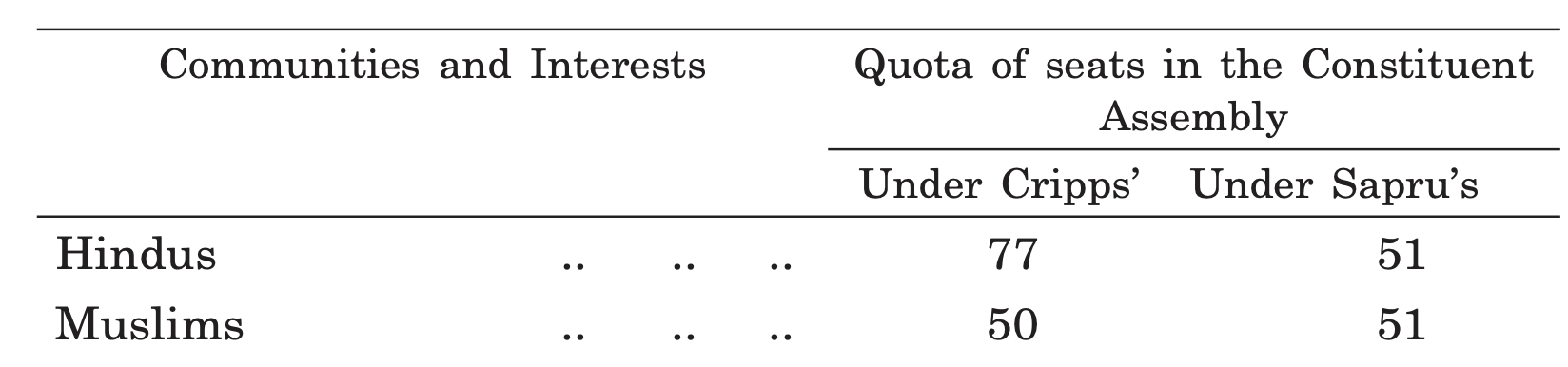
Bringing, as always, the scalpel of a data analyst Ambedkar proceeds to show how Sapru, compared to Stafford Cripps’ plan given undue equivalence in numbers to Hindus and Muslims in the Constituent Assembly. While coming close to Cripps’ total number of seats, Sapru, quite egregiously, gives 51 seats each to Hindus and Muslims arguing that this was in exchange for Muslims being subjected to joint electorate. Ambedkar trashes that argument saying Cripps plan, giving 50 seats to Muslims and 77 to Hindus, too had, in effect, a joint electorate. “It (Sapru’s report) has given something for nothing to one element and thereby put the other communities in a hazard”.


The real data analyst part is in how Ambedkar studies the composition of legislatures and identifies unerringly, how, beneath the veneer of seats lies a real conundrum of minorities relying on majority communities for being elected to the constituent assembly. (See Reference for detail). “Hindus with their excess of 217 votes can elect 20 non-Hindus, who would be dependent on them; the Muslims with their excess of 44 seats can elect 4 non-Muslims” whereas “the Scheduled Castes with a shortage of 69 votes” will “for 7 seats” depend on Hindus and Muslims”.


“The excess representation granted to the smaller minorities is only an eyewash”, concludes Ambedkar.


Principles Vs Methods

The approach to the communal problem, says Ambedkar, is “fundamentally wrong” by focusing on “methods” instead of “principles”. The then current approach proceeds in a trial and error process of using one ‘method’ after another sans satisfying a principle. 


“When a community grows powerful and demands certain political advantages” the majority community responds, Ambedkar says, by conferring concessions to “win its goodwill”. “There is no judicial examination of its claim; no judgment on merits. The result is that there are no limits to demands and there are no limits to concessions”. 


Proposing that a “governing principle” be identified and made binding on all Ambedkar outlines the principle of representation in legislature, executive and administrative arms of the government. 


Representation and Majoritarianism


Before outlining the principle Ambedkar presents his mechanism of representation of the various communities in Executive and Legislature. In the Executive branch he proposes a proportional representation for Hindus, Muslims and Scheduled castes in relation to their population. About Christians and Sikhs, quite unsympathetically, he says, given their meager population, they cannot be afforded proportional representation without enlarging the Executive to a “fantastic degree”. While true, his tone comes across as dismissive. May I say, a touch Gandhian perhaps.


In addressing the issue of representation in the Legislature Ambedkar uses a formula. A community that has 50-60% population gets roughly 40% seats; a community that is second in population strengt, whether it is 10% or 30%, gets roughly 30% seats and then third largest gets another 20-30%. See the tables below.


The advantage of this system is that that the majority community, Hindus or Muslims, cannot legislate anything without adding the votes of one or other minority groups. On the other hand two minority groups could join together and legislate without the numerically majority community. This scheme and the principle behind it is sheer genius in constitutional governance. This’d become clearer when Ambedkar enunciates his principles.


To allay fears of shortchanging Muslims or Christians Ambedkar lays out in tables that Muslims actually get far more seats than the then Government of India Act gave them and the other communities preserved their then proportions with no injury. 


Combating a Permanent and Communal Majority


Perhaps the most important and puzzling part of the speech is where Ambedkar is rather ready to jettison any clamor for separate electorates. Ambedkar and Gandhi’s titanic clash on the question of separate electorate leading to the Poona pact echoes till today and yet here is Ambedkar saying “Joint electorate or separate electorate is a matter of machinery for achieving a given purpose. It is not a matter of principle”.

“The purpose is to enable a minority to select candidates to the legislature who will be real and not nominal representatives of the minority”. Perhaps he felt that his scheme achieves that holy grail and hence the issue of separate electorate becomes moot. 


Ambedkar is at his best articulating a case ‘against’ the proposition of ‘simple majority’. He leans heavily on lessons learned from American constitution here. In “A word to Hindus” he eviscerates the support for simple majority by citing the example of America where a simple majority does not suffice for major legislation. He also identifies that “in India the majority is not a political majority. In India the majority is born; it is not made. That is the difference between a communal majority and a political majority”. 


As I explained above Ambedkar’s governing principle in arriving at his formula for representation is that the numerical majority can never legislate independently of any minority group but allows the minority groups to become sufficient majority. In this he is as fair as Solomon to both Hindus and Muslims. “The representation”, Ambedkar concludes, “is a balanced representation. No one community is placed in a position to dominate others by reason of its numbers”.


Ambedkar and Muslims


Hindutva ideologues, turning a convenient blind eye to the very harsh rhetoric of Ambedkar against Hindus and Hinduism, harp on quotes from his “Thoughts on Pakistan” that paint an unflattering picture of Islam and Indian-Muslims. Sure they are as painful to any Muslim as Gandhi’s utterances on Dalits. But, like Gandhi on Dalits, that is not all there is to Ambedkar on Muslims. 


Ambedkar certainly felt that unlike Hindus or Muslims the Scheduled Castes were political orphans and lacked any powerful agency despite their numbers and he certainly felt that he owed unto them his all. He was not entirely wrong. 


About his proposal he says it is “for an United India” and that his proposal removes the “danger of a communal majority, which is the basis of Pakistan” demand. He is sympathetic to the demand of Pakistan as it is “founded on principle of self-determination” but argues that his “plan is better than the plan of Pakistan”. 


A more pertinent idea of Ambedkar that would’ve helped Muslims in India today is his suggestion to promulgate a law designed to make it illegal for a “social boycott”.

Published in 1945 as a book, “States and Minorities” is the clearest articulation of safeguards for minorities that literally presages even the American Civil Rights Laws against discrimination. He defines a “social boycott” as


“Refuses to let or use or occupy any house or land, or to deal with, work for hire, or do business with another person, or to render to him or receive from him any service…..”


Social boycotts are not uncommon in India. More recently during protests against CAA Muslims businesses or Muslims in businesses were ostracized by an organized social boycott by Hindutva lobbies via WhatsApp propaganda. 


Critique


Ambedkar’s chief concerns, based on my hitherto sparse readings, are a strong belief in the rule of law and constitutional governance as a protection against systemic racism that was characteristic of India, a search for the holy grail of political representation of minorities wherein the chosen representatives are true and independent representatives and not beholden to the Hindu majority. 


If there is a distinguishing characteristic between Ambedkar and Gandhi it is that he, unlike Gandhi, could never bring himself to trust Hindus. In this his reading of human nature is more in line with Rajaji than the idealistic vision of Gandhi and Nehru. Of course Gandhi and Nehru were no utopians but were using optimism to shape a new future and persistent suspicion would’ve doomed their national enterprise. 


The constant vigil against the tyranny of the numerical majority is very American in spirit. Probably he was familiar with the Federalist Papers written by Alexander Hamilton and John Jay where they too constantly struggle with curtailing numerical majority and wrestle with compositions of legislatures. Notably Federalist papers 55, 57 and 67 are worth reading in this context (see references)

The American system of Electoral College and restricting Senate membership to two, irrespective of size, protects against the harm of tyranny of majority but they also carry within it the seeds of giving minorities, in states like Iowa, too much power compared to a state like California. Essentially a white majority state like New Hampshire or Iowa stands on equal footing with a California or New York. 


On the question of Pakistan it could be argued that Ambedkar was quite prophetic. A nation founded on being homogenous failed to become a liberal and secular democracy. And Muslims in India are seeing how their representation has dwindled in the Parliament corresponding to the rise of militant and fundamentalist Hindutva that is masquerading as party of governance. 


A chief complaint against Gandhi by Ambedkarites is the paternalistic and at time uncharitably dismissive attitude of Gandhi towards Dalits. Ironically Ambedkar too falls prey to that when discussing the neglect of “Aboriginal Tribes” in his proposals due to the fact that they’ve not “developed any political sense to make the best use of their political opportunities and they may easily become mere instruments in the hands either of a majority or minority”. He suggests, based on an example from South Africa, a “Statutory Commission” to administer their areas. This perspective is dangerously close to how Dalits and their own leadership were viewed by others, notably E.V. Ramaswami who alleged that Ambedkar was duped by the upper castes. However, to be fair to Ambedkar, the literacy rates and leadership amongst Scheduled Tribes was indeed no comparison to even the Scheduled Classes. But, he could’ve chosen his words a tad more politely. In this he mirrors Gandhi. 


Ambedkar, unlike Gandhi and Nehru, wrote topical books and monographs. His felicity with language ranks along side any constitutional scholar of repute and his penchant for tables and formula, a challenge for a casual reader, show us that he is ever the professor. The communication styles of Gandhi, Nehru and Ambedkar are as varied as their personalities were. 


While there are legions of Ambedkar scholars their discourse is still in academic halls and propagandistic discussions. On the other end of the spectrum there is deification. I’ve attempted to reach the common reader who is in the middle of that spectrum and this is journey for me too about man who until recent times was more spoken of than read or discussed. 


As always I am thrilled to learn one more facet of India's long march to becoming a liberal and secular democracy. So many who are less known today, like Tej Bahadur Sapru, have played important roles. From the Nehru Report of 1928 to Constituent Assembly post-Independence many sections of India's intellectual leadership were constantly engaged with making India a democracy. It is surprising given how much of that depended on an optimism that liberation would actually come. 


References:

Ambedkar's data on insufficiency of Sapru Committee Recommendation


Ambedkar's analysis of how Sapru's allocation of seats in constituent assembly depends on seats in legislature and how each community has either an advantage (excess voters over the required number to help elect their apportioned quota) or disadvantage (shortage of voters below the required number to help elect their apportioned quota)


Ambedkar analyses mathematically the factor by which the legislative seats should be divided with to yield the final composition. I've simplified it here.


Total Seats by Sapru's Committee in Constituent Assembly == 160

Total seats in legislature = 1577

Factor required to divide the seats in legislature for proportional seats in Constituent Assembly = 1577/160 === approximately 11. 


Hence quota factor = 11 (Ambedkar really calculates these. I've merely paraphrased here). 


  • "The Hindus with their excess of 217 votes can elect 20 non-Hindus, who would be dependent upon them ; the Muslims with their excess of 44 votes can elect 4 non-Muslims, who would be dependent upon them and the Europeans with their excess of 35 votes would be able to elect 3 non-Europeans, who would be dependent upon them."
  • "The Scheduled Castes with a shortage of 69 votes will be able to elect only 13 members on the stock of their own votes and for 7 seats they will have to depend upon Hindu, Muslim or European voters. The Indian Christians with a shortage of 56 votes will be able to elect only 2 seats on the stock of their own voters. For the rest of the 5 seats they will have to depend upon Hindu, Muslim or European voters. Similarly the Sikhs with a shortage of 52 will be able to elect only 3 seats on the stock of their own voters. For the rest of the 5 seats they will have to depend upon Hindu, Muslim or European voters"

  1. Sapru Committee https://www.constitutionofindia.net/historical_constitutions/sapru_committee_report__sir_tej_bahadur_sapru__1945__1st%20December%201945
  2. Sapru https://en.wikipedia.org/wiki/Tej_Bahadur_Sapru 
  3. States and minorities https://www.constitutionofindia.net/historical_constitutions/states_and_minorities__dr__b_r__ambedkar__1945__1st%20January%201945 
  4. Ambedkar's Writings Volume 1 (includes full text of Communal Deadlock and a way to solve it) https://www.mea.gov.in/Images/attach/amb/Volume_01.pdf
  5. Federalist Papers https://guides.loc.gov/federalist-papers/full-text


Monday, May 31, 2021

'Jesus and the Disinherited': Howard Thurman, Gandhi and Confronting Hatred. A Gospel of Love

 The year 2020 was marked in United States not only for the pandemic but also for a nationwide upsurge in the quest for racial justice for Black America in the wake of the murder of George Floyd by a White policeman. Amongst the many discussions I learned of Howard Thurman, a Christian theologian. Thurman's story thrilled me for he had met Gandhi and it was he who brought the message of Gandhi's non-violence to Black America that later animated the Civil Rights Movement. Thurman's "Jesus and the Disinherited" explores whether Christianity has a meaning for the African-American. 

It is my fervent belief that history echoes across societies and histories of repression and rebellion have, within, a universal message. In this blog I'll also touch upon how movements against caste oppression should pay heed to Thurman's message of love and listen to why it is dangerous to nurture hatred.


A Question from a Sri Lankan Hindu and Interpreting Jesus

In 1935 Howard Thurman was touring, with a delegation on a 'pilgrimage of friendship from the students of America, India, Burma and Ceylon. After a speech at the University of Columbo the principal invited Thurman for coffee and posed a question. "What are you doing over here?" The principal's question was more pointedly to Thurman, an African-Amreican, that his preaching of Christianity betrays what his people suffered at the hands of White men, particularly aided by the Church's teachings. Sir John Newton, author of the famous hymns 'how sweet the name of Jesus sounds' and the legendary 'Amazing Grace', was, the principal pointed, a slave trader. 

Stunned by the question Thurman then investigates what Jesus meant to "the disinherited". Jesus was a Jew, a minority community oppressed by the Roman regime, and poor. Vladimir Simkovitch, professor of economics at Columbia University and a Marxist, in his "Toward the Understanding of Jesus", quoted by Thurman, asks if it is correct to assume that Jesus should've been unmoved by the plight of his community and whether he took into account "the great and all-absorbing problem of the very people he taught".

The question of how a Jew could relate to the Roman regime and Romans, the oppressors, obsessed Jesus, says Thurman. "Again and again he came back to the inner life of the individual". "To revile because one has been reviled - this is the real evil because it is the evil of the soul itself".

How should the oppressed, be they Jews in Roman empire or a Black in America, respond to the "rulers the controllers of political, social and economic life?" Resistance and non-resistance are the two key options for the disinherited but they, Thurman points out, carry other choices within the broad categories.

Non-Resistance, in turn, features two forms. One is imitation of the dominant group by the oppressed, reducing "external signs of difference to zero, so that there shall be no ostensible cause for active violence". Herod was an example of this kind of assimilation. In this context it is worthwhile to recall the theory of Indian sociologist M.N. Srinivas's theory of "sanskritization". The other alternative that non-resistance chooses is isolationism. 

Resistance, chiefly takes the form of violence. Thurman cautions that the oppressor, in Jesus's case the Empire, has all the means to crush any such resistance. It is in this backdrop that Jesus proposes a different resistance. It is the resistance from within, "the Kingdom of Heaven is in us". No Indian can read that passage without thinking of Gandhi. 

Thurman, in blistering words notes, that the Christianity born in the mind of Jesus was different from that of what it became under the Church. "I belong", writes Thurman, "to a generation that finds very little that is meaningful in the teachings of the Church concerning Jesus Christ".

Thurman draws a sharp distinction between the Christianity that Paul creates from what Jesus created. Paul was a citizen of Rome while Jesus was not and this vital fact colors how they exhort the Jews to relate to the regime. Where Jesus calls the Jew to eschew hatred and look for Kingdom within Paul calls for obedience. 

Having this interpreted Jesus Thurman proceeds to identify the forces that operate on the disinherited and why they should choose the path of love.

Fear and the Children of God

Fear dogs the disinherited unlike any other. Fear of the oppressor stunts the life and soul of the oppressed. The dominant group does not even have to articulate threats because past incidents would weigh on the collective memory of the persecuted group. The threat of violence "is rooted in a past experience, actual or reported, which tends to guarantee the present reaction of fear".

Jesus confronts the sense of fear amongst his Jewish brethren but it applies to even an African-American terrorized in America or to a Dalit too. Assuring that his Father protects even a sparrow Jesus says, "fear ye not therefore, ye are of more value than many sparrows". This message is further amplified in the Sermon on the Mount. Allaying the fears and its attendant effects, anxiety and despair, Jesus tells the Jews, "take no thought, saying what shall we eat?....for your Heavenly Father knoweth that ye have need of all these things. But seek ye first the kingdom of God".

"This idea", exults Thurman, that God is mindful of the individual- is of tremendous import in dealing with fear as a disease". "You-you are not niggers. You-you are not slaves. You are God's children". Here is Gandhi telling a people who were deemed to be outside the pale of religion and therefore the graces of any God that they are, not outcastes, but indeed the children of God. 

Deception and Gandhi's Call for Truth

Thurman had met Gandhi during the tour mentioned earlier and this book was published in 1949. Yet, Gandhi's memory and philosophy hangs overhead for Thurman. 

The powerless, the oppressed and the disinherited resort to the well worn technique of deception. A Black pastor, unable to openly criticize policemen who had killed a blind Black man, resorted to deception in his sermon by talking to God what he'd talked to the congregation says Thurman citing an incident as an example of how deception is used by the disinherited to rebel.

"The pattern of deception", Thurman says, "by which the weak circumvent the strong and manage to secure some of their political, economic, and social rights is a matter of continuous degradation". "The penalty of deception is to become a deception".

Discussing alternatives to deception Thurman reaches Gandhi. "We come now to the third alternative-a complete and devastating sincerity". Gandhi exhorts in a letter, "Speak the truth, without fear and without exception". Thurman connects Gandhi's exhortation with Jesus's "challenge to the disinherited", telling them "let your communication be, Yea, yea; Nay, nay: for whatsoever is more than these cometh of evil". 

What does sincerity give the disinherited? "In the presence of overwhelming sincerity on the part of the disinherited, the dominant themselves are caught with no defense, with the edge taken away from the sense of prerogative and from the status upon which the impregnability of their position rests". 

Hatred

One day Thurman, seated in the segregated area in a train, overheard two black girls talk about two white girls on the street who were skating dangerously close to the train. The black girls wondered aloud about the prospect of seeing the white girls getting killed. A shocked Thurman wondered, "Through what torture chambers had they come- torture chambers that had so attached the grounds of humanness in them that there was nothing capable of calling forth any appreciation or understand of white persons?" I hail from that part of India where a supposed champion of the oppressed, E.V. Ramasamy, hailed as a messiah, inculcated precisely such hatred in equally blood curdling words targeted at the then oppressors, the Brahmins.

Thurman differentiates the hatred of the oppressed and the oppressor. "Hatred" makes a "profound contribution to the life of the disinherited, because it establishes a dimension of self-realization hammered out of the raw materials of injustice". "It is clear then, that for the weak, hatred seems to serve a creative purpose". Note, how Thurman acknowledged the creative purpose of hatred albeit one tied to the 'weak'. 

Having acknowledged the impulse for hatred by the disinherited Thurman is unsparing in decrying the effect of hatred in the long term. "Hatred destroys finally the core of the life of the hater". "Hatred bears deadly and bitter fruit. It is blind and non-discriminating". "Once hatred is released, it cannot be confined to the offenders alone". This is very evident amongst castes that were once oppressed by Brahmins who nurtured, chiefly by E.V. Ramasamy and others like him, a hatred towards all Brahmins, eventually showed hatred towards other castes and especially towards those below them in the caste hierarchy. Gandhi's life, unlike E.V.Ramasamy's, was a message against hating anyone.

"Jesus rejected hatred because he saw that hatred meant death to the mind, death to the spirit, death to communion with his Father". It'd be worthwhile to recall that James Baldwin, who pretty much forsook Christianity, also cautions against hatred because he saw it as corrosive to the soul of his fellow black Americans. 

Love

What does it take, for a Jew, to love a Roman? "To love the Roman meant first to lift him out of the general classification of enemy. The Roman had to emerge as a person". "There had to be a moment when the Roman and the Jew emerged as neither Roman nor Jew, but as two human spirits that had found a mutual, though individual, validation. For the most part, such an experience would be impossible as long as either was functioning only within his own social context". 

"Love of the enemy means that a fundamental attack must first be made on the enemy status". It does not mean, however, "ignoring the fact that he belongs to the enemy class". "The first step toward love is a common sharing of mutual worth and value. This cannot be discovered in a vacuum or in a series of artificial or hypothetical relationships. It has to be in a real situation, natural, free".

When the Lord says "vengeance is mine" He takes away the need for the disinherited to be vengeful or hateful. It is in Lord's hands.

Gandhi and Thurman

For sake of completeness I'll briefly cover Gandhi's meeting with Thurman that is the subject of another book. In February 1936 Thurman and his entourage met Gandhi at Bardoli. Newspapers run by Black community had for long paid close attention to Gandhi and his movement. Newspapers like the Chicago Defender and giants of African-American leadership like W.E.B. Du Bois had deep admiration for Gandhi. 

Gandhi was inquisitive and asked questions about lynchings, interracial marriages, black history and more to the visitors. When it was their turn to quiz Gandhi the delegation asked him about excluding blacks in South Africa during his Satyagraha. Gandhi was forthright in saying that he feared they would not have understood his new technique. The delegation took Gandhi's reply as being cautious about worrying that Satyagraha campaigns could go out of control. 


Surprisingly Gandhi and Thurman agreed that Islam was a "more congenial religion for many Africans than Christianity". Gandhi told Thurman about the spirit of brotherhood in Islam and underscored the absence of such brotherhood in all other religions including Hinduism and Christianity. Thurman, surprisingly, is more sympathetic to Islamic evangelism than Christian evangelism in India. 

Eventually the conversation turned to the topic of ahimsa. Gandhi regretted that paucity of English language compelled him to give a negative definition of ahimsa as "non-violence". Though Gandhi cited Paul's idea of love to illustrate and add that his, Gandhi's, idea of love was beyond even love of God. Both Gandhi and Thurman agreed that Paul's Christianity was a detour from Jesus's idea. Thurman was stunned to hear Gandhi add that a physical reality, physicality, is an added dimension to non-violence as an idea. 

Sue Bailey Thurman asked Gandhi, what was she to do if she had to witness the lynching of her own brother. Gandhi gave her a lengthy answer of what he meant by self-immolation, not a physical act but one that calls for refusal to wish ill will with Whites and refusal to cooperate. 

Criticism

On January 30th 1948 Gandhi was assassinated by Nathuram Godse. Jawaharlal Nehru told a shocked nation, "the light has gone out of our lives.... the light that shone in our lives was no ordinary light. It was a beacon of hope". Martin Luther King Jr was drawn to Gandhi by his confidant Bayard Rustin who brought to MLK Jr's attention about Thurman and Gandhi. In this cycle of history we see a Indian Hindu learning about Tolstoy and Christ in South Africa and then an African-American Christian theologian learning from Gandhi and taking his lessons to a very different society. Is there no message here that the oppressed of India could learn from? I think there is. 

James Baldwin, Howard Thurman, Martin Luther King Jr and many others of Civil Rights movement repeatedly circle around the topic of corrosive effects of hatred as a response. No one was naive in thinking that hatred was not justified or even natural but they were more worried about what it did, eventually, to the soul of the disinherited. 

For all his genuineness about being sincere in speaking truth and in not hating the perpetrators of violence Gandhi's prescriptions, notably about Ethiopians and Jews to have offered their lives to their conquerors, had its limits in real life.

Arguing for interactions to reinforce mutual value and respect Thurman, for all his criticism of the Church, does not offer secular alternatives as venues or occasions for such interactions. For all of Thurman's criticism of Paul's version of Christianity Arvind Nirmal, originator of Dalit Liberation Theology in India, is drawn towards Paul. 

Amidst all the societal strife we see around us the central message of Thurman and even of Gandhi, the criticisms notwithstanding, still remain the best hope if we are to rise about hatred and to move towards an egalitarian society. 

References

1. Jesus and the Disinherited - Howard Thurman

2. Visions of a better world: Howard Thurman's Pilgrimage to India and the Origins of African American Nonviolence - Quinton Dixie and Peter Eisenstadt

3. Howard Thurman Meets Gandhi

4. https://www.cnn.com/2019/02/01/us/howard-thurman-mlk-gandhi/index.html

5. https://en.wikipedia.org/wiki/Howard_Thurman

6. Howard Thurman Documentary by PBS


Monday, May 10, 2021

வ.வே.சு. ஐயர்: ஓர் அறிமுகம்

 தமிழ் நாட்டில் எதிர்மறையாகவே மட்டும் அறியப்படும் ஆளுமைகளுள் சமீப காலமாக இணைந்திருப்பவர் வ.வே.சு. ஐயர் என்றறியப்படும் வரகனேரி வேங்கடேச சுப்பிரமணியம் ஆவார். ஐயர் நிறுவிய சேரன் மாதேவி குருகுலம் சார்பான சர்ச்சை சமீப காலத்தில் பிரபலமாகும் வரை அவர் மதிப்பு மிக்கவராகவே அறியப்பட்டார். 'வ.வே.ஸு. ஐயர்' என்று தலைப்பிட்ட தி.சே.சௌ.ராஜன் அவர்களின் புத்தகத்தைப் படித்த போது அது ஒருவரை பற்றிய அறிமுகம் என்பதை விட இந்திய வரலாற்றில் முக்கியமான ஒரு காலத்தின் அறிமுகமாகத் தோன்றியதன் விளைவே இப்பதிவு. 


உளவு 

இந்திய விடுதலைக்காக முனைந்தவர்களை வேவு பார்ப்பது காலனி அரசின் முக்கியப் பணியாக இருந்தது. உளவுச் சொல்வோரின் அரசாங்க அறிக்கைகள் மிக முக்கிய ஆவணங்கள். ராஜனின் இந்த எளிய நூலில் லண்டனில் விடுதலை விரும்பிகளின் முக்கிய ஸ்தலமாக இருந்த இந்தியா ஹவுஸ் உளவுப் பார்க்கப்பட்டதை விவரிக்கிறார். ஆச்சர்யமான திருப்பங்களுடன். 

உளவுப் பார்த்தப் பலர் வெகு சாதாரணர்கள். வ.உ.சியை வேவுப் பார்த்த ஒருவரை வ.உ.சி. தனக்குப் பணிவிடை செய்ய வேலைக்கு வைத்துக் கொண்டார். அது பற்றிக் கிண்டலாக அரசு தனக்குச் செய்த கைங்கர்யம் என்றாராம். 

கீர்த்திகர் (Kirtikar) - இவருடைய முழுப் பெயர் கிடைக்கவில்லை- இந்தியா ஹவுஸில் தங்கிய போது அவரைக் குறித்துச் சாவர்க்கர், ஐயர், ராஜன் ஆகிய மூவருக்கும் ஐயமேற்பட்டது. ஒரு நாள் கீர்த்திகர் அறையில் இல்லாத போது அவர் உடமைகளைச் சோதனையிட்ட ஐயர் சந்தேகத்தை ஊர்ஜிதம் செய்தார். பின்னர்க் கீர்ரித்கரை மூவரும் மிரட்டி ஒப்புக் கொள்ள வைத்ததோடு அவர் சமர்ப்பிக்க்கும் அறிக்கைகளை ஐயர் சரி பார்த்தப் பின்பே அனுப்ப வேண்டும் என்று ஒப்புக் கொள்ள வைத்தனர். மேலும் உளவுப் பார்க்க அரசு அவருக்குக் கொடுக்கும் கூலியில் ஒரு பகுதியை இந்தியா ஹவுஸுக்கு செல்லுத்தவும் ஆரம்பித்தார். இந்தியா ஹவுஸில் இருந்த "சுறுசுறுப்பும் நல்ல முகவெட்டும் உள்ள வேலைக்காரி"யுடன் கீர்த்திகருக்கு தொடர்பும் ஏற்பட்டது. 

தங்களை அரசு உளவுப் பார்ப்பதைப் போலவே தாங்கள் அரசை வேவுப் பார்த்தாலென்ன என்ற யோசனையின் விளைவு லண்டனுக்கு வந்து இந்தியா ஹவுஸில் அடைக்கலம் புகுந்த எம்.பி.டி.ஆச்சார்யாவை ஸ்காட்லாண்டு யார்டுக்கு வேலைக்கு அமர்த்தினார்கள் சாவர்க்கரும், ஐயரும். ஆச்சார்யா இப்படியாக ஸ்காட்லாண்ட் யார்டில் பணிக்கு சேர்ந்து அந்த வருவாயையும் இந்தியா ஹவுஸுக்கு கொடுத்தார். ஸ்காட்லாண்ட் யார்ட் ஏமாந்தார்கள். 

மொராக்கோ போன திருமாலாச்சார்யார், துப்பாக்கிப் பயிற்சி எடுத்த ராஜன் 

ஆயுதப் போராட்டமே விடுதலைக்கு வழியென்று சாவர்க்கரும், ஐயரும் பிறரும் தீவிரமாக நம்பிய காலக்கட்டம் அது. அதற்காக லண்டனிலேயே துப்பாக்கிப் பயிற்சிக்கு முயன்றார்கள் ஆனால் எந்த இடத்திலும் அவர்களுக்கு அனுமதி கிடைக்கவில்லை. இந்நிலையில் ராஜனுக்கு மட்டும் ஓரிடத்தில் அனுமதி கிடைத்தது ஆனால் அதுவும் மூன்று நாட்களுக்குப் பின் ரத்தானது. மனம் தளராத ராஜன் பாலிடெக்னிக் ஒன்றில் சேர்ந்து இன்னும் கொஞ்சம் பயிற்சிப் பெற்றார். 

துப்பாக்கிச் சுடுவது மட்டும் போதாது போர் நடத்த அனுபவம் தேவை என்றுணர்ந்தவர்கள் அப்போது, 1909-1910, மொராக்கோவுக்கும் ஸ்பெயினுக்கும் இடையே நடந்த போரில் பங்குப் பெற்றால் படை நடத்தும் அனுபவம் கிடைக்குமென்று எம்.பி.டி. ஆச்சார்யா மற்றும் இருவரை மொராக்கோ அனுப்பி வைத்தனர். அதில் ஒருவர் இஸ்லாமியர். முயற்சி பலனளிக்கவில்லை எந்தப் படையும் இம்மூவரையும் ஏற்கவில்லை. ஏழு மாதங்களுக்குப் பின் ஆச்சார்யா மட்டும் மிகவும் நலிந்த நிலையில் இந்தியா ஹவுஸ் திரும்பினார். 

M.P.T. Acharya

1907-இல் சாவர்க்கரும், ஐயரும் லண்டன் வந்திருந்த துருக்கியின் பிரமுகர் முஸ்டாபா கெமால் அடாடுர்க்கை சந்தித்திருக்கிறார்கள் என்பது குறிப்பிடத் தக்கது. 

காந்தியை சந்திப்பது 

1909-இல் காந்தி லண்டனுக்குச் சென்றார். அப்போது சாவர்க்கரும் ஐயரும் அவரைச் சந்தித்தார்கள். காந்தி ஏதோ பெரிய ஹோட்டலில் தங்கியிருப்பார் என்று தேடி அலைந்து பின் அவர் ஒரு சாதாரண இடத்தில் இந்தியாவிலிருந்து வந்து சிற்றுண்டி நடத்தும் ஒருவரின் வீட்டில் சந்த்தித்தார்கள் சாவர்க்கரும், ஐயரும். சுரேஷ் பிரதீப் சமீபத்தில் "காந்தியத்தின் முதலைப் பற்கள்" என்று எழுதிய போது இந்நிகழ்வை படித்துக் கொண்டிருந்தேன். என்ன முதலைப் பற்களோ. மூன்று நாட்கள் சாவர்க்கரும் ஐயரும் காந்தியை மீண்டும் மீண்டும் சந்தித்து விவாதிக்கிறார்கள். அவ்விவாதங்களுக்கு எதிர் வினையாகத் தான், குறிப்பாக மேற்கத்திய நாகரீகத்துக்கு எதிராகவும் தீவிரவாதத்தை நிராகரித்தும், காந்தி "ஹிந்த் ஸ்வராஜ்" புத்தகத்தைத் திரும்பிச் செல்லும் போது கப்பலிலேயே பித்துப் பிடித்தவரைப் போல் எழுதி முடித்தார். 

24 அக்டோபர் 1909-இல் இந்தியா ஹவுஸில் தீபாவளிப் பண்டிகையைக் கொண்டாடினார்கள் (மற்ற சரித்திர ஆசிரியர்கள் எல்லோரும் இதனை விஜய தசமி விழா என்றே குறிப்பிடுகிறார்கள்). பண்டிகை பல இந்தியர்களை ஒருங்கிணைக்கும் என்று எண்ணியவர்களுக்கு ஒரு சிக்கல், அப்போது லண்டனில் தங்கியிருந்த பிரபலமான இந்தியர்கள், கோகலே, விபின் சந்திர பால், லாஜபதி ராய், எல்லோரும் விழாத் தலைமையேற்க மறுக்கவும் காந்தியை சாவர்க்கரும் ஐயரும் அழைத்தார்கள். 

விழா நாளன்று இந்தியா ஹவுஸ் வந்த காந்தியை அங்கிருந்தோர் அடையாளம் தெரியாமல் விருந்துக்கு வந்தவர் என்று நினைத்து அப்போது நடந்து கொண்டிருந்த சமையல் வேலையில் ஈடுபடுத்துகிறார்கள். ஐயரும் சாவர்க்கரும் வீட்டுக்கு வந்து இவர் தான் காந்தி என்ற போது மற்றவர்கள் திகைக்க அந்த முதலைப் பற்களுக்குச் சொந்தக்காரர் சிரித்தார். 

காந்தியின் உரையை விடச் சாவர்க்கரின் ராமாயணம். பற்றிய உரை மிகவும் ரசிக்கப்பட்டது. காந்தியை சந்தித்த முதல் நாள் மாலை ஐயர் ராஜனிடம், "மனித சிருஷ்டியில் உயர்ன்ந்த்அஅவ்அஅர்உஉம் ஒப்பற்றவருமான ஒருவரை இன்று சந்தித்தேன்" என்றாராம். ராஜன் வருடத்தைத் தவறாக 1908 என்று குறிக்கிறார். 

மேடம் காமா

மேடம் காமா (Madam Cama) என்றழைக்கப்பட்ட பிகாஜி காமா ஒரு பார்ஸி பெண்மணி, விவாகரத்தானவர், தேச விடுதலைக்காகப் போர்க் குணத்தோடு செயல்பட்ட ஆச்சர்யபடத்தக்க பலருள் ஒருவர். இந்திய விடுதலைப் பயணத்தில் தான் எத்தனையெத்தனை ஆச்சர்யப்படத்தக்க ஆளுமைகள். ஓ அது ஒரு காலம். 

காமா செல்லுமிடமெல்லாம் தான் வைத்திருக்கும் மூவர்ணக் கொடியை "மேஜையிலோ அல்லது நாற்காலியிலோ ஒரு சன்னக் குழாயை நிறுத்தி அதில் பறக்கவிட்டுப் பிறகு தான் பேச ஆரம்பிப்பார்கள். ஆங்கிலப் பத்திரிக்கைகளில், "கொடி தாங்கி அம்மையார்" என்று எழுதுவது வழக்கம்". 

சாவர்க்கர் வழக்கும் துரோகிகளும் ஐயரும்

அக்காலத்தில் பாரீஸ் இந்திய விடுதலைப் போராட்ட வீரர்களுக்கு அடைக்கல நகராகச் செயல்பட்டது. இந்தியாவில் பாண்டிச்சேரி போல். ஜனவரி 1910-இல் சாவர்க்கர் லண்டனில் தான் கைது செய்யப்படலாம் என்று பாரிஸுக்குப் போனார். பிறகு 13 மார்ச் 1910 லண்டனுக்குத் திரும்பும் போது விக்டோரியா ஸ்டஷனில் கைது செய்யப்பட்டார் (ராஜன் இதை டோவர் துறைமுகம் என்று எழுதுகிறார்). சிறையில் இருந்த சாவர்க்கரை அடிக்கடி சந்தித்தது ஐயர் தான். சாவர்க்கரை தப்புவிக்கும் ஒரு முயற்சியில் ஈடுபட்டார் முயற்சி பலனளிக்கவில்லை ஆனால் அம்முயற்சிக்காக லண்டன் போலீசால் கைது செய்யப்பட இருந்தார். ஏப்ரல் மாதம் ஐயர் பாரீஸுக்கு சீக்கியர் போல் வேடமிட்டு தப்பினார். அதற்கு அவர் தாடியும் தோற்றமும் துணைப் புரிந்தன. 

ஜூலை 1910 சாவர்க்கரை இந்தியாவுக்கு அனுப்பி வழக்கை எதிர்கொள்ள வேண்டும் என்று லண்டனில் முடிவானது. ப்ரான்ஸில் இருக்கும் மார்ஸே வழியே தான் கப்பல் பயணிக்க வேண்டும். மார்ஸே துறைமுகத்தில் சாவர்க்கர் கழிப்பறை துளை வழியே தப்பிக் கடலுக்குள் குதித்தார். ராஜன் சாவர்க்கர் நிர்வாணமாகக் குதித்ததாகச் சொல்கிறார். வழக்கு ஆவணம் ஒன்று "almost naked" என்கிறது ஆனால் சாவர்க்கர் வாழ்க்கை வரலாறு எழுதிய விக்ரம் சம்பத் அது பற்றிச் சொல்லவில்லை. 

கடலில் குதித்த சாவர்க்கரை போலீசார் நீந்தி துரத்தினர். நிர்வாணமாகக் கரையேறிய சாவர்க்கர் தனக்காக வண்டியுடன் கரையில் காத்திருக்கும் வ.வே.ஸு. ஐயர் மற்றும் மேடம் காமா நோக்கி ஓட பின்னால் போலீஸ் துரத்தி அவரைப் படித்து விட்டது என்கிறார் ராஜன். சம்பத்தின் புத்தகம் ஐயரும் காமாவும் வந்தடைய தாமதமாகி விட்டதென்கிறது. எப்படியோ சாவர்க்கர் பிடிப்பட்டார். 

சாவர்க்கரின் கைதுக்குப் பின் ஐயர் ஓர் இஸ்லாமியராக வேடமிட்டு இந்தியாவுக்கு "எகிப்து, பம்பாய், கொழும்பு, கடலூர்" வழியே தப்பி வந்தார். "அந்தணர் குலத்தவர் இஸ்லாமியப் பக்கிரியாக மாறினார். அதற்கான சின்னங்கள், முஸ்லீம் பழக்கங்கள், பேச்சு இவைகளுடன் உளவுப் போலீஸ்காரர்களுக்குத் தெரியாமல் தப்பினார்" என்கிறார் ராஜன். 

சாவர்க்கர் வழக்கில் முக்கியமானவர்கள் ராமராவ் என்பவரும் அரிச்சந்திர கோரேகாவகர் (Harishchandra Khoregaonkar) என்பரும் முக்கியமானவர்கள். 

பாரீஸில் துப்பாக்கிகளையும் ரவைகளையும் எளிதாக வாங்க முடியும் என்பதால் அங்குத் தங்கியிருந்த காலத்தில் துப்பாக்கிகளை வாங்கி இந்தியா செல்லும் ராமராவ் மூலம் அனுப்பினார் ஐயர். ஆனால் பாரீஸில் இங்கிலாந்து உளவுத் துறை இதை மோப்பம் பிடித்து விட்டதை ஐயரும் ராமராவும் உணரவில்லை. பாம்பே வந்திறங்கிய ராமராவ் கைது செய்யப்பட்டுத் துப்பாக்கிகளும் பறிமுதல் செய்யப்பட்டன. பின்னர் ராமராவ் கொடுத்த வாக்குமூலம் சாவர்க்கரை நாஸிக் வழக்கில் சிக்க வைக்க உதவியது. 1917-இல் காங்கிராச் மாநாட்டில் ராமராவை சந்தித்ததைக் கசப்போடு நினைவு கூர்ந்தார் ராஜன். 

கோரேகாவ்கர் மிக முக்கியமான சாட்சியம் வழங்கினார். இந்தியா ஹவுஸில் தங்கியிருந்த போது சாவர்க்கரோடு உரையாடியது, திங்கிராவின் கொலைத் திட்டம், இன்னும் பல விவரங்களை அளித்துச் சாவர்க்கருக்கு எதிரான வழக்கு வலுப் பெற கோரேகாவ்கர் முக்கியக் காரணம். அரிச்சந்திரன் என்று பெயர் கொண்டவர் இப்படித் துரோகம் செய்து விட்டாரே என்று வருந்தி எழுதுகிறார் ராஜன். 

இந்தியாவில் ஜூன் மாதம் ஆயுள் தண்டனை விதிக்கப்பட்டு அந்தமானுக்குப் போகும் வழியில் சென்னை வந்தார் சாவர்க்கர். 17 ஜூன் 1911-இல் ஆஷ் துரையை வாஞ்சி கொன்றிருந்த செய்தி சாவர்க்கரை அடைந்ததென்றும் அவர் அச்செயலுக்கு ஐயர் அனுப்பிய துப்பாக்கிகள் உதவியிருக்கலாம் என்று உணர்ந்ததாகச் சாவர்க்கரின் வரலாறு எழுதிய விக்ரம் சம்பத் சொல்கிறார். (ஆதாரம் எதுவும் கொடுக்கவில்லை). 

குருகுலமும் முடிவும்

1920-இல் புதுச்சேரியை விட்டுச் சென்னை வந்த ஐயர் 'தேசபக்தன்' என்று ஒரு இதழில் எழுதிய கட்டுரைக்காக 9 மாதம் சிறையில் இருந்தார். சிறையில் இருந்து வெளி வந்த ஐயர் திருநெல்வேலிக்கு அருகே சேர மாதேவி என்ற இடத்தில் "பாரத்துவாஜ ஆசிரமம்" என்ற பெயரில் காங்கிரசிடம் இருந்தி ரூ.10,000 பெற்று (முதல் தவணை ரூ. 5000) ஒரு குருகுலம் ஆரம்பித்தார். 

குருகுலத்தில் சில பிராமண மாணவர்களுக்குத் தனியாக உணவு பரிமாறியது பெரும் சர்ச்சையைக் கிளப்பியது. குறிப்பாக வரதராஜுலு நாயுடுவும் ஈ.வெ.ராவும் முன் நின்று எதிர்த்தார்கள். ஐயங்காரான ராஜன் தானும் தனியே ஐயரிடம் இப்படிச் செய்யலாகாது என்று கூறியதாக எழுதுகிறார். இன்றளவும் இந்த ஒரு விஷயத்தை வைத்தே ஐயர் பேசப்படுகிறார். சம காலத்தில் அரசுப் பள்ளிகளில் மதிய உணவுத் திட்டத்துக்காகத் தலித்துகள் சமைத்தால் தங்கள் பிள்ளைகள் சாப்பிடக் கூடாதென்று இடை நிலை சாதி இந்துக்கள் எதிர்த்த போது திராவிட இயக்கம் பாராமுகமாக இருந்து விட்டது. 

இந்தச் சச்சரவு "1924-ஆம் வருஷம் துவங்கிற்று. 1925-ஆம் வருஷம் ஜூலை 3" அன்று "பாபநாசம் நீர் வீழ்ச்சியில் தம் மகளைக் காப்பாற்றும் பொருட்டு ஐயர் உயிர் நீத்தார்". வ.வே.சு. ஐயருக்கு வயது 44. 

மதிப்புரை

முதல் கேள்வி ராஜனின் புத்தகம் வரலாறா? நிகழ்வுகளை நம்பலாமா? விக்ரம் சம்பத் எழுதிய சாவர்க்கர் வாழ்க்கை வரலாற்றோடு ஒப்பிட்டுச் சொல்கிறேன் ராஜன் எழுதியது வரலாறு. ஆச்சர்யமான விஷயம் சம்பத் எங்குமே ராஜனின் புத்தகத்தைச் சொல்லவில்லை, ராஜனின் புத்தத்தில் மட்டுமே கண்டிருக்கக் கூடுய ராஜன் துப்பாக்கி பயிற்சி பெற்றது பற்றிக் கூட எழுதியிருக்கிறார் சம்பத் ஆனால் ராஜனின் புத்தகத்தைச் சுட்டவில்லை. மற்ற நிகழ்வுகளுக்குச் சம்பத் வேறு ஆதாரங்கள் தருகிறார் ஆனால் அவை எல்லாமே ராஜன் எழுதியதோடு ஒத்துப் போகின்றது. 

T.S.S. Rajan (1880-1953)

1946-இல் வெளிவந்த இந்நூல் ஒரு காலத்தின் சித்திரத்தை கூட அல்ல மாறாக ஒரு நிழலை, silhouette, அளிக்கிறது என்று தான் கொள்ள வேண்டும். இந்திய விடுதலை என்பது நீண்ட பயணம். அதில் மிக ஆச்சர்யப்படத்தக்கவர்கள் பயணித்திருக்கிறார்கள். "தண்ணீர் விட்டோ வளர்த்தோம், சர்வேசா இப்பயிரை கண்ணீரால் காத்தோம்" என்ற பாரதியின் வரி சத்தியமான உண்மை. 

ராஜனின் வாழ்வே ஆச்சர்யமானது தான். வைதிக குடும்பத்தில் ஶ்ரீரங்கத்தில் பிறந்து திருச்சி செயிண்ட் ஜோசப் கல்லூரியில் படித்து, ரங்கூனில் பணியாற்றி, லண்டனில் படித்து மருத்துவராகி, விடுதலைப் போராட்டத்தில் இரண்டு முறை (இரண்டறை வருடம்) சிறையில் இருந்தவர், தமிழ் நாடு ஹரிஜன சேவா சங்கத் தலைவர், சென்னை அரசில் இரண்டு முறை அமைச்சராக இருந்திருக்கிறார். 

எம்.பி.டி ஆச்சார்யா எப்பேர்ப்பட்ட வாழ்வு அவருடையது. வைஷ்ணவர், இந்தியா பத்திரிக்கை நடத்தியவர், இங்கிலாந்துக்குப் போய் உளவுப் பார்த்தவர், பின்னர்க் கம்யூனிஸ்டாகி லெனினை சந்தித்தவர், மிக ஏழையாகப் பம்பாயில் இறந்தார். 

காந்தி, பாரதி, வ.வே.சு. ஐயர், நேரு, சாவர்க்கர் இவர்கள் எல்லோருமே மாஜினியையும், கரிபால்டியையும் பற்றிப் படித்தும் எழுதியும் இருப்பது உலகத்தின் விடுதலை மற்றும் ஒருங்கிணைப்பு முயற்சிகளையெல்லாம் நம் தேச விடுதலைக்காகப் படித்து ஆராய்ந்ததைச் சொல்லும். 1850-1950 நூற்றாண்டை இந்தியா உருவான நூற்றாண்டு என்று சொல்ல முடியும். 

எப்படியாவது தேசத்துக்கு விடுதலை கிடைத்து விட வேண்டும் என்று தமக்குச் சரி என்று தோன்றிய எல்லா வழிகளையும் தேச பக்தர்கள் கையாண்டிருக்கிறார்கள். இதில் முக்கியமாகப் பிராமணர்கள், தன்னளவில் ஆசார நம்பிக்கைகள் கொண்டிருந்தாலும், நிறையச் சாதிய கட்டுப்பாடுகளை மீறி இருக்கிறார்கள். இன்று நாம் தட்டையான சித்திரங்களால் புரிந்து கொண்டிருக்கும் பலரும் மிகச் சிக்கலான வாழ்க்கையை வாழ்ந்திருக்கிறார்கள். 

எளிய மொழியில் எழுதப்பட்ட சிறிய நூல் ஆனால் இன்றைய சந்ததியினர் அவசியம் படிக்க வேண்டிய நூல் ராஜனின் 'வ.வே.ஸு. ஐயர்'. வ.வே.சு. ஐயர் பற்றிய இன்னொரு முக்கியமான நூல் பெ.சு. மணியின் "வ.வே.சு. ஐயர் அர்சியல்-இலக்கிய பணிகள்". ராஜன் தொடாத ஐயரின் இலக்கியப் பணிகள் குறித்து மணி எழுதியிருக்கிறார். 


References


2. வ.வே.சு ஐயர்: அரசியல்-இலக்கியப் பணிகள் - பெ.சு.மணி https://www.tamildigitallibrary.in/book-detail?id=jZY9lup2kZl6TuXGlZQdjZt3juUy&tag=வ.+வே.+சு.+ஐயர்#book1/


Wednesday, March 31, 2021

A Historian Reflects on the Meaning of Good Friday

Quintus Lucilius Balbus (c 100 BCE), quoted by Marcus Tullius Cicero, said, "To sum up, the existence of the gods is so abundantly clear that I regard anyone who denies it as out of his mind". Voltaire famously went to war against the Church but insisted that "if God did not exist it'd be necessary to invent him". India's own Jawaharlal Nehru, an atheist, understood that "religion had supplied some deeply felt inner need of human nature, and that the vast majority of people all over the world could not do without some form of religious belief". Religion, irrespective of whether you practice it or not, is a subject to be engaged with. 

While religion or its practice has little value or interest for me I am always fascinated by how the philosophical upper reaches of religion captivates human minds, minds that I tend to respect for their intellectual breadth. Thanks to my father, a devout Christian who took pride in calling himself a 'humanist', I've a healthy appreciation of the religious instinct and a definite distaste for bigotry. A person's religion is his own private matter as long as it does not color his profession, whatever that may be. When I came across Pulitzer winner and historian Jon Meacham's "The hope of glory: Reflections on the last words of Jesus from the Cross" I was intrigued to read what a person like him could say on a matter of faith. 


Tamil writer Jeyamohan recently ruffled quite a few feathers with an article addressed to a skeptic of Hinduism. As is his wont Jeyamohan did not stop with making the case for Hinduism but happily extended to offer prejudiced criticisms of Christianity and Islam based on partisan cherrypicking of history. Meacham's book, a slim one, that had hitherto been gathering dust on my bookshelf, became an urgent need to be read and contrasted with Jeyamohan's style of writing on religion. 

Not an Evangelist

Meacham declares in his prologue. "I am, however, in no sense an evangelical, for I do not share the view that faith in Jesus is the only route to salvation, nor am I determined to convert others to my point of view". As a biographer of Thomas Jefferson, the president who most notably laid the foundations of secularism in America, Meacham quotes the sage from Monticello, "It does me no injury for my neighbor to say there are twenty gods, or no god". 

So, why did Meacham bother to write this book? "I am sharing these meditations in the hope that a sense of history and an appreciation of theology might help readers make more sense of the cross". Meacham walks a tightrope as a historian, his known avocation, and a man of faith, his private world that he is now opening to wider and open scrutiny.

What is history and what is theology? Meacham answers, "History is what happened in time and space. Theology can be understood as what people think history means in relation to a presumed order beyond time and space". "History is horizontal, theology vertical, and their intersection is a motive force behind our religious , national, and personal imagination." 

To Meacham the crucifixion and the existence of Jesus is factual but he is comfortable in referring to the last words of Jesus as "may or may not have been spoken". The crucifixion is to Meacham, "a reminder that at the center of the Christian story lies love, not hate; grace, not rage; mercy, not vengeance". India's Mahatma, a devout Hindu, saw the same message as the heart of Christianity and was moved when he visited the Sistine Chapel. 

The life of Jesus, if we were to accept the narrative of the Bible, is very unlike most other Gods. The life of Jesus is bookended by helplessness. He's born in a manger and the people who know of his birth are nomads. He dies, flagellated and nailed to the cross. He preached a religion which rewarded the poor, for being poor and the weak for being weak. No wonder Nietzche, preaching a gospel of strength, repudiated Christ. 

The "Last words of Jesus" are meditated upon by the faithful on Good Friday. It is a day of reflection of what Christ and Christianity mean to each of them and to society at large. Jon Meacham offers us his reflections.

Forgiveness

Probably the most famously known words of Jesus are "Father, forgive them; for they know not what they do" (Luke 23:32-38). The crucifixion is a foretold event and Jesus was fulfilling a prophecy and in essence His mission on Earth. If crucifixion was a prophecy then perforce there should be the executioners who were merely playing their parts in a drama orchestrated from beyond human realm. The immortal Bard of Avon had the blind and desperate Earl of Gloucester lament, "As flies to wanton boys are we to the gods". 

If the Roman executioners were playing out their parts did they need to be forgiven? The last words of Jesus, seven phrases, are spread across the various Gospels and this, the first, come from St. Luke. Meacham reasons that Luke included these lines not because Jesus perhaps said them or that the Roman executioners needed forgiveness. The gospels were written, supposedly, decades after Jesus's crucifixion and were addressing a different audience. Luke, by ascribing these words to Jesus as he hung on the cross, was meant to lift the sense of guilt that his Jewish and Gentile audience might have for what their forefathers did. 

Rejecting the notion that scriptural text is to be read literally Meacham exhorts us to "engage with the texts of the faith with reason, a critical intelligence and a capacity to distinguish history from legend, narrative from allegory, and fact from apologetics". 

"Woman, Behold thy son"

Two stories from Indian mythology always strike me for their similarity with these words of Jesus addressed to his mother. Philosopher extraordinaire Adi Shankara, a sanyasi, sensing that his mother is ailing rushes to her side to be with her as she draws her last breath. Tamil devotional poet Pattinathar also rushes to be with his mother at her death and famously, instead of cremating her with wood, lest it hurt her, sets the pyre alight with verses. 

As a Child Jesus admonishes his parents who come looking for him, thinking he's lost, that he's "about his Father's work".  Yet, as life ebbs from him and hanging from the cross he looks down and sees his distraught mother. Like a man taking care of his family that he leaves behind he speaks to his mother, referring to his disciple John, "woman, behold thy son" and to John he says, "Behold thy mother" (John 19:25-27). To Meacham this act of a dying man showing love to another person and not himself is an act that Jesus wants his follower to, well, follow. 


That a man whose skin had been shredded to His bones and nailed to the cross would spare a thought for others might strain the credulity of any listener and Meacham concedes, "you may well find that the whole story is not something you can accept". Then he assures us that we share company with none less than Benjamin Franklin himself.

Franklin, writing to Ezra Stiles, President of Yale, confesses his belief in "one God, creator of the Universe". "The most acceptable service", Franklin continues in the letter, "we can render him, is doing good to his other children. That the soul of man is immortal, and will be treated with justice in another life respecting its conduct in this." Franklin then tips a hat to other religions, "These I take to be fundamental principles of all sound religion, and I regard them, as you do, in whatever sect I meet with them".

America's founding Father aside from casting aspersions that Jesus's message, with the passage of time and other factors, would've been corrupted voices what could be blasphemous doubt about the very divine nature of Jesus. "I have....some doubts as to his divinity; though it is a question I do not dogmatism upon". To Franklin the divinity of Jesus is doubtful and not even a pre-requisite to value his teachings or following his teaching of brotherhood and doing good to others.

"Into Thy hands I commend My Spirit"

Having taken care of his mother Jesus cries out fin desperation, in a very human moment, "My God, My God, why hast thou forsaken me" (Matthew 27:45-46). Then he asks for water, "I thirst" (John 19:28-29). Having tasted water he then resignedly recognizes the moment is drawing close, "It is finished" (John 19:30). The last gasp is when he let's out his sprit saying, "Father, into thy hands I commend my spirit" (Luke 23:46). 

It is this moment of surrender that to Meacham is a call to all Christians to "committing ourselves to a habit of mind and of heart that tends toward love and order rather than selfishness and disorder". Willam James, Meacham says, "put it well, saying 'We and God have business with each other; and in opening ourselves to his influence our deepest destiny is fulfilled". 

Good Friday, marking death of the Son of Man, is a moment of darkness but beyond the darkness of the moment lies hope, the resurrection and salvation. Faith, to Meacham, is not magic but mystery. Mystery, for Meacham, holds the promise of hope. That faith embodies hope, not uncertainty or fear, is best shown in the words of T.S. Eliot, that Eliot had himself borrowed, "All shall be well, and all shall be well, and all manner of thing shall be well". 

Leap of Faith and Hope of Glory

As Jesus commended his spirit unto his Father's so should we, says Meacham quoting the famous words of Coleridge (1772 - 1834), have a "willing suspension of disbelief". The idea of "willing suspension of disbelief" dates back to Aristotle and in this context Coleridge and Meacham argue that such a suspension of disbelief opens our souls to an enriching experience. What would that help for? 

Meacham calls forth the reader to "seek the means of grace, and the hope of glory" irrespective of which God you choose to worship. Seeking grace is all there is to it. 

Meacham further presses his case for faith by calling forth the mathematician Blaise Pascal (1623 - 1662). Pascal argued, in Meacham's words, "It is smarter to bet that God exists, and to believe in him, because if it turnout that he is real, you win everything; if he is not, you lose nothing. So why not take the leap of faith. 

Criticism

Jon Meacham sets himself a tall task in a field populated by intellectual giants of the highest order and writers of great merit. Writing about Christianity and what faith means for an audience of common reader has a very long tradition that includes the likes of G.K. Chesterton, C.S. Lewis, William James, to name a few. Then in recent years we have highly regarded writings of Elaine Pagels and Jack Miles who approach the question of religion and God from academic perch. Meacham, for all his erudition and culling of quotes from a vast repertoire of theologians and poets pretty much loses steam after the second or third "word of Jesus". History, not theology, is Meacham's forte. 

Of course one could say that the book is meant for the faithful and it'd fail to strike a chord in a secular reader or an agnostic. Fair enough. But Meacham set himself out "not to convert" and hence the aim to impress upon the reader, the meditative truth that the author found, in language that appeals to the mind in such a way that the reader could at least say, "if I were faithful I'd enjoy this more". On that Meacham fails. 

Now, once we cross the Western academic nature of writing that Sarvepalli Radhakrishnan and S.N. Dasgupta did and we reach particularly the likes of Jeyamohan who have a cultivated animosity for the Western intellectual tradition we find that the writing is not just uneven but lacks a balance. The writing suffers from an eagerness to court a reader to join the fold and despite any good intention to keep the courting positive it inevitably lapses into enveloping irrelevant negativity. Meacham, who functions as secular historian, while being faithful member of the Church, is still trying to speak to a secular reader. Elaine Pagels, historian of the Gnostic Gospels, is sympathetic to the religious instinct but is careful not to sound like a televangelist. Jeyamohan's problem is he tries not to be a televangelist but his impulses get the better of him. Sad.