On April 11th 1985 Gorbachev addressed a Politburo meeting on the topic of the state of Soviet farming which was in dire straits. There were warehouses for only 26% of the fruit and vegetables. Only a third of them had refrigeration facilities. He, according to a diary entry of a member, threatened the politburo with a very simple threat. Gorbachev the General Secretary of the Communist Party of United Soviet Socialist Republic, a super power, threatened members of the politburo with revocation of privileged access to eatery and special food store this forcing the Politiburo members to face the privations of the common soviet citizen at common grocery stores. THAT was the true accomplishment of Karl Marx’s Communism that Lenin and Stalin inflicted on humanity.
This is only a blog and as such I’m only giving a sampling of the scale of horror and plain stupidity that Communism inflicted on humanity. For ease of reading I’ve omitted citing the actual sources of each incident or quote. Given that this is a blog and not an academic paper I’ve cited the sources individually at the end. Every information here is sourced and mostly verified as to whether the author used primary sources or other corroborative material.
Communists and Orwell’s Pigs
“All animals are equal! But some animals are more equal than others” said the pigs in Orwell’s timeless classic “Animal Farm”. Communism produced such pigs. Orwell’s pigs embodied communism.
“When Brezhnev came to the Azerbaijan capital Baku in 1978, Aliyev gave him a gold ring with a huge solitaire diamond, a hand woven carpet so large it took up the train’s dining salon, and a portrait of the general secretary onto which rare gems had been pasted as ‘decoration”. When politburo members went fishing swimmers would go underwater to fix fishes on the baits and when they went hunting choice animals would be herded within point blank range.
Communist party leaders lived in luxury in dachas and escaped the pain their policies created for their own citizens. “In the Soviet Union no economic transaction was untainted”. “No one could afford to avoid at least a certain degree of complicity. That was one of the most degrading facts of Soviet life: it was impossible to be honest. And all the baksheesh, eventually, ended up enriching the Communist Party”.
Lenin’s Bloodlust
When Revolution came to Russia Lenin was in Switzerland and Trotsky in New York and Stalin was in exile. They were not the revolutionaries they’re made out to be. They usurped power and turned a peasant uprising into a bloody coup to seize power as the provisional government teetered. How did Lenin arrive in that train station in Finland?
 |
| Lenin's Statue being toppled in Ukraine (2008) - Courtesy the Week |
Lenin, accompanied by his wife and mistress, a sort of menage-a-trois, arrived in a ‘sealed train’ transported by the courtesy of Germans. Churchill memorably said that Germany, then at war with Russia, “turned upon Russia the most grisly of all weapons. They transported Lenin in a sealed truck like a plague bacillus from Switzerland to Russia.”
Lenin, who was anti-war, was sent by Germany to undermine the provisional government from making peace with Britain and France and continuing the war with Germany. The extent of German help was assiduously hid by Lenin and the Bolsheviks and the myth of the ‘sealed train’ was born to promote the idea that the bacillus arrived untainted. Lenin “had accepted the kaiser’s money — “German gold” — to help finance Bolshevik propaganda and amplify his strident appeals against the provisional government and anyone, Bolshevik or otherwise, who thought of cooperating with it”
Louis Fisher, a onetime Communist sympathizer and later admirer of Gandhi, paints a stark picture of Lenin in his biography, “Lenin”. “He considered violence a levitate, indeed a preferred method, and advocated is coldly and openly. The end hallowed all means”. “There are moments when the interests of the proletariat demand the merciless annihilation of the enemy in open armed battles”. “Theere has not been a single revolution, or era of civil war, without executions” said Lenin. Duly, the first institution that the Bolsheviks created was the Cheka, the precursor of later day NKVD and finally the KGB.
Stalin, Pulitzer winning author David Remnick wrote, was a lamb compared to Lenin. Here’s Lenin on August 11th:
- Hang (hang without fail so the people see) no fewer than one hundred known kulaks, rich men, bloodsuckers.
- Publish their names.
- Take from them all the grain
- Designate hostages
"Do it in such a way that for hundreds of versts around, the people will see, tremble, know, shout: they are strangling and will strangle to death the bloodsucker kulaks."
Recovering from an assassination attempt Lenin wrote, “it is necessary secretly-and urgently to prepare the terror”. Thus started a period that is now referred to as ‘Red Terror’. “Lenin personally signed the execution lists, thereby inventing another tradition that was carried on under Stalin”. Maxim Gorky supported Lenin and said “if the enemy does not surrender, he must be destroyed”.
Historian and biographer Stephen Kotkin writes, “Stalin and many other Marxists avowed, the capitalists would never allow themselves to be buried. Rather, they would fight to the death against socialism, using every means-lies, espionage, murder-because this was a war in which only one class could emerge victorious. Socialism therefore, would also have to use mass violence and deceit. The most terrible crimes became morally imperative acts in the name of creating paradise on earth”.
Stalin’s terror by quota. Reign of Yezhov. Khrushchev’s massacre
Stalin was Lenin’s protege, especially, when it came to bloodlust and monstrosity. Unlike Lenin, Stalin, unfortunately, lived too long.
On 30th July 1937 Nikholai Yezhov, head of NKVD, after Genrik Yagoda the previous head and his wife were executed under Stalin’s orders, proposed Order No. 00447 to the politburo. “The regions were to receive quotas for two categories: Category one- to be shot. Category two - to be deported. They suggested that 72,950 should be shot and 259,450 arrested”. “The regions could submit further lists. The families of these people should be deported too. The politburo confirmed the order the next day”. Nearly “1.5 million were arrested in these operations and about 70,000 shot”. “Yezhov even specified what bushes should be planted to cover mass graves”.
“On 5th July 1937, the Politburo ordered the NKVD to ‘confine all wives of condemned traitors…in camps for 5-8 years’ and to take under State protection children under fifteen: 18,000 wives and 25,000 children were taken away. “On 15th August Yezhov decreed that Children between one and three were to be confined in orphanages but ‘socially dangerous children between three and fifteen’ could be imprisoned ‘depending on degree of danger’. Almost a million of these children were raised in Orphanages and often did not see their mother for twenty years”. Following the execution of Bukharin his wife Larina was sent to the Gulags for twenty years and she saw her son, an infant when she was sent away, only after her release.
Too often apologists for Stalin paint his terror as par for the course for that era. No it was not. No leader of any civilized country treated children of their own citizenry as Yezhov did with Stalin’s blessing. This is naked barbarism.
Zinoviev trying to curry favor with Lenin signed on for terrorizing the populace saying “to overcome our enemies we must have our own socialist militarism. We must carry along with us ninety million out of the one hundred million of Soviet Russia’s population. As for the test, we have nothing to say to them. They must be annihilated”.
That Zinoviev, when he faced his executioner in the Lubyanka prison during the Stalinist purges, wailed “Please, comrade, for God’s sake, call Joseph Vissarionovich! Joseph Vissarionovich (Stalin’s real name) promised to save our lives!”. Kamenev, fellow accused and about to be executed, reportedly said “we deserve this because of our unworthy attitude at the trial”. Yagoda, then chief of NKVD, dug out the bullets from the skulls and kept them as souvenirs labeled ‘Zinoviev’ and ‘Kamenev’. Zinoviev and Kamenev, along with Trotsky and Bukharin were once fellow revolutionaries rubbing shoulders with Lenin.
How Stalin’s one time compatriots fell is a tragic story. Initially everyone wanted to isolate and exterminate Trotsky by aligning with Stalin. Then one by one they exterminated their political enemies by cooperating with Stalin until they themselves faced the executioner. One by one they fell pitilessly for the sin of having underestimated Stalin and for wanting to see their enemies crushed, literally. Even the NKVD chiefs were not immune. Yagoda was killed by YEzhov, Yezhov was killed by Beria and Beria was executed by Krushchev. Khrushchev executed Beria to hide his own complicity in the Stalinist era as he was busy denouncing Stalin after his death.
Soviet Russia paid a very grim price in World War II compared to the Western allies. True, Hitler had flung the greatest war machine in human history against Soviet Russia but that was not the only reason for how close Russia came to being defeated by the Nazi warlord.
The Stalinist purges completely devastated the army and left it almost leaderless. Tukachevsky, a Marshal, was tortured for confession before being executed. By the time the purges subsided “three of five marshals, fifteen of the sixteen commanders, sixty of the sixty seven corps commanders, and all the seventeen commissars were shot”. No military in history can survive the loss of almost its entire leadership.
Beria and Yagoda were fond of pornography and sex. Beria was a complete pervert. “In his office Beria kept blackjack clubs for torturing people and the array of female underwear, sex toys and pornography that seemed to be obligatory for secret-police chiefs. He was found to be keeping eleven pairs of silk stockings, eleven silk bodices, seven silk nighties” and “large quantity of items of male debauchery”.
Nikita Kruschev raised the prices of meat and butter on June 1st 1961 and on the same day, as per economic plans, productions quotas of workers in factories was increased thus effectively delivering a double whammy to the worker. Riots broke out in Novocherkassk. The riot, of course, was quelled by the army. Blood was washed off the road, new asphalt laid and bodies cremated anonymously. It took 20 years for USSR to even acknowledge the heinous act.
Secrecy, treachery and outright lies characterized the regime throughout its existence. After signing a pact with US to abolish research and production of biological weapons the USSR continued to invest and produce biological weapons in anthrax farms. In 1979 an anthrax leak occurred in Sverdlovsk and “throughout the decade of 1980s, the Soviets fabricated details about the outbreak”. Then it was repeated during the Chernobyl cataclysm in the initial stages of the disaster.
The crushing of Eastern Europe
The US, after the end of World War II, vowed not to repeat the mistakes of Versailles treaty of punitively punishing the defeated belligerents and to lure countries into their orbit it came up with the Marshal Plan that pumped American taxpayer money into Western Europe, especially West Germany. Germany and Japan were literally resurrected and reincarnated as liberal democracies with their own versions of free market by the US and the countries remain economic power houses even today.
On the other hand Stalin and his successors treated Eastern Europe that was under their jackboot as vassal states. “From Stettin, in the Baltic”, said Churchill presciently, “to Trieste, in the Adriatic, an iron curtain has descended across the continent”.
 |
| Eastern Europe under Soviet Russia (from Wikipedia) |
A museum in Berlin dedicated to showcasing life in East Germany and the STASI museum in Leipzig show in startling detail the cruel police state that existed in the Eastern bloc right up to the moment the Wall fell. Privacy, more than private property, was completely absent. When STASI files were opened to the public couples were stunned to discover that husbands had spied on wives, wives had informed on husbands, lovers informing about each other and children encouraged to inform on parents. No relationship was too sacred for the tentacles of the surveillance state. School children were given toy grenades to play with in order to prepare them when imperialist armies invade. Then there’s Khrushchev’s Berlin wall. The communists had to construct a wall and point guns towards their citizenry to keep them from leaving the paradise on earth.
When Soviet tanks entered the city of Warsaw, on 201 August 1968, to halt the meager reforms initiated by Alexander Dubcek the Czechs rose in futile revolt. Think about it. Czechoslovakia was supposed to be an ally, not an enemy state. Dubcek was deported, literally taken hostage to Moscow and compelled to address his people to not resist Soviet forces.
Per wikipedia, “Between 1945 and 1953, the Soviets received a net transfer of resources from the rest of the Eastern Bloc under this policy (plunder policy) of roughly $14 billion, an amount comparable to the net transfer from the United States to western Europe in the Marshall Plan.”
When Communism and the Soviet empire crumbled Eastern Europe was at last liberated. No country under Soviet domination had escaped deprivation whereas no country in US domain of influence in Western Europe had not progressed. Poland’s GDP growth since the liberation has been significant and underscores a sad question of what might have been if only Western Allies had foiled the plans of Comrade Stalin at Potsdam.
 |
| Meteoric rise of Poland's economy after liberation from Soviet era colonial rule (Wikipedia) |
Persecution of intellectuals and apostates
No ideology in human history was more eagerly sold by intellectuals to unsuspecting public as Communism was and is. Ironically, no ideology persecuted intellectuals more cruelly and without fail as Communism did and does.
Pol Pot did not come up with the idea of expelling the educated and the intelligentsia, it was Lenin. IN 1922 the Soviet Regime under Lenin expelled 160 Russian intellectuals and their families aboard what came to be called “philosopher’s ships”. Of course, as in everything connected to terror, Stalin outdid Lenin.
Poet Osip Mandelstam and his wife Nadezhda were arrested and sent to labor camps by Stalin. Osip Mandelstam died in a transit camp. Nadezhda later wrote a two volume memoir and in 1976 gave her archives to Princeton University. Trotsky’s archives are in the Hoover institution in Stanford University. Mikhail Bulgakov’s makes for a grim reading of how he led a fearful existence during the Stalinist era. Victor Serge barely escaped death thanks to the intervention of Andre Gide and others.
In Post Stalin era Andrei Sakharov, Alexander Solzhenitsyn, Vasily Grossman and Boris Pasternak, amongst many others were persecuted. Solzhenitsyn who was exiled and later emigrated to US literally became the rallying icon of the many against Soviet totalitarianism. Nikita Krushchev, a peasant and a complete unsophisticated boor, happily hectored intellectuals and writers and chilled them with fear for their lives. Pasternak contemplated double suicide with his wife.
Raymond Aron famously labeled Communism ‘the opium of the intellectuals’. American philosopher Robert Nozick diagnosed the penchant intellectuals have for communism as based on their desire to occupy a predestined pedestal that they thought communism accorded them and helped them avoid the toss and tumble of free market. Polish Nobel Laureate Czeslaw Milosz in his ‘Captive mind’ compared the bromides of Communism to a pill that promised utopia.
Arthur Koestler, a one-time card carrying communist, wrote in ‘The God that failed’, a collection of essays by notable apostates of Communism including Koestler, Louis Fisher, Andre Gide and Stephen Spender, “a special feature of Party life at that period was the cult of the proletarian and the abuse of the intelligentsia”. “The correct way was never to write, say and above all never to think, anything which could not be understood by the dustman.
Louis Fisher wrote, “My years of pro-Sovietism have taught me that no one who loves people and peace should favor a dictatorship”. “Bolshevism”, he added, “was the world’s biggest agglomeration of power over man”. Fisher, a native of Pennsylvania, was disgusted by the company towns operated by Steel conglomerates but he saw even in those towns people could escape to a life of their choosing unlike the Soviet Union which was “one gigantic company town in which the government controls all the jobs, owns all the homes, and runs the stores, schools, newspapers etc and from which there is no escape”.
Andre Gide, who visited the Soviet Union, was more critical. Commenting on regiment uniformity of thought he said, “each time you speak with one Russian it is as if you had spoken with all”. “The disappearance of Capitalism has not brought freedom to the Soviet workers”,”they are exploited, and in so devious, subtle and twisted a manner that they don't know anymore whom to blame”.
What was the fountainhead of all the above? Were all or part of the above mere aberrations? Karl Marx’s Communist Manifesto was the fountainhead of all the above and no none of it was an aberration, as a principle. Marx had decreed the abolition of private property, prophesied the demise of capitalism and Communism was to be the global phenomenon to unite the proletariat, cutting across ethnic and national divisions, in a class war against the bourgeoisie. And Marxism became a religion, Lenin its prophet and Soviet Russia the promised land.
‘The Exhibit of Poor Quality Goods’. ‘Encircled by superior economies’.
It was not American military might that defeated what Ronald Reagan aptly called the ‘Evil Empire’, rather it was the futile and ultimately self-defeating attempt of USSR to catch up to the American economy. Gorbachev said, “we are encircled not by invincible armies but by superior economies”. To drive home the point the Gorbachev administration organized, as reported by David Remnick in Washington Post and later incorporated in his book ‘Lenin’s Tomb’, an exhibition in Moscow titled “The Exhibit of Poor Quality Goods”.
“Sponsored by the new U.S.S.R. Consumer Society and the weekly tabloid Nedelya, the exhibit features oblong volleyballs, cross-eyed teddy bears, rusted samovars, chipped stew pots, putrid lettuce, unraveled shuttlecocks, crushed cans of fish and, perhaps the show-stopper, a bottle of mineral water with a tiny dead mouse floating inside. "We're all glad about foreign affairs, but what you see is real life," said Marina Nitchkina, a government bureaucrat who specializes in quality control. In order to assemble the exhibit, Nitchkina said, "we didn't have to go to much effort. We just went into a few stores picked at random and that was that."
Libraries are filled with arcana about Marx’s economic philosophy and yet this is all there was to it. This is the inescapable ugly truth of Communist planned economy. While American workers go on strike for pension benefits, job protections, anti-trade, etc Siberian miners went on a strike, a new possibility under Gorbachev, for ‘soap’. Yes, miners went on strike for a bar of soap because that was the least they could ask for to keep themselves clean and hygienic.
Seeing Americans raising alarm at Soviet military sophistication, particularly citing the test facility at a Sary Shagan, it was suggested to Gorbachev that it might be in their own interest to open the facility to American inspection to assuage fears. Alas, the idea was scuttled not because USSR had anything sinister to hide but because the laser equipment at the facility were nothing but experimental samples from the 1970s. “The only thing to hide at Sary Shagan was the painful truth: Soviet technology was way behind”.
After the Soviet Union disintegrated the then US Secretary of State James Baker visited one of their fabled nuclear laboratories on February 14th 1992. Chelyabinsk-70 which had been the Soviet answer to Los Alamos and boasted of fine scientific talent had become a intellectual drab house. At Los Alamos supercomputing had arrived by at Chelyabinsk-70 “there were no computer monitors in sight”. “The salaries for top scientists were no more than fifteen hundred rubles per month, or $15 at the official exchange rate”. Gorbachev was shown an Apple computer as the next revolution by an official during a tour. The emperor was stark naked.
How did a country that initiated the space race and gave the US a run for its money once get reduced to such intellectual impoverishment? Simple answer. Totalitarianism and planned economy can do to you what even your worst enemy cannot inflict upon you.
Scientists were forbidden to travel abroad, visas were rare and when given the families were held hostage back home. Biological weapons researchers when they traveled abroad, undercover, realized the backwardness of scientific progress in genetics and biology in USSR. Well, Stalin’s pet biology Lysenko had almost killed the very discipline of genetics. The Royal Society was formed for free traffic of ideas and had Francis Bacon as its patron saint. A totalitarian society is the anti-thesis of such an intellectual freedom.
At the heart of all this was the need to establish a command economy and its sprit was was animated by the biblical decree to abolish private property.
Red Plenty
Kruschev had vowed to America, ‘we will bury you’ and in his era it appeared, thanks to the space race, that that just might happen. Francis Spufford, not a professional economist, wrote a genre bending critically acclaimed book ‘Red Plenty’ that gives a factual account of the working of the Soviet economy sprinkled with fictional characters. It is the most accessible and compelling read for anyone interested in tracing the road to utopia that communism took on the basis of planned economy.
Leonid Vitaliyevich Kantorovich (https://en.wikipedia.org/wiki/Leonid_Kantorovich ) , awarded the Nobel prize in economics in 1975, worked for the Soviet government at a plywood factory where he was tasked with optimizing productivity. Kantorovich thought, in Spufford’s colorful narration, “if you could maximize, minimize, optimize the collection of machines at the Plywood Trust, why couldn’t you optimize a collection of factories, treating each of them one level further up, as an equation? You could tune a factory, then tune a group of factories, till they hummed, till they purred”. “He could see that this would not be possible under capitalism, where all the factories had separate owners, locked in wasteful competition”.
Vasily Sergeevich Nemchinov (https://en.wikipedia.org/wiki/Vasily_Sergeevich_Nemchinov ) is credited with creating the mathematical basis of central planning in Khrushchev era. “Mathematical models were being built for supply, demand, production, transportation, factory location, short term planning, long-term planning, sectoral and regional and national and international planning”. “Every year, every enterprise in the Soviet Union had to agree a tekhpromfinplan”, which, “covered finance for the enterprise, and the technology it would be using over the next twelve months, but most importantly it set targets for production. It specified what the eenterprise must produce, and in what quantity and in what quality”.
In such interlocked and rigid system any disruption to any input anywhere rippled across the economy delivering a shock to the system. This system assumed that automatons, not human beings, governed by central programming are the citizenry that form the cogs in the wheel of economic activity. It was classically Marxist.
Stakhanovites and Henry Ford’s gift to workers
Ayn Rand noted that it was America which made it fashionable to say “make money” and nobody symbolized it better than Henry Ford. True, Ford did not invent the automobile or the assembly line but he did invent consumerism.
Ford, in 1914, offered his workers $5 per day and profit sharing and top it off he created the 5 day week at the rate of 8 hours per week. Essentially, Ford created conditions for his workers that workers in Communist countries, even into the 90s, rarely saw. Sure, paying his workers meant that they could buy the cars Ford produced, at affordable prices. Cars were no longer a luxury.
On the other hand in Soviet Union the Stakhanovite movement, named after Aleksei Stakhanov, was taking root. Aleksei Stakanov reportedly “mined 102 tons of coal in less than 6 hours”. In East Germany Adolf Hennecke, who reportedly produced 287% of his production quota became a publicity mascot. In Hunagary it was Ignac Pioker, who ‘achieved 1470% of his production quota (and completed his personal five-year plan four years ahead of schedule)”. Such feats were extolled and presented as models for other workers. The difference cannot be stark. Workers have better protections and rights and means of livelihood in liberal democracies that followed free market rather than socialism or communist totalitarianism.
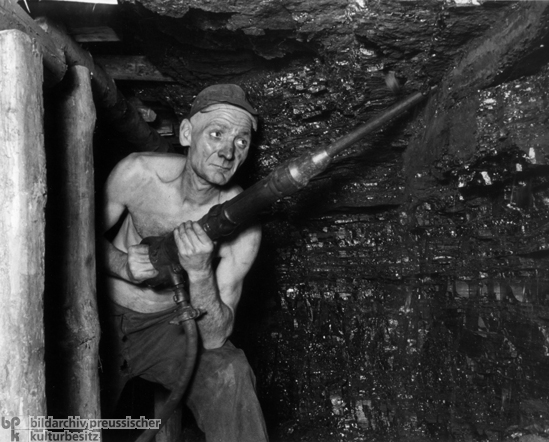 |
| Iconic picture of Adolf Hennecke used in propaganda. |
Richard Thaler’s Nobel, Silicon Valley and American Colossus
2017 Nobel prize for economics was awarded to American behavioral economist, a discipline that Marx and Stalin would despise if they were alive and opining, for the theory that people make irrational choices in economics. This comes close on the heels on the Nobel for economics awarded to, Daniel Kahneman for similar theories in behavioral economics.
No planned economy can mimic the effectiveness of a free market for transmission of information. Walmart learned, and profited from the knowledge, that before hurricanes it is not only flashlights that sell but also pop-tarts (http://www.nytimes.com/2004/11/14/business/yourmoney/what-walmart-knows-about-customers-habits.html ).
Soviet military did conduct a lot of research and so did the US military establishment. Key difference was that the latter collaborated with academia and private sector and unleashed creativity at a scale that the Soviet regime or Communism never could. American capitalism is unique in its characteristics.
When FDR declared war on Japan the US military was under equipped worse than Netherlands. Limping out of the Great Depression FDR and the country had kept Big Business chafing under controls but at this moment of national crises the country turned to Bechtel and Henry Ford. Arthur Herman’s “Freedom’s Forge: How American Business produced victory in World War II” is a racy read that gives a good and easy understanding of why the Capitalist machinery still hums while the Communist machinery sputtered.
What do Amazon, Apple, HP and Microsoft have in common? They were all started in car garages by very young men. Facebook originated in a college dormitory. Sure, there’s a Steve Jobs in France or Germany or Uganda but only in America does that incognito become an icon of innovation. Only in America can a founder of a trailblazing company be fired, go out, make a mark elsewhere, be brought back in CEO again and finally invent three products that essentially remakes how the world lives. This is an eco-system that is not easily replicated elsewhere as the Soviets learned to their chagrin when they tried to create their own Silicon Valley. Silicon Valley cannot exist in a totalitarian system because Silicon Valley needs more than just a few intelligent men and money.
Jon Gertner’s ‘Idea factory: Bell Labs and the great age of American innovation’ gives a good idea of how government, private initiative and educational institutions form a symphony in the American economic system. NASA defeated USSR and today it appears a private individual, Elon Musk, is the hope of future for NASA. This is America.
The End of History
Stephen Kotkin in a blistering essay titled “Communism’s Bloody Century” wrote, “Marx’s demand to “abolish private property” was a clarion call to action—and an inexorable path to the creation of an oppressive, unchecked state.”
It is not an accident that all communist countries are dictatorships. Only dictatorship can achieve or strive to achieve a Marxist economy and no communist country that does not aspire to be a Marxist economy can call itself communist.
The trajectory of totalitarianism and command economy leading to ruins is not exceptional but the rule. What can reduce an oil rich state like Venezuela to ruins and beggary? Only Marxism could and it did. What can keep a state like Cuba in pathetic penury where its citizens brave an ocean to escape to plenty? Only Marxism. Is it any wonder that in Venezuela and Cuba there’s no democracy to speak of.
It is beyond silliness to see Marxists prattle that Capitalism is exploitative. 14 million illegal immigrants live, mostly Mexicans, in US and several million legal immigrants from all corners of the world, mostly socialist or communist countries like India. What draws them to the shores of the US? They see, as I did and still do, that the US has ladders of opportunities. Certainly the US is not paradise. In fact I don't want it to be a paradise because what I think of as paradise maybe Hades to another and vice-versa.
An exploitative system cannot produced a $19 Trillion economy, be a magnet to immigrants, dominate academic rankings, lead the world in research and literary and artistic output. What was the intellectual output, artistic and scientific, from Communist hellholes? If anything the intellect and its tap root, individualism, were crushed by the inexorable wheels of Communism. It is not for nothing that Ayn Rand located the individual as the Fountainhead of free market.
Marxists often scoff at the notion of characterizing American economic structure as ‘free market’ and they justifiably point to how government help, tax code help corporations receive. The beauty of free market is nations have created their own versions of it that mirror local culture. Germany, Canada, England and US have all created their own versions of free market and of course the US is indeed the most free of all. The charm of free market is that it is not, like Marxism, a religious orthodoxy.
 |
| Statue of Lenin being removed in Lithuania on August 23rd 1991 |
The collapse of Soviet Union and Marxist economics resolved the debate about the kind of political structure a peaceful society desirous of prosperity should adopt - Liberal democracy and Free Market. They both reinforce each other and though one can exist without another it is the combination that creates the best result.
References:
- https://www.nytimes.com/2017/06/09/books/review/lenin-on-the-train-catherine-merridale.html
- https://en.wikipedia.org/wiki/Philosophers%27_ships
- Soviet Exhibition Reported by David Remnick https://www.washingtonpost.com/archive/politics/1989/12/04/meanwhile-soviets-view-a-hit-parade-of-shoddy-goods/90668fa0-298f-40c3-b916-161832ddec67/?utm_term=.11197834337a
- Polish People's Republic (Poland under Soviet Occupation) https://en.wikipedia.org/wiki/Polish_People%27s_Republic#Economy
- Red Plenty -- Essay by Francis Spufford in Guardian https://www.theguardian.com/books/2010/aug/07/red-plenty-francis-spufford-ussr
- Lenin’s Tomb: The Last Days of the Soviet Empire — David Remnick (Pulitzer)
- Dead Hand: The untold story of the Cold war arms race and its dangerous legacy - David Hoffman (Pulitzer)
- Lenin - Louis Fischer (National Book Award)
- The Haunted Land: Facing Europe’s ghosts after communism — Tina Rosenberg (Pulitzer and National Book Award)
- Iron Curtain: The crushing of Eastern Europe 1944-56 — Anne Applebaum (National Book Award finalist)
- Red Plenty - Francis Spufford
- Lenin’s private war: The voyage of the philosophy steamer and the exile of the intelligentsia - Lesley Chamberlain
- Krushchev: The Man and his era — William Tubman (Pulitzer)
- Lenin, Stalin and Hitler: The age of social catastrophe - Robert Gellately
- The Cheka: Lenin’s political police — Leggett
- The God that failed — Edited by Richard Crossman
- The Captive mind - Czeslaw Milosz
For Further Reading:
- Karl Marx: Greatness and Illusion — Gareth Stedman
- Karl Marx: A Nineteenth century life — Jonathan Sperber
- The Opium of the intellectuals — Raymond Aron
- A peoples tragedy - Orlando Figes
- Stalin (Volume 1 & 2) - Stephen Kotkin
- The Fellow Traveler - David Caute
- A Memoir - Andre Sakharov.
- Untimely thoughts - Maxim Gorky
- Harvest of Sorrow - Robert Conquest
- Gulag - Anne Applebaum
- Voices from Chernobyl: The oral history of a nuclear disaster —Svetlana Alexeivich
- Kolyma Tales -- Varlam Shalamov
Fiction
- Darkness at noon- Arthur Koestler
- Animal Farm - George Orwell
- 1984 - George Orwell
- Unbearable lightness of being - Milan Kundera


