Sunday, October 2, 2016

இந்தியாவின் நாற்றங்கால், காந்தி. செல்வந்தர்களின் செல்லப் பிள்ளையா? நீலகண்டனுக்கு மறுப்பு

காந்தியும் நேருவும் "பணத்தில் கொழித்துப் புரண்ட" குடும்பங்களில் இருந்து வந்து காங்கிரஸ் தலைமைக்கு வந்ததிலிருந்து இரண்டாம் நிலைத் தலைவர்கள் உருவாகாத "மலட்டுத் தன்மை" உருவானது என்று அரவிந்தன் நீலகண்டன் தன் கட்டுரை ஒன்றில் எழுதியுள்ளார். மதிமாறன் எனும் திராவிட இயக்கத்தவர் காந்தியின் உடை ஒரு காஸ்டியூம் என்று பேசியதை மறுத்து எழுதிய போது நான் நீலகண்டன் போன்ற இந்துத்துவர்களின் அவதூறையும் சுட்டிக் காட்டினேன். இன்று காந்தி ஜெயந்தி ஆகவே விரிவான மறுப்புரை.

கருணாநிதிகளையும் நரேந்திர மோடிகளையுமே பார்த்துப் பழகிய கண்களுக்கும் மனங்களுக்கும் காந்தியையும் நேருவையும் புரிந்து கொள்ளும் அறிவுத் திறன் இல்லாதது ஆச்சர்யமல்ல. காந்தி எப்படித் தலைமைப் பொறுப்புக்கு வந்தார் என்ற வரலாறைப் பின்னோக்கிப் பார்த்தல் அவசியம்

அரசியல் அனாதையான காந்தி

ஜனவரி 9 1915 காந்தி மும்பை வந்தடைந்தார். அவருக்குக் கோலாகலமான வரவேற்பு கொடுக்கப்பட்டது தென்னாப்பிரிக்காவில் அவர் ஆற்றிய தொண்டுகளுக்கு மதிப்பளித்து. வரவேற்புகளும் புகழுரைகளும் காந்தியைச் செல்லுமிடமெல்லாம் தொடர்ந்தன. நெடுங்காலமாக இந்தியாவில் வாழாதக் காரணத்தால் இந்தியாவை முதலில் அறிந்து கொள்ளும் வரை மவுனம் காக்கும்படி கூறிய கோகலேவின் கட்டளையை ஏற்றுக் காந்தி அரசியல் தளத்தில் மவுனம் காத்தார். அரசியலில் ஈடுபடாவிடினும் சமூகப் பணியாற்ற விழைந்த காந்தி கோகலே நடத்திய 'ஸர்வண்ட்ஸ் ஆப் இந்தியா'வில் இணைய விண்ணப்பித்தார். கோகலேவின் தோழர்கள் காந்தி சேருவதை விரும்பவில்லை. விண்ணப்பம் ஏற்கப் படவில்லையென்றாலும் பணியாற்ற விரும்பிய காந்தி சங்கத்தின் கழிப்பறையைச் சுத்தம் செய்ய ஆரம்பித்தார். துணுக்குற்ற கோகலே காந்தியை தடுத்தார். பின்னர் ஆசிரமம் தொடங்க காந்தி எத்தனித்த போது கோகலே தன் சங்கத்திலிருந்து பண உதவி செய்யப் படும் என்றார். ஆனால் ஒரே மாதத்தில் கோகலே இறந்தார். தலைமைப் பொறுப்பேற்ற ஸ்றீனிவாச சாஸ்திரியும் ஏனையோரும் காந்தியிடம் சங்கத்தின் விதிகளின் படி ஒரு வருடம் இந்தியா முழுதும் சுற்றுப் பயணம் செய்ய வேண்டுமென்றனர். அதை ஏற்றுக் காந்தி இந்தியச் சுற்றுப் பயணம் மேற்கொண்டார். "பணத்தில் கொழித்துப் புரண்ட" குடும்பத்தில் பிறந்தவர் ரயிலில் மூன்றாம் வகுப்பில் பணித்தார். அவ்வகுப்புக் கழிப்பறைகளில் மலம் கனுக்கால் வரை தேங்கி நிற்கும் அவலைத்தைப் பின்னர்க் காந்தி எழுதினார். அந்நாட்களில் சென்றவிடமெல்லாம் கொண்டாடப் பட்டாலும் எந்த இயக்கமும் காந்தியை ஏற்கத் தயாரில்லை. காந்தி அரசியல் அனாதையாக உலா வந்த காலம் அது.


தமிழகம் வந்த ஏழை தேசாந்திரித் தம்பதி. மாயவரம் உரை.

பார்ப்பதற்கு வடக்கிலிருந்து வந்த ஏழை தேசாந்திரிகள் போல் துணி மூட்டையுடனும், கசங்கிய உடையிலும் ரயிலின் மூன்றாம் வகுப்பில் இருந்து காந்தியும் கஸ்தூரிபாவும் சென்னை புகை வண்டி நிலையத்தில் இறங்கினார்கள் என்கிறார் டி.ஜி. டெண்டுல்கர். ஜி.ஏ. நடேசன் வீட்டில் ஒதுக்கப்பட்ட அறையில் மேஜை, நாற்காலி, படுக்கை என்று ஏற்பாடாகியிருந்தது அவற்றை அப்புறப் படுத்த சொன்னார் காந்தி.

டெண்டுல்கரின் புத்தகத்தில் காணப்படும் உரைகளின் தமிழாக்கம் "தமிழ் நாட்டில் காந்தி' எனும் புத்தகத்தில் கிடைக்கிறது. ஏப்ரல் 21 1915 நடந்த வரவேற்பில் தமக்களிக்கப் பட்ட புகழுரைகளை மறுதலித்த காந்தி தென்னாப்பிரிக்கப் போராட்டங்களில் உயிர் நீத்த தமிழர்களை நினைவுக் கூர்ந்து "அந்தப் பெரிய மனிதர்களுக்கும் மாது சிரோன்மணிகளுக்கும் நான் உணர்வூட்டியதாக நீங்கள் கூறீயிருப்பதை நான் ஏற்க முடியாது. நம்பிக்கையுடன் எவ்விதமான பலனையும் எதிர்பாராது பணியாற்றிய அந்த எளிய மக்கள் தான் எனக்கு உணர்வூட்டியவர்கள்". அன்றும் இன்றும் இப்படித் தனக்கான புகழுரைகளை மறுத்த தலைவர்கள் சொற்பம். காந்தியின் அடியொற்றி வந்த நேரு அத்தைகயப் பண்பாளராக இருந்தார். அது அவர் காந்தியிடம் பயின்றது.

சென்னையில் அன்னி பெஸண்ட் அம்மையாரின் ஸ்தாபனங்களைக் கண்ட காந்தி ஸ்தாபனத்துக்குரிய கட்டிடங்கள் படாடோபமாகவும் 'பஞ்சமர் பள்ளி' தகரக் கொட்டகையில் இயங்குவதையும் கண்டு வெகுண்டார். பின்னர் மாயவரத்தில் பேசிய காந்தி தீண்டாமை பற்றிக் கடுமையாகப் பேசினார்.

"தங்களுடைய தற்கால நிமைமை பூர்வீகத் தவபலத்தால் தலைமுறை தத்துவமாய்க் கிடைத்தது என்று பிராமணர்கள் சொல்வார்களேயானால் அவர்களே தேசத்தை நாசமாக்கும் பாவிகளாவார்கள்...வெளிநாடுகளில் இருந்து கொண்டு நான் இந்து மதத்தைப் பற்றி அறிந்த வரை தாழ்த்தப்பட்டோர் முதுகில் ஏறி உட்காருவது இந்து மதமல்ல என்றே தெரிந்தது. இது தான் இந்து மதம் என்று என்னிடம் மெய்ப்பிக்கப்பெற்றால், நான் அதன் பகிரங்க விரோதியாவேன்."

காந்தியின் கருத்துகளை வெறும் பேச்சுகள் என்று ஒதுக்கிவிடக் கூடாது. காந்தியைப் போலல்லாது ஏழமையில் பிறந்த திலகர் பெண்கள் கல்வி, குழந்தைகளை மணம் செய்விப்பது, தாழ்ந்த சாதியினரின் கல்வி என்று ஒன்று விடாமல் எல்லாவற்றிலும் அதி தீவிர சநாதன இந்துவாகவே இருந்தார் என்பது குறிப்பிடத் தக்கது. ஏழ்மையில் பிறந்தார்களா செல்வம் கொழிக்கும் குடும்பங்களில் பிறந்தார்களா என்பதல்ல முக்கியம் என்ன வாழ்க்கை வாழ்ந்தார்கள் யாருக்காகப் பேசினார்கள் எதன் பொருட்டுப் போராட்டங்களை முன்னெடுத்தார்கள் என்பது தான் முக்கியம். ஒரு புறம் சநாதனம் பேசிய திலகர் இன்னொரு புறம் பிராமணீயத்தை தேசிய விழுமியங்களாக முன்னிறுத்திய பெஸண்ட் இவர்களிடையே எல்லோரும் கொண்டாட விரும்பிய ஆனால பின்பற்றத் தயாரில்லாத காந்தி.

மேலும் பேசிய காந்தி "இங்கே வரவேற்புரை ஆங்கிலத்தில் இருந்தது. காங்கிரஸ் மாநாட்டில் சுதேசிக் கொள்கையை ஆங்கிலத்தில் பிரகடனம் செய்கின்றார்கள்....நான் ஆங்கிலத்திற்கு எதிரியல்ல ஆனால் பிராந்திய மொழிகளின் சமாதியின் மீது ஆங்கிலம் எழுப்பப்படுமானால் நீங்கள் உண்மையான சுதேசித்தன்மையை ஆதரிக்கவில்லை என்பேன்". காந்திக்குப் பிறகு தான் காங்கிரஸில் பிரதேச மொழிகளில் நிகழ்ச்சிகள் நடத்தப்பட்டன என்பதை நினைவில் கொள்ள வேண்டும். காங்கிரஸை மையப்படுத்தப் பட்ட ஸ்தாபனமாக இருந்ததைப் பிரதேசக் கிளைகள் திறக்கச் செய்து பிரதேச மொழிகளில் நிகழ்ச்சிகள் நடத்த வைத்து எல்லாத் தளத்திலும் தேர்தல் மூலம் தேர்ந்தெடுக்கப் பட்டத் தலைவர்கள் மலரக் காரணம் காந்தியே.

"காந்தி, உட்கார்" வாரணாசியில் மோதிய காந்தியும் அன்னி பெஸண்டும்

பிப்ரவரி 4 1916 வாரணாசி இந்துப் பல்கலைக் கழகத் திறப்பு விழாவில் அன்னி பெஸண்டுடன் பேச அழைக்கப் பட்ட காந்தி வைஸ்ராயும், ராஜா ராணிகளும் செல்வந்தர்களும் வீற்றிருந்த மேடையில் சன்னதம் செய்தார்.

"விஸ்வநாதர் ஆலயத்திற்குச் சென்றேன். அக்கோவில் இருக்கும் தெரு அசுத்தமாக இருக்கிறது. இது சரியா? இந்துவாக வலியோடு பேசுகிறேன். நம் கோவில்களே சுத்தத்திற்கும் விசாலத்திற்கும் எடுத்துக் காட்டாக இல்லாமல் போனால் நாம் அமைக்கப் போகும் சுயராஜ்ஜியம் எப்படி இருக்கும்?"

போலீஸ் பாதுகாப்போடு வளைய வந்த வைஸ்ராயை, "இப்படி வாழும்போதே செத்துக் கொண்டிருப்பதை விட வைஸ்ராய் செத்து விடலாம்". தீவிரவாதிகளின் மன நிலை புரிந்து கொள்ளக் கூடியது என்றார் காந்தி. சினத்தின் உச்சிக்குச் சென்ற பெஸண்ட் "காந்தி, உட்கார்" என்று ஆணையிட்டார்.

சம்பரான் போராட்டமும் காந்தி தலைமை நோக்கி நகர்ந்ததும்

கோகலேவின் மறைவுக்குப் பிறகு 1916-இல் கூடிய லக்னோ காங்கிரஸ் மாநாட்டில் திலகர் மீண்டும் காங்கிரஸில் இனைந்தார். ஒரு புறம் முஸ்லீம்களூடனான ஒப்பந்தம், திலகர் இனைப்பு, தீர்மானங்கள் என்று மாநாடு முக்கியத்துவம் பெற்ற போது அங்கே எந்தத் தலைமைப் பொறுப்பிலுமில்லாத காந்தியை ஓர் ஏழை விவசாயி அனுகினான்.

வடக்கே நேபாளத்தை ஒட்டிய பீகார் மாநிலத்தைச் சார்ந்த சம்பரான் எனும் கிராமத்து விவசாயிகளின் கண்ணீர் கதையைக் காந்தியிடம் சொன்னான் அந்த விவசாயி. அம்மாநாட்டில் குழுமியிருந்த அத்தனை தலைவர்களிடமும் செல்லத் துணியாத அந்த விவசாயி காந்தியை, ஒரு குஜராத்தியை, அணுக முடியும் என்று யாரோ சொன்னதைக் கேட்டு அவ்வாறே செய்கிறான்.

சம்பரான் போராட்டம் பற்றி அறிய சிறந்த புத்தகம் ஜூடித் பிரவுன் எழுதிய "Gandhi's Rise to Power: Indian Politics 1915-1922". காந்தியின் தலைமை மலட்டுத் தன்மை வாய்ந்தது என்று விஷம் கக்கும் நீலகண்டன் போன்றோர் படிக்க வேண்டிய புத்தகம் அது.

ராஜேந்திர பிரசாத், கிருபளாணி என்று ஒரு சிறு அணி ஏற்கனவே சம்பரானில் இயங்கி வந்தது. தொண்டாற்றும் வழக்கறிஞர்கள் காசு பெறலாகாது என்று அவர்களுக்குக் காந்தி உணர்த்தினார். பின்னர்த் தான் சிறை செல்லத் தயாராக இருப்பதாகச் சொல்லி "எனக்குப் பிறகு இப்போராட்டத்தை யார் முன்னெடுத்துச் செல்வீர்கள் என்று வினவினார்". "நீங்கள் சிறைக்குச் சென்று விட்டால் அதன் பிறகு எங்களுக்கு இங்கென்ன வேலை நாங்கள் எங்கள் ஊருக்குப் போய் விடுவோம்" என்றார்கள் அந்த வழக்கறிஞர்கள். பதிலைச் சொன்னப் பிறகு தான் காந்தி எதிர்ப்பார்ப்பது அவரைப் பின் தொடர்ந்து தாங்களும் சிறைச் செல்லத் தயாராக வேண்டுமென்பதே. உண்மை உரைத்த தொண்டர்கள் இசைந்தனர்.

பிரவுன் சொல்கிறார், "சம்பரான் போராட்டத்தின் போது காந்தி அக்கிராமத்தின் உயர் குடியினரின் தொடர்பை தவிர்த்தார்". "காந்தியின் முக்கியமான உதவியாளர்கள் நடுத்தர வர்க்க படித்தவர்களும் குக்கிராமங்களிலுள்ள சிறு வியாபாரிகளும்". ஒரு வெகுஜனப் போராட்டத்தில் முரன்பாடுகளுடைய தூய எண்ணமற்றவர்களும் இணைவார்கள் அவர்களையும் ஒதுக்காமலே தான் முன் செல்ல வேண்டுமென்று காந்தி உணர்ந்திருந்தார்.

காந்தியின் போராட்ட முறைகளைப் பற்றிப் பிரவுன் ஒரு வித வியப்புடனே விவரிக்கிறார். சம்பரானை ஒரு விவசாயப் போராட்டமாக மட்டுமே காந்தி முன்னிறுத்தினார். அதில் எவ்விதமான விடுதலைப் போராட்டத்தின் சாயலையும் அவர் அனுமதிக்கவில்லை ஏனென்றால் அது பிரச்சினையைத் திசை திருப்பி விடுமென்பதால். பத்திரிக்கைகளுக்குச் செல்லும் செய்திகளைக் கவனமாக ஒழுங்குப் படுத்தினார். போராட்டத்திற்கு விளம்பர வெளிச்சம் தேவைப் படும் போது மட்டும் செய்திகளை ஊக்குவித்து மற்ற நேரங்களில் செய்திகள் பரவுவதையோ அவை போராட்டத்தின் தன்மையைச் சிதைத்துவிடுவதையோ தடுத்தார். பிரசாத்தும், கிருபளானியும் ஆயிர கணக்கான விவசாயிகளிடம் நேர்முகம் நடத்தி ஆய்வறிக்கையைத் தயார் செய்தனர். காந்தியும் அவர் குழுவும் அதற்கு முன்னர் எந்த அரசியல் வாதியும் செல்லாத குக்கிராமங்களுக்குச் சென்றனர். காங்கிரஸில் இதற்கு முன்னர் யாரும் இப்படிச் செய்ததில்லை.

காந்தி எப்போதும் முழுமையான விடுதலை நோக்கி நகர்தலையே விரும்பினார். சம்பரானில் வெறும் விவசாயக் கஷ்டங்களை நிவர்த்திச் செய்வது என்பது அவர் வழியல்ல. அம்மக்களின் வறுமை அவரை வருத்தியது. பள்ளிகள் நிறுவினார், அதற்குத் தன்னார்வலர்களைச் சேர்த்தார். மக்கள் அழுக்கையே உடுத்துவது கண்டு சுத்தமான உடைகள் அணிய வேண்டுமென்றார். கஸ்தூரிபாவை தன் குடிசைக்கு அழைத்துச் சென்ற ஓர் ஏழைப்பெண்மணி தன்னிடம் இருப்பதே ஓர் ஆடை தான் ஆகவே துவைத்து வேறு உடை அணிய முடியாதென்று காட்டி கலங்க வைத்தார். காந்திக்கு முன்பிருந்த அரசியல் வாதிகள் யாரும் இது பற்றியெல்லாம் அறிந்ததுமில்லை இவற்றைப் பொருட்படுத்தியதுமில்லை.

திலகர் இந்திய வரலாற்றில் முக்கியப் பங்காற்றினார் என்பது மறுப்பதற்கில்லை. ஆனால் காந்தியே முதன் முதலில் சுதந்திரம் என்பது வெறும் காலணியாதிக்கத்திடமிருந்து விடுதலைப் பெறுவதல்ல மாறாகச் சமூகமும் அதை உருவாக்கும் தனி மனிதனும் விடுதலையடை வேண்டுமென்று அதற்காகத் தன் வாழ்க்கையை அர்ப்பனித்தார். திலகர் சிறைச் சென்ற காலங்களில் சிறைகள் மனிதத் தன்மையற்றவையாக இருந்தது உண்மை ஆனால் திலகர் ஒன்றும் வெகுஜனப் போராட்டத்திற்காகச் சிறைச் செல்லவில்லை என்பதும் கசப்பான உண்மை. காந்திக்கு முன் எத்தனை வெகுஜனப் போராட்டங்களைக் காங்கிரஸ் முன்னெடுத்தது? காந்திக்குப் பின் எத்தனை?

சாதாரணப் பிரதேசத் தொண்டனாக இருந்த பிரசாத் பின்னர்த் தேசத் தலைவரானார். சம்பரானைத் தொடர்ந்து குஜராத்தில் கேதா மற்றும் அகமெதாபாத் ஆகிய இடங்களில் தொழிலாளர்கள் சார்பில் முக்கியமான போராட்டங்களை முன்னெடுத்தார். குஜராத்தில் இப்போராட்டங்களில் காந்திக்குத் துணையாக இருந்த பின்னாளில் சர்தார் என்று பெயரெடுத்த வல்லபாய் பட்டேல். வரலாற்றில் சீஸரும் அலெக்ஸாந்தரும் இத்தனை தளபதிகளை உருவாக்கியதில்லை. அமெரிக்கச் சுதந்திர வரலாற்றில் வாஷிங்டன் யாரையுமே உருவாக்கவில்லை என்று சொல்லலாம். ருஷ்யப் புரட்சியும் அப்படியே. இந்திய சுதந்திரப் போராட்டத்தில் உருவான அளவு இரண்டாம் நிலை தலைவர்கள் வேறெங்கும் வேறெப்போதும் உருவானார்களா என்பது சந்தேகம். அப்படி உருவானவர்கள் எல்லோரும், காந்தியை எதிர்த்தவர்கள் உட்பட, காந்தியோடும் அவர் உருவாக்கியச் சூழலோடும் தொடர்புடையவர்களே.

1919-20 நெருங்கிய போது பிரசாத் என்ற பீகாரி, நேரு என்ற காஷ்மீரி, ராஜாஜி என்ற தமிழர், பட்டேல் என்ற குஜராத்தி, கிருபளானி, மகாதேவ் தேசாய் என்று தேசம் தழுவிய முரன்பாடுகளுடைய ஒரு பெரும் கூட்டம் காந்தியின் பின் அணிவகுத்து நின்றது. பஞ்சாப் படுகொலைக்குப் பிறகு 1920 ஆகஸ்டு 1-ஆம் தேதி மாபெரும் சத்தியாகிரகப் போராட்டத்தை அறிவித்திருந்தார் காந்தி. அதே நாளில் திலகர் மறைந்தார். அதன் பின் முப்பதாண்டு காலம் காந்தி இந்தியாவில் விஸ்வரூபமெடுத்தார் என்றால் மிகையாகாது.

போலீஸ் தடியடியில் காயம்பட்ட ஜவஹர்லாலும் ஸ்வரூப் ராணியும்

நேரு குடும்பத்தினரின் செல்வ செழிப்பு மிகுந்த காழ்ப்புகளுக்கு உள்ளாகியிருக்கிறது. இழப்பதற்கு எதுவுமில்லாதவர்களின் தியாகம் மெச்சத் தக்கது. ஆனால் இழப்பதற்கு நிறைய இருந்து அவற்றை இழக்கத் தேவையில்லாதவர்கள் போராட்டங்களில் ஈடுபட்டு இழப்புகளைச் சுமந்ததும் வணங்கத் தக்கதே. சுதந்திரத்தின் பின் நேருவும் அவர் தங்கையும் அடைந்த புகழும் அதிகார பீடங்களில் அமர்ந்ததும் பலருக்கு இன்றும் ஒவ்வாமையைத் தருகிறது. நேரு குடும்பத்தினர் செல்வ செழிப்போடு கோட்டும் சூட்டும் போட்டுக் கொண்டு இருக்கும் புகைப்படத்தை வெளியிட்டு தன் அரிப்பைத் தீர்த்துக் கொள்ளும் நீலகண்டன் அவர்கள் பின்னாளில் காந்தியினால் ஈர்க்கப்பட்டு இந்திய உடைகளைத் தரித்ததும் சிறைச் சென்றதும் போலீஸ் தடியடிகளில் காயம் பட்டதையும் சேர்த்திருக்கலாம். ஆனால் அதெற்கெல்லாம் ஓர் அடிப்படை நேர்மை வேண்டுமே.

போலீஸ் தடியடியில் அடி வாங்கியது பற்றி நேரு ஓர் அத்தியாயமே எழுதியிருப்பார் தன் சுயசரிதையில். தான் அடிப்பட்டதைப் பிரலாபிக்கும் நோக்கத்தில் எழுதவில்லை மாறாக ஒரு இளைஞனாகத் தான் திருப்பி அடிக்கும் உணர்வைக் கட்டுப் படுத்தியதையும் அத்தகைய வன்முறைகளை எதிர் கொண்ட மன நிலையையும் விவரித்திருப்பார் நேரு. நேருவின் அம்மா ஸ்வரூப் ராணி செல்வ சீமாட்டி அவரும் வீதிக்கு வந்து போராடுகிறார் அதுவுமில்லாமல் தடியடியில் காயப்பட்டார். காந்தி எவ்வகையான குடும்பத்தில் பிறந்தார் என்பதை விட இங்கே நாம் ஆச்சர்யப்பட வேண்டியது பல செல்வந்தர்களும், செல்வம் ஈட்டும் கல்விப் பெற்றவர்களும் அதையெல்லாம் துறந்து துயர் அனுபவிக்கத் தயாரானது தான். அதுவும் வசதியான வீட்டுப் பெண்கள் போராட்டங்களில் ஈடுபட்டது மாபெரும் புரட்சி. கேதா போராட்டத்தில் மண் சுமந்த அனுசுயா பென் பணக்கார முதலாளியின் பெண்.

நேருக் குடும்பத்தில் சிறைச் செல்லாத பெண்ணே கிடையாது. சிறைவாசத்தின் நடுவே நோய்வாய்ப்பட்ட தன்னைக் காணவந்த நேரு சிறைக்குத் திரும்பிச் செல்லும் முன் அவரைத் தன்னருகே அழைத்து ஈனஸ்வரத்தில் "அரசாங்கத்திற்கு ஏதும் உத்தரவாதம் கொடுத்து விடாதீர்கள்" என்று கூறுகிறார் எங்கே தன் கணவன் தன் பொருட்டு மண்டியிட்டுவிடுவாரோ என அச்சப்பட்டு. நேரு தன் வாழ்நாளில் கிட்டத்தட்ட ஒன்பது வருடங்கள் சிறையில் கழித்தார்.

வன்முறைக்கு எதிர்வினை வன்முறையல்ல என்ற கருத்துடைய ஷெல்லியின் "மாஸ்க் ஆப் அனார்க்கி" (Mask of Anarchy) காந்திக்கும் நேருவுக்கும் உவப்பான ஒரு கவிதை. இருவரும் அதை மேற்கோள் சொன்னதுண்டு.

And if then the tyrants dare
Let them ride among you there,
Slash, and stab, and maim, and hew,-
What they like, that let them do.

'With folded arms and steady eyes,
And little fear, and less surprise,
Look upon them as they slay
Till their rage has died away.

தடியடியில் ஏற்பட்ட காயத்தின் விளைவாக லாலா லஜபதி ராய் இறக்கவும் நேர்ந்தது. "தண்ணீர் விட்டோ வளர்த்தோம் சர்வேசா" என்று பாரதி ஆருடமாக எழுதினான்.

காந்தி-பிர்லா உறவு: செல்வந்தர்களும் காங்கிரஸும்

அகாகான் மாளிகையில் சிறைவாசம் இருந்ததையும் கடைசி நாட்களில் பிர்லா மாளிகையில் தங்கி இருந்ததையும் வைத்தே காந்தி என்னமோ செல்வந்தர்களின் செல்லப் பிள்ளையாக இருந்தது போலவும் காங்கிரஸை மிட்டா மிராசுகளுக்குத் தாரை வார்த்தார் என்றும் திமுக மேடைகள் முதல் இந்துத்துவ முகாம்கள் வரை ஒரு அவதூறு பரப்பப்படுகிறது.

"In search of Gandhi" என்ற புத்தகத்தில் பி.ஆர்.நந்தா இந்த அவதூறை திட்டவட்டமாக மறுப்பதுடன் இந்திய முதலாளிகளுடனான காந்தியின் உறவு பற்றி அழகான கட்டுரை ஒன்றைத் தருகிறார்.

இந்திய முதலாளிகள் காங்கிரஸை பயன்படுத்திக் கொண்டது தான் அதிகம் காங்கிரஸ் அவர்களைப் பயன் படுத்திக் கொண்டதை விட. சுதேசி தொழிற்சாலைகளின் பாதுகாப்பிற்காகக் காங்கிரஸின் உதவியை நாடி அதில் பயனும் பெற்ற பிறகு தேர்தல் நிதி கோரிய மோதிலால் நேருவிடம் அகங்காரத்தோடு காந்தி உட்பட மற்ற காங்கிரஸ் தலைவர்களோடு நேர்முகம் வேண்டும் என்று கேட்டபோது மிகக் கடுமையான கடிதமொன்று எழுதி மறுத்தார் மோதிலால் நேரு.

ஜம்னாலால் பஜாஜ் போன்று விரல் விட்டு எண்ணக் கூடிய அளவே முதலாளிகள் காங்கிரசிற்கு உதவினர். பிர்லா தன் உறவு காந்தியோடு தான் காங்கிரசோடு அல்ல என்பதை அரசுக்குத் தெளிவுப் படுத்தினார். 1920 ஒத்துழையாமை இயக்கம் ஆரம்பித்த போது டாடா உட்படப் பல முதலாளிகள் இயக்கித்திற்கு உதவ மறுத்ததோடு எதிர் அணியையே துவக்கி மும்முரமாக எதிர்த்தனர். பின்னாளில் ஜவஹர்லால் நேரு, பூலாபாய் தேசாய், கோவிந்த் பல்லப் பந்த் ஆகியோர் நிதித் திரட்ட செல்வந்தர்களை அணுகியபோது கல்லில் நார் உரிப்பதை விட அதிகம் கஷ்டப்பட்டனர்.

காந்தி எப்போதும் தில்லியில் சேரிகளில் தான் தங்குவார். ஜனவரி 1948-இல் கலவர பூமியான தில்லியில் சேரியில் தங்குவது அங்கிருப்போருக்குச் சங்கடத்தை உண்டாக்கும் என்று தான் பிர்லா மாளிகையில் தங்கினார். காந்தி சேரியில் தங்கினால் அதிகாரிகளும், செல்வந்தர்களும் அங்கே சென்றனர்; மாளிகையில் தங்கினாலோ சாமான்யர்களும் அங்கே சென்றனர். காந்தி எங்கே தங்கினாலும் அதைச் சமத்துவப் பூங்காவாக்கினார் என்பது தான் முக்கியம்.

விவிலியத்தில் பணக்காரன் கொடுக்கும் கொடையை விட ஏழைப் பெண்மனி கொடுக்கும் கொடையே சிறந்தது என்பார் இயேசு. இயேசு என்பவர் வாழ்ந்தாரோ இல்லையோ காந்தி என்பவர் வாழ்ந்தார்.

'காந்தியின் வருகை' - நேரு

ஜவஹர்லால் நேரு "டிஸ்கவரி ஆப் இந்தியா" (Discover of India) புத்தகத்தில் காந்தியின் வருகை எத்தகைய மாற்றத்தை உண்டுப் பண்ணியது என்று அவருக்கேயுரிய நுண்ணுணர்வுடன் விவரித்தது எனக்கு பத்தாம் வகுப்பில் ஆங்கிலப் பாடம்.

"He was like a powerful current of fresh air that made us stretch ourselves and take deep breaths; like a beam of light that pierced the darkness and removed the scales from our eyes; like a whirlwind that upset many things, but most of all the working of people's minds. He did not descend from the top; he seemed to emerge from the millions of India, speaking their language and incessantly drawing attention to them and their appalling condition.....The greatest gift for an individual or a nation, so we had been told in our ancient books, was abhaya, not merely bodily courage but the absence of fear from the mind....against all pervading fear that Gandhi's quiet and determined voice was raised: Be not afraid.

Gandhi influenced millions of people in India in varying degree. Some changed the whole texture of their values, others were only partly affected, or the effect wore off; and yet not quite, for some part of it could not be wholly shaken off."

இன்றளவும் என் அரசியல் பார்வையை, அமெரிக்க அரசியலோ இந்திய அரசியலோ எதுவாயினும், காந்தியப் பார்வை ஆக்கிரமித்திருக்கிறது.


காந்தியின் எளிமைப் பற்றி ஜெயமோகன்

காந்தியின் எளிமைப் பற்றிய எள்ளி நகையாடல்களுக்கு பதில் சொல்லும் முகமாக ஜெயமோகன் எழுதியக் கட்டுரை முக்கியமானப் பார்வையை முன் வைக்கிறது. அக்கிட்டுரையில் நேருப் பற்றிய காழ்ப்பு மிகுந்த கருத்துகளை அவர் இன்றும் அப்படியே கொண்டுள்ளாரா என்றுத் தெரியாது அது முக்கியமுமல்ல. அக்கட்டுரையில் இருந்து ஒருப் பகுதி:

"காங்கிரசுக்கு காந்தி காலத்தில் கிட்டத்தட்ட நாலரை லட்சம் முழுநேர ஊழியர்கள் இருந்தார்கள். சம்பளம் பெறும் ஊழியர்கள்.  அவர்களுக்கு மாதம் எட்டணா ஊதியம் அளிக்கப்பட்டது. படுகேவலமான வறுமையில்தான் அவர்கள் வாழ்ந்தாக வேண்டும். வக்கீல்கள், ஜமீந்தார் பிள்ளைகள், பட்டதாரிகள் அந்த ‘வருமானத்துக்குள்’ வாழ்ந்து ஊர் ஊராகச் சென்று பணியாற்றினார்கள். வெறுந்தரையில் படுத்து இரந்து உண்டு கால்நடையாக அலைந்தார்கள். 

எண்ணிப்பாருங்கள், காந்திவரும்வரை காங்கிரஸில் அந்தப் பண்பாடு இருந்ததா? சட்டமேதைகளும் பேராசிரியர்களும் முதல்வகுப்பில் சென்று கட்சிகட்டிய காலம் அது. வருடம்தோறும் மாநாடு போடுவதற்கு அல்லாமல் எதற்கும் காங்கிரஸ் கூடாமலிருந்த காலம். [உண்மையில் காங்கிரஸ் என்ற பேரே மாநாடு என்ற பொருளில்  போடப்பட்டது. வெறுமெ கூட்டங்கள் நடத்துவதற்கு மேலாக காங்கிரஸை ஒருவெகுஜன இயக்கமாக ஆக்கும் நோக்கமேதும் முன்னோடிகளுக்கு இருந்ததில்லை.] எளிய மக்களுக்கும் அவர்களுக்கும் தொடர்பும் இல்லை. காந்தி எப்படி பலலட்சம் ஊழியர்களை கவர்ந்தார்? கோகலேயிடமும் திலகரிடமும் இல்லாத எது அவரிடம் இருந்தது? எளிமை. முன்னுதாரணமான எளிமை."

வரலாற்றுத் திரிப்பே தொழிலாக.

மதிமாறன் பெரியார் திடலில் விநியோகிக்கப்படும் துண்டறிக்கைகளைத் தாண்டி வேறெதுவும் படித்து விடக் கூடாதென்று கங்கணம் கட்டிக் கொண்டிருப்பவர். நீலகண்டன் அப்படியல்ல. அதனாலேயே நீலகண்டனுக்குப் பரவலாக ஒரு பிம்பம் உண்டு. நீலகண்டனின் பார்வைகளோடு ஒத்துப் போகாதவர்கள் கூட அவரை ஒரு ஆராய்ச்சியாளராக முன்னிறுத்துவதைக் கண்டிருக்கிறேன்.

அரவிந்தன் நீலகண்டனைப் போல் வரலாறைத் திரிப்பதற்கும், தேர்ந்தெடுத்த உண்மைகளின் (selective truth telling or half truths) துணைக் கொண்டு தன் தரப்பை நிறுவுவதற்கும், அடிப்படை நேர்மையைக் காற்றில் பறக்க விட்டு எழுதுவதற்கும் இனி ஒருவர் பிறந்து தான் வர வேண்டும். அவருடைய கட்டுரைகள் முதல் சமீபத்தில் வெளிவந்த 'இந்திய அறிதல் முறைகள்' வரை கொஞ்சம் நெருங்கி தகவல்களைச் சரி பார்த்தால் திரிபுகள் அம்பலம் ஆகும். ('இந்திய அறிதல் முறைகள்' குறித்து விரிவான விமர்சணம் அல்லது கட்டுடைப்புச் செய்ய உத்தேசம். காலம் கனிய வேண்டும்).

டான் அஷோக் என்னும் திமுக அனுதாபி ஒருவர் இன்று (காந்தி ஜெயந்தி) எழுதுகிறார் காந்தி சாதி ஒழிப்புக்குப் பாடு படவில்லையென்று. திமுக அனுதாபி அல்லவா திமுக மேடைப் பேச்சுகளைத் தவிர வேறொன்றும் படித்தறியாதவர் போலும். ஜோசப் லெலிவெல்ட் காந்தியின் தீண்டாமை ஒழிப்பு யாத்திரைப் பற்றி ஆச்சர்யம் பொங்க எழுதியுள்ளார். தன் வாழ்நாளெல்லாம் தீண்டாமைக்கெதிராக உழைத்தவர் காந்தி. 'பிராமணர்கள் நடு நடுங்க வேண்டும்' என்ற பிரகடணத்தோடு உதயமான ஜஸ்டிஸ் கட்சியின் தலைவர்களெல்லாம் தீண்டாமை ஒழிப்புக்கு என்ன செய்து கிழித்தார்கள் அவரவர் ஜாதியில் எல்லாம் தீண்டாமையை ஒழித்துச் சமபந்தி போஜனம் நடத்தி விட்டார்களா என்ன?

காந்தியை விமர்சிக்கவே கூடாதா என்று கேட்பவர்களுக்கு என் பதில் என்றும் "காந்தியே அவரின் முதல் விமர்சகர்". சம காலத்தில் காந்தி விமர்சிக்கப் பட்டார், சிலரால் முழுவதுமாக நிராகரிக்கவும் செய்யப் பட்டார்.

ஜூடித் பிரவுன் தொகுத்த "The Cambridge Companion to Gandhi" அற்புதமான கட்டுரைகளைக் கொண்டது. தனிகா சர்க்கார் என்பவர் துல்லியமாக "காந்திக்குச் சாமான்யனை நோக்கிப் பேசத் தெரிந்தது. ஆனால் அவர் எப்போதும் சாமான்யனுக்காகப் பேசினார் என்று சொல்ல முடியாது". நகர்புற வாழ்க்கை, நகர்புறத்தாரின் விழுமியங்கள் குறித்த காந்தியின் பார்வை, குஹா காந்தி பற்றி முன் வைத்த விமர்சனங்கள் ஆகியவற்றைச் சரமாகத் தொகுத்துள்ளார்.

நம் சமூகத்தில் இன்றும் அவதூறூக்கும் விமர்சனத்திற்கும் வித்தியாசம் தெரியாததே மிகப் பெரிய நோய்.

இந்தியாவின் நாற்றங்கால்

காந்தியை கடுமையாக விமர்சிக்கவும் நிராகரிக்கவும் செய்யலாம் ஆனால் அதில் ஒரு அடிப்படை நேர்மை வேண்டும். அது அரவிந்தன் நீலகண்டன், மதிமாறன் போன்றோரிடம் கிடையாது. காந்தியை நிராகரிப்பதில் இந்துத்துவர்களும் பெரியாரிஸ்டுகளும் கைக்கோர்த்தே செயல்படுகிறார்கள். திராவிட இயக்கத்தினரின் எழுத்துகள் புறங்கையால் எளிதாகத் தள்ளிவிடக் கூடியவை. இந்துத்துவர்களின் பிரச்சார உத்திகள் கோயபல்ஸையே பள்ளி மாணவன் தரத்தில் பின் தள்ளக் கூடியவை.

நியு ஜெர்ஸியில் உரையாற்றிய ஜெயமோகன் இந்திய இலக்கியத்தின் ஆளுமைகளுக்குக் காந்தி எப்படியொரு மைய ஈர்ப்பாக இருந்தார் என்று நிறுவி இந்திய இலக்கியத்தின் நாற்றங்கால் காந்தி என்றார். அதை இன்னும் நீட்டித்து இந்தியாவின் நாற்றங்கால் என்பது மிகப் பொறுத்தம்.


References:

1. அரவிந்தன் நீலகண்டனின் கட்டுரை http://www.tamilhindu.com/2013/11/tea2/
2. 'Mahatma' by D.G. Tendulkar Vol 1. Pages 156-234
3. 'The Life of Mahatma Gandhi' by Louis Fischer. Pages 157-176, 189-197
4. 'Gandhi's Rise to Power: Indian Politics 1915-1922' by Judith Brown. Pages 16-123
5. 'Jawaharlal Nehru' by Sarvepalli Gopal - Vol 1. Pages 172-193
6. 'Discovery of India' by Jawaharlal Nehru pages 358-359
7. 'In search of Gandhi: Essays and Reflections' by B.R. Nanda. Pages 124-138
8. 'தமிழ் நாட்டில் காந்தி' - அ.ராமசாமி pages 166-170
9. 'காந்தியின் எளிமையின் செலவு' - ஜெயமோகன் கட்டுரை http://www.jeyamohan.in/557#.V_Gwljvijoo
10. 'The Cambridge Companion to Gandhi' Edited by Judith Brown and Anthony Parel. Pages 173-199
11. Autobiography by Jawaharlal Nehru

Sunday, September 25, 2016

Hillary Clinton: A Role Model for Girls. Period

Hillary Rodham Clinton stands poised to make history and shatter, what she aptly called, the 'hardest glass ceiling' by becoming the first woman president of United States and yet women voters have not only been lukewarm to her candidacy but many even consider her in terms that are no less sexist than her male detractors, of whom there are legions. Sexism is a state of mind and has little to do with the gender of the detractor.

A group of women professionals shared a photograph of first ladies, current and former, and went gaga over Michelle Obama while omitting any mention of Hillary Clinton. These professionals, incidentally, also want to encourage, through mentorship, other women to aspire and achieve professional success which they feel needs training to surmount the odds of the working place where women are still seen as less than equals. Asked "what about Clinton" the response was "the jury is still out". This is stunning sexism and would be called out as such if a male had said it. Michelle Obama is a charismatic first lady and remains a traditional first lady espousing non-controversial feel good causes like combating obesity, a national epidemic, with feel good initiatives like growing a vegetable garden in the White House and by exhorting people to exercise more. On the other hand there's Hillary Rodham Clinton, former first lady, first woman senator from New York, first woman to win primaries in a major party, first woman nominee of a major party and former secretary of state. How could a group of strong willed independent minded women, especially those who run a group meant to promote women leadership, ignore Clinton and hold Obama higher? Sexism, albeit of a different kind from the readily recognizable one by males.

Whether it is 2008 or 2016 women in the democratic primaries did not flock to Clinton but they backed Obama and Sanders enthusiastically. In both cases Clinton was seen as not "progressive" enough compared to her rivals. This is not the place to litigate the merits or demerits of those arguments.

The Lady in the Pant Suit. Image courtesy http://cdn-img.instyle.com/sites/default/files/styles/622x350/public/images/2015/06/061715-hillary-clinton-pantsuits-lead.jpg?itok=LI0CvZMq


Lost in the din was the fact that while Clinton got no favors for being a candidate who could make history. She was rather held to a different standard, mostly because the candidate was Hillary Clinton and almost as frequently because it was a woman candidate.

Clinton has been in the national public eye for over 20 years since her husband got elected as president in 1992 and yet it was not until this year did the media unearth a little spoken of speech delivered by her in 1969. Clinton led a group of students and demanded from the dean of Wellesley that a student representative should be allowed to give a speech during Commencement. Clinton herself was the chosen speaker. Echoing FDR she said "Fear is always with us but we just don't have the time for it now. Not now". In her speech Clinton passionately spoke of poverty, student diversity and most importantly, rather shocking  to some, rebuked a sitting senator who was the Commencement speaker. Senator Edward Brooke, first African-American elected to the senate, cautioned against "coercive protests" in his speech. Clinton, ad libbed extemporaneous remarks to say "Part of the problem with just empathy with professed goals is that empathy doesn't do us anything" and she went on to say, in words that a Obama or a Sanders would later use, "for too long our leaders have viewed politics as the art of the possible. And the challenge now is to practice politics as the art of making what appears to be impossible possible". A young girl changed tradition at a hoary university and went beyond just rising up to the occasion and verbally dueled with a senator.

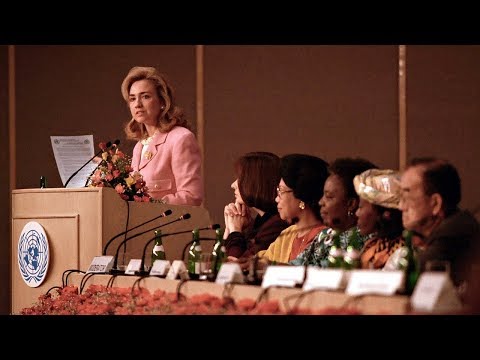
In 1995 Clinton gave a rousing classically feminist speech in Beijing that told the world "women's rights are human rights". It was, given the fragile state of US-China relations at that time, a gutsy speech and one that inspired many women.

"Women's Rights Are Human Rights" -- Hillary Clinton in UN Conference at Beijing in 1995
Today voters remember the Whitewater investigation, more appropriately it should be called witch hunt, as the start of the perpetual air of suspicion that would always hover above Hillary. What is less remember or completely unknown is Hillary redefined the role of a spouse of a politician in office. Not since Eleanor Roosevelt had a politician's spouse played a pivotal role in the administration. Whether as first lady of Arkansas or of the nation Hillary lived up to the promise of Bill, "two for the price of one". In Arkansas Hillary chaired the Education Standards Committee that literally reformed Arkansas schools to make them one of the nation's best from what used to be one of the worst.

Hillary Clinton and her campaign have not done a good job of introducing her to the voters. Bill Clinton's speech about his wife in the Democratic convention provided a sweeping view of the person Hillary was. As a Yale student Hillary involved herself in laws regarding child abuse, migrant labor and legal assistance for the poor.  She went on to write an oft cited article in Harvard Law Review titled "Children under the law".

When Bill Clinton lost the 1982 gubernatorial election he became, as he joked, 'the youngest ex-governor'. Hillary worked to get him rehabilitated and in response to suggestion that her retention of her maiden name does not help she changed her name to Hillary Rodham Clinton. That's the price a woman had to pay.

We forget that before Obamacare there was Hillarycare. Clinton fought a bruising battle for Universal Healthcare. The battle almost derailed her husband's nascent presidency. Her mastery of the subject remains unrivaled. In 2008 Obama airily promised universal healthcare without a provision called 'mandate' unlike that of Clinton's. Clinton's plan that included a 'mandate' was derided as a 'tax'. As president Obama's plan included a mandate and the US Supreme Court later called it a tax. While her efforts to overhaul the nation's healthcare burned to the ground Clinton gained a small but very significant victory by working with her Republican detractors to create a Children's Health Insurance Plan (CHIP). Today that plan helps millions of poor children get lifesaving health care. If this is not leadership what else is?

Hillary Clinton's run for the US Senate showed her at her best. Ridiculed a 'carper bagger' Clinton worked her heart out to earn the votes and her opponent's sexism helped. During a debate Clinton's opponent Rick Lazio walked up to her podium and glowered above her and hectored her into signing a declaration.

Asked about her high unfavorables recently Clinton opined that her favorability ratings are usually very high while she's in office as First Lady or Senator or Secretary of State but drop, precipitously, when she's running for office. It was an astute observation that says she shares an interesting relationship with the  electorate. Her brilliance and experience is never in question and, to be fair, she herself is in question when she is seeking office but, to be equally fair, some of those questions are often in the tone of "any woman, but this woman". This is despicable cop out by those, men and women, who hold Clinton to a harsher standard because she is a woman to pretend like they would vote for a better woman. No and No and not at all.

Clinton has sponsored more successful bipartisan legislation than Obama and Kerry. In the Senate Clinton earned the very grudging respect of her GOP colleagues who had declared earlier never to do anything that would even remotely help her look good when she decides to run for the presidency. Though she entered the senate as a former first lady she played by the rules in a chamber that has archaic rules of seniority. A landmark work of her in the senate was getting the healthcare help that firemen of New York City who worked at the World Trade Center needed. She took on the Bush administration and got billions for New York City. A representative of the Firemen Union, a traditional republican supporting group, expressed admiration recently for her work. How this work even rated as "jury is out" category by a group that purportedly exists to help women become leaders? Pray, what kind of leaders do these women want to create? Ah, the politically correct woman leader who'll plant vegetable garden and talk about healthy diet. If a man had drawn such a distinction he'd be called, correctly, a sexist and these women should not be spared that label either.

8 years later things were not much different when she ran for the presidential nomination. At New Hampshire two men stood in a Clinton rally holding up a T-shirt that read "go home and do laundry". Clinton, running for elected office, had to manage an adroit chuckle to brush it aside with a "the last vestiges of sexism are alive". Charged endlessly that she's icy and does not show 'human warmth' Clinton partly won the state when in a candid moment she almost choked answering how she picked herself up every day despite the drumbeat of defeat from all quarters. Nobody thought it was abominable when a debate moderator cheerfully asked why she is not liked by many, because, after all, a woman should be liked by all. Never mind that all politicians, male or female, are not universally loved. Obama and Bush remain hated by half the country and yet it is only Clinton who gets that question. Obama, in an unfortunate moment for him, interjected to answer, without even looking at her, "you're likable enough Hillary". Clinton won New Hampshire, narrowly. The world loves a woman when she acts, well, 'womanly', looking askance for support and craving public approval but hates her when she is strong and is a rampart of strength.

The millenials we're told don't think it's a big deal anymore to elect a woman to office. That is wrong. Dead wrong. Senator Kirsten Gillibrand in her memoirs recalled how she was taunted by her male colleagues for her appearance. It took Obama 8 years to acknowledge that Clinton, as a woman candidate, was measured by different standards.

It is ok for male candidates to strut about in the same dark suit, white shirt and red tie combo every day but Clinton's wardrobe was closely scrutinized for including when she wore tops that, horror of horrors, seemed to show just a hint of a cleavage. The storied Washington Post screamed "Hillary Clinton's Tentative Dip into Neckline Territory". From exposing Nixon and Watergate The Post's journalism had dipped, not tentatively, into 'neckline territory'. Defending the article the columnist said that how a candidate delivers the message, "the tone of voice, the appearance, the context", matters. Really? How many articles are devoted to any male candidate's wardrobe choices in that context? The Post's then media critic Howard Kurtz wrote an explanatory column about the scurrilous post article and helpfully titled it "Cleavage & the Clinton Campaign Chest".

A popular cop out admonition about Hillary Clinton is her standing by Bill Clinton despite his peccadilloes. Women, who anyway hate Hillary, often say with righteous indignation "oh I'd have left my husband". Did not Tolstoy teach us that "each unhappy family is unhappy in it's own way"? It never strikes many that Hillary and Bill could possibly love each other too much and love in such a way that it triumphs the pain. These are two very politically active spouses with a deep strain of activism in their veins. They, as a couple, have done much to shape up the Democratic party after the humiliating landslide loss of Hubert Humphrey. Marriages are complicated and the Bill-Hill marriage is complicated too but it is none of the voter's business. Let's not forget that Eleanor Roosevelt and Jackie Kennedy, not to mention a long list of others including most recently the wife of David Petraeus, all have stood by their philandering husbands.

Google the words "Hillary Clinton screaming" and you'll be surprised by the number of articles on that. Obama, Sanders and, of course, Trump all scream at the top of their lungs but it is Clinton who is considered a shrew because she speaks at the top of her voice. If she speaks softly she's seen as weak, not just weak but 'woman like weak', and if she speaks loud she's screaming. Late night comedian Jimmy Fallon mansplained to her how as a woman candidate she can never catch a break on her decibel.

Ask any working woman today and she'd confide how a male boss would look disapprovingly at her taking a sick day off or god forbid a day off to take care of a sick child. Yes, Clinton has a penchant for secrecy that is fueled by how her privacy has often been violated by witch hunting opponents and a public that simply thinks she's a congenital liar. But, it was not just her penchant for secrecy that made her to be less than forthcoming about her pneumonia afflictions. She later confided that as a woman, especially as one who's stamina is being questioned by her misogynist opponent, she thought she could downplay the news and work through the sickness. No, it is not easy to run as a woman for the highest office of the land even today.

If Donald Trump delegitimizing Barack Obama's birth and thereby the presidency is correctly labeled as racism then why is delegitimizing Clinton winning the nomination not labeled sexism? If it was ok for Obama to win the nomination powered by unprecedented turnout of the black vote why is it any less when Clinton does the same? Who gave Sanders the right to run down Clinton's victories as something she won "in the south"? First they said she won the primaries in the South. Then she won the Mid West. Then she won the North and then she won the very liberal California. Two days before the New York Primary pundits were musing over a possible humiliating loss for Clinton in her home state after Sanders held rallies attended by raucous tens of thousands, twice. Clinton won by a wide margin and then pundits and others brushed it as "oh well it's her home state".

The Sanders candidacy has cast a shadow on how brilliantly Clinton won against heavy odds. Nothing illustrates this better than what happened in the Dakotas. North Dakota had a caucus, a format that heavily favored Sanders's motivated youth vote, and Sanders won by 40 points. South Dakota had a traditional primary, a format that is truly democratic and tends to favor Clinton whose voters are older, and Clinton won by 2 points. But the real story is within. The total votes cast in North Dakota were 400 and Sanders got 250, Clinton 101 and uncommitted 10. The total votes cast in South Dakota were 53,00 and Clinton got 27046 to Sanders's 25,958. Sanders carried the Alaska caucus by 63 points by taking 440 votes to Clinton's 90 votes. In the much anticipated California primary, Clinton got 2.7 million votes and bested Sanders by 9 points to his 2.3 million votes. In New York out of 1.8 million Clinton garnered 1.05 million and beat Sanders by 16 points for his 750,000 votes. When all was done Clinton led Sanders by millions of votes and hundreds in delegate count. Yet, on the night she officially crossed the threshold and made history by becoming the first woman nominee of a major party Sanders not only refused to even acknowledge that but he even went to the extent of disputing her win.

Clinton showed what leadership is in 2008 when after a very hard fought primary Obama barely edged her, unlike how she beat Sanders handily in 2016, she not only bowed to the inevitable she turned herself into the most committed soldier to getting Obama elected. A group of African-American women told NPR that Clinton's conduct earned their respect. How Clinton conducted herself vis-a-vis Obama earned the votes of a critical section of the Democratic party and it is precisely those voters that Sanders brushed aside.

The sexism of Sanders was very latent and couched within his perfectly democratic rights to fight for an electoral victory that he thought he should get but many of his followers did not bother with any fig leaves and flaunted their sexism against Clinton. A Washington Post analysis of sexist tweets showed that of all the sexist tweets against Clinton nearly 14% came from Sanders's supporters. When Sanders's combative campaign manager Jeffrey Weaver said Clinton's "ambition" could tear the Democratic party US News rightly called it out as sexist by saying that running for the presidency, indeed, takes ambition and Sanders himself was no less ambitious by calling for a revolution and therefore to single out Clinton, a woman, for ambition is sexist. Sanders acted so sexist during a debate that left wing economist and columnist Paul Krugman said Sanders was beginning to mirror the "Bernie Bros", a virulently sexist group of Sanders supporters.

Another popular trope to discredit Clinton is to accuse anyone or any organization supporting her as being "in the tank" or, oh the horror, "establishment". This came mostly from the Sanders supporters. Sure, not every criticism of Clinton should be tagged sexist and there is ample in Clinton's conduct and ideas that could be subject to fair criticism. But criticisms often descend into delegitimization of her candidacy and her wins. Editorial boards of newspapers sympathetic to Sanders's policies gave him latitude to explain details regarding his foreign policy and his central theme of taking the financial industry to the woodshed and Sanders, to their surprise, came out woefully uninformed or to be blunt, clueless. Naturally, they all endorsed Clinton and for that sin alone they were tarred with the "establishment" brush. Commenting on a Washington Post article that sought to explain to Clinton why she's not winning by a large margin against a horrible opponent like Trump a reader listed a whole litany of epithets, "lying, imperious, vindictive, harridan". Harridan? My foot. The comment was a top pick comment. Clinton, as per the fact checking site politifact, is no more lying than Sanders and way more truthful than Trump who has no notion of what truth is. Calling for a 'revolution' is not imperious but Clinton is. Let's not fool ourselves that Clinton's candidacy is something that's not historical and that her struggle in the polls is only because it is a Clinton.

Amongst the so called progressive it is an article of faith that Clinton is hawk compared to the peacenik Sanders. Sanders is a hypocrite when it comes to war. He often claims that he voted against the Iraq War resolution because he felt it did not meet his criteria owing to lack of specifics, plans etc.  By that standard he should've voted against the Afghanistan war too but he happily voted for it because he realized that voting against it would cost his senate seat and he did not, in his own words, want to lose an election for the sake of a war vote.

The Iraq vote has been used to literally pillory Clinton for nearly 8 years. What is little known is how Obama very adroitly cast only "present" votes, not even abstentions, as state legislator in Illinois and cast every vote for Iraq related resolutions later just as Clinton. Unlike Obama Clinton was not known to shy from action. Senator Tom Daschle advised freshman senator Obama to prepare a run for the presidency as early as possible and not be inhibited by lack of experience. Daschle reasoned that a freshman senator will have little or no votes to defend. Yes, Obama mounted a successful campaign because, unlike Clinton, he had nothing to defend.

From Madeleine Albright to Samantha Powers and Hillary Clinton it is interesting that strong willed women have persuaded American presidents to initiate a military action in the interest of preventing genocides. If this is hawkish then so be it. Rarely has a presidential candidate been so experienced and shown such deep engagement with issues as Clinton has. If there is one thing that Clinton will never be accused of it is inaction.

There is endless prattle about Clinton and Benghazi but little note of the fact that as Secretary of state Clinton worked with republicans to increase "survivor benefits for military families" from a paltry $12,000 to $100,00. Pray what is Sanders's legislative record, that too with bipartisan support? Nothing. Zilch. To say that he does not have a commendable legislative record because he's a puritan warrior only insults the process of democracy.

Clinton has a great record of working with republicans. As member of the Senate Armed Services committee she earned the respect of senators like John McCain. Today, faced with a Trump takeover of the White House, droves of republicans, diplomats and others, have endorsed Clinton. This is a stunning act that is often taken little notice. Newspapers in deep red states that have never endorsed a democrat in many decades have endorsed Clinton. If this person is not a role model for women who else is?

For those sexist doubters of whether a woman can be a commander-in-chief another woman from another era answered best when her island nation was threatened total annihilation by an armada.

"I know I have the body of a weak, feeble woman; but I have the heart and stomach of a king, and of a king of England too, and thin foul scorn that Parma or Spain, or any prince of Europe, should dare to invade the borders of my realm; to which rather than any dishonor shall grow by me, I myself will take up arms, I myself will be your general, judge, and rewarder of every one of your virtues in the field".

The words of Queen Elizabeth spoken to her troops at Tilbury will be vindicated by Hillary Rodham Clinton. Let us then elect Hillary Clinton, not only because she's a woman but because, today, she's the best choice. Anyone voting for Trump, directly or indirectly is a traitor to the American dream and such votes have the danger of making November 8th "a date that will live in infamy". Hillary Rodham Clinton is all that stands between a racist, misogynist, bigot and the Oval office. Let's get Hillary Clinton elected so that we can make the words of Longfellow, that FDR quoted in his handwritten letter to Churchill amidst another era of great peril, come true:

Sail on, Oh Ship of State!
Sail on, Oh Union strong and great.
Humanity with all its fears
With all the hope of future years
Is hanging breathless on thy fate

References:

1. North Dakota Caucus http://www.nytimes.com/elections/results/north-dakota
2. South Dakota Primary http://www.nytimes.com/elections/results/south-dakota
3. Alaska Caucus http://www.nytimes.com/elections/results/alaska
4. California Primary http://www.nytimes.com/elections/results/california
5. New York Primary http://www.nytimes.com/elections/results/new-york
6. Washington Post Analysis of sexist tweets https://www.washingtonpost.com/news/monkey-cage/wp/2016/02/24/these-6-charts-show-how-much-sexism-hillary-clinton-faces-on-twitter/
7. Sanders campaign and charges of sexism http://www.usnews.com/opinion/blogs/opinion-blog/articles/2016-04-15/sanders-self-righteousness-allows-sexist-overtones-in-attacks-on-clinton
8. Queen Elizabeth speech to troops https://en.wikipedia.org/wiki/Speech_to_the_Troops_at_Tilbury
9. Jimmy Kimmel mansplains to Hillary Clinton https://youtu.be/j2wBpYT6Zlo
10. Hillary Clinton and Surviving families benefits http://correctrecord.org/hillary-clinton-a-record-of-service-to-veterans/
11. Obama's "present votes" http://www.factcheck.org/2008/09/obamas-legislative-record/
12. FDR's letter to Churchill https://www.loc.gov/exhibits/churchill/interactive/_html/wc0112.html
13. Hillary Clinton's Commencement speech at Wellesley http://time.com/4359618/hillary-clinton-wellesley-commencement-transcript/
14. Why Hillary Clinton's Beijing speech matters http://time.com/4125236/hillary-clinton-beijing-speech-video/
15. Washington Post article on Hillary Clinton's 'neckline' http://www.washingtonpost.com/wp-dyn/content/article/2007/07/19/AR2007071902668.html
16. NYT article about the Post article on Clinton's 'neckline' http://www.nytimes.com/2007/07/28/us/politics/28hillary.html
17. Washington Post article by Howard Kurtz "Cleavage & Clinton Campaign Chest" http://www.washingtonpost.com/wp-dyn/content/article/2007/07/27/AR2007072702369.html

Sunday, September 18, 2016

Underground Railroad: Slavery in America and Colson Whitehead's Searing Fiction

Steven Spielberg's chose to depict the Allied Army landing on D-Day for a gut wrenching and blood soaked 30 minutes only so viewers cannot but escape the gore by looking away for a minute or two. Colson Whitehead's much acclaimed 'The Underground Railroad', a fictional narrative of a slave trying to escape to freedom, is riveting and from the get go assaults the reader in unremitting prose the horrors of slavery until the last page. Whitehead pulls no punches in his depictions of the physical and moral cruelty of Slavery as an institution.

From Amazon.com
The book opens with the story of Ajarry, grandmother of the protagonist Cora. The price Ajarry was sold for in an African town to slave buyers could not be determined because she was part of a 'bulk purchase, eighty-eight human souls for sixty crates of rum and gun powder'. 'Able bodied men and children bearing women fetched more than juveniles, making an individual accounting difficult'. Whitehead is relentless in depicting the horrific fact that slaves were looked at as commodities and sometimes less respectful than furniture and sometimes valued more, especially when they disobey or worse, runaway, only so that they can learn that had they behaved no wiser than a stool they may not have suffered the unspeakable tortures or grisly death. Seen as property the slaves were subject to the vicissitudes of commodities trading. When the ship carrying Ajarry reaches America she is sold for $226 because of the "season's glut in young girls". Being sold repetitively Ajarry is taught the lesson's life by life. "She learned to quickly adjust to the new plantations, sorting the nigger breakers from the merely cruel, the layabouts from the hardworking, the informers from secret keepers". 

Ajarrys granddaughter Cora was born in a Georgia plantation and abandoned by her mother Mabel, who went in search of freedom, when Cora was just 10. We raise our children today in a cloistered environment and cannot even begin to fathom how a mother could abandon a child and go in search of her own freedom and how a child would even survive in horrendous conditions, all alone. From holocaust to civil war torn areas of today we see this time and again. Whether it is a teenage Anne Frank in Bergen-Belsen or a blood soaked and shell shocked toddler in Syria the life of Cora echoes across the ages and different horrors. In bringing that horror home Whitehead succeeds. Whitehead's book is not just about the darkest chapter of American history but a retelling of how wicked human soul can be and how the story can be taken as metaphor for current events. Elie Wiesel, survivor of Auschwitz, recalled how young sons abandoned their parents to survive. Once torn asunder each member of the Frank family then focuses on just his or her survival alone with probably wistful thinking, like Ajarry thinks of her cousins, that their other family members would've somehow survived the tragedy better.

During a party a boy spills "a single drop of wine staining the cuff of" the brother of a slave owner at the Georgia plantation. Terrence, whose cuff was stained, rains blows at the boy's head with his cane. "One drop" think Cora and rushes to defend the boy. Cora is no stranger to slaves being brutalized. "She had seen men hung from trees and left for buzzards and crows. Women carved open to the bones with cat-o'-nine tails. Bodies alive and dead roasted on pyres". The boy and Cora are flogged by Terrence. Terrence's bother James is annoyed only that his brother infringed upon his own property rights by overstepping and punishing his slaves. The slave overseer is incensed at the carelessness of the boy and the impudence of Cora. Both are stripped and flogged to their bones and washed with pepper water. 


Colson Whitehead - From www.colsonwhitehead.com


Big Anthony, a runaway slave who gets caught, is barbarically brutalized and Whitehead spares no details. Big Anthony's punishment is arranged as a spectacle and guests, other slave owners, were invited to watch. "Big Anthony was whipped for the duration of their meal and they ate slow". "Visitors sipped spiced rum as Big Anthony was doused with oil and roasted. The witnesses were spared his screams, as his manhood had been cut off on the first day, stuffed in his mouth, and sewn in". The brutal murder and disfigurement of Emmett Till, a 14 year old boy, comes to mind. Till's murder in 1955 and the open casket funeral held by his mother set off the Civil Rights struggle just a few decades ago.


Emmett Till's brutalized face. Courtesy Wikipedia
Whitehead's novel is not just a gory retelling of a past but it connects, a tad subtly but explicitly, with current events. Black Americans are too frequently stopped while driving and checked by police in today's America. Slave catching patrolmen in Whitehead's novel "stopped any niggers they saw and demanded their passes. They stopped niggers they knew to be free, for their amusement but also to remind the Africans of the forces arrayed against them, whether they were owned by a white man or not".

The Underground Railroad that existed in the ante-bellum era was a metaphorical references to a loose network of abolitionists and slaves who had escaped who took it upon themselves to help others escape. Harriet Tubman, herself an escapee, was a 'conductor' on one such railroad. Whitehead takes the metaphor and makes it a Gabriel Garcia Marquess-like realism with a fictional but physical underground railroad that snakes from Georgia to the North Eastern states. Slaves are approached by station masters who then conduct them to a train that runs underground and accessed by a trap door. The trapdoor is a multi-layered symbolism. 

Slavery was not a monolithic uniform institution but varied across the states. While Georgia and the south were drenched in blood states like the Carolinas had their own hypocrisies and brutality, albeit more refined, like sterilization of blacks by stealth. The Tuskegee syphilis experiment, the most notorious experiment in American medical history where blacks afflicted by syphilis were given placebos and studied for the effects of progression of disease, finds a mention. Till today the experiment affects how blacks perceive medical professionals in America and a chastised medical fraternity is aware of the deep distrust of African-Americans towards them. 

Cora escapes from the Georgia plantation and reaches South Carolina where a doctor gently suggests to her that she should get sterilized. One night Cora hears a woman scream that her child was stolen. She at first thinks the woman is having nightmares remembering of perhaps a child stolen from her and sold off and only later learns that having been sterilized by stealth the woman had gone mad realizing what was stolen from her. 

Slavery was justified by one too many that it was Biblically sanctioned. While Cora convalesces at a safe house in South Carolina the white lady taking care of her recites Bible verses to her and gently tells her that if God had not intended for slavery to exist they'd be free. Cora bitterly remembers the overseer at the Georgia plantation reciting those verses punctuating them by lashing the slaves with a cat-o'-nine tails. 

Cora had even heard the 'Declaration of Independence'. A slave boy, Michael, used to recite the Declaration and it was an amusement to the Whites who marveled at a slave boy narrating it. "Michael's ability never amounted to more than a parlor trick, delighting visitors before the discussion turned as it always did to the diminished faculties of niggers".

Hearing Michael's recitation of the Declaration Cora "didn't understand the words, most of them at any rate, but created equal was not lost on her. The white men who wrote it didn't understand it either, if all men did not truly mean all men. Not if they snatched away what belonged to other people, whether it was something you could hold in your hand, like dirt, or something you could not, like freedom". The jab at slave owning Thomas Jefferson is all too explicit. George Washington freed his slaves in his will but while he lived he hunted anyone who escaped from his clutches. The US constitution included what is now shamefully called one-fifths compromise whereby slaves were counted as property.

Benjamin Franklin had famously cautioned that "people who give up essential liberty to purchase a little temporary safety  deserve neither liberty nor safety". South Carolina, not wanting to be a safe haven for slaves fleeing southern states, instituted slave patrols that would barge into homes of whites and inspect for slaves who might be harbored by abolitionists. "Cora thought that the whites would be loath to give up their freedoms even in the name of security" but was shocked to learn that those desirous of being seen as patriots "boasted of how often they'd been searched and given a clean bill". It was common for neighbors, servants and even children  to inform on those who harbored slaves. The perils of nationalism could not be more tellingly illustrated. From the slave holding south to Stalinist Russia to today's 'see something, say something' America one can hear the echoes of that. In Stalin's Russia it was common of husbands to denounce wives and children informed on their parents.  

Cora is hidden in an attic by a family in South Carolina until the maid, tempted by reward, informs on the family. Cora is dragged away by a slave catcher engaged by the Randall family in Georgia while the family that sheltered her are hung from a tree. The story of Anne Frank comes to mind. Again and again the story that Whitehead tells is not just about slavery but of how people behave in circumstances not too different. This is a story of humanity at large told with slavery as central theme but one could see the stories of Holocaust, the horrors of Stalinism, the grotesqueness of India's caste system and more.

Nothing is black and white in the story. The pun is unintended. While there are whites who inflict such brutalities there are the white abolitionists who put their lives in harms way to liberate slaves and there were slaves who cooperate with the white man. Whether it is the Judenraat, the Jewish councils, in the concentration camps or the vast hundreds of thousands of Indians who served the British Raj or the groveling communists in the Stalin era or the members of the Vichy France the stain of collaborating with the oppressor is a human history not all too unique.

Having captured Cora the slave catcher Ridgeway lectures her on the 'American imperative': I prefer the American spirit, the one that called us from the Old world to the New, to conquer and build and civilize. And destroy that what needs to be destroyed. To lift up lesser races. If not lift up, subjugate. And if not subjugate, exterminate. Our destiny by divine prescription - the American imperative.

Having indicted the 'American imperative' through the slave catcher Whitehead then gives voice through Elijah Lander, a mulatto abolitionist, about what Freedom is: Work needn't be suffering, it could unite folks...Freedom was a community laboring for something lovely and rare.

Controlling access to education from those seen as unworthy of wisdom by those who think they've a god given right to wisdom is seen across cultures with sickening regularity. From an ancient Indian treatise that forbade knowledge to those called Shudras to white plantation owners who thought "the only thing more dangerous than a nigger with a gun was a nigger with a book" it is a common thread. A slave being seen reading a pamphlet, not even a book, could suffer an agonizing death.

Colson Whitehead's book is an urgent read in a year where a racist and xenophobic demagogue is within striking distance of the American presidency. After I visited the 'Topology of terror" museum in Berlin I wrote that America too needs such a museum to teach Americans of the nation's darkest chapter. It so happens that the Smithsonian museums just opened up a museum about African-Americans in Washington DC, thanks to the ceaseless efforts of Civil Rights icon and Congressman John Lewis. It is worth noting that Lewis had to prevail over a racist congressman, Jesse Helms of North Carolina, who time and again was resolutely against such a museum. The museum fulfills an urgent need. 

Whitehead wrote a column titled "Rules for Writing" in New York Times. Reading his book one could say that Whitehead has diligently followed the rules he had set forth. His very first rule was 'Show and Tell'. He disagrees with the "Show, don't tell" school of writing and calls for 'show and tell' because "when writers put their work out into the world they're like kids bringing their broken unicorns and chewed up teddy bears into class in the sad hope that someone else will love them as much as they do". Whitehead strikes the delicate balance in 'show and tell' where the telling could degenerate into total lack of nuances or subtleties. Referring to a dead dog of a slave owner he writes "the mutt was loved by man and nigger". The subtleties are packed into the sentences.

Rule 2 is "don't go searching for a subject, let the subject find you". 16 years in the making the subject had indeed found the author.

Saul Bellow, Whitehead quotes in Rule 3, said "fiction is higher autobiography". Whitehead lays down as dictum and adheres to "write what you know". 

Rule 4 is "never use three words when one will do" and rule 11 is "revise, revise, revise". Again, Whitehead practices what he preaches. The prose is sparse and completely shorn of unnecessary ornate phrases or metaphors. 

Having told writers to 'show and tell' he cautions in rule 6 that "what isn't said is as important as what is said. In many classic short stories the real action occurs in the silences". While he gives graphic details of the physical nature of the violence inflicted upon the slaves he  only implies the lurking moral corruption. No one, neither the slave owner or the slave, escapes the moral corruption of a society plagued by such violence. When Cora becomes a woman her fellow slaves gang rape her. Nudity is no sacred secret offered as token of intimacy because Cora is whipped naked in full view of her fellow slaves and others. Musing about sex with Ceasar, who had hatched the plan  to escape, Cora thinks to the day she was whipped naked and how Ceasar had looked at her unflinchingly even when other slaves, shuddering at the prospect that one day they certainly would be in her place, avert their eyes. After Cora's mother escapes scheming slaves make the 10 year old abandoned child's life miserable. The moral corruption of a violent system is hinted at. Again, the moral corruption of Stalinism and socialism in India came to my mind. 

'Underground Railroad' deserves to be read, re-read, re-read and reflected upon. The book is about the past but it shows how the past is never truly past and the present not only is an echo but is a progeny. This is not a story of one country's dark past but the story of humankind that even today murders and pillages in the name of race.

Whitehead's 'Underground Railroad' should become required reading in schools. I wish the book gets a Pulitzer next April.

References:

1. 6 Questions for Colson Whitehead - Time Magazine interview http://time.com/4447972/colson-whitehead-the-underground-railroad/
2. The Real Underground Railroad https://en.wikipedia.org/wiki/Underground_Railroad
3. Michiko Kakutani's review of the book in NYT http://www.nytimes.com/2016/08/03/books/review-the-underground-railroad-colson-whitehead.html?action=click&contentCollection=Book%20Review&module=RelatedCoverage&region=Marginalia&pgtype=article
4. Colson Whitehead interview with NYT on writing the book http://www.nytimes.com/2016/08/04/books/colson-whitehead-on-slavery-success-and-writing-the-novel-that-really-scared-him.html
5. Colson Whitehead's rules for writing in NYT http://www.nytimes.com/2012/07/29/books/review/colson-whiteheads-rules-for-writing.html?_r=0
6. Emmett Till https://en.wikipedia.org/wiki/Emmett_Till
7. Civil Rights icon and Congressman John Lewis on the opening of Smithsonian museum about African Americans https://www.washingtonpost.com/lifestyle/magazine/john-lewis-spent-15-years-fighting-for-the-museum--now-the-dream-is-realized/2016/09/14/eeb0ca10-64bb-11e6-96c0-37533479f3f5_story.html

Thursday, August 25, 2016

Dad, A Life at Many Levels: Mundane to Sublime and Everything in Between

"நின்றான், இருந்தான், கிடந்தான் தன்கேள் அலறச் சென்றான்" என்ற சராசரி வாழ்க்கை வாழவில்லை அப்பா. A year ago today dad left, as Reagan put it, 'the surly bonds of earth to touch the face of god'. He lived a simple and honest life and managed to leave not just memories but changed lives. Eulogizing the death of JFK Jr. Roger Rosenblatt called the expression "untimely death" a "cant expression" and wrote that "when a man dies, a civilization dies with him. Whatever constituted his being-- his gait, manners, tone of voice, political opinions, appearance, his particular use of language, philosophy, sense of beauty, sense of style, his personal history, ambitions, his smile--all go". That eulogy was aptly titled "The Measure of Life".

My brother and I took a boat ride in the Lake District in UK and as talk turned about our father we both marveled that for a man who came from a very humble and unintellectual background his interests were encyclopedic. We marveled at how a man born to a humdrum life insurance agent and lived his life mostly in a parochial small town had a diverse spectrum of interests. From Bharathi to Shelley, including Tamil film lyricists; from an interest in Mozart to Rabindra Sangeet, including Carnatic music and film music; from Jeyakanthan to Bernard Shaw; from enjoying Rex Harrison to Sivaji Ganesan he was of his times and beyond at the same time. If his wide ranging intellect was impressive his steely sense of morals was unshakeable and his ethics were unimpeachable. Sure he was human too with his mercurial temper and more.

Dr. T.Kannaiyan (August 2nd 1941 - August 25th 2015)
As an impulsive school boy I had volunteered to compete in the annual competitions for elocution and essay writing, both Tamil and English. From my 6th grade to my college days I've won many a competition, particularly elocution contests and I owe it all to dad. Dad took a pocket tape recorder and a blank cassette for training me. While lengthy introductions filled with honorific epithets addressing the judges, the authorities and the audiences were popular as opening remarks dad dispensed with it and went with a simple 'Good evening everybody'. That saved time when a speech was restricted to just 5 minutes. It remains my signature opening even today. Then he tutored me in the art of public speaking. Voice moderation, appropriate gestures, how to rest the hands on the lectern, how to scan the audience from one end to another, how to give a gentle smile at appropriate junctures and more. Then he made me speak out what he written about Gandhi and recorded it. He'd then play it back pausing it every now and then to show what was wrong and how to correct it.

Many students recalled what a wonderful teacher he was in Tanjore Medical College. Dad loved to teach. He'd never be didactic. His lectures were filled with humor, good natured humor. He despised silly scatalogic humor that is still quite the staple in India. He hated obscene and silly jokes about women on TV. When a student was too ill to take classes dad recorded a course on cassettes and sent it to him. There was nobody that he would not teach to and there was no one he'd not learn from. When a student mentioned Saul Bellow dad just got up and grasped his hands saying "oh, who in this small town would even mention Bellow". Till the very last he read about what was new in his field, ENT.

Pride in his work was paramount for dad. He was uncompromising when it came to his professional knowledge, how he treated his patients and his ethics. In a profession that is plagued by unethical conduct dad was above reproach. He never earned a single dishonest penny in all his career. He never took commissions from medical representatives or laboratories or nursing homes. There was never a surgery performed that was not necessary. He took care to write honest prescriptions that only had what was necessary and when cheaper drug alternatives existed he insisted on only writing them. His prescriptions are models of clarity. For a doctor his handwriting was beautiful and legible and he wrote detailed instructions for the exact timings to take a medicine and even included details about acceptable food choices post-surgery. He never hesitated to refer a patient to a better surgeon when situations demanded. Though he had a testy relationship with his one time chief surgeon he'd refer patients requiring intricate microscopic surgeries, the kind that was not commonly done in Tanjore, to him. He never treated a patient who needed a different specialist.

One reason why his students adored him was that unlike many doctors he treated house-surgeons (resident doctors) as human beings. When it was common to dish out sexist insults he never did that. Seeing him call a resident doctor "sonny" they took to calling him "Dada".

"Learn from my mistakes" he would say to us boys. As a young doctor with a short temper he once came home to boast to his dad how he flung an instrument in an operation theater that his attending nurse had handed wrongly but got reprimanded by his dad that "had her dad had enough money to educate her to be a doctor would she have suffered today". In a profession that looked down upon nurses he treated them with great respect. After he passed away a nurse saw my mom at a nursing home and came up to her and said "madam, sorry for your loss, he treated us so well".

Going to Chennai from a small town for his MBBS and away from the thumb of a very stern father he squandered his undergrad days. Though he cracked a state prize in his MS (Master of Surgery) he regretted how he tormented his aging dad by not being a good student. Dad was quite forthcoming above what he was not proud about himself. He was quite a terror in his college days. Egged on by classmates he once took a junior girl and dunked her into a water fountain. I've never heard him speak of that incident without regret. Much later as an examiner frustrated at a student who was plainly a failure he took out his wallet and wagered that the student would flunk the next question too. Next day he regretted that it was conduct unbecoming a teacher.

Temper, he'd confess was his undoing."My only enemy is my tongue" he'd often say. Quick to be angered he could let loose a string of choice bilingual expletives in vernacular and English. He could, as Henry Higgins would say in 'Pygmalion', curse like a sailor.

A devout Christian he taught us to be courteous and not wipe out the sacred ash the mom of a Hindu friend would apply on our forehead when we headed to our exams. Living in a mixed neighborhood he commanded respect from all and was courteous to all. To the entire street he was the first doctor on call for anything they needed.

Faith in Christ was central to his life. He'd often quote from the 'Book of Esther' words to the effect that one is possibly in a special position only to do good to others in their moment of need. He'd also add that as Esther's uncle reminds her that if does not rise up to the occasion help will still come to needy from above. While he'd gladly go to any temple he'd not step into the sanctum sanctorum out of respect for true believers of the faith. He enjoyed reading all religious texts or religious classics or the epics of India.

Though devout he was nevertheless a man of science. On science he was uncompromising. When religion stood in opposition to science he would unhesitatingly side with science. He loved reading books on science. Mediocrity and pseudoscience would anger him. He loved succinct writing that is lucid and clear.

Science supplied reason and religion gave him a moral compass. Besides religion he also learned liberally from literature. Shaw's 'Caesar and Cleopatra' that portrays a very generous and magnanimous Caesar was a big inspiration for him. Shylock's monologue lamenting that a Jew is as human as others was almost a credo for my father. He discovered Ayn Rand much later in life and saw her as inspirational. A little known fact is dad loved Tamil literature too very much. While he was not a serious student of literature he was a discerning reader. And yes my name does come from N.Parthasarathy's 'Kurinji Malar'. Verses from Tamil literature were his favorite repartees. He could recite entire sections of Silappathikaram and Bharathi, of course, copiously. Rudyard Kipling's "If", Leigh Hunt's "Abou Ben Adham", Tennyson's "Brook", Wordsworth's "daffodils" were among his most loved poems.

Dad was no crusty intellectual. "Have fun but such fun that you would not be ashamed to tell your children" was his favorite aphorism and one that he lived by. He was an entertainer who could literally play act a Sivaji Ganesan movie or 'Pygmalion'. To all his nephews and nieces and our friends he was no forbidding elder but one they all could join in laughter with, unlike most of their own dads. He was no prude and could regale everyone with the specialness of "Roop Tera Mastana" or how a drenched Padmini in "Jish Desh Mein Ganga Behti Hai" would make hearts flutter by exhaling and heaving her bosom. Though not a prude he disliked gratuitous vulgarity and titillation for the sake of titillation.

'I'm a perfectionist' he often would say and lived up to it. Whether it is the fabric of a pant material or the choice of a type of paper for his souvenir; whether it is a surgical suture or writing song lists on cassette sleeves nothing was too small to be prefect about. He always wanted only wholesome experiences. Seeing his kids losing themselves in Tamil film songs he sought out his good friends, descendants of Abraham Pandithar, to record choice Western Classical music. He gave them blank cassettes with the instruction "don't split a musical piece between two sides of a cassettes, leave blank spaces if required, its ok to waste tape space rather than having to switch cassette sides while listening to a piece of music".

Nothing disgusted dad more than mediocrity and especially pseudo-scholarship. He'd often narrate an incident about his professor who when treating V.K. Krishna Menon told him "your problem is you don't just call a spade a spade but you call it a bloody spade". Dad always called a spade a bloody spade. A friend recently said that I'm the 'uncrowned king of being caustic'. As we often joke in our home I'm, after all, a chip of the old bloke (we always said 'bloke' instead of 'block'). While he would be eager to call out a 'bloody spade' none can match him in encouraging talent, irrespective of age. Tasked with bringing out a souvenir for a prestigious conference held for the first time in Tanjore he sought out little known names, the oft ignored 'roadside pimpernels' he called them, to write articles. He has brought out publications to shine a light on students.

Family was everything to my dad. A doting son, he got himself transferred out of Madras to come and be with his father and provide medical care. It was a career altering decision and one that he took much against the advice of practically everyone. Then when he was promoted and transferred he resigned rather than see his boys grow up from a distance. He went to great lengths to ensure we boys never lost out on academic or extra curricular enrichment due to growing up in Tanjore. In high school we would get NCERT text books that my cousins in Madras used to reading from. "Go for the horizons", "I should be known in your schools as your father and not the other way", "don't choose soft options. Soft options like literature and politics are bromides, science is the ultimate" used to be his set of oft repeated aphorisms. He'd have been the first ENT surgeon in all of India to have majored as a plastic surgeon too but for an asinine dean who made him withdraw his application not wanting to set a precedence. Time and again dad swallowed disappointments in his profession out of pragmatic concern to keep the family running. Like any family there'd be squabbles with relatives but if there was any medical help needed nothing would stop him and he'd go all in to be of support. Caesar's magnanimity was not an idle belief but a creed to live by for him. He was deeply attached to the extended family and they to him.

As dad declined in health and became an invalid for nearly 10 months mom and his friends supported him like a rock of Gibraltar. Dad had submitted his resignation nearly 30 years ago and literally stopped practicing as a doctor nearly a decade ago and yet the reservoir of good will that he had cultivated was unbelievable. For a person who was uncompromising in how he lived and very discerning in his choices I was stunned to see so many rallying to his side and supporting him with only one aim "he should not suffer". It is testimony that in a world spiraling downward into a decline of morals there are still those who value a well lived life.

American pediatric neuro-surgeon Ben Carson's autobiography would end with the line "my two sons are my everything". Dad had underlined those words in the copy I gifted to him.

Dad lived a fulfilling life and blogs can never do justice to any life, much less one like that he led. I've only touched upon vignettes of his life. He will forever be missed for he was more than just dad to me and my brother, he was a soul-mate. A good movie, a place of history, a good book, fine poetry, a musical performance, a fine piece of clothing, a tasty food, a luxurious restaurant, a well appreciated blog of mine or a seminar my brother delivers and in so many innumerable moments his memory would forever linger in our minds.

இன்று கோகுலாஷ்டமி. அப்பா அடிக்கடி பாரதியின் கண்ணண் பாட்டிலிருந்து 'நண்பனாய், மந்திரியாய், நல்லாசிரியனாய், பண்பிலே தெய்வமாய்" என்ற வரியை மேற்கோள் சொல்வார்கள். எங்களுக்கு என்றும் அவர்கள் அப்படித்தான்.

Dad's most loved lines from Shakespeare was what Mark Antony would say of Brutus and they'd apply to dad too, "the elements were so mixed in him that one day all nature would say 'this was a man'".


Sunday, August 7, 2016

'Gandhi's dress, a 'costume': Mathimaran's Calumny. "காந்தியின் உடை ஒரு 'காஸ்டியூம்' - மதிமாறனின் அவதூறு"

திராவிட இயக்கத்தினருக்கே உரித்தான வரலாறைப் பற்றிய அறியாமையும் அதனாலேயே உண்டாகும் தடித்தனத்துடனும் மதிமாறன் என்பவர் காந்தி தரித்த உடையை ஒரு 'காஸ்டியூம்' என்றும் ஏழைகளின் ஏழ்மை குறித்துக் கவலைக்கொள்ளாதவர் என்றும் மாட மாளிகைகளிலேயே காந்தி தங்கினார் என்றும் அவதூறாக எழுதியுள்ளார். அதற்குத் திமுகவில் பொறுப்பில் இருக்கும் ஒரு இஸ்லாமியரும் 'லைக்' போட்டுள்ளார். மதிமாறனையெல்லாம் மதித்துப் பதில் சொல்ல வேண்டுமா என்று ஒதுங்குவது சரியல்ல. மறுக்கப் படாத அவதூறுகள் மீண்டும் மீண்டும் உரைக்கப்பட்டு உண்மைகளாக உலா வரும் கோயபல்ஸ் தந்திரத்திற்கு நாம் துணைப் போகலாகாது.

அந்த இஸ்லாமிய நண்பரை மனத்தில் நிறுத்தி என் மறுப்புரையைத் தொடங்குகிறேன். அகா கான் அரண்மனையில் சிறை வைக்கப் பட்டது, பிர்லாவின் மாளிகையில் தங்கியிருந்த போது கொலையுண்டது ஆகியன போன்ற தருணங்களை வைத்துக் காலம் காலமாகக் காந்தியின் மீது வீசப்பட்ட அவதூறுகளைத் தான் மதிமாறன் கையில் எடுத்துள்ளார். உண்மையென்ன?

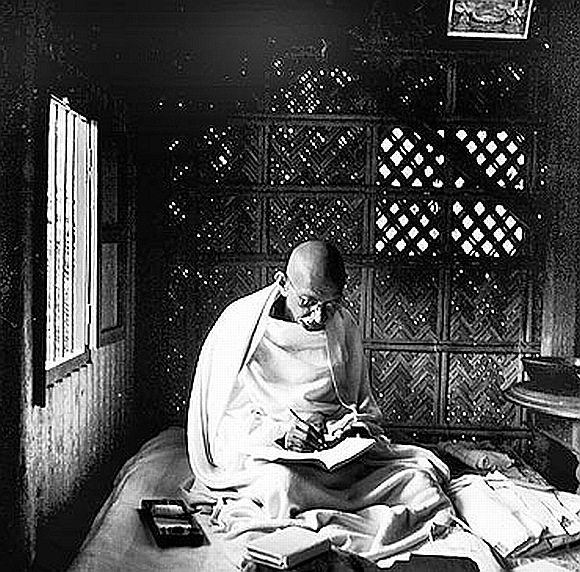
நவ்காளி யாத்திரைப் பற்றி லாரி காலின்ஸும் டாமினிக் லேபியரும் எழுதிய "Freedom at Midnight" புத்தகத்தில் சொல்கிறார்கள், "ஒவ்வொரு கிராமத்திலும் காந்தியின் வழக்கம் ஒன்றே. உலகத்தின் மிகப் புகழ்பெற்ற ஆசிய மனிதன் ஒரு கிராமத்தை வந்தடைந்தவுடன் ஏதாவது ஒரு குடிசைக்குச் சென்று, இஸ்லாமியரின் குடிசையாக இருத்தல் கூடுதல் தகுதி, தங்குமிடத்திற்காக இறைஞ்சி நிற்பார். இடம் மறுக்கப்பட்டால் வேறு குடிசைக் கதவைத் தட்டுவார். 'எனக்கு இடம் கொடுப்பார் யாருமில்லையென்றால் மர நிழலில் சந்தோஷமாக ஒதுங்குவேன்'". மத நல்லிணக்கம் மட்டுமே காந்தியின் குறிக்கோளாக இருக்கவில்லை என்கிறார்கள் அந்த ஆசிரியர்கள். இந்தியர்களின் சுகாதாரமின்மை குறித்துச் சினம் கொண்ட காந்தி கிராமத்தில் கழிப்பறைகள் இருக்கின்றனவா என்று கண்டறிந்து அப்படியில்லையென்றால் எளிமையான கழிப்பிடங்கள் கட்டுவது பற்றி வகுப்பெடுத்தார். காந்தியின் வழியில் விஷமிகளால் இறைக்கப்பட்டிருக்கும் மலத்தினைக் காந்தியே அப்புறப்படுத்துவார். உலகப்பிரகாரமான அன்றாடக் கணக்குகளின் படி நவ்காளி யாத்திரை ஒரு தோல்வியே என்று சொல்லும் ஜோசப் லெலிவெல்ட் அந்த யாத்திரை நடந்து அரை நூற்றாண்டு கழித்து 2009-இல் நடந்த மத நல்லிணக்கக் கூட்டத்தில் அந்த யாத்திரையின் எதிரொலியினைப் பார்த்து வியந்து இது தான் காந்தியின் வெற்றி என்று அவர் புத்தகத்தில் கூறுகிறார்.காஸ்டியூமாம் காஸ்டியூம்.

நவ்காளியில் காந்தி. லெலிவெல்டின் புத்தகத்திலிருந்து.
இந்தியாப் பிரிவினை செய்யப்படும் என்றறிந்தப் போது காந்தி ஒருவர் தான் அது எத்தகைய கொடூரமாக இருக்கும் என்று ஆரூடம் சொன்னார். 'தாயின் கர்ப்பத்தைக் கிழித்து இந்தத் தேசங்கள் பிறக்கும்' என்றார். மதக் கலவரங்கள் வட இந்தியா முழுக்க விழுங்கிக் கொண்டிருக்க வங்காளம் சிதறுண்டால் உள் நாட்டுக் கலகத்திற்கினணையான சூழல் உருவாகி இந்தியாவே சிதறலாம் என்று நேரு, பட்டேல், மவுண்ட்பாட்டன் அஞ்சினர். ராணுவமோ பஞ்சாபில் குவிக்கப்பட்டு விட்டது. காஷ்மீர் எல்லையில் பதட்டம். 1946-இல் நேரடி நடவடிக்கை தினம் என்று அறிவித்து ரத்த வெறியாட்டத்திற்குப் பிள்ளையார் சுழிப் போட்ட முஸ்லிம் லீக்கின் தலைமை கல்கத்தாவில் இந்துக்கள் பழி வாங்கத் தொடங்கினால் குருதிப் பெருக்கெடுத்து ஓடும் என்று தெரிந்துச் செய்வதறியாது திகைத்தனர். எல்லோர் மனத்திலும் எழுந்த பெயர் 'காந்தி'.

காந்தி புனதராகப் போற்றப்படுவதை ரசிக்காத வேவல் மவுண்ட்பாட்டனிடம் "wily Gandhi" என்றார். மேற்கத்திய ஆசிரியர்கள் பலரும் காந்தியின் புனிதப் பிம்பத்திற்குப் பின் ஒரு பனியா இருப்பதைப் பல முறைச் சுட்டிக் காட்டியுள்ளனர். அவர் ஏமாற்றுக்காரர் என்றல்ல அவருடைய எதார்த்தவாதம், மக்களின் உணர்வை புரிந்து அவர்கள் அளவில் செயல் திட்டங்களை வகுத்து நடைமுறை படுத்தக் கூடியதும் அதே சமயம் ஓர் உயர்ந்த கொள்கையின் பால் அவர்களைத் தவறாமல் ஈர்க்கும் சாமர்த்தியமும் ஒரு தேர்ந்த அரசியல்வாதியின் நாடகத்தன்மை கொண்ட போராட்டத் தருணங்களை முன்னெடுக்கும் திறன் ஆகியவற்றை வியந்திருக்கின்றனர். கல்கத்தாவில் அந்தக் காந்தி மீண்டும் ஒரு முறை ஒளிர்ந்தார்.

1946 கலவரத்தைத் தூண்டி வழி நடத்தியதில் முக்கியஸ்தரான ஷகீத் சுராவர்தியினைக் காந்தி தன்னோடு வந்து தங்கும் படி அழைத்தார். காந்தி தங்குவதற்குத் தேர்ந்தெடுத்த இடம் பெலியாகட்டா என்னும் சேரி. பெலியாகட்டா முஸ்லிம்களும் இந்துக்களும் வாழ்ந்த இடம் மட்டுமல்ல கலவரங்கள், ஆயுதங்களோடும் வெடிகுண்டுகளோடும், நடைப்பெற்ற இடம். காந்தியின் திட்டம் கேள்விப்பட்ட சர்தார் பட்டேல் எள்ளலோடு "So you have got detained in Calcutta..[in] a notorious den of gangsters and hooligans. And in what company too!" என்று டெல்லியில் இருந்து உள்துறை அமைச்சராக எழுதினார்.

காந்தியும் சுராவர்தியும் தங்கிய 'ஹைதாரி மன்ஸில்' (Hydari Manzil) "ஒரு பாழடைந்த ஒற்றைத் தளம் கொண்ட வீடு. ஒரு கழிப்பறை, ஒரு சார்ப்பாய்" என்கிறார் லெலிவெல்ட். சத்தியாகிரகம் கோழைகளுக்கானது அல்ல என்று சொன்ன காந்தி கலவரத்தைத் தடுப்பதிலும் உயிர்களைக் காப்பதிலும் உயிர் தியாகம் செய்ய அழைப்பு விடுத்தார். தான் அப்படிப்பட்ட முயற்சிகளில் ஈடுபட்டால் தன்னைப் பாதுகாக்கும் நடவடிக்கையில் மற்றவர்கள் கவணிக்கப் படமாட்டார்கள் என்று சொல்லி உண்ணாவிரதம் மேற்கொண்டார் காந்தி.

உண்ணாவிரதத்தால் குண்டர்கள் மனம் மாறுமா என்று கேட்ட ராஜாஜியிடம் குண்டர்கள் உருவாக்கப் படுக்கிறார்கள், அவர்களை உருவாக்குபவர்களின் ஆன்மாவோடு தான் போரிடுவதாகவும் அப்போரில் தன் உயிர் போவது உயிரோடு இருந்து ஒன்றும் செய்ய முடியாமலிருப்பதை விட மேல் என்றார். மனங்கள் மாறியது. இந்துக்களும், முஸ்லிம்களும் காந்தியிடம் சரண் அடைந்தனர். மவுண்ட்பாட்டன் "பஞ்சாபில் 55000 எல்லைப் பாதுகாப்பு வீரர்கள் இருக்கிறார்கள் ஆனால் கலவரத்தை அடக்க முடியவில்லை. கல்கத்தாவில் ஒற்றை மனிதர் கலவரத்தை அடக்கி விட்டார்" என்று அதிசயித்தார். அவதூறுக்கு லைக் போட்ட இஸ்லாமிய நண்பருக்கு வரலாறுத் தெரியவில்லை என்று நினைக்கிறேன். காந்தி எங்கே தங்கினார் என்று ஆராய்பவர்கள் அவரால் பிழத்த உயிர்களின் எண்ணிக்கையைப் பட்டியலிடத் தயாரா?

Hydari Manzil as in 1947 (More info and pictures in http://sohamchandra.blogspot.com/2015/10/gandhi-bhawan-hyderi-manzil.html)


அடுத்து டெல்லிச் சென்ற காந்தி வழக்கமாகத் தங்கும் சேரியில் தங்கவில்லை. காந்தித் தங்குகிறார் என்பதாலேயே அடிப்பொடிகள் அங்கு வசிப்பவர்களுக்குத் தொல்லைக் கொடுத்ததாலும் கலவரத்தால் பாதிக்கப்பட்ட பலர் அங்கே குடியேறியதால் இட நெருக்கடி ஏற்பட்டதால் பிர்லாவின் மாளிகையில் காந்தி தங்கினார் என்கிறார் லெலிவெல்ட். அந்தச் சேரிகளில் காந்தித் தங்கிய முன் காலங்களில் அவரைக் காண்பதற்காக எல்லோரும் தீண்டத் தகாதவர்கள் என்று ஒதுக்கப்பட்டோர் வாழ்ந்த அந்தச் சேரிக்குச் சென்றதையும் லெலிவெல்ட் சுட்டிக் காட்டுகிறார்.

இர்வினுடன் ஒப்பந்தம் கையெழுத்தானப் பின் இரண்டாம் வட்ட மேஜை மாநாட்டுக்காக லண்டன் சென்ற காந்தி ஹோட்டல்களையும் அவர் தங்கள் வசதியான வீடுகளில் தங்க வேண்டுமென்றும் விரும்பிய பலரையும் ஒதுக்கிவிட்டு ஏழ்மையான பகுதியான ஈஸ்ட் எண்டில் சாதாரணக் குடியிருப்பில் தான் காந்தி தங்கினார். இறக்குமதித் துணிகளுக்கெதிரான காந்தியின் கொள்கையால் பாதிக்கப்பட்ட லண்டன் மில் தொழிலாளிகள் ஆயிரக்கணக்கில் கூடி காந்தியை அரவனைத்து இன்முகம் காட்டிக் கொண்டாடினர்.வரலாறில் அதற்கு முன்னும் பின்னும் தங்கள் பொருளாதார இழப்பையும் பொருட்படுத்தாது தங்கள் நாட்டிற்குச் சவால் விட்ட ஒரு தலவைனை அந்நாட்டின் குடிமக்கள் கொண்டாடிப் பார்த்தது கிடையாது.

காந்தி இங்கிலாந்தில் தங்கிய இடம் (http://www.ppu.org.uk/memorials/peace/london/kingsley.html) 
தொழிலாளிகளோடு காந்தி (http://dilipsimeon.blogspot.com/2012/10/gandhi-visits-poor-people-of-england-in.html)


காந்தி அவரின் அரை நிர்வாணக் கோலத்தில் இர்வினைக் காணச் சென்றது சகிக்காமல் வின்ஸ்டன் சர்ச்சில் இங்கிலாந்தின் பாராளுமன்றத்தில், "கிழக்கில் வெகு பரிச்சயமான அரை நிர்வாண பக்கிரியைப் போல் உடை தரித்து வைஸ்ராயின் மாளிகையின் படியேறி நம் மகாராஜாவின் பிரதிநிதியான வைஸ்ராயோடு சரி சமமாகப் பேச்சுவார்த்தை நடத்தப் போகிறார் (காந்தி)" என்று முழங்கினார். காந்தியை வன்மத்தோடு இகழ்ந்தபோதும் சர்ச்சில் அதனூடாக முக்கியமான ஒரு தருணத்தைத் தனக்கேயுரிய வரலாற்றுத் திறனோடு அடையாளம் காண்பிக்கிறார். காந்தி வெறும் கலகக்காரராகவோ, ஓர் குழுவின் தலைவராகவோ இர்வினைக் காணச் செல்லவில்லை மாறாக ஒரு தேசத்தின் பிரதிநிதியாக வைஸ்ராயோடு சரி சமமாக உரையாடச் செல்கிறார் என்பது தான் அது.

இங்கிலாந்து ராஜாவைக் காணப் போகும் போதும் அரை நிர்வாணமாகவே சென்ற காந்தி மகாராஜா இருவருக்கும் போதுமான உடை அணிந்திருந்ததாக நகைத்தார்.

தண்டியாத்திரையின் போது காந்தி தங்கிய குடிசை வெறும் குச்சிகளாலும் சில ஓலைகளாலும் கட்டப் பட்டது. தன் பரிவாரத்திற்காகச் சூரத்திலிருந்து பால் வரவழைக்கப்பட்டதைக் கேள்விப்பட்ட காந்தி சினந்தார். தன்னோடு நடைப் பயணம் மேற்கொண்டவர்களுக்காகச் செலவழிக்கப்பட்ட ஒவ்வொரு பைசாவிற்கும் கணக்கு கேட்டார்.

தண்டி அருகே காரடி எனும் ஊரில் காந்தி பண்ணிரண்டு நாட்கள் இந்தக் குடிசையில் தங்கினார் (புகைப்படம்: Gandhi's hut at Karadi Dandi) 
தன்னுடைய உப்புச் சத்தியாகிரக யாத்திரையில் பெண்கள் கலந்து கொள்ள வேண்டாம் என்றார் காந்தி ஏனெனில் பெண்கள் இருந்தால் ஒரு வேளை ஏகாதிபத்தியத்தின் அதிகார இரும்புக் கரம் இளகி எங்கே தன் முழுமையான வன்மத்தைக் காண்பிக்காமல் போய்விடுமோ என்ற ஐயப்பாட்டினால். பின்னாளில் தான் எதிர்ப்பார்த்தக் கடுமையான ஷரத்தை விடச் சாதாரணமானச் சட்ட விதியைக் கான்பித்துக் கைது செய்யப்பட்ட போது காந்தி வருத்தப்பட்டார்.

இந்தியாவை முதலில் அறிந்துக் கொள் என்று கோகலே சொன்னதற்காக ரயிலில் மூன்றாம் வகுப்பிலேயே இந்தியாவைச் சுற்றிப் பார்த்து அப்பயணத்தில் தான் காண நேர்ந்த ஏழை இந்தியா பற்றி மிகக் கவலையோடு காந்தி எழுதியது முக்கியமான ஆவணம்.

மேற்சொன்னவற்றையெல்லாம் படிப்பவர்கள் "சரி, அப்படியென்றால் காந்தியை விமர்சிக்கவே கூடாதா?" என்பார்கள். அப்படியில்லை. அவர் காலத்திலேயே அவர் பிரதம சீடர் நேரு காந்தியின் பொருளாதாரக் கொள்கைகளை நிராகரித்துள்ளார் அவை ஏழ்மையைப் போக்க வல்லமையற்றதென்று சொல்லி. காந்தி ஏழ்மையைத் துதிபாடுவதை நேரு ரசித்ததேயில்லை. பாரதி கூடக் காந்தியின் செல்வத்தை நிராகரிக்கும் கொள்கையை மறுக்கிறார். காந்தியின் பொருளாதாரக் கொள்கையை நிராகரிப்பது என்பது வேறு அவருக்கு ஏழைகள் பால் இருந்த அக்கறையை மறைத்து ஏழைகளைப் பற்றிக் காந்திக்குக் கவலையில்லை என்று அவதூறுச் சொல்வது வேறு.

முன்பொருமுறை அரவிந்தன் நீலகண்டன் காந்தியின் பூர்வீக விட்டின் புகைப்படத்தை வெளியிட்டு காந்தி ஒன்றும் ஏழைப் பங்காளி இல்லை என்ற தொனியில் எழுதியதாக நினைவு. திராவிட இயக்கத்தினரும் இந்துத்துவர்களும் இணையும் புள்ளி காந்தியை வெறுப்பது. கல்கத்தா கலவரத்தை காந்தி அடக்கியப்பின்னர் ராஜாஜி "இன்று காந்தியின் உயிர் இந்துக்களை விட இஸ்லாமியர்களிடம் பத்திரமாக இருக்கிறது" என்றார். எவ்வளவு பயங்கரமான தீர்க்கத் தரிசனம்.

மதிமாறன் போன்ற உள்ளூர் பீரங்கிகள் முதல் அருந்ததி ராய் போன்ற அரைவேக்காடு உலகப் பிரசித்தமான பீரங்கிகள் வரை காந்தியைப் புழுதி வாரித் தூற்றிக் கொண்டேயிருக்கலாம் ஆனால் உண்மையைச் சிறிதேனும் அறிய முற்பெடும் எவெரும் மகத்துவத்தை எளிதில் அறியலாம். மீண்டும் ஒரு முறை அவதூறுகளை மறுப்பதற்காகக் காந்தியைப் பற்றிப் படித்த போது மீண்டும் ஒரு முறை காந்தியின் விஸ்வரூப தரிசனம் கிடைத்தது.

ஐன்ஸ்டீன் காந்தி பற்றிச் சொன்னது உலகப் பிரசித்தம். ஆயினும் இன்னுமொரு முறை அதை நினைவுக் கூர்தல் அவசியம். "இப்படியொருவர் சதையும் எலும்புமாக நம்மிடையே வாழ்ந்து மறைந்தார் என்பதை வருங்காலச் சந்ததியினர் நம்புவதற்கு மிகவும் பிரயத்தனப்படுவார்கள்".

வாழ்க நீ! எம்மான், இந்த வையத்து நாட்டி லெல்லாம்
தாழ்வுற்று வறுமை மிஞ்சி விடுதலை தவறிக் கெட்டுப்
பாழ்பட்டு நின்ற தாமோர் பாரத தேசந் தன்னை
வாழ்விக்க வந்த காந்தி மஹாத்மா நீ வாழ்க, வாழ்க!
அடிமை வாழ்வ கன்றிந் நாட்டார் விடுதலை யார்ந்து, செல்வம்
குடிமையி லுயர்வு, கல்வி ஞானமும் கூடி யோங்கிப்
படிமிசைத் தலைமை யெய்தும் படிக்கொரு சூழ்ச்சி செய்தாய்!
முடிவிலாக் கீர்த்தி பெற்றாய, புவிக்குள்ளே முதன்மை யுற்றாய்!


References:


  1. கோவணம் கட்டிய காந்தியும் கோட் சூட் போட்ட அம்பேத்கரும் - மதிமாறன் (https://www.facebook.com/mathimaranv/posts/10206888757719555)
  2. "Mahatma" - D.G. Tendulkar Vol 3 & 8
  3. Freedom at Midnight -- Larry Collins and Dominique Lapierre
  4. Great Soul: Mahatma Gandhi and his struggle with India -- Joseph Lelyveld
  5. Gandhi - William Shirer
  6. On the Salt March: Historiography of Mahatma Gandhi's march to Dandi --- Thomas Weber.
  7. Gandhi's Visit to London (a short documentary )